

More news on this day
Amtrak passengers across the Midwest are grappling with an extended wave of cancellations, equipment failures and last-minute schedule changes as the railroad struggles to recover from the fallout of a brutal late-January winter storm.
Days after roads were cleared and skies seemed calmer, key state-supported routes from Chicago into Michigan and Illinois remain curtailed or suspended, exposing vulnerabilities in Amtrak’s aging fleet, its newer Midwest equipment and its ability to rebound quickly from extreme weather.
More News
- Caribbean Travel to U.S. Upended by New Visa Freezes and Expanded Bans
- Mexico Restores E-Visas for Brazilians, Paving the Way for Borderless Tourism
- Philippine Airlines Joins Regional Carriers Powering Southeast Asia’s Tourism Boom
Storm Fern’s Aftermath Lingers Across the Network
The immediate trigger for the current disruption was Winter Storm Fern, part of a powerful late-January system that swept across much of the United States with subzero temperatures, heavy snow and ice, and dangerous winds. The storm brought widespread travel shutdowns on highways and in the air, but it also left a lingering mark on rail operations, particularly in the Chicago hub that anchors much of Amtrak’s Midwest network.
While most intercity passenger services can be slowed or temporarily suspended during the height of a storm, the real test often comes afterward. In this case, the combination of extreme cold and deep snowpack strained locomotives, froze water systems, clogged switches and created persistent mechanical problems that have proved difficult to resolve quickly. Amtrak has acknowledged in internal advisories that “ongoing cold temps” and “weather-related equipment issues” are playing a direct role in the extended cancellations now frustrating passengers across multiple states.
Compounding the meteorological fallout are the operational realities of running a largely shared network over freight-owned tracks. Host railroads must also assess damage, clear snow and ice and restore normal speeds, which can limit the windows Amtrak has to reposition trainsets, test equipment and restart normal timetables. That ecosystem of interdependent players has slowed the return to full service even as the region begins to emerge from the most dangerous conditions.
Michigan Corridors Hit Hard by Prolonged Cancellations
No region has felt the impact of Amtrak’s winter challenges more acutely than Michigan, where state-supported Wolverine and Blue Water services form a vital rail link between Chicago, Detroit, Pontiac and Port Huron. In recent days, repeated advisories have informed passengers that multiple Wolverine departures between Chicago and Pontiac remain canceled over a span of several days, with trains 351, 352, 353 and 354 among those affected.
The Chicago–Port Huron Blue Water has also taken a direct hit, with eastbound train 364 and westbound 365 canceled across several consecutive days. These trains are core to cross-state connectivity in Michigan, bringing college students, business travelers and leisure passengers into and out of Chicago, while providing smaller cities with one of their few direct connections to the national rail network.
Frustration among riders has been amplified by inconsistent or confusing real-time information. Some passengers have reported discrepancies between Amtrak’s online train-status tools and what they encounter at stations or via trip alerts, noting that a train may appear “on time” in one system even as another quietly lists it as canceled. As cancellations are extended day by day, rather than resolved quickly, the perception has grown that Michigan corridors are bearing a disproportionate share of the lingering disruption from last month’s storm.
Illinois Routes and the Chicago Hub Under Strain
Illinois, home to Amtrak’s busiest Midwest hub at Chicago Union Station, is also facing sustained cuts, especially on shorter-distance routes that normally see frequent daily departures. The Chicago–Quincy corridor, served by the Illinois Zephyr and Carl Sandburg, has seen persistent adjustments. Westbound Illinois Zephyr train 383 and eastbound train 380 are among those canceled through early February, limiting options for travelers along the Mississippi River corridor.
Farther south, the Chicago–St. Louis Lincoln Service, one of the Midwest’s flagship higher-speed corridors, has experienced a notable thinning of its timetable. Southbound trains 305 and 307 and northbound trains 300 and 302 remain suspended across multiple days, even as major highways between the two cities have reopened. For communities such as Bloomington–Normal, Springfield and Alton, fewer trains mean more crowding on remaining departures and a steeper challenge for anyone trying to adjust travel at short notice.
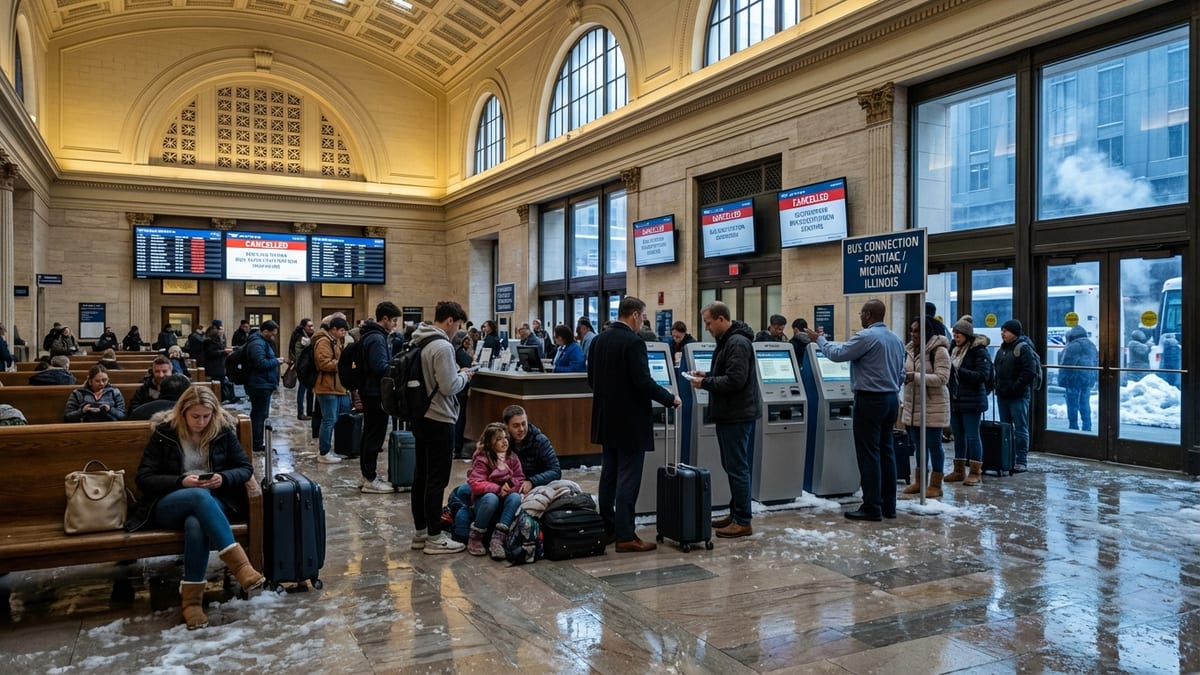
Inside Chicago Union Station, the effects are visible in the form of longer lines at customer service counters, busier waiting areas when trains do operate and an uptick in substitute bus departures. The hub’s role as a turnaround point for many regional services also complicates recovery: when a trainset arrives late or is sidelined for repairs, the ripple cascades through several subsequent round trips, sometimes forcing Amtrak to choose between shortened consists, bus substitutions or outright cancellations.
Bus Substitutes Offer Relief but Capacity Is Tight
To partially offset the wave of canceled trains, Amtrak has leaned heavily on substitute bus transportation across several disrupted routes, particularly in Michigan and Illinois. For Wolverine passengers stranded by unavailability of train equipment, buses have been deployed between Pontiac and Chicago, while similar arrangements have been advertised for some Chicago–Michigan and Chicago–Quincy segments where rail service is suspended.
However, these bus alternatives have limited reach and capacity. Many of the substitute services have quickly been marked as “sold out” in Amtrak’s booking system, hinting that buses are largely being used to accommodate travelers with existing reservations rather than those trying to book new trips. That leaves late planners, or those whose work or family obligations require flexibility, with few viable options other than driving or rebooking on much later departures.
Passengers also face very different travel experiences on these buses compared with trains. While they may preserve the basic function of getting from point A to point B, buses lack the legroom, onboard amenities and ability to move about that draw many riders to rail service in the first place. In winter conditions, long-distance bus journeys can also be slower and less predictable than train journeys, particularly if road crews are still clearing ice or dealing with lingering weather impacts.
Equipment Failures Expose Weak Spots in the Fleet
Behind the schedule disruptions lies a deeper technical story: Amtrak’s rolling stock in the Midwest is under pressure from both age and design limitations. The railroad has publicly pointed to “equipment unavailability” and “weather-related equipment issues” as central reasons for the continued cancellations, citing problems with both locomotives and passenger cars that have yet to be fully resolved.
In particular, the Siemens Charger locomotives and Venture coaches that form the backbone of many Midwest state-supported routes have drawn scrutiny. These newer trainsets were designed to modernize service, offering improved efficiency and passenger comfort. But in recent seasons, extreme cold snaps, blowing snow and ice have exposed vulnerabilities, leading to mechanical faults, frozen systems and related delays or cancellations on corridors such as the Wolverine and Blue Water.
The Midwest’s brutal winter conditions are notoriously hard on rail equipment, and even legacy fleets suffer from frozen brake lines, iced-over doors and climate-control failures when temperatures plunge for days at a time. Yet the current crisis has highlighted that adding new equipment alone is not enough without robust winterization, maintenance capacity and spare units ready to step in when trains fail. Until Amtrak can address those underlying constraints, passengers may continue to see rolling waves of cancellations whenever the mercury drops sharply.
Operational Recovery Hampered by Network and Staffing Limits
Restoring a disrupted rail network is rarely as simple as flipping a switch back to “on.” After Winter Storm Fern, Amtrak has had to contend not only with damaged or disabled equipment but also with a complex matrix of staffing, crew qualifications and host railroad constraints that slow the rebound. Train crews must be positioned in the right locations, rested under federal work rules and qualified for specific routes. When service is abruptly curtailed, those patterns are broken and can take days to realign.
Host freight railroads that own the tracks across much of the Midwest have also been recovering from the same storm, inspecting infrastructure for damage, clearing drifts, thawing switches and managing their own freight backlogs. Until they are ready to support normal passenger speeds and schedules, Amtrak’s ability to add back frequencies remains limited. Even when tracks are passable, temporary speed restrictions imposed to prevent broken rails in extreme cold can lengthen schedules and absorb spare equipment time, leaving fewer trainsets available for additional departures.
Staffing has been an additional pinch point. Like many transportation providers, Amtrak continues to manage retirements, hiring challenges and ongoing training needs. In a disrupted environment, spare crews and mechanical staff become particularly critical to restart sidelined trains quickly. When those resources are stretched, recovery tilts from hours to days, and passengers feel the difference sharply.
Passenger Frustration Grows as Communication Lags
For many passengers, the most visible aspect of Amtrak’s winter struggles has been not just the cancellations themselves, but the way information about them has been communicated. Riders in Michigan and Illinois have reported learning about canceled trains only on the day of departure, receiving conflicting notifications or discovering that alternate buses were already full when they tried to rebook.
On social platforms and rail-focused forums, travelers have voiced concerns about gaps between Amtrak’s customer alerts, its website, station signage and third-party tracking tools. Some have questioned why extended cancellations are being announced in a piecemeal fashion, with daily updates that make long-term planning difficult. Others have raised broader questions about the resilience of the railroad’s operations in a climate where severe winter storms are expected to recur.
Amtrak has urged passengers to monitor real-time Service Alerts and Notices, check their trips frequently and ensure contact details are updated for notifications. Yet such advice offers little comfort for those whose plans are upended at short notice, or for travelers in smaller communities with limited alternative transportation options. The tension between operational uncertainty and the need for clear, timely communication has emerged as one of the central customer-experience challenges of this winter season.
What Travelers Can Expect in the Coming Days
With equipment repairs ongoing and a finite pool of spare trainsets available, Amtrak’s path back to a full Midwest schedule is likely to be gradual rather than instant. Cancellations on the Wolverine, Blue Water, Pere Marquette, Illinois Zephyr and Lincoln Service corridors have already been extended across multiple days, and further adjustments remain possible if additional mechanical issues surface or if another burst of severe weather hits the region.
Industry observers note that winter is far from over, and that the same system that brought deadly conditions to parts of the country could be followed by additional cold snaps or snow events. Each new storm introduces the risk of further mechanical failures, particularly if repairs and inspections on the existing fleet are still catching up. That reality has prompted calls from passenger advocates and some state partners for deeper investment in winter-proofing equipment, expanding maintenance capacity at Chicago’s yards and building more redundancy into schedules.
In the short term, travelers are being advised to build extra flexibility into their plans, consider earlier departures when possible and remain vigilant for updates before heading to the station. For those who can postpone non-essential trips, waiting a few days may reduce the risk of disruption, though that is not a practical option for everyone. As the recovery continues, the Midwest will offer a critical test of Amtrak’s ability to operate reliably in an era of increasingly volatile winter weather.
FAQ
Q1: Which Amtrak routes in the Midwest are currently most affected by the winter-related disruptions?
The most heavily affected routes are the Michigan state-supported services, including the Wolverine corridor between Chicago and Pontiac and the Blue Water between Chicago and Port Huron, along with Illinois routes such as the Chicago–Quincy Illinois Zephyr and the Chicago–St. Louis Lincoln Service. Several daily round trips on these corridors have been canceled or reduced for multiple consecutive days.
Q2: Are long-distance trains to and from Chicago also impacted?
Some long-distance trains using Chicago as a hub have experienced delays, shortened consists or isolated cancellations, particularly at the height of the storm and immediately afterward. However, the most persistent, multi-day cancellations have been concentrated on shorter regional and state-supported services rather than the flagship cross-country routes.
Q3: Why is Amtrak still canceling trains even after the storm has passed?
The lingering cancellations are primarily due to equipment damage and mechanical issues caused by prolonged extreme cold, snow and ice. Locomotives and passenger cars need inspections, repairs and in some cases replacement parts. Until enough working trainsets are available and properly positioned, Amtrak is forced to suspend some departures to keep a reduced but more reliable schedule running.
Q4: What role do the Siemens Charger locomotives and Venture cars play in the current problems?
These newer locomotives and coaches make up much of the Midwest fleet. While they were intended to modernize service, some units have experienced weather-related failures in the recent cold snap, including issues with onboard systems exposed to ice and snow. When several trainsets are sidelined at once for repairs, the network quickly runs short of spare equipment, triggering extended cancellations.
Q5: How is Amtrak accommodating passengers whose trains are canceled?
Amtrak has arranged substitute bus services on certain affected routes, especially between Pontiac and Chicago and on segments where individual train departures are suspended. In many cases, these buses are prioritized for travelers with existing reservations. Passengers are also being offered rebooking on later trains where space allows, as well as refunds or eVouchers according to standard Amtrak policies.
Q6: Why are some of the substitute buses showing as sold out?
Bus capacity is significantly lower than what a full-length train can carry, and the number of vehicles and drivers available at short notice is limited. As a result, substitute buses often fill quickly, especially on popular routes. Once those seats are allocated to existing ticket-holders, new bookings may be blocked, which is why many bus legs appear sold out in the reservation system.
Q7: What can travelers do to reduce the risk of being stranded?
Travelers are advised to check their train status frequently in the 24 hours before departure, ensure that Amtrak has up-to-date email and mobile contact information, and consider traveling earlier in the day or on less busy dates when feasible. Allowing extra time, having a backup plan such as rental cars or regional buses in mind, and avoiding tight connections to flights can also help mitigate the impact of last-minute changes.
Q8: How long are these extended cancellations expected to last?
The exact duration varies by route and depends on how quickly damaged equipment can be repaired and returned to service. Some cancellations have already been extended through the first week of February, and further adjustments are possible. Amtrak and its state partners are reassessing conditions daily, so service may be restored incrementally rather than all at once.
Q9: Is Amtrak doing anything long term to improve winter resilience in the Midwest?
Amtrak and the states that fund regional corridors have been investing in newer equipment, expanded maintenance capacity and infrastructure upgrades, but the recent storm has underscored that further steps may be needed. These could include enhanced winterization of locomotives and cars, more robust snow- and ice-mitigation at key yards and stations, additional spare trainsets and refined contingency plans for severe weather events.
Q10: Where should passengers look for the most current information about their train?
Passengers should rely on Amtrak’s official channels, including its Service Alerts and Notices, trip-specific notifications, mobile app and station announcements for the latest updates. Because conditions and equipment availability can change quickly, it is important to recheck status close to departure time rather than assuming earlier information is still accurate.