

More news on this day
The Milan Cortina 2026 Winter Olympics were sold to Italians and to the world as a “light” Games that would reuse existing venues, leave a gentle footprint in the Alps and avoid the financial hangover that has haunted so many past hosts.
As the opening ceremony on 6 February 2026 draws near, however, a different picture is emerging. Behind the celebrations, organizers are grappling with rising costs, unfinished infrastructure, environmental backlash and questions over who will ultimately pay for a sporting spectacle that was meant to be budget conscious and sustainable.
More News
- Caribbean Travel to U.S. Upended by New Visa Freezes and Expanded Bans
- Mexico Restores E-Visas for Brazilians, Paving the Way for Borderless Tourism
- Philippine Airlines Joins Regional Carriers Powering Southeast Asia’s Tourism Boom
Budget Creep Behind the “Low Cost” Promise
When Milan and Cortina d’Ampezzo won the bid in 2019, Italian officials highlighted a compact budget and heavy reliance on existing facilities. Early political messaging repeatedly framed the project as a model of thrift that would not weigh on taxpayers, contrasting it with the multibillion-euro overruns of Sochi 2014, Turin 2006 and other editions.
Since then, cost estimates linked to the Games have steadily climbed. Civic watchdogs following public contracts and tenders report that the infrastructure budget alone associated with Milan Cortina now runs into several billions of euros, much of it underwritten by the Italian state. One recent analysis by civil-society monitors tracking the state-owned infrastructure company Simico calculated that of roughly 3.5 billion euros in its Olympic-related spending, only a small fraction is going directly into competition venues. The majority is flowing into broader road, rail and urban projects presented as “legacy” investments for host territories.
This shift matters because it obscures the true public cost of hosting. While the organizing committee’s operating budget is largely funded through broadcasting rights, sponsors and ticketing, the bulk of concrete, steel and asphalt is paid for outside that balance sheet. Experts who have compared the original candidature file with updated data now talk of a total outlay that could approach or surpass 5 billion euros once all related infrastructure is included, challenging the narrative of a lean, low-cost Olympics.
Italian authorities insist that the money is not being wasted, arguing that improved highways, rail links and digital networks will serve residents and tourists long after the Olympic flame is extinguished. Critics counter that many of these works were repackaged under the Olympic label to accelerate approvals and funding, and that the Games have become a political lever to push through long-planned construction, regardless of local priorities.
Legacy or Long-Term Burden for Alpine Communities
In the high valleys of Lombardy and the Veneto, the word “legacy” has become central to official speeches about 2026. Organizers say the Games will leave safer mountain roads, upgraded hospitals, new sports facilities and revitalized ski resorts. Yet according to monitoring by the Open Olympics 2026 civic network, more than half of the infrastructure projects branded as Olympic legacy are not scheduled for completion until after the event, some as late as the early 2030s.
Out of dozens of listed works, only a minority are expected to be finished before athletes arrive. That means local communities have endured years of construction sites, traffic detours and environmental disruption without the guarantee of seeing benefits any time soon. In places such as Cortina d’Ampezzo and the surrounding Dolomites, the pressure is particularly acute. Here, residents are watching the rapid transformation of their landscape into a mega-event corridor, with new roads, service areas and technical installations carved into slopes that are already crowded with ski infrastructure.
There are also doubts about how equitably the benefits will be shared. Touristic hotspots may see new lifts and higher-end accommodation, while smaller villages off the main Olympic map fear being left with higher living costs and little direct gain. Environmental groups argue that large injections of public money are effectively subsidizing a winter tourism model that is increasingly dependent on artificial snow and energy-intensive operations, despite the realities of a warming climate and shrinking natural snow cover at mid-altitudes.
Italian officials respond that the Games offer a once-in-a-generation chance to modernize fragile mountain territories and keep young residents from leaving. But as deadlines approach, a growing number of locals worry that their regions are shouldering long-term financial and ecological risks for a three-week global show whose profits will largely accrue elsewhere.
Cortina’s Controversial Sliding Track
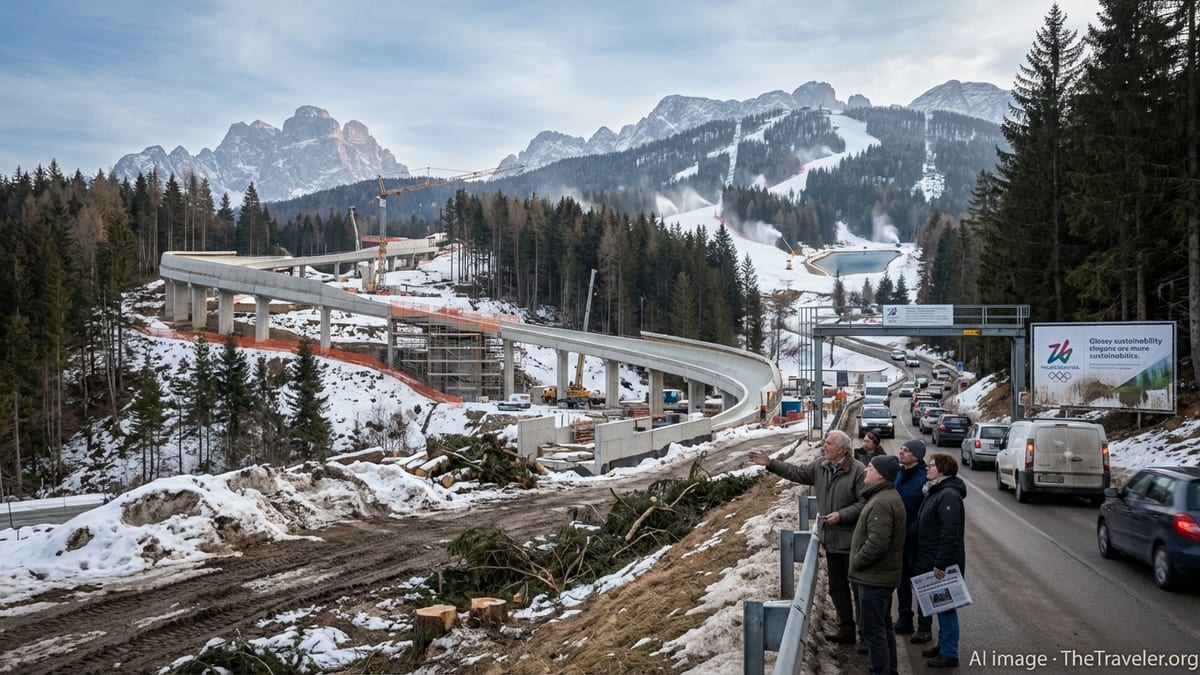
No project has crystallized the debate over hidden Olympic costs more clearly than the sliding center in Cortina, intended to host bobsleigh, luge and skeleton. From the outset, the International Olympic Committee urged Italy to use an existing track abroad, in places such as St Moritz in Switzerland or Igls in Austria, rather than rebuild Cortina’s historic Eugenio Monti track, which closed years ago. The IOC cited both the financial burden and the risk of creating another “white elephant” that would struggle to find regular use after 2026.
Italian authorities nevertheless pushed ahead, citing national pride and the desire to keep all events on home soil. Initial cost estimates, which once floated figures of around 50 million euros, climbed sharply during political negotiations and tender procedures. By 2024, contracts were being discussed in the range of 80 million euros, and more recent figures linked to construction and technical systems place the bill at roughly 118 million euros for the track alone, folded into a wider multibillion-euro infrastructure budget.
The project has been beset by controversy and even acts of resistance. Environmental groups document the felling of hundreds of mature larch trees on the Cortina basin slopes to clear space for concrete structures and service roads. Activists point to the dormant Turin 2006 sliding track, awaiting demolition after years of underuse, as a cautionary tale of what can happen when highly specialized venues outlive a short Olympic spotlight. In early 2025, authorities reported an incident at the construction site in which a refrigeration pipe was removed and used to block a local road, an episode a government agency described as sabotage.
Despite these setbacks, infrastructure officials insist the project will be ready for test events and that Cortina’s long sliding tradition justifies the investment. Yet even in optimistic scenarios, maintaining such a facility in a small resort will cost well over a million euros annually, for sports that draw limited audiences. For taxpayers across Italy, the question is not only whether the sliding center can be finished in time, but whether it will become an expensive monument to political stubbornness once the Games move on.
Environmental Strain in a Warming Alps
The Milan Cortina Games have also become a flashpoint in a broader debate over whether the Winter Olympics remain compatible with a rapidly warming climate. Italian and international environmental organizations argue that the 2026 edition is exposing some of the starkest contradictions yet between sustainability pledges and on-the-ground realities in the mountains.
Across the competition clusters, organizers and resort operators are relying heavily on artificial snow to guarantee race-quality slopes and consistent conditions. Reports from alpine venues suggest that around 1.6 million cubic meters of so-called technical snow have been produced for the Games period, requiring energy-intensive snowmaking systems and large volumes of water drawn from rivers and reservoirs. In Livigno alone, a high-altitude host for freestyle and snowboard events, hundreds of thousands of cubic meters of artificial snow are being laid out over the pistes.
Scientists and local activists warn that this industrial-scale snow production puts fragile alpine ecosystems under severe stress. Water captured in reservoirs for snowmaking is no longer available downstream at critical times, altering river flows and affecting aquatic habitats. New ponds, pipelines and pumping stations often require blasting and earthworks, further fragmenting landscapes already criss-crossed by lifts and roads. As temperatures rise, more snowmaking is required to maintain ski seasons of similar length, creating an energy and water spiral that many see as unsustainable.
Organizers emphasize investments in renewable energy sourcing, efficient snowmaking technology and measures to offset carbon emissions. They present Milan Cortina as a testing ground for greener mega-events. Yet the scale of the interventions, alongside the emissions tied to construction materials and spectator travel, has led some environmental commentators to brand 2026 as one of the most environmentally costly Winter Games to date, despite the rhetoric of sustainability.
Transparency, Corruption Fears and Civic Oversight
Italy’s long struggle with organized crime and political corruption has added another dimension to the hidden costs debate. With billions in public contracts at stake, anti-mafia prosecutors and civil-society groups have kept a close watch on tenders and subcontracts linked to Milan Cortina 2026.
In 2024, an investigation dubbed Operation Reset led to arrests in Cortina involving figures suspected of seeking to influence nightlife and construction sectors in the resort, raising alarms about attempts to infiltrate Olympic-related works. Data from the national anti-mafia directorate show that the construction industry, which includes major infrastructure projects, remains a preferred field for criminal networks, making the Olympic building spree a tempting target.
In response, the civic network Open Olympics 2026, coordinated by the anti-mafia association Libera and supported by environmental and mountaineering groups, has pushed for far-reaching transparency. The group successfully pressed Simico to publish a public dataset listing Olympic-related projects, costs and timelines, allowing journalists and citizens to compare the evolving picture with the original bid promises. Their latest report highlights cost overruns concentrated in so-called legacy works and flags the absence of environmental impact assessments for many projects.
Italian officials argue that strengthened oversight mechanisms and cooperation with anti-mafia bodies are limiting risks, and they point to the very existence of independent scrutiny as a sign of a maturing democracy. Nevertheless, every delay, renegotiation or sudden price increase adds to public suspicion that the true cost of the Games will not just be measured in euros and cement, but also in the erosion of trust in institutions.
Gentrification, Housing Pressure and Social Tensions
While alpine valleys contend with construction and environmental strain, Milan itself is experiencing a more urban kind of Olympic side effect. Long before the flame arrives at San Siro stadium for the opening ceremony, the city’s real estate market has been heating up, especially in districts slated to host the athletes’ village and new sports facilities.
In areas such as Porta Romana, where a former rail yard is being transformed into the main Olympic village before later conversion into housing and offices, property prices and rents have surged. Milan was already among Europe’s hottest markets, driven by fashion, finance and a favorable tax regime that attracted wealthy foreign residents. The promise of the Olympics, combined with speculative bets on post-Games redevelopment, has added further pressure.
Local tenants’ groups and housing advocates describe a growing gap between glossy Olympic marketing and everyday realities. Families on average incomes report being priced out of central neighborhoods, while short-term rentals and luxury developments proliferate. Critics say marquee events like the Games accelerate gentrification, shifting public resources and political attention toward high-profile zones at the expense of affordable housing and basic services in less visible parts of the city.
City officials counter that the Olympic village conversion will ultimately deliver new apartments and green spaces, and that planning rules include quotas for social and student housing. But with deadlines tight and costs climbing, there is skepticism about how much of the original social vision will survive once investors and developers push to recoup their stakes in the post-2026 market.
Security, Branding and the Politics of Image
Beyond bricks, concrete and snow cannons, the Games carry softer but still significant costs linked to security arrangements and national image. The Milan Cortina Olympics are taking place in a tense geopolitical climate, with Italian and international authorities keen to avoid any hint of disorder at such a high-profile event.
This has translated into expanded security perimeters, surveillance systems and coordination with foreign agencies, all funded directly or indirectly by public budgets. While officials stress that such measures are necessary to protect athletes and spectators, civil-liberties advocates warn against mission creep and worry about how long certain technologies or practices might remain in place after the Olympics end.
Symbolic controversies around branding and messaging have also surfaced. In one recent example, the United States team rebranded its hospitality space in Milan, dropping a name that unintentionally echoed the U.S. immigration enforcement agency after protests from activists. For critics, such episodes highlight how the Olympic stage can amplify political sensitivities far beyond sport, creating reputational risks that host nations must manage carefully.
All of this contributes to an intangible but real cost: the strain on local communities asked to navigate restricted zones, heavier policing and global scrutiny for months, not just during the fortnight of competition. For some residents, the glamour of hosting is offset by a feeling that their cities are being temporarily repurposed for television audiences and sponsors rather than everyday life.
FAQ
Q1. How much are the Milan Cortina 2026 Winter Olympics expected to cost Italy overall?
The official organizing committee budget runs to several billion euros, largely covered by private revenue. However, when wider infrastructure funded by the state and regions is included, independent analyses suggest the total public bill could reach or exceed 5 billion euros, challenging initial claims that the Games would be low cost.
Q2. Who is paying for most of the new infrastructure related to the Games?
While the organizing committee covers event operations through broadcasting, sponsorship and ticket sales, major construction projects are largely financed by Italian taxpayers via national and regional budgets, coordinated in part by the state-owned infrastructure company Simico.
Q3. Why is the sliding track in Cortina so controversial?
The new bobsleigh, luge and skeleton track in Cortina has drawn criticism because costs have risen to around 118 million euros, hundreds of mature trees have been felled, and international experts question whether the venue will be viable after 2026. The International Olympic Committee had recommended using an existing foreign track to avoid these risks.
Q4. Are environmental concerns limited to the sliding center?
No. Environmental groups highlight a broader pattern of stress on the Alps, including large-scale artificial snow production, construction of reservoirs and pipelines, and expansion of ski infrastructure in areas already vulnerable to climate change and biodiversity loss.
Q5. Will all Olympic-related projects be completed before the Games begin?
Not according to data compiled by civic monitors. Only a portion of the infrastructure works labeled as Olympic or legacy is expected to be finished before the opening ceremony. Many projects are scheduled for completion years later, meaning residents endure disruption now without immediate benefits.
Q6. How are local communities in the Alps reacting?
Reactions are mixed. Some residents welcome investment and hope the Games will boost tourism and jobs. Others, including environmentalists and small-business owners, worry about long-term debt, environmental damage and increased pressure on housing and services once the global spotlight moves on.
Q7. Is Milan itself affected by hidden Olympic costs?
Yes. In Milan, the main concerns focus on rising rents and property prices around Olympic sites, especially the future village in Porta Romana, as well as the diversion of public funds and political attention toward high-profile redevelopment projects.
Q8. What safeguards exist against corruption and mafia infiltration?
Italian authorities have expanded cooperation with anti-mafia bodies and introduced special oversight for major contracts. Civil-society initiatives such as Open Olympics 2026 are also monitoring tenders and costs, publishing data to enhance transparency and enable independent scrutiny.
Q9. Are the organizers still claiming that Milan Cortina 2026 will be sustainable?
Organizers maintain that the Games are pursuing ambitious sustainability goals, citing renewable energy, reuse of many existing venues and efforts to offset emissions. Critics argue that heavy construction, artificial snow reliance and long-term maintenance needs undermine these claims.
Q10. What will determine whether the Olympics were ultimately “worth it” for Italy?
The balance will depend on whether promised legacies such as improved transport, lasting sports facilities and fairer economic opportunities materialize, and whether the environmental and social costs prove manageable. That reckoning is likely to come years after the last medals are awarded in February 2026.