

More news on this day
A repeat stowaway who allegedly slipped onto a United Airlines flight from Newark to Milan without a ticket has reignited fears over aviation security and shaken confidence among international travelers at one of the United States’ busiest transatlantic gateways.
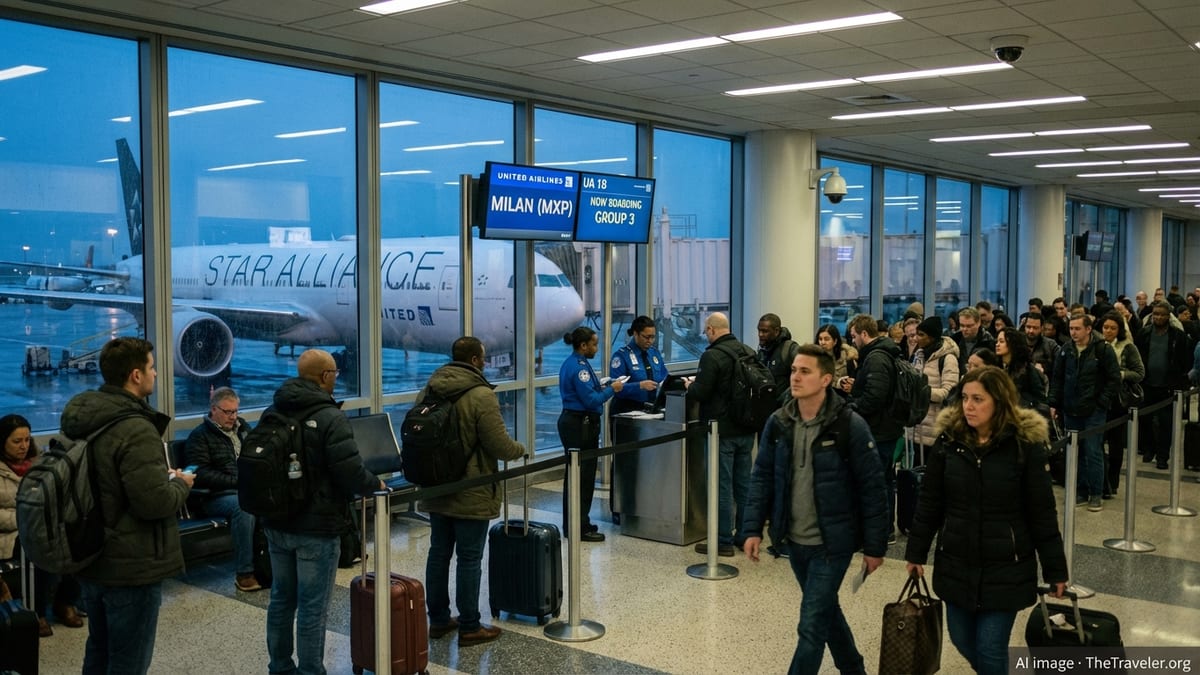
Serial Stowaway Slips From Newark to Milan
Authorities in Italy and the United States are investigating how a woman with a known history of stowing away on long-haul flights managed to board a Newark Liberty International Airport departure to Milan without a valid ticket or passport. The passenger, identified by law enforcement sources as Russian-born U.S. resident Svetlana Dali, was taken into custody at Milan Malpensa Airport after United Airlines crew determined mid-flight that she was not listed on the manifest.
The incident occurred on the evening of February 25, when United Flight 19, a Boeing 777-200, departed Newark for Milan with what was believed to be a full load of paying passengers. Only after the aircraft was well over the Atlantic did flight attendants discover that Dali could not produce valid travel documents, according to multiple reports from U.S. media citing investigators familiar with the case.
Because the discovery came hours into the overnight crossing, the crew proceeded to Milan rather than diverting the aircraft, coordinating instead with Italian police to meet the flight on arrival. Dali was detained at Malpensa and is expected to face fresh legal proceedings in Italy and the United States, where she was already on supervised release for a similar stunt on a New York to Paris flight in 2024.
Security Lapses at a Major Transatlantic Hub
The breach has renewed scrutiny of security procedures at Newark Liberty, one of the New York region’s primary international gateways and a key hub for transatlantic tourism. Investigators are focusing on how a repeat offender, already known to federal authorities, was able to bypass both Transportation Security Administration screening protocols and United’s gate controls for an international departure.
Preliminary accounts from law enforcement sources suggest Dali blended in with a stream of legitimate passengers during boarding, slipping past gate staff without attracting attention. That mirrors techniques she was accused of using at New York’s John F. Kennedy International Airport in 2024, where surveillance footage showed her moving with ticketed travelers and avoiding direct interaction with airline employees.
The Port Authority of New York and New Jersey, which operates Newark Liberty, is working with the TSA, the FBI and United Airlines to conduct a line-by-line review of the passenger path on the Milan flight. Investigators are examining closed-circuit video, boarding gate logs and access-control data to determine whether the breach reflects an isolated human error, a process failure or a combination of both.
Tourism Sector Fears a Hit to Traveler Confidence
For the global tourism industry, the optics of a serial stowaway repeatedly slipping through airport defenses are deeply unsettling. Newark is a crucial entry and exit point for European leisure travelers visiting the United States and for American tourists heading to Italy’s fashion and cultural capital of Milan and onward to destinations across the continent.
Travel analysts warn that even a single high-profile incident can erode passenger confidence, particularly among infrequent international travelers who already perceive air travel as stressful. The notion that an un-ticketed passenger could cross the Atlantic undetected may amplify existing anxieties about airport safety, long lines and complex security procedures.
Italian tourism stakeholders are watching closely as well. Milan Malpensa is a primary gateway for visitors heading not only into the city’s design and fashion districts, but also toward popular destinations such as Lake Como and the Italian Alps. Local tourism boards and hotel associations are keen to ensure that travelers understand the stowaway was detained on arrival and that there was no direct threat to tourists on the ground, even as they press airlines and regulators for clearer reassurances on in-flight security.
Pressure Mounts on TSA and Airlines to Tighten Controls
The case is especially embarrassing for U.S. aviation authorities because Dali’s previous conviction for stowing away on a Delta Air Lines flight from New York to Paris had already prompted promises of strengthened safeguards. At the time, federal officials said gate and identity checks would be tightened, particularly on international services from major hubs.
Security experts now say the Newark to Milan breach underscores the limits of policies that rely heavily on human vigilance in crowded boarding areas. Gate agents are tasked with rapid processing of hundreds of passengers in narrow time windows, creating opportunities for determined individuals to exploit brief distractions or gaps in attention.
Industry specialists anticipate a renewed push for more robust identity verification at the gate, such as biometric boarding that matches each traveler’s face to passport and reservation data in real time. While many carriers and airports have been gradually rolling out facial recognition and digital document checks, the Milan stowaway case is likely to accelerate calls to make such systems mandatory on all outbound international flights from U.S. airports.
United Airlines has said it is cooperating fully with investigators and reviewing its own boarding and manifest procedures. Aviation unions are also expected to weigh in, as cabin crews often become the last line of defense once a plane is airborne, responsible for spotting irregularities that should have been caught long before doors were closed.
Balancing Security With a Seamless Travel Experience
The incident lands at a sensitive moment for global tourism, which is still rebuilding from years of pandemic disruption and working to streamline journeys that many travelers now view as overly complicated. Airports and airlines walk a fine line between imposing stringent checks and preserving the sense of ease and welcome that destinations like Milan rely on to attract visitors.
Tourism officials and airport managers caution against reactive measures that might introduce intrusive, poorly designed rules which slow boarding without clearly improving safety. Instead, they argue, the Milan stowaway case should drive investment in smarter, more integrated systems that verify each traveler at multiple points without adding visible layers of hassle.
For travelers, the immediate advice from security consultants remains straightforward: arrive early, keep documents readily available, comply promptly with staff instructions and report anything that appears out of place. Though stowaway incidents on modern commercial flights are rare, the Newark to Milan breach is a reminder that even mature aviation systems are not infallible.
In the coming weeks, regulators on both sides of the Atlantic are expected to demand detailed timelines and corrective plans from Newark Liberty, United Airlines and the TSA. Their responses will be closely watched by airports and tourism boards worldwide, all of which have a direct stake in ensuring that a ticketless traveler can never again slip quietly from a U.S. gateway to a European tourism capital.