

More news on this day
Minnesota, long known as the Land of 10,000 Lakes, is rapidly cementing its status as one of America’s premier ice fishing destinations. Recent participation figures, strong fish populations and rising winter tourism spending are pushing the state into the same national spotlight as established ice fishing powerhouses in Wisconsin, Michigan, New York, Colorado, North Dakota and Montana.
From vast walleye factories like Mille Lacs and Upper Red to remote border waters on Lake of the Woods, Minnesota is leveraging its frozen assets in a way that is reshaping winter travel across the Upper Midwest.
More News
- Caribbean Travel to U.S. Upended by New Visa Freezes and Expanded Bans
- Mexico Restores E-Visas for Brazilians, Paving the Way for Borderless Tourism
- Philippine Airlines Joins Regional Carriers Powering Southeast Asia’s Tourism Boom
Minnesota’s Breakout Moment on the Ice
For years, Minnesota has been central to the culture of ice fishing in the United States, but new data and policy decisions are now putting hard numbers behind its reputation. State fisheries managers report that key walleye lakes, including Mille Lacs and Upper Red, are entering the 2024–25 and 2025–26 winter seasons with healthy stocks and harvest opportunities that rival any in the country. Updated winter limits on those lakes reflect confidence in both adult and juvenile fish, giving anglers more reason to travel and invest in multi-day trips focused entirely on fishing through the ice.
Minnesota’s Department of Natural Resources tracks harvest and angler effort on Mille Lacs through extensive creel surveys, and the latest tallies show tens of thousands of pounds of walleye harvested during recent ice seasons alongside strong catch-and-release activity. That monitoring framework, expanded to other large lakes, underpins regulations that are designed to keep fishing strong year after year, a key selling point as the state competes with other regions for visiting anglers.
At the same time, Minnesota’s fishing license sales are trending upward. By early May 2025, state officials reported more than 220,000 fishing licenses sold, about 10 percent higher than the same point a year earlier, and attributed part of the surge to a particularly strong ice fishing season that had locals and visitors eager to stay on the water once it finally thawed. The numbers help quantify what resort owners along popular lakes have been reporting anecdotally: more winter bookings, more guided trips and more visitors planning vacations specifically around ice fishing.
Rising Tourism and Winter Economy in the North Star State
Ice fishing is also emerging as a major economic driver within Minnesota’s broader winter recreation sector. A December 2024 analysis from the state’s Department of Employment and Economic Development highlighted ice fishing as a prime example of how Minnesota’s network of about 11,800 lakes fuels spending on equipment, ice houses, snowmobiles, licenses and winter travel. Officials emphasize that the economic benefits extend well beyond bait shops and tackle retailers to include resorts, rental cabins, hotels, restaurants and main-street businesses in small communities that rely on a robust winter season.
State outdoor recreation accounts show that lodging alone generates hundreds of millions of dollars annually in Minnesota, with winter visitors making up a growing share of those receipts. As anglers travel to Mille Lacs, Leech Lake, Lake of the Woods and dozens of smaller regional hotspots, they are increasingly bundling fishing with other cold-weather experiences such as snowmobiling, cross-country skiing and local winter festivals. This mix broadens the appeal of ice fishing destinations to families and groups where not everyone plans to sit over a hole in the ice all day.
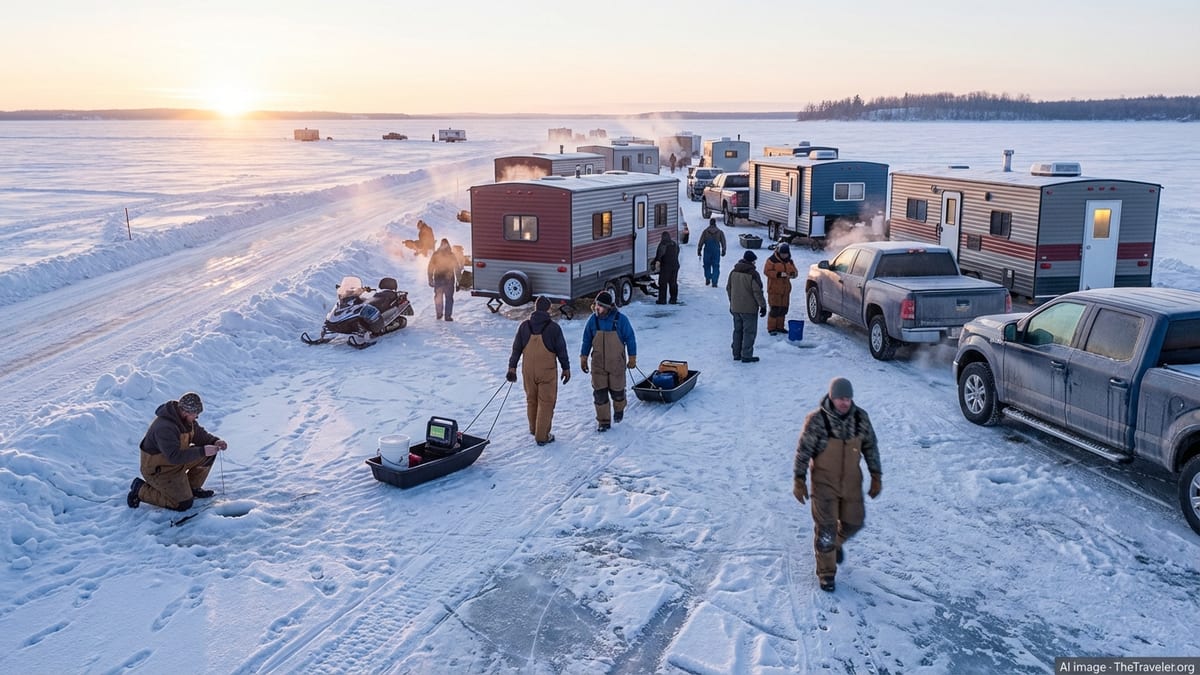
Local officials are responding by investing in infrastructure that supports longer winter stays. Communities near major lakes have expanded plowed access routes, parking areas and emergency services on the ice. Resorts are upgrading rental ice houses with more comfortable bunks, better insulation and reliable heat, making overnight stays a mainstream option rather than a rugged novelty. These improvements mirror developments long seen in Wisconsin and North Dakota and are helping Minnesota better compete for regional tourism dollars.
How Minnesota Compares With Other Top Ice Fishing States
As Minnesota’s ice fishing profile grows, it joins a short list of states consistently mentioned by national boating and angling organizations as the country’s premier hardwater destinations. Familiar names on those lists include Wisconsin, with its celebrated Lake Winnebago system; North Dakota, anchored by Devils Lake; Montana, with sprawling Fort Peck Reservoir; Michigan, whose Great Lakes bays and inland lakes see intense winter effort; New York, home to Oneida Lake and parts of the St. Lawrence; and Colorado, where high-elevation reservoirs freeze solid while surrounding peaks draw ski tourists.
Wisconsin’s outdoor recreation office reports that outdoor activities contribute more than 11 billion dollars annually to that state’s economy, with snowmobiling, ice fishing and winter sports playing a central role. North Dakota’s Devils Lake has become almost synonymous with guided hardwater trips thanks to extensive local services and aggressive promotion. Montana’s Fort Peck, remote and largely accessible by snowmobile or tracked vehicle in midwinter, has drawn national attention for trophy pike and lake trout. These examples illustrate the competitive field Minnesota is entering as it pushes its own lakes onto the national radar.
What sets Minnesota apart, according to fisheries experts and tourism officials, is the combination of sheer lake density, specialized management and an already strong culture of winter recreation. While other states may be best known for a handful of marquee destinations, Minnesota offers a constellation of ice fishing opportunities that range from heavily serviced, road-accessible lakes dotted with thousands of permanent fish houses to quiet backcountry lakes that require snowshoes or a long snowmobile ride to reach.
Mille Lacs, Upper Red and Lake of the Woods Lead the Charge
Three lakes in particular are anchoring Minnesota’s push into the top tier of national ice fishing hotspots: Mille Lacs Lake in central Minnesota, Upper Red Lake in the north and Lake of the Woods along the Canadian border. Each has a distinct character, but together they show the diversity of experiences available to winter anglers in the state.
Mille Lacs, roughly two hours from the Twin Cities, is one of Minnesota’s most closely monitored and heavily regulated fisheries. Recent fall gill-net surveys have revealed strong walleye year-classes and abundant forage, allowing the state to maintain what it describes as liberal winter harvest options in the 2024–25 season, with a two-fish limit within a protected slot and allowances for a single large trophy fish. Those rules reflect a cautious confidence that the light at the end of a long period of tight restrictions has finally arrived, making Mille Lacs newly attractive for traveling anglers who want a reasonable chance to bring fish home.
Upper Red Lake, by contrast, has been in a surplus condition for walleye, according to field biologists, with fall surveys indicating plenty of fish and room for harvest. As a result, winter limits there allow more keeper fish than many other large walleye lakes, drawing heavy attention from both Minnesota residents and out-of-state visitors. Local guides report that the combination of easy access, shallow flats and consistent early ice frequently make Upper Red one of the first major lakes in the region to see significant travel each season.
Farther north, Lake of the Woods offers a quasi-arctic experience, with vast frozen expanses that often stay fishable well into March. Charter services there plow extensive road networks, haul out heated sleeper houses and target not only walleye and sauger but also trophy pike and occasional lake sturgeon encounters. For many visiting anglers from other states, Lake of the Woods has become the point of entry into Minnesota ice fishing, a trip that resembles a remote northern expedition while still relying on well-developed services on the U.S. side of the border.
Safety, Climate and Evolving Ice Seasons
Even as Minnesota and its neighboring states push to attract more ice anglers, climate variability and safety remain central concerns. Recent winters have seen increasingly erratic freeze-up dates and mid-season thaws, forcing tourism operators and fisheries managers to adapt. In some regions, lakes that traditionally supported truck traffic by late December are now seeing a patchwork of safe and unsafe areas, requiring more frequent checks and more cautious messaging from local authorities.
Minnesota’s Department of Natural Resources and county emergency managers regularly issue detailed ice safety recommendations and stress that conditions can vary widely from lake to lake, and even within the same body of water. Resorts and guides have responded by investing in updated equipment such as ice thickness monitoring tools, lighter transport vehicles and shuttle services that limit how many personal trucks venture onto the ice at one time. These adaptations, while sometimes adding logistical complexity, are helping the industry maintain visitor confidence even in marginal conditions.
Climate challenges are not unique to Minnesota. Wisconsin, Michigan and New York in particular have also confronted shortened or interrupted ice seasons on some lakes, prompting a shift toward more flexible bookings and diversified winter attractions. For travelers, this means the era of assuming uniformly thick ice from December through March is over. The new norm involves checking local reports before committing to a trip, taking safety briefings seriously and being prepared for schedule changes if a midwinter thaw temporarily closes travel routes or access points.
Planning a Trip: What Ice Anglers Look for in Minnesota and Beyond
As Minnesota joins Wisconsin, Michigan, New York, Colorado, North Dakota and Montana on national “top ice fishing” lists, anglers planning winter travel are becoming more discerning about what each destination offers. In Minnesota, proximity to a major airport in the Twin Cities, a deep bench of professional guides and a wide range of lodging options are key selling points. Travelers can fly in, rent gear near Mille Lacs or Lake of the Woods, and be on the ice within a day, a convenience that has helped the state draw visitors from as far away as the East Coast and southern states.
By comparison, regions like Devils Lake in North Dakota and Fort Peck in Montana appeal to anglers who are comfortable with longer drives and more isolated conditions in exchange for less fishing pressure and a higher likelihood of trophy fish. Wisconsin’s Winnebago region and Michigan’s Saginaw Bay serve a large drive-in population from Chicago, Milwaukee and Detroit, combining urban access with robust local tournament calendars that appeal to competitive anglers as well as spectators.
Across these destinations, today’s travelers are also seeking more comfortable on-ice experiences. Heated wheelhouses, high-tech sonar and underwater cameras, and improved winter apparel have transformed a once-gritty pastime into a more accessible winter vacation. Minnesota outfitters have been quick to adopt these amenities, positioning themselves at the front of the pack for guests who want the romance of sitting over a frozen lake without enduring extreme discomfort.
FAQ
Q1. Why is Minnesota increasingly mentioned among America’s top ice fishing hotspots?
State data shows strong walleye populations on marquee lakes, rising fishing license sales and growing winter tourism, putting Minnesota on par with traditional leaders like Wisconsin, North Dakota and Montana in both angler interest and economic impact.
Q2. Which Minnesota lakes are considered must-visit destinations for ice anglers?
Mille Lacs Lake, Upper Red Lake and Lake of the Woods are widely regarded as the state’s flagship ice fisheries, with Leech Lake, Red Lake’s surrounding waters and many smaller central and northern lakes also drawing significant winter crowds.
Q3. How does Minnesota compare to Wisconsin and Michigan for ice fishing trips?
Minnesota offers a greater concentration of large, managed walleye lakes and an extensive guide and resort network, while Wisconsin and Michigan pair strong inland ice fishing with Great Lakes opportunities; all three deliver high-quality fishing, but Minnesota stands out for its density of accessible destinations.
Q4. What species can travelers expect to target through the ice in Minnesota?
Walleye is the primary draw, supplemented by sauger, northern pike, yellow perch, crappie, bluegill and occasional lake trout or eelpout, depending on the lake and region.
Q5. How important is ice fishing to Minnesota’s winter economy?
Ice fishing contributes to a broader winter recreation sector that supports hundreds of millions of dollars in lodging, retail and equipment spending annually, sustaining jobs in small communities that rely heavily on cold-weather tourism.
Q6. Are ice conditions in Minnesota reliable throughout the winter season?
While many northern lakes usually maintain solid ice for much of the winter, freeze-up and thaw patterns have become more variable, making it essential for visitors to check local reports and follow guidance from resorts and state agencies before venturing out.
Q7. What safety precautions should visiting ice anglers take?
Travelers are advised to confirm ice thickness with local experts, avoid driving heavy vehicles on uncertain ice, carry safety gear such as ice picks and flotation devices, and heed any posted closures or warnings from authorities.
Q8. Do visitors need special licenses to ice fish in Minnesota?
Nonresidents must purchase a Minnesota fishing license, which covers both open-water and ice seasons; licenses are available for various durations, and conservation officials emphasize that revenues support fisheries management and habitat.
Q9. How far in advance should anglers book ice houses or guided trips?
For peak periods in January and February on high-demand lakes like Mille Lacs, Upper Red and Lake of the Woods, tourism operators recommend reserving several months in advance, especially for weekend stays or larger groups.
Q10. Can families and non-anglers enjoy Minnesota’s ice fishing hubs?
Yes, many communities pair ice fishing access with winter festivals, snowmobile trails, cross-country skiing, tubing hills and cozy resort amenities, making them suitable for mixed groups where only some travelers plan to spend full days on the ice.