

More news on this day
Hundreds of travelers using Minot International Airport in North Dakota are confronting unexpected overnight stays, missed connections, and hastily improvised road trips as a convergence of federal flight cuts, staffing constraints, and severe winter weather triggers repeated cancellations at the small but strategically important regional hub.
Get the latest news straight to your inbox!
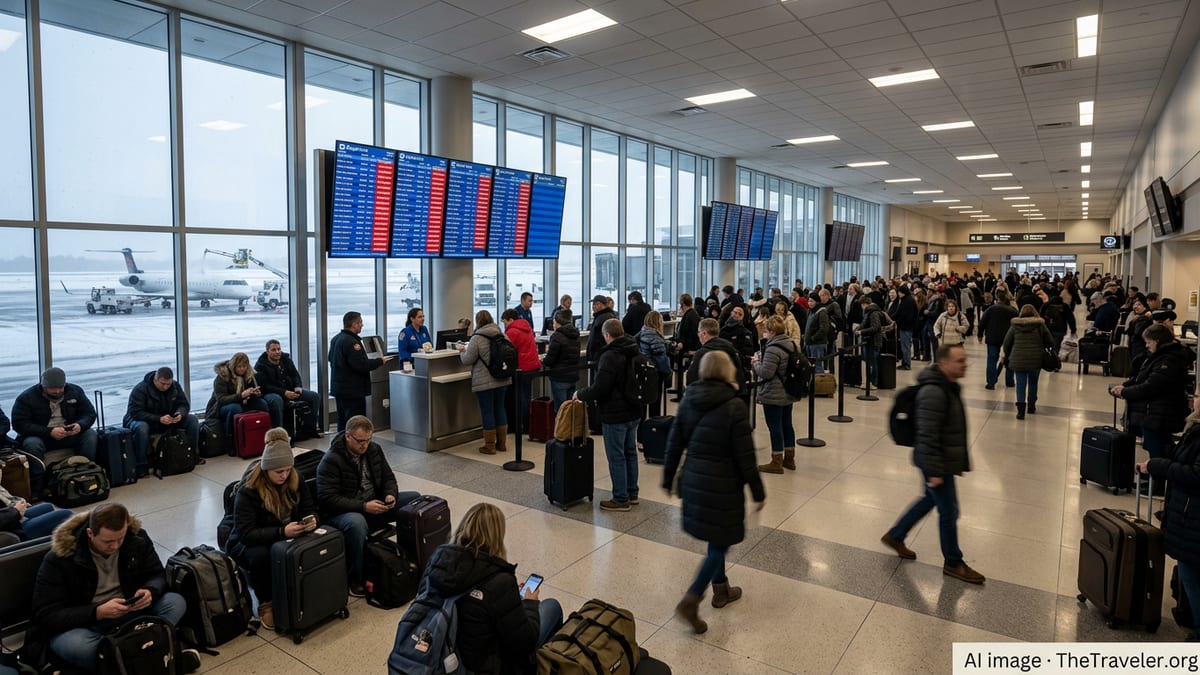
Chain Reaction of Cancellations Hits a Small-City Hub
Recent days have seen a sharp spike in cancellations at Minot International Airport, amplifying travel chaos for passengers who often rely on just a handful of daily departures to reach major hubs. Publicly available data and local coverage show that Minot’s limited schedule leaves little slack in the system. When even one or two flights are pulled, travelers can find themselves without same-day alternatives, especially when storms or air traffic restrictions ripple through connecting airports such as Minneapolis–St. Paul and Denver.
Reports from North Dakota media in late 2025 already documented a pattern of cancellations tied to a protracted federal government shutdown, with multiple Delta and United flights into and out of Minot scrubbed on a single day as air traffic control staffing tightened nationwide. That disruption, combined with a federal directive requiring airlines to pare back schedules at key hubs, signaled how quickly a national policy shift can cascade into severe service gaps for smaller communities.
The latest wave of travel turmoil is unfolding against the backdrop of an active 2025–26 winter season, with major storm systems sweeping across the northern tier of the United States. When severe weather snarls operations at Minneapolis–St. Paul or Denver, the impact is magnified in places like Minot, where flights are few and aircraft and crews are tightly scheduled. For passengers, that can mean cancellations with little warning and rebooking options stretched across days, not hours.
Federal Flight Cuts and Government Shutdown Fallout
Minot’s fragile air service has been under mounting pressure since a federal directive called on airlines to cut a portion of flights at selected large airports to ease strain on the air traffic control system. According to published coverage, a Delta flight between Minneapolis and Minot was among the early casualties of those mandated reductions, giving travelers an early preview of how national directives can leave smaller markets exposed.
Further analysis from North Dakota aviation authorities on the 2025 federal government shutdown points to dozens of canceled flights statewide, concentrated at airports including Minot, Fargo, Bismarck, and Grand Forks. The assessment highlights how temporary policy shocks can erase thousands of expected passengers in a single month, undermining revenue for airports and local businesses while eroding traveler confidence in regional connectivity.
For Minot, where most commercial itineraries depend on a single stop at a larger hub, the math is unforgiving. When a hub airport pulls back departures under federal pressure or staffing shortages, regional spokes such as Minot are among the first to lose service. Each lost rotation means fewer seats, longer gaps in the timetable, and a higher risk that a disruption at one end of the route will strand passengers at the other.
Stormy Winter Exposes Vulnerabilities in Regional Air Networks
This winter’s succession of large-scale storms across North America has further exposed the vulnerabilities of small-city air service. Major systems in January and February produced thousands of cancellations nationwide, as snow, ice, and high winds forced airlines to preemptively trim schedules. Even when Minot itself avoids the worst of the weather, disruptions at connecting hubs quickly reverberate through its already sparse timetable.
Regional jets serving markets like Minot are typically scheduled tightly, cycling between multiple small airports and a central hub in a single day. When a storm shuts down operations for several hours at a hub, aircraft and crews are left out of position, and downstream flights to places like Minot are often the first to be cut. With limited spare capacity and few backup aircraft, airlines prioritize restoring high-density routes before they can turn back to smaller spokes.
For passengers, that operational logic translates into long waits and complicated workarounds. Travelers attempting to reach Minot during major winter events have reported being rerouted through distant hubs, forced to overnight in connecting cities, or abandon air travel altogether in favor of long drives across the northern Plains. Each change adds cost and uncertainty, underscoring how weather-driven cancellations can quickly escalate into what feels like systemwide breakdown for those caught in the middle.
Staffing Shortages and Pilot Constraints Deepen the Crisis
While storms and federal directives are the most visible triggers, the underlying structure of regional aviation is also contributing to Minot’s current turmoil. Industry analyses point to persistent shortages of qualified pilots and air traffic controllers, particularly affecting regional carriers that operate smaller jets on thin routes. As wages and hiring standards adjust, carriers have trimmed or consolidated routes, leaving communities such as Minot with fewer daily options and less resilience when something goes wrong.
Public documents from North Dakota and airport planning reports note that Minot has long depended on a relatively small number of flights operated by regional affiliates of major airlines. When those partners face pilot or crew shortages, they often respond by cutting flights in marginal markets rather than reducing capacity on lucrative trunk routes. The result for Minot is a network that can appear stable during fair weather but rapidly frays under stress.
The effect is cumulative. Each time a route is cut or downgraded, the airport boards fewer passengers, which in turn makes it harder to argue for additional capacity or new destinations. Recent state-level statistics already show a drop in January boardings at Minot compared with the previous year, an early indication that frequent disruptions and uncertainty may be pushing some travelers to drive to larger airports hours away to secure more reliable options.
Stranded Passengers Face Difficult Choices
For travelers on the ground, the result is a kind of ultimate travel chaos: families sleeping in terminals after late-night cancellations, business travelers scrambling to rebook online, and military personnel and oilfield workers juggling critical reporting dates with limited flight availability. With few same-day alternatives, some passengers departing or arriving in Minot are left to choose between waiting multiple days for an open seat or renting a car and driving long distances across winter roads.
According to publicly available information from airlines serving Minot, change-fee waivers and travel advisories are sometimes issued during major weather events or operational disruptions. Yet those measures do little to solve the underlying scarcity of seats. When a day’s worth of departures disappears, vouchers and flexible rebooking policies cannot create additional capacity into or out of a small regional airport.
Local officials and aviation planners have previously emphasized the importance of maintaining strong passenger numbers to support existing routes and attract new service, but the current pattern of rolling cancellations risks undermining that effort. As more travelers conclude that Minot’s air service is unreliable during peak disruption periods, they may shift permanently to larger airports, further weakening the case for robust year-round connectivity and leaving the community more vulnerable the next time a national crisis or severe storm hits the aviation system.