

Few places in Salzburg capture the city’s blend of Baroque elegance and Alpine drama quite like Mirabell Gardens. Set beneath the towers of Hohensalzburg Fortress and wrapped around Mirabell Palace, these formal gardens are compact enough to explore in under an hour, yet intricate enough that most visitors still miss the very best viewpoints. This guide walks you through Mirabell Gardens as if following a map, describing exactly where to stand for postcard-perfect photos, quieter perspectives, and those subtle angles that turn a short stop into a memorable visit.
Understanding the Layout of Mirabell Gardens
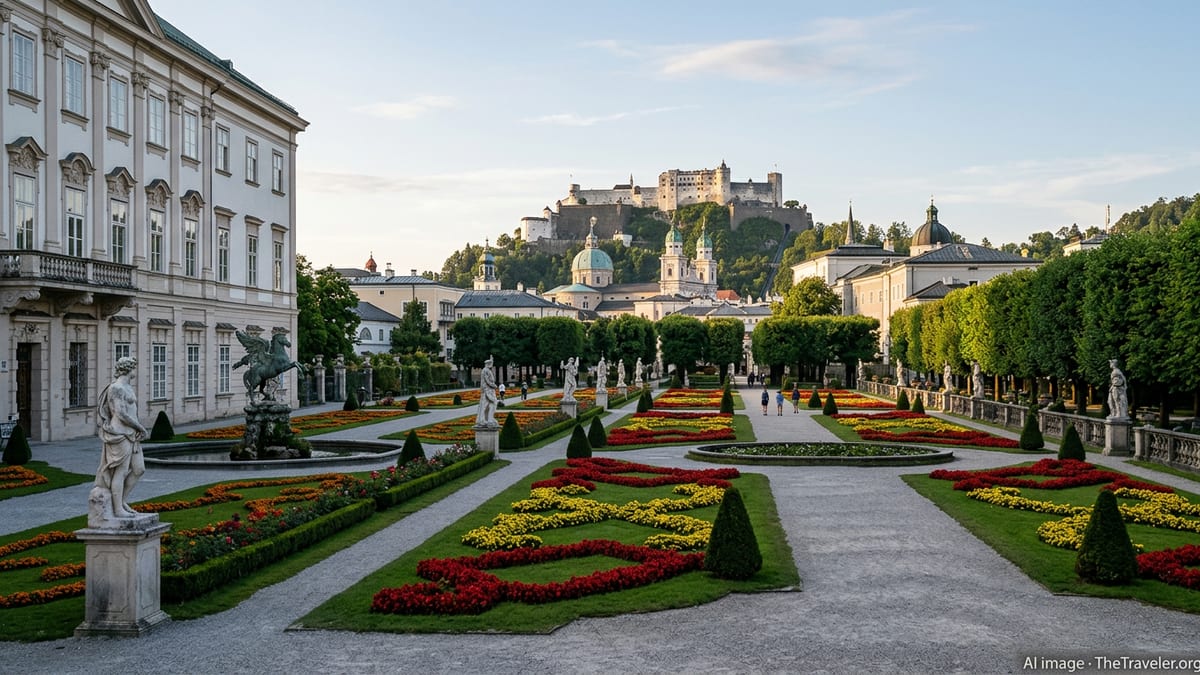
Before searching for viewpoints, it helps to picture Mirabell Gardens as a series of connected rooms rather than one big park. At the heart lies the geometric Grand Parterre, the formal lawn and flowerbeds stretching from Mirabell Palace toward the south, perfectly aligned with the skyline of Salzburg’s Old Town and Hohensalzburg Fortress. Paths frame this central axis, lined with statues and low hedges; this is where most iconic photos of Salzburg with flowerbeds in the foreground are taken.
To the east of the Grand Parterre you will find the Pegasus Fountain and the Rose Garden terraces, where steps and railings create layered vantage points. To the west, the Dwarf Garden hides behind trees and a gentle slope, providing slightly elevated side views of the city. Beyond the gardens’ southern boundary, the Salzach River and the footpath toward the Old Town create further lines of sight back to Mirabell that many travelers overlook.
Most printed tourist maps of Salzburg, including the ones given out at hotels and at the tourist information near Mozartplatz, show Mirabell Gardens as a green rectangle north of the river, labeled “Schloss Mirabell” or “Mirabellgarten.” Once you are at Mirabellplatz, a few minutes’ walk from the river and about 15 minutes on foot from Salzburg Hauptbahnhof, you will find park maps on information boards near the main entrances that sketch out the palace, fountains, terraces and side gardens in simple, easy-to-follow diagrams.
Because the gardens are not large, you can comfortably visit all of the key viewpoints in under an hour, even with photo stops. Allow 90 minutes if you want to explore the palace interiors on a weekday morning when the Marble Hall and grand staircase are usually open, or if you plan to sit and linger on one of the terraces with a coffee from a nearby café at Mirabellplatz.
The Classic Axis: Central Parterre and Main Fortress View
The central lawn and flowerbeds form the most famous perspective in Mirabell Gardens. If you stand at the southern end of the Grand Parterre, facing south toward the Old Town, the fortress caps the skyline like a stone crown. In early summer, the beds are usually planted in geometric color blocks, so your composition stacks neatly: bright flowers in front, then statues and gravel paths, church domes in the middle, and the fortress above.
To find this spot, enter the gardens from the Mirabellplatz side, walk past the palace façade, and follow the central path straight down the steps into the Grand Parterre. Continue along the gravel until you are almost at the far end of the lawn, stopping just before the low balustrade that closes the garden. From here, crouching slightly or holding your camera at chest height will give you the most balanced ratio of flowers to skyline. Many travelers using standard smartphones find that a focal length equal to about 24–28 mm equivalent frames the whole fortress without distorting the foreground statues.
If you are visiting around midday in summer, when the sun is high and harsh, the fortress can look washed out. In that case, walk a few meters to the side, closer to the tree line on the east or west edge of the lawn. This allows you to bring some shade and foliage into the frame, which softens the contrast. Morning visitors often get the gentlest light, especially between April and September, when the first tour groups are still gathering at Mirabellplatz for bus excursions and the Grand Parterre is comparatively empty.
For slightly elevated shots along this axis, look for the short steps at the northern end of the lawn, closer to the palace. Taking a few steps up and shooting down the length of the parterre compresses the flowerbeds and paths into pleasing stripes, while still keeping the fortress centered in the background. This angle works especially well with a 35–50 mm focal length, which flattens the perspective slightly and gives Salzburg’s skyline a grander presence behind the garden geometry.
Pegasus Fountain and Rose Garden Terraces
Arguably the single most recognizable feature inside Mirabell Gardens is the Pegasus Fountain, set slightly northeast of the Grand Parterre. Fans of classic cinema will remember this as one of the filming locations for the “Do-Re-Mi” sequence in The Sound of Music. Even if you are not chasing film history, this small plaza delivers some of the richest combinations of water, statuary, palace façades and fortress views in the park.
Stand behind the Pegasus Fountain so that the rearing bronze horse is in the center of your frame with Mirabell Palace on the left and the fortress aligned in the distance. From here, you can either shoot low to capture reflections in the water, or step up onto the surrounding ledge to get slightly above the crowd. Early in the day, often before 9 am outside peak summer, the fountain surface is relatively calm, giving you mirror-like reflections that add depth to the image. Later in the day, the spot fills with tour groups, so patience and a little side-stepping help you isolate the statue.
Above the fountain, a set of steps leads to the Rose Garden terraces. This small elevated platform is one of the most overlooked viewpoints in Mirabell. When you reach the top, walk to the balustrade and look back over the roses toward the fortress. The pattern of rose beds below and the Pegasus Fountain slightly off to one side creates a layered effect that feels more intimate than the main parterre. This is a good place for portraits with the fortress behind you; the railing gives you a clean edge to lean against, and the roses provide a softer, romantic foreground without needing a wide-angle lens.
Because this terrace sits a few meters above the garden, it works well even when the main parterre is crowded. In the late afternoon, you often get warm side light on the fortress walls, while the roses glow gently without becoming overexposed. Add a moderate zoom, around 50–70 mm on a camera or 2x on a smartphone, to compress the distance between the flowers and the fortress, making them appear closer together than they are in reality.
Hidden Corners: Dwarf Garden, Side Paths and Quiet Benches
On the western side of Mirabell Gardens, slightly tucked away behind trees and hedges, lies the Dwarf Garden. This quirky collection of stone dwarf statues dates back to the 18th century and forms a low plateau that naturally lifts you above the level of the central lawn. While many visitors come here for playful photos with the statues, the slight elevation also offers an alternative angle on Salzburg’s skyline that avoids some of the crowds of the main axis.
Walk along the gravel paths between the dwarfs and look for gaps in the foliage that open toward the fortress. Because you are off to the side rather than aligned with the central axis, the churches and townhouses of the Old Town appear more staggered, creating a layered roofscape behind the garden trees. In late afternoon, the light often falls across the scene at an angle, highlighting the fortress while leaving parts of the garden in gentle shadow, ideal for more atmospheric, less touristy shots.
Several lesser-used benches line the side paths between the Dwarf Garden and the central parterre. From these seats, you can capture candid scenes of locals crossing the garden, children playing around the fountains, and tour groups moving in the distance, all with the fortress looming in the background. These quieter corners are particularly pleasant in spring and autumn, when the air is crisp and the crowds are lighter, giving you space to experiment with composition without feeling rushed.
If you prefer people-free images, aim for early morning on weekdays outside school holidays. Local workers often cut through the garden on their way to offices in the Neustadt district north of Mirabellplatz, but foot traffic remains thin compared to mid-morning. With a longer focal length, such as 85 mm or the portrait mode on your phone, you can isolate a single statue or tree branch with the fortress softly blurred behind, creating more artistic impressions of Mirabell without leaving the main paths.
Mirabell Terrace and Palace Perspectives
Just north of the Grand Parterre, close to the palace façade, a slightly raised terrace acts almost like a balcony over the gardens. This is one of the best spots if you want to capture the full geometry of Mirabell’s design in a single frame. Stand near the center of the terrace, looking south, and you will see the axial layout of lawns, fountains, statues and paths leading directly toward the Old Town and fortress.
From this vantage point, using a wider focal length of about 20–24 mm lets you include both the palace edge and the gardens below, providing context that pure garden views lack. It is also a good place to film short videos panning from the palace across the garden toward the skyline. Many professional photographs used in brochures and hotel lobbies are taken from here or from nearby windows in the palace when accessible.
Inside the palace itself, the grand marble staircase and Marble Hall are renowned as one of Salzburg’s most romantic civil wedding venues. Although these interiors are more about architecture than views, some upstairs corridor windows occasionally offer glimpses back over the gardens, especially during weekday visiting hours when official functions are not taking place. When they are open, step carefully to the window, avoid blocking the corridor, and look for symmetrical compositions combining garden geometry and the fortress beyond.
Do keep in mind that palace interior access can vary due to events and weddings, especially on Fridays and Saturdays. The gardens, however, remain public and open daily, usually from early morning until late evening, so the terrace outside provides the most reliable elevated perspective. Even on overcast days, this view works well, as the even light brings out the textures of gravel paths, clipped hedges and statuary without harsh shadows.
Looking Back at Mirabell: Views from the River and Beyond
Some of the most satisfying images are taken not inside Mirabell Gardens, but looking back at them from across the Salzach River or from higher ground on the city’s hills. After exploring the garden, exit toward the south and walk a few minutes to the riverside promenade. Turn around and you will see the north bank with Mirabell Palace and the gardens’ treetops, with the fortress rising above the Old Town on the opposite bank.
At dusk, when the city lights begin to glow and the sky turns deep blue, this riverside angle can be magical. If you frame your shot with the river in the foreground, Mirabell’s façade illuminated in the middle distance, and the fortress glowing above, you create a layered image that tells the story of Salzburg’s relationship between river, garden and hilltop fortification. A small travel tripod helps in low light, but many modern smartphones with night modes can handle this scene handheld if you brace yourself against the railing.
Another worthwhile viewpoint is from the paths on Mönchsberg, the wooded hill that rises directly behind the Old Town. Several terraces and lookouts along the Mönchsberg trail offer sweeping panoramas across the city. With a bit of zoom, you can pick out Mirabell’s formal geometry as a bright rectangle of order amid the denser urban fabric below. This is less about capturing intimate garden detail and more about placing Mirabell within the wider Salzburg landscape.
For travelers who enjoy slower city walks, combining a visit to Mirabell Gardens with a stroll up to one of the Mönchsberg viewpoints or the Kapuzinerberg on the opposite bank offers a satisfying circuit of perspectives. You start among the flowers and fountains, then end the day looking down at them, better appreciating how thoughtfully the garden was aligned with the fortress and the river centuries ago.
Practical Map Tips, Entrances and Best Times to Visit
On most Salzburg maps, Mirabell Gardens sit between Mirabellplatz to the north and the Salzach River to the south. The main palace entrance faces Mirabellplatz, where several city bus lines and sightseeing buses stop. From Salzburg Hauptbahnhof, many visitors simply walk down Rainerstrasse for about 10–15 minutes until they reach Mirabellplatz and the palace façade. Others hop on a trolleybus toward Mirabellplatz; the ride is short and usually costs just a few euros, making it convenient if you are carrying luggage or visiting in bad weather.
Once at Mirabellplatz, look for park maps mounted near key gates. These diagrams typically highlight landmarks such as Schloss Mirabell, the Pegasus Fountain, Rose Garden, Dwarf Garden, and the main axial path. Even if the map is in German, the icons and layout are easy to follow. Using these boards, you can trace a simple loop: start at the terrace by the palace, move down the central parterre, detour to Pegasus Fountain and the Rose Garden, cross to the Dwarf Garden, then return to the terrace. This circuit covers almost all the major viewpoints described in this guide.
The gardens are freely accessible and open daily, with gates generally unlocked from early morning until late evening, though exact times can vary slightly by season. In high summer, sunrise visits around 6–7 am reward you with soft light and almost empty paths. In winter, the gardens are quieter throughout the day, though some side features such as the Dwarf Garden may have limited access in icy conditions, and flowerbeds are less colorful. Spring and early autumn strike a balance between floral display and manageable crowds, especially on weekdays.
Weather plays a big role in how Mirabell feels. On clear days, the fortress stands crisp against the sky, making strong silhouettes and graphic compositions. On overcast or slightly misty days, the mood becomes more subdued and romantic, with even light that flatters portraits and architectural details. Consider visiting twice if you have time in Salzburg: once in bright conditions to capture classic postcard shots, and once in softer light for more atmospheric images and quieter strolls.
Photo Tips for Capturing Mirabell’s Best Viewpoints
Whether you are shooting on a full-frame DSLR or a basic smartphone, a few simple choices can make a big difference in how your Mirabell images turn out. At the central parterre and Pegasus Fountain, use a moderately wide perspective so you can include both foreground detail and the fortress. On many phones, this means staying with the main camera rather than switching to the ultra-wide, which can distort vertical lines and make the fortress appear tiny.
Foreground interest is key in Mirabell. Position flowerbeds, statues, balustrades or the fountain in the lower third of your frame and let the fortress occupy the upper third. At the Rose Garden terraces, frame a single rose or cluster of blooms close to the camera, using portrait mode or a wide aperture if you have one, to blur the background slightly while keeping the fortress recognizable. This approach works well during busy times, because the shallow depth of field softens passersby into pleasant, anonymous figures rather than distractions.
Time of day matters as much as equipment. Early morning gives you soft front light on the fortress when shooting from the terrace or central axis, while 1–2 hours before sunset can bathe the garden in warm side light that sculpts the statues and hedges. If you are in Salzburg only briefly and the weather is changeable, prioritize Mirabell when the light is at its best and save indoor attractions, such as nearby churches or museums, for the flat midday hours.
Finally, do not forget to turn around. Some of the most charming images at Mirabell come from facing away from the fortress: children running toward the palace steps, couples sitting quietly on benches beneath the trees, or local musicians practicing in a corner. These scenes may not be the classic skyline views, but they capture the human life of the garden and give your photo set a richer, more authentic narrative.
The Takeaway
Mirabell Gardens is more than a quick stop between Salzburg attractions. With a little awareness of its layout and a mental “map” of key viewpoints, you can turn a casual stroll into a series of memorable scenes. The central parterre offers the iconic fortress alignment, the Pegasus Fountain and Rose Garden terraces add sculptural drama and floral romance, the Dwarf Garden and side paths provide quieter, elevated angles, and the riverside and hilltop lookouts complete the story by placing Mirabell within Salzburg’s broader landscape.
You do not need elaborate gear or detailed technical knowledge to enjoy these views. A willingness to explore a few extra paths, climb a short set of steps, or revisit the garden at a different time of day is often enough. With this guide in mind, the next time you unfold a map of Salzburg or open your phone’s map app, Mirabell Gardens will no longer be just a green rectangle, but a small world of viewpoints waiting to be discovered.
FAQ
Q1. Where exactly is the classic postcard viewpoint in Mirabell Gardens?
The classic postcard view is along the central parterre axis. Enter from Mirabellplatz, walk past the palace onto the terrace, then descend the steps toward the main lawn. Stand near the far, southern end of the lawn, facing the Old Town, with the flowerbeds in front of you and Hohensalzburg Fortress centered in the distance.
Q2. How do I find the Pegasus Fountain and Rose Garden terraces on the map?
On most maps of Mirabell Gardens, the Pegasus Fountain is marked just east of the central lawn, slightly closer to the palace. From the terrace, walk down into the garden and veer left. You will see the circular fountain with the rearing horse statue, and a staircase behind it leading up to the Rose Garden terraces.
Q3. Are there good viewpoints that are less crowded?
Yes. The Dwarf Garden on the western side of Mirabell is usually quieter and sits slightly higher than the main lawn, providing side-on views of the fortress through trees. Benches along the side paths between the Dwarf Garden and central parterre also offer calmer spots for photos and people-watching compared to the busy central axis.
Q4. What is the best time of day for photos in Mirabell Gardens?
Early morning often provides the softest light and the fewest people, making it ideal for clear views of the fortress from the terrace and main parterre. Late afternoon and the hour before sunset bring warm side light that adds depth to statues, hedges and roses. Midday can be harsh and crowded, but is still fine for exploring and casual snapshots.
Q5. Can I get good views of Mirabell Gardens from outside the park?
Yes. Walking along the Salzach River just south of Mirabell lets you look back at the palace façade and treetops of the garden with the fortress above. Higher viewpoints on Mönchsberg or Kapuzinerberg hills offer panoramic views where Mirabell appears as a neat green and stone rectangle within the wider cityscape.
Q6. How do I reach Mirabell Gardens from Salzburg Hauptbahnhof?
From Salzburg Hauptbahnhof, you can walk along Rainerstrasse for about 10 to 15 minutes until you reach Mirabellplatz and the palace. Alternatively, several city trolleybus lines run from the station toward Mirabellplatz; the ride typically takes just a few minutes and costs only a small single fare, which you can buy from machines, kiosks or via local transport apps.
Q7. Do I need a ticket to enter Mirabell Gardens?
No, the gardens are public and free to enter. You can walk through any of the main gates during opening hours without a ticket. Only certain palace interiors, such as the Marble Hall during specific concerts or events, may require paid admission or reservations.
Q8. Are the viewpoints accessible for visitors with limited mobility?
The central parterre and many main paths are flat and surfaced with compacted gravel, making them reasonably accessible for wheelchairs and strollers in dry conditions. Some of the best elevated viewpoints, like the Rose Garden terraces and palace terrace steps, require climbing short staircases. If stairs are a concern, focus on the flat central paths and the lower level around the Pegasus Fountain.
Q9. Can I visit Mirabell Gardens in winter and still enjoy the views?
Yes. While flowerbeds are less colorful in winter and some features may have limited access in icy weather, the main paths usually remain open. The fortress and Old Town skyline are visible year-round, and on clear winter days the crisp air and snow-dusted rooftops can make for especially striking photographs from the terrace and central parterre.
Q10. Is Mirabell Gardens safe to visit early in the morning or at dusk?
Mirabell Gardens is in a central, well-frequented area of Salzburg and is generally considered safe during normal visiting hours. As with any urban park, basic precautions such as keeping valuables secure, staying on lit paths after dark, and being mindful of your surroundings are sensible, but most travelers report feeling comfortable exploring at both early and late daylight hours.