

More news on this day
When Air Canada Express Flight 8646 collided with an airport fire truck on LaGuardia’s Runway 4 on the night of March 22, 2026, the scene suggested catastrophe. Yet, in what many observers have called a miracle, the vast majority of those on board survived, turning a devastating crash into a hard-earned case study in modern aviation safety and the unforgiving complexity of busy urban airports.
Get the latest news straight to your inbox!
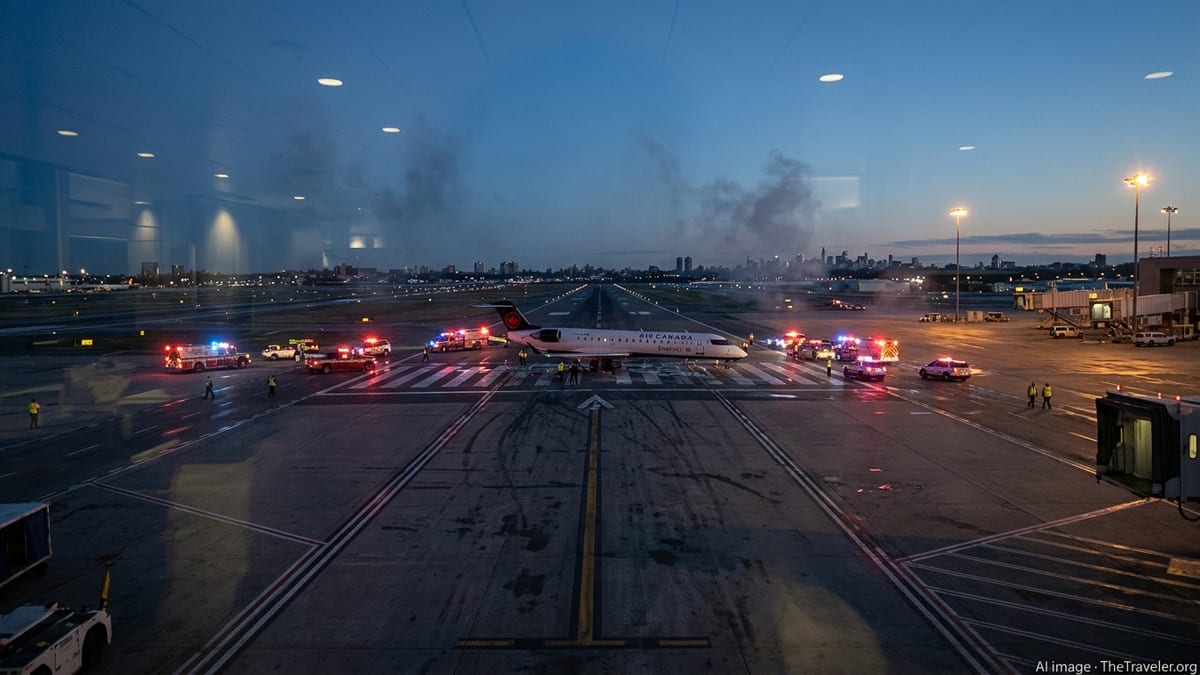
A routine Montreal–New York hop turns tragic
Air Canada Express Flight 8646, a regularly scheduled regional service from Montréal–Trudeau to New York’s LaGuardia, was nearing the end of a familiar one-hour hop when routine gave way to disaster. Publicly available flight and media data describe a Bombardier CRJ900 with 76 people on board approaching Runway 4 at LaGuardia late on March 22 under nighttime conditions.
According to published coverage and initial timeline reconstructions, an airport firefighting vehicle operated by the Port Authority of New York and New Jersey was crossing the active runway to respond to an unrelated emergency on the airfield. In the same critical window, the arriving jet was on short final. The collision sequence destroyed the cockpit and forward galley of the aircraft and severely damaged the fire truck.
Reports indicate that both pilots of Flight 8646 were killed in the impact, along with at least one member of the fire truck crew. Dozens of passengers and crew were injured, some seriously, but the fuselage remained largely intact, allowing most occupants to escape. Emergency services declared a mass-casualty incident and LaGuardia was closed for hours as responders worked in the glow of floodlights and emergency strobes.
For many travelers, the incident was a chilling reminder that the most dangerous moments of flight often occur not at cruise altitude but in the brief seconds where aircraft, vehicles and people intersect on the ground.
How 74 people survived a runway collision
The survival of 74 of the 76 people on board has drawn intense attention from aviation safety specialists. Photographs and video from the scene, along with descriptions in international media reports, show the CRJ900’s nose largely torn away while the fuselage remained upright and structurally recognizable. That pattern is consistent with how modern regional jets are engineered to absorb and redirect impact forces away from the passenger cabin.
Cabin safety features that travelers rarely think about also played a critical role. Reinforced seat structures, energy-absorbing seat tracks and overhead bins designed to remain latched in high deceleration events all reduce the likelihood of secondary injuries. In this case, reports from hospitals around New York describe a wide range of trauma, but also suggest that many passengers were able to walk or be helped away from the wreckage.
Orderly evacuation appears to have been another decisive factor. Publicly available descriptions mention passengers using both the main door area and overwing exits in dark, chaotic conditions, with debris from the fire truck scattered nearby. The fact that fuel did not immediately ignite around the cabin gave rescuers and survivors precious minutes to move clear of the aircraft.
For investigators, the case is likely to become a reference point in understanding how structural design, crew training and emergency response intersect to turn a high-energy collision into a survivable accident for most occupants.
Focus turns to ground safety and runway incursions
The collision at LaGuardia is already being framed within a broader pattern of ground-safety scares at major North American airports. In recent years, there have been several widely publicized close calls involving aircraft and ground vehicles, as well as low-speed collisions between jets taxiing in congested ramp areas. Aviation analysts note that LaGuardia’s confined footprint, intersecting runways and dense schedule leave little margin for error.
Early descriptions of the AC8646 crash emphasize a convergence of factors: an emergency elsewhere on the airfield, a firefighting vehicle cleared to move, and an arriving passenger jet in the final moments of landing. In that split second, the systems designed to keep metal from meeting metal did not prevent disaster. Publicly available discussions among pilots and controllers have focused on how air traffic control phraseology, ground radar systems and automated runway status lights might have interacted before the crash.
Runway incursions, where an unauthorized aircraft or vehicle is present on an active runway, are not new. Regulators in the United States and abroad have spent decades introducing layered defenses, from improved signage and lighting to advanced surface movement radar. The LaGuardia collision, however, illustrates that even with such tools in place, human workload, stress and communication overload can still create dangerous gaps.
For travelers, the event may be largely invisible beyond delays and cancellations. For airport operators and regulators, it adds urgency to long-running efforts to better separate rescue equipment, construction vehicles and routine airline movements on crowded airfields.
Lessons for travelers: safety briefings and seatbelts matter
Beyond system-level questions, the AC8646 tragedy offers sobering, practical lessons for individual passengers. Survival in serious but survivable accidents often hinges on simple behaviors: paying attention to the safety briefing, noting the nearest exits, keeping seatbelts fastened snugly during landing, and leaving baggage behind in an evacuation.
Published accounts of past runway accidents show that unrestrained passengers are far more likely to be injured when an aircraft suddenly decelerates or pivots on impact. In a collision where the front of the aircraft absorbs the brunt of the force, those seated farther back, securely belted and aware of their escape routes, statistically have better odds. The overall survival rate on Flight 8646 is likely to reinforce longstanding guidance that most serious injuries occur during takeoff and landing, when seatbelts are required but not always worn tightly.
Cabin crew instructions during the chaotic seconds after impact are another recurring theme. Even without access to cockpit leadership, trained flight attendants are equipped to assess which exits are usable, direct passengers away from hazards and speed evacuation. Travelers who respond quickly, follow commands and move well clear of the aircraft once outside help keep escape routes open for those behind them.
While no amount of personal preparation can fully offset a catastrophic collision, the survival of so many people at LaGuardia underlines that small, individual choices can make the difference between serious injury and walking away.
What comes next for LaGuardia and global aviation
In the coming months, the AC8646 crash is expected to become a central case study in discussions about ground operations at high-density airports. Publicly available information confirms that the National Transportation Safety Board has launched a full investigation, deploying specialists in operations, human performance, airport infrastructure and survival factors to New York.
Attention is likely to center on how instructions were issued and acknowledged, what the various surveillance and alerting systems displayed, and whether the fire truck and the arriving jet each had an accurate picture of the other’s position. Findings from previous LaGuardia incidents, including minor collisions between taxiing jets, may be revisited to identify recurring themes in training and procedures.
Globally, regulators and airport operators are watching closely. Many major hubs share LaGuardia’s constraints: aging layouts hemmed in by water or urban development, soaring traffic demand and a growing mix of regional jets, narrowbodies and ground vehicles competing for limited pavement. The LaGuardia crash is likely to influence investment in enhanced runway status systems, more conservative spacing between movements during airfield emergencies, and perhaps new rules on how and when rescue vehicles are cleared to cross active runways.
For travelers moving through New York and other busy gateways in the weeks ahead, the most visible legacy of Flight 8646 may be longer taxi times, more frequent ground holds and the occasional missed connection. Behind the scenes, however, the tragedy is pushing the industry toward stronger defenses against runway collisions, seeking to ensure that the next apparent miracle of survival does not begin with a preventable crash.