

I had been to Lisbon before, but on this trip I set myself a simple challenge: pick one sunset viewpoint and really live it, instead of racing between every miradouro in town. Of course, I promptly failed. Miradouro da Graça and Miradouro da Senhora do Monte sit on the same hill, a short walk apart, and every local I asked had a different favorite.
So I did what any indecisive traveler would do. I visited both, at different times of day, several times over a few days, and then tried to answer the question that seems to divide viewpoints in Lisbon: which one is actually better.
First Impressions: Two Viewpoints, Two Very Different Vibes
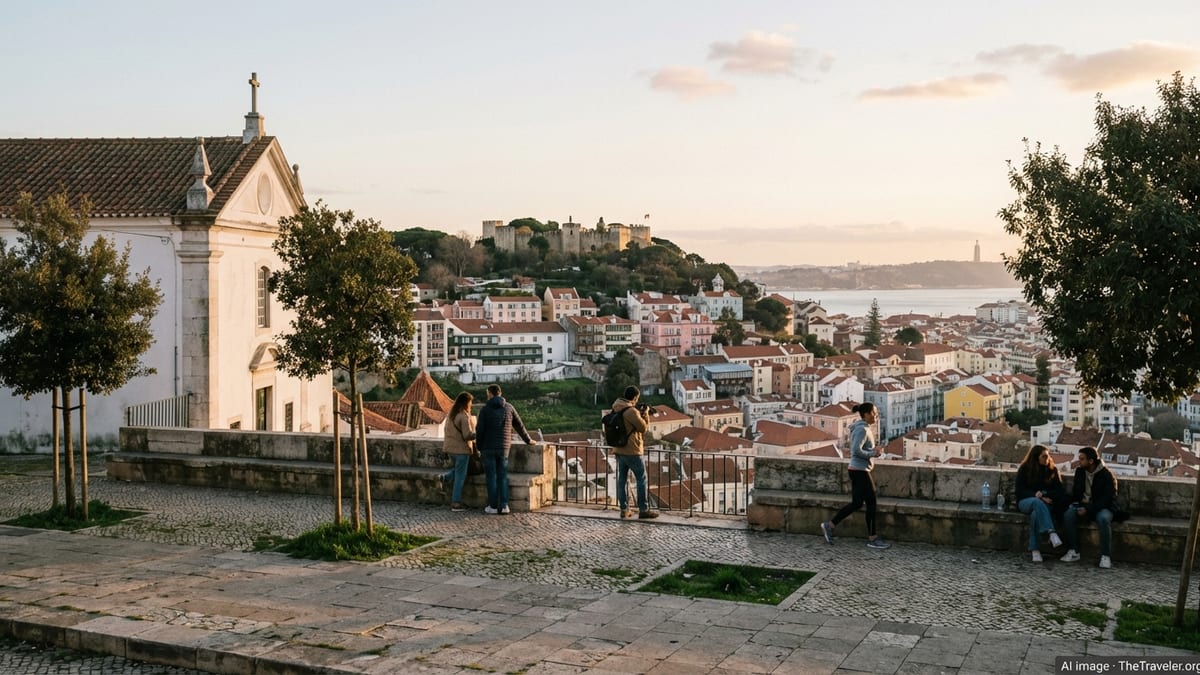
My first encounter with Miradouro da Graça came on a warm late afternoon. I stepped off tram 28E in Graça, wove through a tangle of tuk-tuks and tourists, and followed the small stream of people drifting toward the hilltop church. The miradouro sits by the Igreja da Graça, now officially named Miradouro Sophia de Mello Breyner Andresen, and the whole place felt instantly lived in: a terrace shaded by pines, a café, clusters of locals chatting, kids running around. It felt like a neighborhood viewpoint that had learned to live with tourism rather than being defined by it.
Miradouro da Senhora do Monte, just a ten-minute uphill walk away, hit me very differently. It is higher up, more exposed, and wrapped around a small chapel. The first time I climbed there was in the morning, when the city was still rubbing its eyes. The view unfolded as a huge, almost cinematic sweep over Lisbon: Castle of São Jorge directly opposite, the river glinting in the distance, Avenida Almirante Reis funneling into the city center. It felt less like a hangout and more like a lookout, with the chapel adding a touch of quiet solemnity that Graça does not really try to have.
From the very first visits, I realized I was not comparing like with like. Graça felt sociable and anchored, with its café, its plaza and a sense of daily life. Senhora do Monte felt like a platform built just for the view, with fewer distractions. One is more of a living room, the other more of a balcony. Already I suspected my answer to “which is better” would depend heavily on what kind of moment someone is looking for.
Getting There: Trams, Hills and a New Funicular
Reaching both viewpoints is conveniently centered on the famous tram 28E, but the romance of the tram is not always matched by its practicality. On my first afternoon, I queued in Martim Moniz, only to find the line of people curving well beyond the tram stop. Between route adjustments and a mix of actual trams and replacement buses, the 28E no longer feels like a guaranteed vintage joy ride; it is more of a sometimes-charming, sometimes-frustrating means to an end, especially at peak hours when you might stand in a packed car all the way up to Graça.
There is also a newer piece of infrastructure that changes the game a bit. The Elevador da Graça, a modern funicular-style lift, now links the Mouraria area (Rua dos Lagares) to the vicinity of Miradouro da Graça. It runs roughly from morning to early evening, and when it is working it saves you from one of Lisbon’s steeper climbs. I used it once in the late morning and had the car basically to myself; it felt clean and efficient, if a bit sterile compared with the creaky funiculars elsewhere in the city. When it is running smoothly, it makes Graça much easier to reach, especially for anyone who struggles with inclines.
From Graça to Senhora do Monte you still have to walk, but it is a short, fairly steep ascent through narrow residential streets. I never saw any formal signage pointing clearly to the viewpoint; I mainly followed maps and small clusters of people. This lack of wayfinding felt typical of Lisbon: charming when you are in the mood to wander, mildly irritating when you are hot, tired and trying to time a sunset. The walk is not long, but if you have mobility issues or heavy bags, it can be a factor in how often you will realistically go up there.
Practicalities: Opening Hours, Facilities and Hidden Costs
One of the odd frictions with Miradouro da Graça is that the terrace is essentially tied to the onsite café-bar and its operating hours. During the day it feels casually open, but in practice you are sharing a semi-managed space that tends to shut down in the evening. During my visit, the bar operated roughly from around mid-morning to early evening, with closing usually before or around sunset in winter. On one occasion I watched a few latecomers get turned back nearly half an hour before the posted closing time because the staff wanted to wrap up early. It was not dramatic, but if you arrive last minute hoping for a leisurely sunset drink, you do run the risk of getting a rushed experience or being told it is too late.
The other quirk, which I found both understandable and a little disappointing, is that the best part of the terrace increasingly feels tied to consumption. The café tables claim the prime shaded spots, and while you can technically stand at the railings without buying anything, most people end up ordering at least a drink. That is not a huge financial burden, but it subtly shifts the miradouro from pure public lookout to a semi-commercial hangout. Bathrooms are available but belong to the café; again, you generally need to be a customer.
At Miradouro da Senhora do Monte, the setup is more bare-bones but also freer. The viewpoint itself is a public terrace in front of the small chapel, with no admission fee and no obligation to buy anything. It is effectively open all day and night. I visited at sunrise, mid-afternoon and after dark, and never saw any form of gate or closure. There are a couple of small vendors at busy times, and a few tuk-tuks waiting for fares, but there is no central café that anchors the space. The downside is that amenities are limited: no guaranteed toilets, nowhere truly sheltered from strong sun or wind, and no seating that feels comfortable for more than a short stay unless you find a spot on the low walls.
Those practical details may sound minor, but they matter. If you are planning a slow afternoon with drinks and conversation, Graça’s café structure is a plus, provided you accept the time limits. If you are chasing a sunrise, want flexibility with time of day, or simply do not like feeling nudged into buying something, Senhora do Monte wins by being more of an open public space. I found myself returning to Senhora do Monte when I wanted total schedule freedom, and to Graça when I wanted the guarantee of shade, seating and a drink.
The Views: Framing Lisbon from Two Angles
On paper, Miradouro da Senhora do Monte offers the superior view, and I understand why so many people insist on that. It sits higher than Graça, and the panorama is almost 360 degrees: the castle on the opposite hill, the Baixa grid fanning out below, the river in the distance, the long corridor of Almirante Reis stretching north. There is even a tiled panel that labels the key landmarks, which I initially dismissed as touristy but later found genuinely helpful when I tried to orient myself in the city’s maze of hills.
The first time I watched the sun rise there, the city looked washed in soft pastels, the castle silhouette sharpening as the sky lightened. It was one of those genuinely quiet Lisbon moments I sometimes wonder if still exist. The elevation also works well in photographs. Rooflines, churches and the river orchestrate into a single composition, making it easy to come away with satisfying shots without much effort or equipment. If you are a photographer, this is probably the viewpoint you imagine when you think of Lisbon.
Yet, over several visits, I realized that I sometimes preferred the view from Miradouro da Graça, at least emotionally. Graça looks more directly onto the castle as a near neighbor, and the view opens toward the river and the downtown area in a slightly more compressed way. The effect is less sweeping and more intimate. You see laundry on lines, small squares, the crooked rooftops of Alfama, all packed into a view that feels closer at hand. In the late afternoon, when the light slants in, the colors of the buildings warm up and the castle glows amber. From Graça, the city feels like something you could step into; from Senhora do Monte, it can feel a bit like a painted backdrop.
If I am forced to be clinical, Senhora do Monte wins on breadth and drama, while Graça wins on warmth and texture. The higher viewpoint is undeniably more impressive on first arrival, but the lower one felt, to me, more human-scaled and easier to connect with. It is not that one is better in absolute terms; it is that they offer different emotional registers of the same city.
Crowds, Noise and Atmosphere from Day to Night
Neither viewpoint is a secret anymore, and if you arrive expecting a postcard scene with just a handful of locals and a guitar, you are setting yourself up for disappointment. The real difference is how each location absorbs or amplifies the crowds. Miradouro da Graça tends to blend tourists into a broader neighborhood rhythm. Around lunchtime and late afternoon, you get a mix of local families, students, solo travelers with laptops, couples nursing drinks, and the inevitable group tours. It can be busy, but the presence of the café and the church square gives people multiple places to spread out. The background soundtrack is clinking glasses, conversation in multiple languages, and the occasional busker.
Miradouro da Senhora do Monte, by contrast, warps quite dramatically between quiet and chaos. Early in the morning, I shared the terrace with a jogger and a couple of photographers, and the atmosphere felt almost contemplative. By late afternoon on a clear day, the tone shifted completely. Tuk-tuks lined up outside, groups arrived for sunset photos, and the small plateau felt quite packed. Because there is less seating and no café terrace to absorb people, the crowding is more acute. Tripods poked into walkways, people edged past each other to reach the railing, and the ambiance began to feel more like a viewing platform at a famous natural attraction than a laid-back city miradouro.
Evening changes things again. Graça tends to calm down when the café closes, and without many streetlights or official lighting for the terrace, it becomes more of a local after-dinner hangout than a tourist spot. I never felt unsafe, but I also did not feel compelled to linger there late at night; there was simply not much happening. Senhora do Monte, thanks to being always accessible, stays in use later. On a warm night I found small clusters of locals quietly talking, some people sharing a bottle of wine, and a couple of night photographers. It felt calm but not deserted, although I still would not recommend going too late or alone if you are the cautious type. The lack of strong lighting means it can feel isolated, especially outside of peak season.
If you are sensitive to crowds and noise, the timing of your visit matters more than the choice of viewpoint. For both places, I found early morning and late morning vastly more enjoyable than late afternoon, especially on weekends. My best experiences at Senhora do Monte were at sunrise and just before lunch. My favorite moments at Graça came in the late morning or on a weekday when the café was open but not full, and the city below was busy while the terrace remained relaxed.
Comfort, Shade and the Little Things That Shape Your Stay
Choosing between these viewpoints is not just about the view; it is about how long you want to stay there, and what you expect to do while you are there. Miradouro da Graça has a distinct advantage when it comes to comfort. Tall pine trees provide genuine shade, which is invaluable in Lisbon’s summer heat. The café tables, benches and low walls all invite lingering. I spent the better part of an afternoon there, working my way through a couple of drinks and a simple snack, watching the castle and the river change color. It was the kind of place you can plausibly use as an outdoor living room.
The trade-off is that comfort is not free from compromises. Prices at the café are not outrageous for a prime viewpoint, but they are naturally higher than in less scenic parts of Graça. Service was sometimes rushed or distracted, especially when staff were clearly prioritizing quick turnover of tables to serve new customers. On one visit, a server forgot part of my order and seemed genuinely annoyed when I reminded them. It was not enough to spoil the overall experience, but it chipped away at the easygoing atmosphere. There is also music at times, which can either enhance or grate, depending on your taste and mood.
At Miradouro da Senhora do Monte, fewer comforts paradoxically make the experience feel purer. There is less shade, just a few trees and the occasional sliver of shadow against a wall. Seating is mostly limited to low stone walls around the terrace. I ended up perching on those for half an hour at a time, which was enough for a sunrise or quick midday break but not for a full lazy afternoon. Without a café, you are also responsible for bringing your own water or snacks, and you have to carry your trash back out; I did see some litter collecting in corners, which took away from the beauty of the setting.
Yet it was precisely the stripped-down nature of Senhora do Monte that I came to appreciate. There is nothing to do there except look, talk, think and maybe take photos. It felt less like a “venue” and more like an urban lookout that had not been fully packaged. If you are the sort of traveler who prefers a bench in a park to a rooftop bar, you might find Graça a little over-curated and Senhora do Monte more in line with what you want a viewpoint to be.
Expectations vs Reality: What Surprised Me and What Fell Short
My expectations were shaped heavily by the way these places are discussed. Miradouro da Senhora do Monte is often described as a kind of secret or lesser-known gem, a romantic hideaway above the city. That was flatly out of date. While it may once have been a quiet spot for locals, it is now firmly on the mainstream tourist circuit. Tuk-tuks advertise it, guided tours schedule it as a sunset highlight, and social media has familiarized almost every angle of the view. Arriving late on a clear evening, I sometimes felt more like I was queueing for a shot than discovering a hidden corner.
Miradouro da Graça, on the other hand, tends to be described as more crowded and commercial, perhaps because of the café. That is partially true, but I found the commercialization less aggressive than expected. Yes, the terrace is shaped by the presence of the bar, and yes, you will probably buy something. But the ambiance is still refreshingly mixed, with locals using it as a real neighborhood space. I watched a group of teenagers practice dance moves, an older couple sharing a quiet beer, and tourists nervously taking their first tram selfies. It felt like a rare place where Lisbon life and tourism coexisted rather than collided.
The biggest disappointment for me was not any one viewpoint, but the sunset rush that affects both. The narrative that Lisbon is best seen at sunset from its miradouros has become so dominant that those hours can be the least enjoyable time to actually be at these places. I had my most frustrating moments crammed against railings with dozens of other people, cameras all pointing in the same direction, everyone competing for the same thin sliver of sky. The experience felt more obligatory than magical. When I shifted my schedule and visited outside of those golden hours, I started to appreciate both viewpoints for what they actually are.
Another small but real frustration was the lack of consistent up-to-date information on exact café hours or crowd levels. Official descriptions rarely match reality on the ground. At one point I climbed up to Graça expecting an open bar and found it closed without explanation, even though the posted closing time was still a while away. You cannot fully plan around that; Lisbon requires a bit of flexibility and a tolerance for mild inconvenience.
So, Which Viewpoint Is Better for You?
After multiple visits at different times and in different moods, I realized there is no single honest answer to the question of which viewpoint is objectively better. What I can say is that each one clearly serves a different kind of traveler and a different kind of moment. If I had to choose just one for a first-time visitor with limited time, I would probably send them to Miradouro da Senhora do Monte for the sheer drama of the panorama, but I would add several conditions to that recommendation.
If you care most about photography, sweeping views and seeing the city laid out like a map, Senhora do Monte has a clear edge. The higher elevation, almost complete sweep of the skyline and direct view of the castle and Baixa make it the place where you can take that one photograph that seems to summarize Lisbon. It is also better suited to early risers and anyone who likes quiet, contemplative moments before the city fully wakes up. For that version of Lisbon, I would pick Senhora do Monte every time, and I would tell you to avoid sunset if crowds bother you.
If, however, you want a place to linger for a while, to sit with a drink, to enjoy shade and a bit of people-watching, I would choose Miradouro da Graça. It is the more comfortable of the two, and the view, while less expansive, is still beautiful and, in some ways, more intimate. It also benefits from the new funicular and tram access, making it an easier destination for anyone not keen on steep climbs. I would go there for a mid-morning coffee, a lazy early afternoon or a quieter non-summer sunset rather than the most hyped golden hour in peak season.
In my own ideal version of this trip, I would repeat both viewpoints, but I would time them more ruthlessly. I would plan one early morning at Senhora do Monte, arriving well before sunrise with a thermos of coffee. I would then save Graça for a weekday late morning or early afternoon, sitting under the pines with a simple drink and nowhere else to be. I would skip the sunset race entirely, except perhaps in midwinter when the crowds thin out. That, to me, is the way these viewpoints still feel magical without becoming victims of their own popularity.
The Takeaway
In the end, my days shuttling between Miradouro da Graça and Miradouro da Senhora do Monte left me with a realistic but still affectionate view of Lisbon’s hilltop lookouts. Neither place is a secret, and both bear the fingerprints of modern tourism: tuk-tuks idling, influencers posing, cafés capitalizing on prime locations. Yet neither has been fully hollowed out. Locals still sit on the walls, children still play under the trees, and the cityscape spread below remains genuinely beautiful, even if you have seen it a hundred times in photos before arriving.
Miradouro da Senhora do Monte is worth it if you want the big reveal, the expansive panorama that puts Lisbon into perspective and gives you that almost cinematic sense of place. Go early, or go at off-peak times, and you will likely find that the view lives up to its reputation. You may be disappointed if you arrive at peak sunset expecting a quiet, romantic hideaway; those days are largely gone. Instead, you will find a busy but still impressive vantage point where the city feels small and legible beneath you.
Miradouro da Graça is worth it if you want comfort and atmosphere, if you like your views with a side of shade, a table, and the gentle messiness of ordinary city life. It will frustrate you if you are allergic to semi-commercialized public spaces or if you are unlucky with inconsistent opening hours. But at its best, it offers a slower, more grounded way to enjoy Lisbon from above, one that lets you stay long enough for the light and your own mood to shift.
If you are short on time and forced to choose just one, your decision should be brutally simple. Choose Senhora do Monte if you want the postcard and a sense of scale; choose Graça if you want to sit down, exhale and watch the city breathe. If you have the time and energy, visit both, but be strategic. The reality of these viewpoints is more crowded and more commercial than the romantic stories suggest, yet under the right conditions they still deliver those rare, quiet moments when Lisbon feels truly yours for a few minutes.
FAQ
Q1: Which viewpoint has the better overall view, Miradouro da Graça or Miradouro da Senhora do Monte?
In terms of sheer breadth and drama, Miradouro da Senhora do Monte offers the better overall view. It sits higher and gives a wide panorama that includes the castle, Baixa, the river and the long axis of Avenida Almirante Reis. Miradouro da Graça has a slightly lower, more intimate view focused on the castle and downtown, which some people find more atmospheric, but in a strict scenic contest Senhora do Monte wins.
Q2: Which viewpoint is easier to reach for someone who does not like steep climbs?
Miradouro da Graça is easier to reach if you want to avoid steep climbs. You can get close via tram 28E or use the newer Elevador da Graça from the Mouraria area, which cuts out much of the uphill walking. To reach Miradouro da Senhora do Monte you still have to climb a short but fairly steep stretch from Graça, which can be tiring in the heat or for anyone with mobility issues.
Q3: Are both viewpoints free to visit?
Yes, both viewpoints are free. Miradouro da Senhora do Monte is a fully public terrace in front of a chapel with no entrance fee at any time of day. Miradouro da Graça is also free to enter, but the main terrace is closely integrated with a café-bar, so in practice many visitors end up buying a drink or snack to use the seating and facilities.
Q4: Which viewpoint is better for watching the sunset?
Both are popular for sunsets, but they behave differently. Miradouro da Senhora do Monte gives the more spectacular wide-angle view, which is ideal for photography but can be very crowded and feel like a viewing platform at peak times. Miradouro da Graça offers a warmer, more intimate sunset experience with a café and seating, but it may close or reduce service around or before sunset depending on the season and staff decisions, so you cannot always rely on staying long afterward.
Q5: Is it safe to visit these viewpoints at night?
In general, both viewpoints felt reasonably safe in the early evening, with people still around and a mix of locals and visitors. Miradouro da Senhora do Monte remains accessible later and can have small groups there at night, while Miradouro da Graça gets much quieter once the café closes and the area darkens. I would avoid going very late at night alone to either viewpoint, more out of common sense than specific incidents. Sticking to early evening is usually a sensible compromise.
Q6: Can I find toilets and other facilities at the viewpoints?
Miradouro da Graça has better facilities because of the café, including access to toilets for customers and proper seating under shade. Miradouro da Senhora do Monte has minimal infrastructure, no guaranteed public toilets and limited seating, mostly on low stone walls. If facilities are important to you, Graça is the more comfortable option.
Q7: Which viewpoint is less crowded?
Crowd levels vary by time of day, but in my experience Miradouro da Graça spread people out better thanks to its café and larger terrace. Miradouro da Senhora do Monte can feel more crowded during sunset because everyone bunches along the same railing. Early mornings and late mornings are quieter at both, while late afternoons and sunsets, especially on weekends, are busy almost by default.
Q8: If I only have time for one viewpoint, which should I choose?
If this is your first time in Lisbon and you want that big city panorama, I would choose Miradouro da Senhora do Monte, ideally in the morning or outside peak sunset. If you prioritize comfort, shade, the ability to sit with a drink and a more lived-in neighborhood feel, then Miradouro da Graça is a better one-stop choice. Your decision should reflect whether you care more about the view itself or the overall atmosphere and comfort.
Q9: Are there places to eat or drink near the viewpoints?
Yes. At Miradouro da Graça you can eat and drink directly on the terrace at the café-bar, though prices reflect the location and service can be variable. Around the Graça neighborhood there are additional local cafés and restaurants within a short walk. Near Miradouro da Senhora do Monte, options are more limited immediately next to the terrace, but you can walk back down toward Graça or further toward the center for more choice.
Q10: Can I realistically visit both viewpoints in one outing?
Yes, visiting both in one outing is very manageable. They are only about a ten-minute walk apart, with Miradouro da Senhora do Monte slightly higher up the hill than Graça. A practical route is to ride tram 28E or use the Elevador da Graça to reach Miradouro da Graça, spend some time there, then walk up to Senhora do Monte for a contrasting perspective before heading back down on foot. Just be prepared for a bit of uphill walking between them.