

More news on this day
Air travel across the Middle East has been plunged into turmoil after Iran’s launch of its Khorramshahr 4 missile and subsequent exchanges of fire prompted sweeping airspace closures from the United Arab Emirates to Lebanon and Cyprus, stranding tourists, halting thousands of flights and severing vital links between Europe, Asia and Africa.
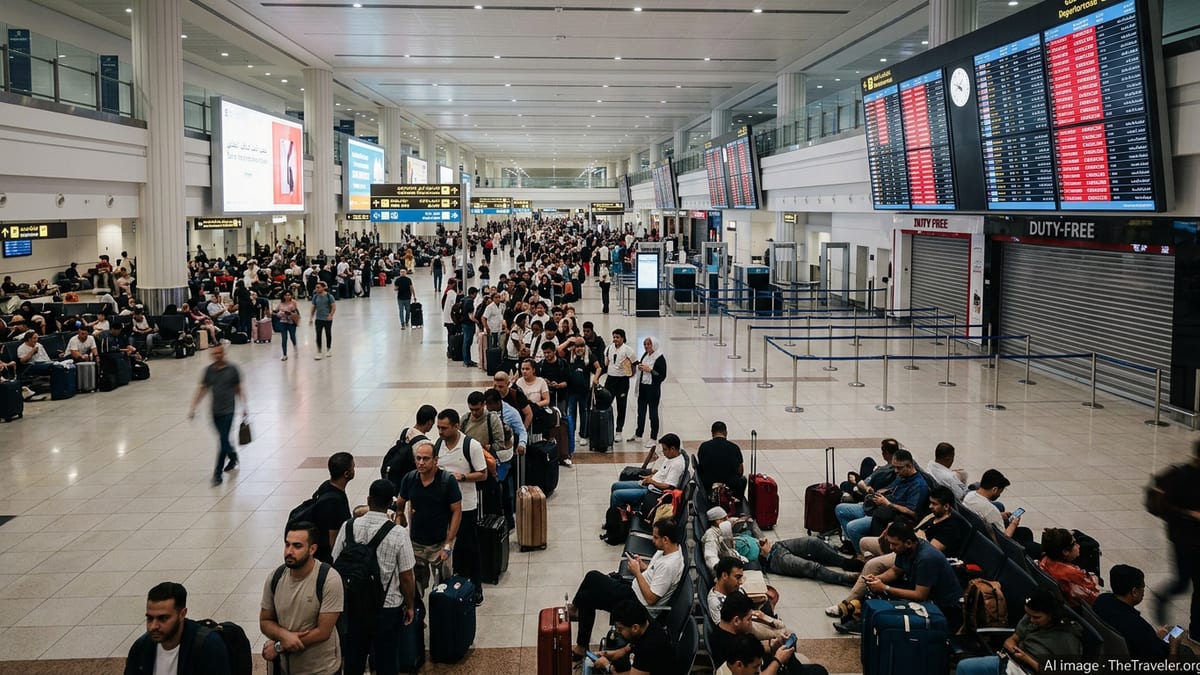
Gulf Aviation Powerhouses Forced Into Sudden Standstill
The United Arab Emirates, Qatar, Kuwait, Saudi Arabia and Bahrain, usually the region’s most reliable aviation hubs, have been forced to curtail or close airspace following the latest escalation. Dubai International and Abu Dhabi’s Zayed International, which together handle tens of millions of passengers each month, have seen the bulk of their schedules wiped out as airlines ground aircraft or divert around the Gulf.
Flight tracking data and airline statements indicate that more than 20,000 flights have been canceled or rerouted in recent days, with Dubai, Doha, Riyadh, Jeddah, Kuwait City and Manama among the worst affected. Carriers that built their business models on rapid, high-frequency connections between continents are now operating only limited services or special repatriation flights when security windows allow.
Officials in the UAE and neighboring states have framed the closures as a necessary response to heightened missile and drone risks after the Khorramshahr 4 launch and subsequent salvos, saying the priority is to protect passengers and critical infrastructure. For now, safety protocols require wide exclusion zones around potential targets, effectively shutting down key air corridors that normally funnel traffic between Europe, Asia, Africa and Oceania.
The abrupt standstill has rippled far beyond the region. Airports as distant as London, Singapore, Bali and major European leisure gateways are seeing banks of long-haul departures canceled or aircraft arriving hours late after circuitous detours that skirt the conflict zone.
Tourists Stranded from Dubai to Beirut as Options Narrow
For holidaymakers and business travelers, the disruption has turned routine connections into open-ended ordeals. In Dubai and Abu Dhabi, thousands of tourists are camped out in hotel lobbies and airport terminals, sheltering from intermittent missile alerts while they wait for news of repatriation flights. Similar scenes are playing out in Doha, Kuwait City and Manama, where stranded passengers have been advised not to head to airports until they have confirmed seats.
In Lebanon and Jordan, countries that already walk a delicate security tightrope, partial closures and overflight restrictions have left Beirut and Amman with sharply reduced schedules. Travelers who used these cities as quieter alternatives to the Gulf hubs are now discovering that onward seats are scarce and often prohibitively expensive, as airlines consolidate operations and prioritize evacuation lists.
Cyprus, which normally benefits from its position just outside the region’s main flashpoints, has emerged as both a refuge and a bottleneck. With many Middle East overflights rerouted north over the eastern Mediterranean, Larnaca and Paphos are handling waves of diverted aircraft and rebooked tourists. Hotels and car hire firms report a sudden influx of guests who never planned to set foot on the island but are now waiting days for a path home.
Diplomatic missions across the Middle East report being inundated with calls from citizens stuck in the UAE, Qatar, Saudi Arabia, Bahrain, Kuwait, Lebanon, Jordan and beyond. Many have been advised to register with consular services, conserve cash, keep proof of all travel expenses and be prepared to move quickly if a seat on a government-organized flight becomes available.
Repatriation Flights, Land Routes and Patchwork Escape Corridors
As closures drag on, governments and airlines are piecing together makeshift escape corridors. Some European states have begun dispatching special flights to relatively safer gateways such as Muscat in Oman, Jeddah in western Saudi Arabia, and Cairo in Egypt, then bussing or shuttling citizens from neighboring Gulf countries to those departure points when security conditions allow.
Bahrain’s aviation authorities have opened short, carefully timed airspace windows for selected repatriation flights, often routing aircraft south over the Arabian Sea to avoid riskier skies. Similar arrangements are being explored in coordination with regional air defense networks to allow limited flows of traffic without compromising safety.
Travel advisers say that overland routes are becoming critical alternatives. Some stranded visitors in the UAE and Qatar are attempting to reach Oman by road to catch flights from Muscat, while others in Jordan and Lebanon look to cross into Egypt or Turkey. However, security analysts warn that road journeys can be unpredictable, with checkpoints, sudden closures and the ever-present risk of escalation.
Industry experts caution that even as selected flights resume, the recovery will be uneven. Airlines must reposition aircraft and crews, inspect infrastructure for potential damage and align operations with evolving military risk assessments. Many predict weeks of rolling cancellations, diversions and last-minute schedule changes before anything resembling normal service returns.
Economic Shock for Tourism Hotspots and Global Travel
The timing of the crisis is particularly painful for regional tourism economies that had been enjoying a strong rebound. The UAE, Saudi Arabia and Qatar have invested heavily in positioning themselves as year-round destinations and high-end stopover hubs, attracting travelers bound for safaris in Africa, beach resorts in the Indian Ocean and cultural tours across Asia and Europe.
With cruise ships unable to pass safely through the Strait of Hormuz and airlines slashing frequencies, occupancy rates at hotels in Dubai, Abu Dhabi and coastal Oman are swinging wildly between full and half-empty as tour groups cancel at short notice or extend enforced stays. Travel agencies from Europe to Australia report surging refund claims, while insurance companies brace for a wave of disruption-related payouts.
The knock-on effects are being felt across global aviation. Longer detours around the Gulf increase fuel burn, squeeze already tight crew rosters and reduce the number of daily rotations aircraft can complete. That leaves fewer seats on long-haul routes, pushing fares higher and making it harder for stranded travelers to find affordable options even on unaffected carriers.
For countries such as Lebanon, Jordan and Cyprus, which rely heavily on regional connectivity to feed their tourism sectors, the sudden loss of Gulf traffic is a serious setback. Hoteliers and tour operators warn that if the closures persist through the coming weeks, they could wipe out an entire peak season that many businesses were counting on to stabilize after years of political and economic volatility.
What Travelers Should Expect in the Coming Days
Travel authorities and security analysts agree that the near-term outlook remains uncertain as military dynamics evolve around Iran’s missile capabilities and allied responses. While some Gulf and Levant airports may reopen in stages, they are likely to operate under tight restrictions, with last-minute closures possible if further launches or strikes are detected.
Passengers with itineraries touching the UAE, Qatar, Kuwait, Saudi Arabia, Bahrain, Lebanon, Jordan or nearby states are being urged to treat all bookings as provisional. Airlines are granting fee waivers, travel credits or rerouting options on a case-by-case basis, but call centers and messaging channels are heavily congested. Many carriers are using their social media feeds and mobile apps to push real-time updates as conditions shift.
Travel planners recommend that anyone currently in the region keep bags packed, documentation ready and devices charged in case a seat opens at short notice. Those yet to depart for nonessential trips to affected destinations are being advised to postpone until airspace conditions stabilize and carriers publish more predictable schedules.
For now, the Khorramshahr 4 launch and its aftermath have exposed just how central Gulf and Levant hubs have become to modern travel. With tourists stranded from Dubai’s beachfront resorts to Beirut’s waterfront and Cyprus’s coastal hotels, the crisis is reshaping itineraries and underscoring the fragility of a global network that depends on a few strategic corridors remaining open.