

More news on this day
Iran’s overnight missile and drone strikes on Dubai and Abu Dhabi have ripped through the heart of the Gulf’s aviation and hospitality ecosystem, damaging high-profile assets including Dubai International Airport and the Burj Al Arab, and plunging major carriers such as Emirates, Etihad Airways, Qatar Airways and British Airways into a fresh wave of cancellations, reroutings and uncertainty.
Airlines Scramble as Gulf Skies Partially Shut
Regional and international airlines woke on March 1 to a radically altered operating environment, as Iran’s retaliatory strikes against the United Arab Emirates and other Gulf states prompted emergency airspace restrictions, airport incidents and cascading schedule disruptions. Dubai International Airport, one of the world’s busiest long-haul hubs, reported minor damage to a concourse and four injured staff, while Abu Dhabi’s Zayed International Airport confirmed one fatality and multiple injuries after an incident linked to the overnight attacks.
Etihad Airways moved first with a blanket suspension of all departures from Abu Dhabi until at least mid-afternoon local time, advising passengers not to travel to the airport unless specifically instructed and urging those with imminent departures to monitor status updates. Emirates, whose entire hub model depends on Dubai’s role as a 24-hour connecting gateway between Europe, Asia, Africa and Australasia, was forced into rolling delays, equipment swaps and diversions as airport authorities managed damage assessment and crowd control.
Qatar Airways, though based in Doha rather than the UAE, has also been drawn into the disruption as Iran’s missile salvos targeted multiple Gulf aviation gateways and triggered temporary airspace closures and rerouting across the region. British Airways, which relies heavily on Dubai and Abu Dhabi for premium leisure and corporate traffic from London, has begun contingency planning that includes turning back or diverting inbound flights, extended duty times for crew, and the prospect of overnighting aircraft outside the Gulf if conditions deteriorate.
Real-time flight-tracking data on Sunday morning showed large swathes of Gulf airspace unusually sparse, with carriers threading narrow, approved corridors around affected zones or holding aircraft on the ground. Travel agents across Europe and Asia reported a spike in calls from passengers seeking rebooking options, refunds or alternative routings that bypass the Gulf altogether.
Iconic Burj Al Arab Singed as Hospitality Nerve Centers Hit
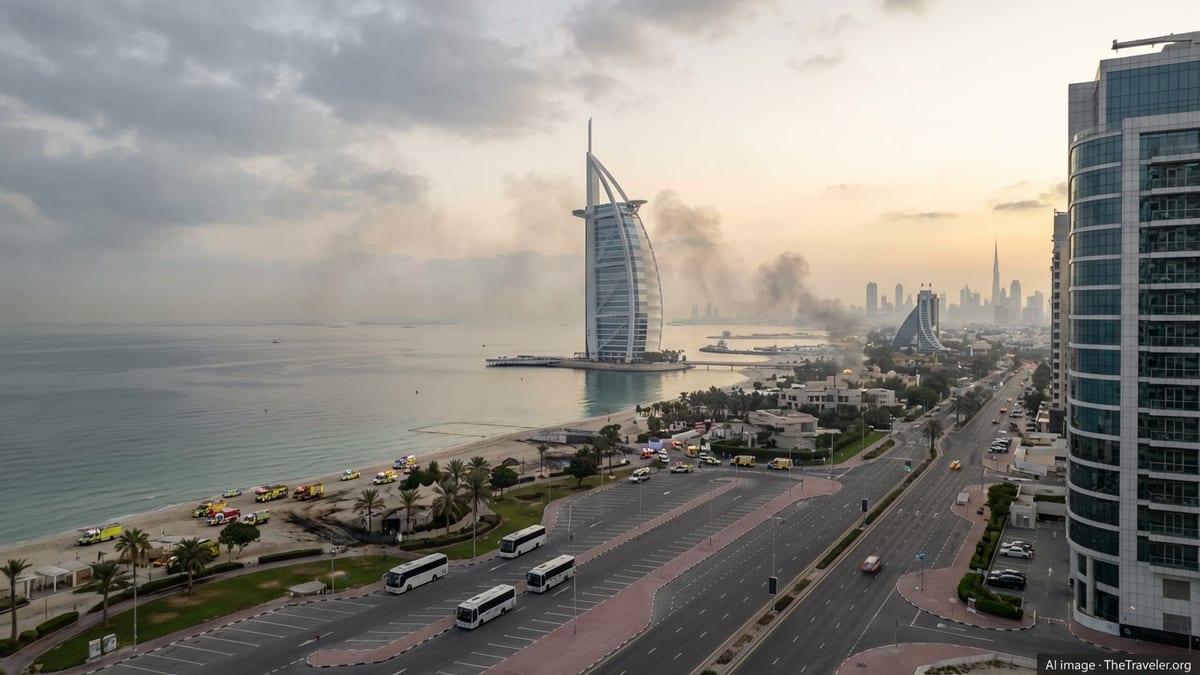
The visual symbol of Dubai’s luxury ambitions, the sail-shaped Burj Al Arab, was among the most high-profile properties caught up in the strikes. Authorities said debris from an intercepted drone caused a minor fire on the hotel’s outer facade, which civil defence teams quickly brought under control. No injuries were reported at the property, but images of smoke rising near one of the world’s most recognisable hotels ricocheted across social media, underscoring how far the conflict has spilled into civilian and tourism infrastructure.
Elsewhere along the coast, Dubai’s Palm Jumeirah reported explosions and fires that damaged at least one five-star hotel and injured several people, while a separate blaze broke out at a berth in Jebel Ali Port after debris from an aerial interception ignited stored material. Fire crews worked through the night to contain the incidents, even as interceptions continued in the skies above.
Hospitality executives, speaking on background due to the sensitivity of the situation, described a night of tense evacuations, guest relocations and emergency drills across properties in Dubai and Abu Dhabi. Some hotels moved guests away from seafront-facing rooms and high floors as a precaution, while others activated back-of-house crisis command centers typically reserved for major storms or security incidents.
For an emirate that has built its global brand around effortless luxury, safety and seamless transit, even limited physical damage to an icon such as the Burj Al Arab is symbolically jarring. Industry analysts say that while early reports point to superficial exterior damage rather than structural harm, the images are likely to weigh on traveler perceptions at least in the short term.
Tourism Confidence Tested at Peak Travel Period
The strikes come at a sensitive moment in the Gulf’s tourism calendar, overlapping with high-occupancy spring travel and a busy events season that draws visitors for conferences, exhibitions and sporting fixtures. In Dubai, where international visitors underpin everything from shopping malls to desert resorts, hoteliers reported a wave of nervous inquiries overnight from guests asking whether to cut trips short or postpone upcoming stays.
Travel insurers are bracing for an uptick in claims linked to missed connections and curtailed holidays, particularly from long-haul markets such as Europe and North America that route heavily through Gulf hubs. Corporate travel managers are re-evaluating non-essential trips to the UAE and wider region, weighing the operational importance of in-person meetings against the risk of further missile or drone activity and potential airspace closures.
At the same time, tourism authorities in Dubai and Abu Dhabi are moving quickly to project calm, highlighting the speed of emergency response and the limited scope of damage relative to the scale of their aviation and hotel networks. Civil defence statements have emphasized that fires at major sites were contained rapidly, and that most of the vast hotel inventory across the emirates continues to operate as normal.
Analysts note that the UAE has rebounded before from security shocks, including regional conflicts and health crises, by leaning on its reputation for rigorous infrastructure standards and tight coordination between government, airports and major hotel groups. The question for 2026, however, is whether a direct missile and drone campaign against key tourism corridors will have a deeper psychological impact on would-be visitors.
Operational Headaches for Emirates, Etihad and Global Partners
Operationally, the strikes have created a complex puzzle for network planners at Emirates and Etihad, who must now juggle aircraft rotations, crew duty limits and stranded passengers across multiple continents. With Dubai International and Zayed International both dealing with damage and heightened security checks, turnaround times have slowed and the carefully calibrated waves of inbound and outbound flights that underpin their hub strategies have been thrown off balance.
Codeshare and alliance partners such as British Airways and Qatar Airways are also feeling the strain. As Gulf airspace tightened, some carriers began exploring alternative routings over the Arabian Sea and Red Sea, which add flight time and fuel burn but reduce exposure to potential interception zones. For long-haul services operating close to crew duty limits, even modest detours can require unscheduled technical stops or crew changes, further complicating schedules.
Ground handling teams at major European and Asian airports are preparing for clusters of disrupted arrivals once affected flights do depart, with the risk of baggage delays and missed onward connections rippling far beyond the Middle East. Airline call centers, already stretched at peak travel periods, have ramped up staffing to handle rebooking requests as flexible policies are temporarily widened for passengers booked through Dubai and Abu Dhabi.
Industry observers say that if airspace restrictions and intermittent attacks persist for days rather than hours, airlines may need to carve out entirely new temporary corridor patterns around the Gulf, reshaping some of the world’s busiest east–west flows and potentially shifting connecting traffic toward alternative hubs in Istanbul, Jeddah or European capitals.
Uncertain Outlook for a Region Built on Connectivity
The UAE’s rise as a global travel and trade powerhouse has been built on the premise of predictable connectivity, embodied by Emirates’ globe-spanning network from Dubai and Etihad’s links from Abu Dhabi. Iran’s latest strikes have laid bare the fragility of that promise, showing how quickly missile and drone technology can reach civilian aviation and hospitality infrastructure even in countries that have long positioned themselves as relative havens in a volatile neighbourhood.
For now, aviation and tourism stakeholders are focused on the immediate tasks of repairing damaged facilities, supporting injured staff and guests, and restoring disrupted schedules. Engineers are assessing the Burj Al Arab’s facade and affected airport infrastructure, while port authorities at Jebel Ali review safety protocols amid evidence that interceptor debris can pose its own hazards for coastal logistics hubs.
In boardrooms from Dubai to London and Doha, risk committees are meanwhile reassessing everything from route planning and fuel hedging to crisis communications playbooks. The consensus among airline and hotel executives is that demand for Gulf travel is resilient, but that the coming weeks will test the region’s ability to convince millions of transiting and leisure passengers that its skies and shorelines remain safe.
With geopolitical tensions still high and military planners on all sides signalling that further responses remain possible, travelers eyeing itineraries through Dubai and Abu Dhabi are being advised to stay flexible, keep close tabs on airline alerts, and be prepared for a period in which the Gulf’s famous seamless connections may come with more turbulence than usual.