

More news on this day
As missiles and drones increasingly reach beyond front‑line battlefields to hit cities such as Dimona, Eilat, Dubai, Riyadh and Doha, once-quiet tourism and pilgrimage hubs across the Middle East are being thrust onto the front line of a fast-evolving security crisis, forcing governments, airlines and travelers to rethink how and where religious and leisure journeys can safely continue.
Get the latest news straight to your inbox!
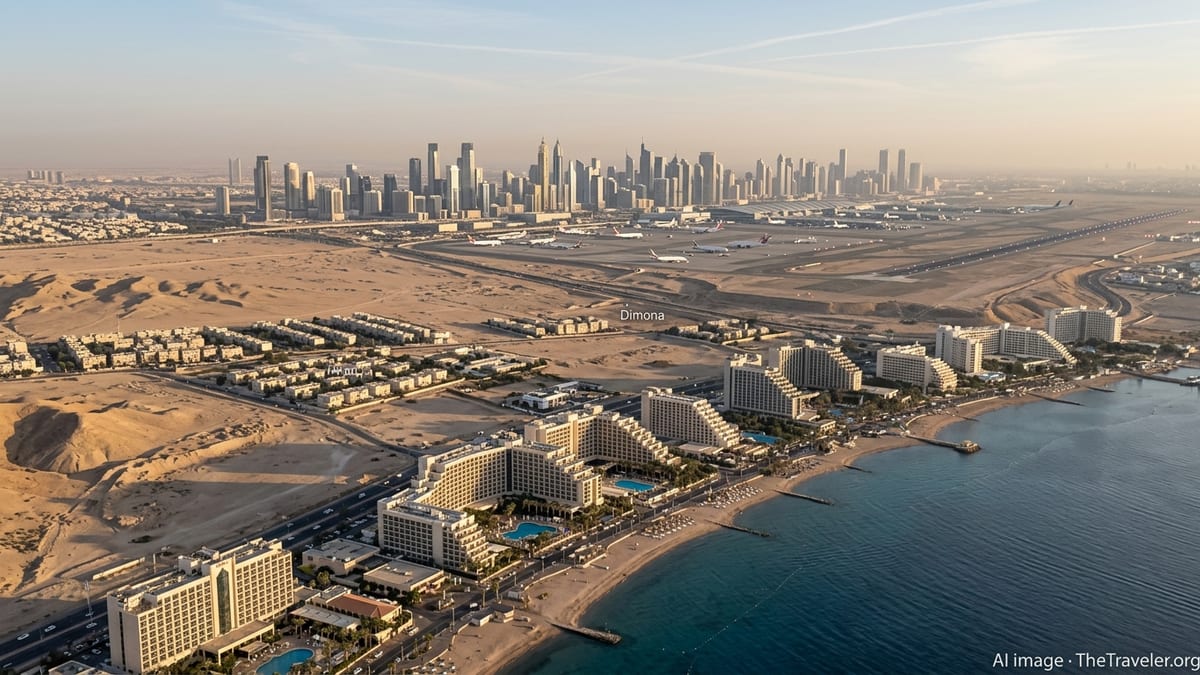
New Strikes Highlight Vulnerability of “Peripheral” Tourism Cities
The latest Iranian missile barrage that shattered buildings in Dimona and nearby Arad in southern Israel has drawn sudden attention to a region better known for desert landscapes, hiking routes and proximity to biblical sites than for front-line fighting. Published coverage describes Dimona as one of Israel’s most heavily defended areas due to its strategic facilities, yet Iranian missiles still reached the city, injuring dozens and signaling that even fortified, tourism-adjacent zones are no longer off limits.
Dimona now joins Eilat, Mitzpe Ramon and Beersheba on a growing list of Negev communities where tourism infrastructure and local residents are adjusting to a new reality. Earlier stages of the conflict saw repeated long-range drone and missile launches toward Israel’s south, including attacks that reached the Eilat area, one of the country’s primary sun-and-sea destinations. In several cases, projectiles fell near hotels, shopping districts or Ramon Airport, underscoring how close core tourism assets have come to direct hits.
Publicly available data from Israel’s Tourism Ministry and hotel associations indicate that, even before the Dimona strike, visitor numbers and overnight stays had been recovering unevenly since the Gaza war began in 2023. Investment programs were launched to upgrade attractions “from Eilat to Mount Hermon,” with a focus on peripheral regions. The renewed wave of attacks is now testing the resilience of those plans just as the industry had been preparing for a stronger 2026 season.
Security analysts note that these incidents blur the line between traditional front lines and so-called “rear” areas that host tourists, internal evacuees and religious visitors. The perception that desert towns and resort cities offered a degree of distance from conflict is weakening, and that shift is already influencing traveler behavior and risk assessments.
Red Sea and Negev: Eilat, Mitzpe Ramon and Beersheba Under Pressure
Eilat, Israel’s southernmost city on the Red Sea, illustrates how quickly a tourism powerhouse can become a conflict touchpoint. Reports over the past two years describe a pattern of threats to the resort: cruise missiles landing in open areas nearby, drones intercepted offshore, and, in September 2025, a drone that penetrated defenses and exploded in a busy commercial and hotel district, injuring scores of people at the height of a holiday period.
Another drone struck Ramon Airport, Eilat’s main air gateway, blowing out terminal windows and prompting temporary airspace closures and flight cancellations. The airport had been positioned as a growth engine for budget tourism from Europe and domestic travelers, with capacity for millions of passengers a year. Each disruption reverberates through hotel occupancy, tour bookings and employment in a city where much of the economy is tied directly or indirectly to travel.
Across the Negev plateau, smaller destinations such as Mitzpe Ramon and the area around Beersheba have marketed astronomy tourism, desert trekking and access to UNESCO-recognized landscapes. While these sites have not experienced the same level of direct damage as Eilat, air-raid sirens, intercepted projectiles and the widely reported strikes on nearby communities have affected traveler perceptions. Tour operators have adapted with revised itineraries, flexible cancellation policies and an emphasis on real-time security updates.
Industry commentary suggests that domestic tourism has partially cushioned the blow, as Israelis relocate vacations to safer-feeling regions or opt for last-minute bookings based on current alerts. International religious and leisure travelers, however, remain far more sensitive to government advisories and headlines referencing missile hits in cities once marketed as tranquil desert escapes.
Gulf Hubs Under Fire: Dubai, Riyadh, Doha, Kuwait City and Manama
The current conflict is not confined to Israel. In recent weeks, coverage from regional and international outlets has detailed Iranian strikes on and around key Gulf hubs, including attacks linked to diplomatic sites in Riyadh and strikes on or near airport and infrastructure targets in Dubai, Abu Dhabi, Doha, Bahrain and other Emirates. These cities serve as vital aviation crossroads for global travelers and as gateways for religious tourism to Saudi Arabia’s holy cities.
Travel and tourism industry analyses had projected that the broader Middle East tourism sector would contribute well over three hundred billion dollars to regional GDP in 2025, with international visitor spending close to two hundred billion dollars. Gulf Cooperation Council states were preparing a unified, Schengen-style tourist visa expected to ease movement between the United Arab Emirates, Saudi Arabia, Qatar, Bahrain, Oman and Kuwait, signaling ambitions to deepen regional tourism integration.
The escalation in missile and drone activity, and the direct targeting of or proximity to major airports and urban cores, has interrupted that trajectory. Time-sensitive dispatches describe thousands of flight cancellations and widespread airspace restrictions following tit-for-tat strikes among Iran, Israel, the United States and Gulf countries. Many commercial carriers have suspended or drastically reduced services to affected cities, while governments organize limited evacuation flights for stranded visitors.
Gulf governments continue to emphasize diversification away from hydrocarbons through tourism, mega-events and cultural offerings. However, the optics of air raid alerts in skylines like Dubai’s or of strikes linked to Riyadh and Manama complicate marketing narratives built around safety, connectivity and luxury. For religious travelers transiting Gulf hubs en route to pilgrimage in Saudi Arabia or visiting new Islamic heritage sites across the peninsula, each new attack introduces additional uncertainty into planning.
Religious Tourism Feels the Strain Across Israel and the Gulf
Religious travel is particularly exposed to these developments. In Israel, pilgrim routes often combine Jerusalem, Bethlehem and Nazareth with side trips to the Negev, the Dead Sea and Red Sea resorts such as Eilat. Many Christian and Jewish itineraries feature desert experiences around Mitzpe Ramon or visits to heritage sites near Beersheba and Arad. Reports of missiles striking Dimona and Arad, and drones reaching Eilat’s hotel and shopping districts, have prompted tour organizers to reevaluate stopovers in the south.
Published data from Israel’s Tourism Ministry show that, since the start of the latest military operations, tens of thousands of foreign visitors have departed the country while only a fraction have continued to arrive. Hotels in cities that once relied heavily on pilgrims now host internal evacuees or operate at sharply reduced occupancy. Travel companies that specialize in faith-based tours are reworking programs, shortening stays or postponing departures until the security environment stabilizes.
In Saudi Arabia, religious tourism remains a central pillar of economic diversification strategies, with official forecasts aiming for tourism to generate more than a tenth of national GDP. Infrastructure investments around Mecca and Medina and new heritage destinations across the kingdom depend on seamless air connectivity through hubs like Jeddah, Riyadh and Dammam. The recent spread of conflict-related strikes into Gulf airspace, together with strong travel advisories from Western governments urging citizens to leave the region, is complicating that outlook.
Elsewhere in the Gulf, Qatar, Bahrain and Kuwait have been positioning themselves as stopover and short-break destinations linked to pilgrimage flows, sporting events and cultural festivals. While most religious sites themselves remain untouched, the perception of a region-wide escalation, coupled with images of damaged city blocks or grounded aircraft, is dampening demand. Industry observers warn that repeated disruptions risk diverting future pilgrimage traffic through alternative routes or encouraging virtual or local observance in place of long-distance travel.
What Travelers Should Consider Now
For prospective visitors contemplating trips to Israel, the United Arab Emirates, Saudi Arabia, Qatar, Kuwait, Bahrain and neighboring states, the rapidly shifting security picture makes preparation essential. Government advisories from countries including the United States now urge citizens to depart much of the region, citing serious safety risks linked to state-on-state confrontation and the possibility of further missile and drone salvos. These advisories can affect travel insurance coverage, airline schedules and consular assistance options.
Travelers who decide to proceed are being encouraged by industry guidance to monitor official bulletins daily, register with consular services where available and verify that their airline continues to operate to intended destinations. Given the experience of passengers stranded after abrupt airspace closures in recent weeks, flexible tickets, contingency routing and clear cancellation policies have become more important than ever, especially for those on fixed-date religious journeys.
On the ground, visitors are likely to encounter heightened security at airports, hotels and religious sites, as well as potential curfews or localized restrictions in response to specific incidents. Tourism businesses from Dimona and Eilat to Dubai and Doha are adapting with revised safety protocols and crisis communication plans, but capacity to respond may vary widely by destination and by the scale of any new attack.
Despite the challenges, regional stakeholders continue to highlight the long-term importance of tourism and religious travel for economic stability and cultural exchange. Whether in Israel’s desert towns or the glass-and-steel skylines of the Gulf, the contest between escalating missile diplomacy and efforts to preserve open, welcoming corridors for pilgrims and holidaymakers will shape Middle Eastern tourism for many seasons to come.