

More news on this day
Commercial air traffic over the United Arab Emirates descended into fresh chaos on March 5 as missile and drone attacks linked to the escalating US-Israel-Iran conflict forced almost all passenger flights bound for Dubai and Abu Dhabi into extended holding patterns or sudden diversions, stranding thousands of travelers across one of the world’s busiest aviation hubs.
Missile and Drone Barrage Disrupts UAE Airspace
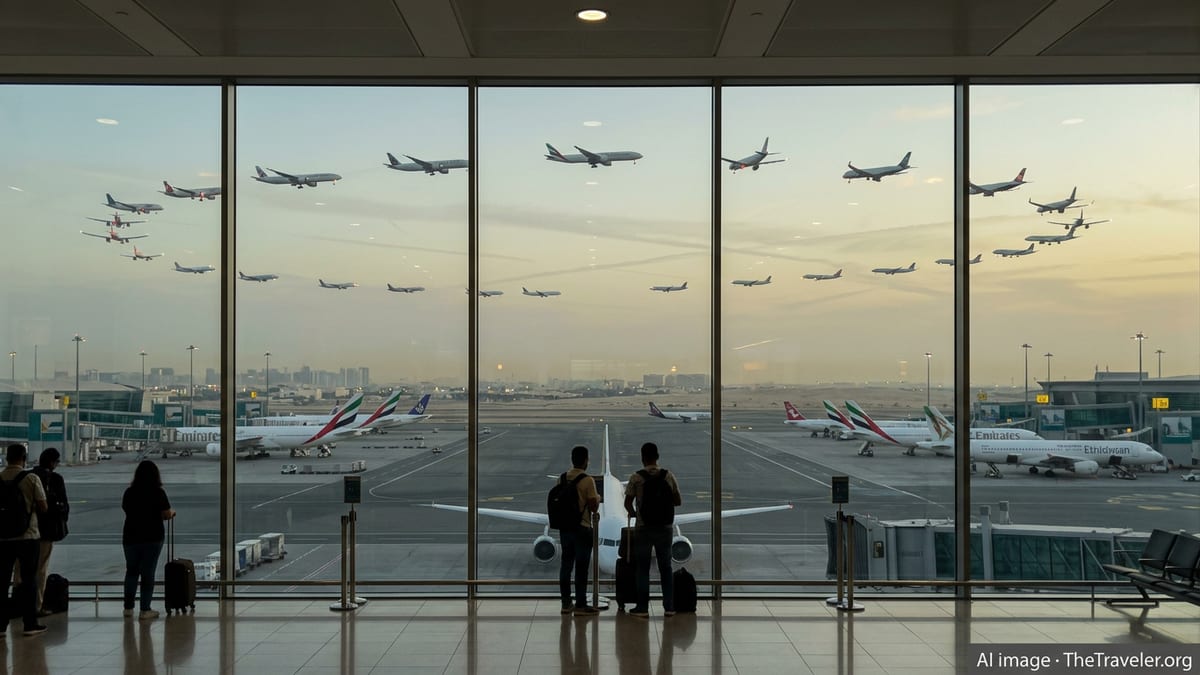
UAE airspace over Dubai and Abu Dhabi was repeatedly restricted on Thursday as air defenses responded to a new wave of Iranian ballistic missiles and drones, prompting controllers to halt landings and instruct inbound aircraft to circle at altitude. Aviation tracking platforms showed arrival streams fanning out over the Gulf and desert in dense holding stacks, an extraordinary sight in a corridor that normally prides itself on precision scheduling.
The UAE Ministry of Defence confirmed that its air defense systems intercepted most of the incoming threats, including multiple ballistic missiles and more than a hundred drones targeting locations across the country. Authorities reported that at least one missile fell inside UAE territory and debris from intercepted drones landed in parts of Abu Dhabi and Dubai, adding a further layer of caution for air traffic managers already juggling tightly packed approach paths.
The renewed barrage followed days of strikes and counterstrikes between the United States, Israel and Iran, with Gulf states increasingly drawn into the outer rings of the conflict. While the UAE insists it is not a party to the war and has not allowed its territory or airspace to be used to launch attacks, it has become a front-line target for Iranian retaliatory fire, with aviation and tourism bearing the brunt of the disruption.
Flights Forced to Circle, Divert or Suspend Operations
As missiles and drones were tracked over the region, nearly all commercial passenger flights inbound to Dubai International, Al Maktoum International and Abu Dhabi’s Zayed International Airport were put into holding patterns, some for more than an hour, while others were ordered to divert to alternative airports or return to their points of origin. Pilots reported receiving last minute instructions to break off approaches as airspace segments were temporarily closed for defensive operations.
Flag carriers Emirates and Etihad, along with low-cost operators flydubai and Air Arabia, moved quickly to extend existing suspensions and capacity reductions. Emirates has halted most scheduled flights to and from Dubai until at least March 7, operating only a limited number of services, mainly for repatriation and essential travel. Etihad has similarly suspended regular commercial flights into and out of Abu Dhabi during peak alert windows, resuming only a skeleton schedule when authorities briefly reopen airspace.
Even where departures were technically possible, airlines advised passengers not to travel to the airport unless they had a confirmed, rebooked itinerary and had received direct notification that their flight was operating. Long lines formed at check-in counters and ticket desks as travelers attempted to secure scarce seats on rerouted services via alternative hubs such as Muscat, Riyadh and European gateways less affected by the missile flight paths.
For those already in the air, the experience was disorienting. Flight-tracking data showed wide arcs of jets tracing circles over the Arabian Gulf, the Empty Quarter and parts of Oman while crews awaited clearance to land. Some aircraft burned through diversion fuel reserves before being forced to reroute, adding further complexity to an already stressed regional network.
Tourism, Business Travel and Transit Passengers Hit Hard
The disruption could not have come at a worse moment for Dubai and Abu Dhabi, which rely heavily on seamless air connectivity to sustain their roles as global transit hubs, business centers and leisure destinations. In Dubai, major attractions and malls extended temporary closures or shortened hours as civil defense warnings and air raid alerts sent residents and visitors indoors, reducing footfall in normally crowded waterfront districts and shopping districts.
Hotels across both cities scrambled to accommodate stranded passengers who suddenly found themselves facing unplanned stopovers. Front desks reported a surge in last minute bookings from transit travelers who had never intended to leave the airport, as well as from residents of other Gulf countries seeking a safe place to wait out continued missile alerts and airspace closures. Some properties introduced flexible check-in and check-out policies as airline schedules shifted by the hour.
For business travelers, the situation complicated efforts to attend conferences, close deals and reach project sites across the wider region. Corporate travel managers noted that executives who would normally use Dubai or Abu Dhabi as fast, predictable gateways into Africa and Asia were now being rerouted via Europe, Turkey or South Asia, adding cost and time as insurance providers reviewed coverage for travel through high-risk airspace.
Perhaps most acutely affected were long haul transit passengers using Gulf mega-hubs as connecting points between Europe, the Americas, Asia and Australasia. Many woke up mid-flight to notifications that their onward connections were canceled or uncertain, turning what should have been a brief layover into an open-ended wait in crowded terminals or nearby hotels.
UAE Authorities Stress Safety and Non-Belligerent Role
As images of circling aircraft and shuttered boarding gates spread on social media, UAE officials sought to reassure residents, visitors and foreign governments that the country’s defenses were functioning effectively and that safety remained the top priority in any decision to close or reopen airspace. The Ministry of Defence said its forces had intercepted the vast majority of incoming missiles and drones since the Iranian strikes began in late February, though it acknowledged that debris had caused injuries and damage in several locations.
At the same time, senior Emirati officials reiterated that the UAE is not participating in offensive operations in the US-Israel campaign against Iran and has not permitted its airspace, territorial waters or land bases to be used to launch attacks. The government framed its posture as one of strict defensive readiness and de-escalation, emphasizing diplomatic efforts to contain the conflict and urging all sides to avoid targeting civilian infrastructure, including airports.
Regulators and airport authorities coordinated closely with airlines and air navigation services to manage rolling airspace closures. Temporary flight corridors were opened at intervals to allow limited arrivals and departures, including evacuation and humanitarian flights, while more exposed routes remained shut for longer periods. Officials cautioned that this patchwork approach would likely continue as long as missile and drone threats persisted, and advised travelers to remain flexible and closely monitor airline communications.
Local telecommunications providers and tourism authorities also introduced support measures for affected visitors, such as additional mobile data packages for those stranded abroad and extended validity on tourist visas for travelers unable to depart on schedule. Travel industry representatives, however, warned that unless the regional security picture stabilizes in the coming days, forward bookings for spring and summer could take a significant hit.
What Travelers Need to Know Now
With the situation evolving hour by hour, aviation and travel experts are urging passengers with upcoming itineraries to or through the UAE to prepare for continued uncertainty. Industry guidance stresses that travelers should not proceed to Dubai or Abu Dhabi airports without verified, up to date confirmation that their flight is operating, as walk-in rebooking options are increasingly limited and access to terminals may be restricted to ticketed passengers only.
Those already holding tickets are being encouraged to stay in close contact with their airline’s official channels and mobile apps, which are providing rolling updates on suspensions, diversions and rebookings. Many carriers are waiving change fees and offering complimentary date changes or refunds on affected routes, but re-accommodating hundreds of thousands of passengers across a region-wide disruption remains a complex logistical task.
Travel planners say passengers with flexible schedules may want to consider postponing non-essential trips that rely on transiting Dubai or Abu Dhabi until airspace restrictions ease and regular traffic patterns resume. For essential journeys, they recommend leaving generous connection times, carrying basic overnight necessities in hand luggage and being prepared for sudden gate changes or lengthy holding periods either on the tarmac or in the terminal.
For now, the iconic scenes of constant movement at Dubai and Abu Dhabi’s airports have been replaced by unusually quiet runways and crowded waiting areas as the skies above remain contested. How quickly the UAE’s crucial aviation arteries can return to something approaching normal will depend not only on its formidable air defense capabilities, but also on whether the wider conflict between the US, Israel and Iran begins to cool or enters an even more volatile phase.