

More news on this day
More than 130 flights were cancelled at Jeddah’s King Abdulaziz International Airport over the weekend as Iranian missile attacks targeting Gulf infrastructure triggered a sweeping aviation shutdown across the Middle East, grounding major regional carriers and leaving thousands of passengers stranded in Saudi Arabia and beyond.
Missile Strikes Escalate Into a Regional Aviation Crisis
The cancellations at King Abdulaziz International Airport in Jeddah unfolded as part of a fast moving crisis that began on February 28, when coordinated United States and Israeli strikes on Iran were followed by retaliatory missile and drone attacks attributed to Tehran. Airports and airspace across the Gulf came under threat, forcing aviation authorities to halt or severely restrict movements in key corridors linking Europe, Asia and Africa.
While Saudi territory has so far avoided the level of direct damage seen at airports in the United Arab Emirates and Kuwait, regional flight paths that normally traverse or connect through Saudi airspace have been thrown into disarray. Aircraft already en route were diverted, turn backs multiplied and departures were scrubbed as operators prioritized crew and passenger safety amid reports of ballistic missiles and drones targeting transport hubs.
By Sunday, the ripple effects had turned King Abdulaziz International into one of the focal points of the disruption, with local authorities and airlines scrambling to manage a rolling wave of cancellations, rebookings and overnight holds as neighboring hubs from Dubai to Doha temporarily shut down or sharply curtailed operations.
Saudia, Qatar Airways, Emirates and Pegasus Among Carriers Hit
National carrier Saudia confirmed it had cancelled a significant number of flights serving Jeddah and other Saudi gateways, citing evolving security conditions and intermittent airspace restrictions across the region. The airline said its emergency coordination center was in continuous contact with regulators and airport operators, and urged passengers to verify departure times before heading to the airport.
Major Gulf transfer airlines that normally funnel traffic through Saudi airspace or connect via Jeddah also faced sweeping operational challenges. Emirates grounded large portions of its regional schedule after its primary hub in Dubai was struck and placed under temporary closure, while Qatar Airways was forced to halt flights as Doha’s airport suspended movements during windows of heightened missile risk. Both carriers had services that feed into or connect through King Abdulaziz International, intensifying the disruption for Saudi bound travelers.
Pegasus Airlines, which links Jeddah with Turkish and European cities, was among the non Gulf carriers affected as flight paths over conflict exposed areas were rerouted or closed outright. With airlines across the Middle East scrubbing or redirecting services, aircraft that would typically reach Jeddah via short Gulf hops suddenly required longer detours or were pulled from rotation altogether.
Thousands Stranded as Jeddah Becomes an Impromptu Holding Point
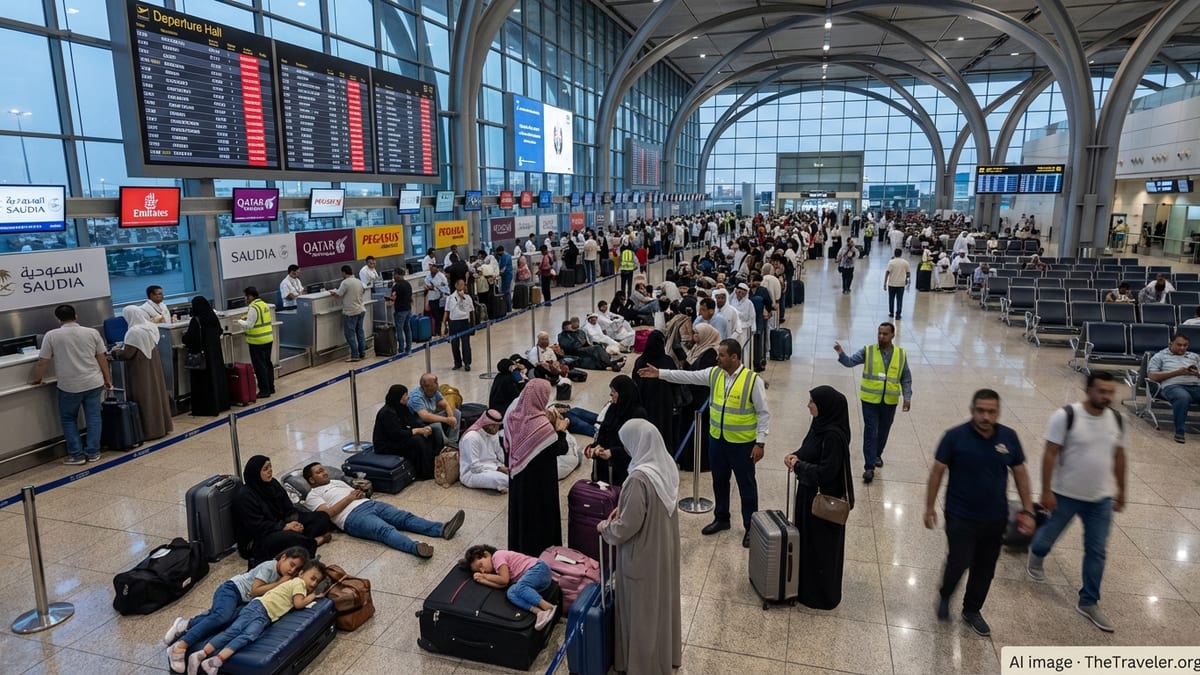
Inside King Abdulaziz International, scenes familiar from earlier global aviation crises returned with a regional twist. Departure boards flickered from delayed to cancelled throughout Saturday night and into Sunday, while long queues formed at airline desks as families, business travelers and pilgrims sought rebooking options or accommodation vouchers.
Airport staff and security teams worked to manage crowding in departure halls as passengers who had already cleared immigration were forced back to check in zones to collect luggage and reassess plans. Many reported being rebooked onto flights days later or being rerouted via secondary hubs in Turkey, Egypt or southern Europe, adding multiple legs and overnight stays to journeys that would typically involve a single short stop.
For some travelers, Jeddah turned into an unplanned stopover altogether. Flights bound for Gulf airports that closed at short notice diverted into Saudi Arabia, with King Abdulaziz International absorbing a share of unscheduled arrivals. Those passengers then joined existing outbound travelers in competing for a shrinking pool of available seats, putting additional pressure on local hotels near the airport and in central Jeddah.
Safety First as Authorities Weigh Airspace and Security Risks
Saudi aviation authorities have stressed that decisions to cancel or delay flights at King Abdulaziz International were taken on safety grounds as missile threats to airports in neighboring states became clearer. With Iran accused of deliberately targeting high profile Gulf aviation infrastructure, officials were reluctant to allow routine operations to continue without reassessing risk exposure along approach and departure routes.
In practice, that meant holding aircraft on the ground while regional partners evaluated radar tracks, intelligence reports and alliance briefings on potential new launches. Airlines were advised to build in extra fuel and routing contingencies for any services permitted to depart, a step that further compressed available capacity as scheduling and crew duty limits collided with longer, more complex flight plans.
The tightening of airspace also forced carriers to funnel flights into narrower safe corridors, many of which run over or near Saudi territory. That congestion has increased the workload for air traffic controllers handling cross regional traffic, leaving less room to accommodate short notice changes for commercial flights operating in and out of Jeddah.
Longer Term Travel Fallout for Pilgrims and Transit Passengers
Beyond the immediate shock of more than 130 cancellations, the disruption at King Abdulaziz International raises broader questions for Saudi Arabia’s role as an aviation and pilgrimage gateway. Jeddah is a primary entry point for millions of Umrah and Hajj pilgrims heading to the holy cities of Makkah and Madinah, many of whom rely on multi leg itineraries involving Gulf or Turkish hubs.
Travel agents handling religious tours reported a cascade of itinerary changes, with some groups asked to shift departure dates or reroute through less congested airports in the region. For independent travelers, the combination of scarce seats, higher fares and volatile schedules has introduced a new layer of uncertainty to plans made months in advance.
Aviation analysts warn that as long as missile and drone attacks remain a tool in Iran’s confrontation with the United States, Israel and Gulf states, the risk calculus for airlines operating in and around Saudi Arabia will remain elevated. That could translate into more conservative scheduling, higher insurance and operating costs, and a slower recovery in the sort of seamless regional connectivity that Jeddah’s King Abdulaziz International has been counting on as it expands its terminals and route network.
For now, passengers are being urged to stay flexible, monitor airline advisories closely and prepare for the possibility that itineraries involving Jeddah and the wider Gulf could change at short notice as the security situation evolves from day to day.