

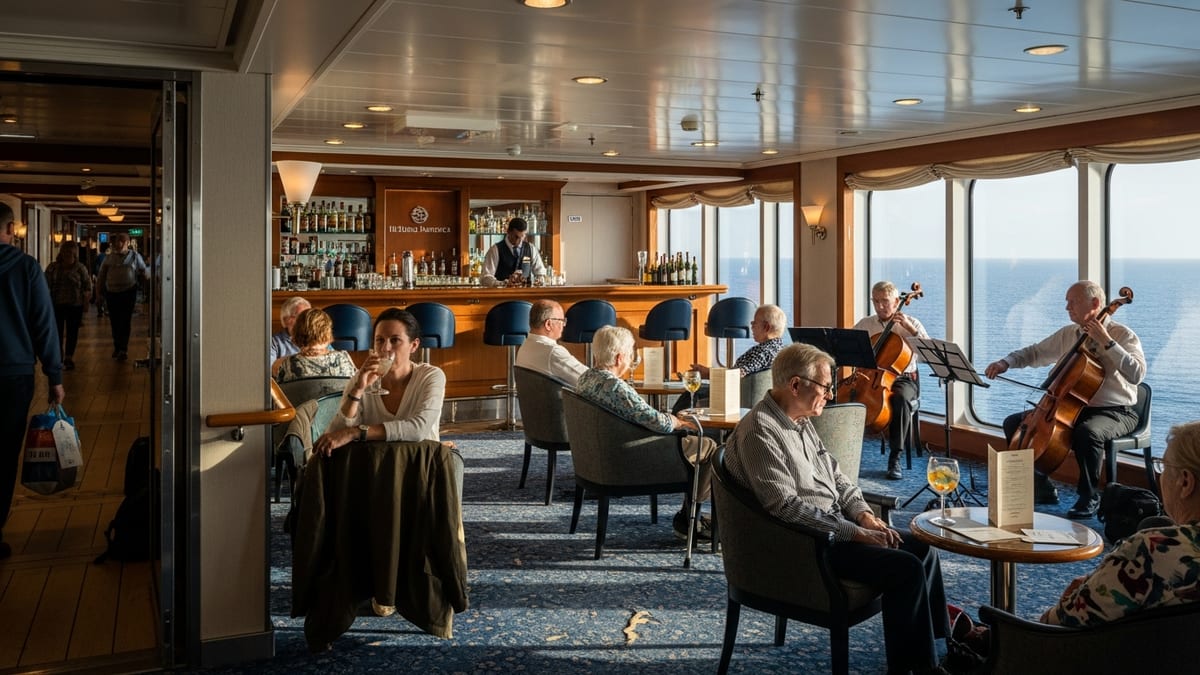
I booked my Holland America Line cruise because I wanted something a little more refined than the mega-ship theme park experience, but less rigid than the ultra-luxury lines. Over the years I had heard that Holland America attracted an older, loyal crowd, prided itself on service, and still cared about traditional touches like proper dining rooms and live music. After actually sailing with them, my feelings are mixed.
There were times when I felt genuinely pampered, sitting in a quiet lounge with a cocktail and a string trio playing nearby, and there were other moments when the experience felt nickel-and-dimed, understaffed, or simply not aligned with how people travel in 2026. If you are considering a Holland America cruise, it is worth understanding the trade-offs before you commit.
Booking, Pricing and First Impressions
I booked directly through Holland America’s website and quickly learned that the advertised fare is only part of the story. The base price looked competitive compared with other mainstream lines, but when I added the “Have It All” package, Wi-Fi, and started reading the fine print on tips and service charges, the true cost crept up fast.
Holland America calls its automatic gratuities “Crew Appreciation” and adds them daily to your onboard account. At the time of my sailing, standard cabins were charged a set daily amount per person and suites a bit more, and there was also an 18 percent service charge on drinks, specialty dining, and spa services. Technically I could adjust the appreciation at Guest Services, but there is social pressure not to be that passenger. It is not unique to Holland America, yet it did make the carefully budgeted fare feel slightly misleading.
Choosing a cabin took more thought than I expected. The ships in the fleet vary in age and layout, and that really matters. I went with a verandah stateroom on one of their mid-sized ships, thinking it was the safest middle ground between price, comfort, and access to fresh air. The deck plans showed decent space, but onboard it felt tighter than I had pictured, especially in the bathroom. Storage was surprisingly good, though, and the balcony became my refuge when public spaces felt crowded. If I sailed with them again I would pay close attention to which ship class I was booking because the difference between an older vessel and a newer one shows in things like USB outlets, lighting, and soundproofing.
In the weeks leading up to the cruise, Holland America’s communication was functional but not especially clear. I was encouraged to complete online check-in and download the Navigator app, which I did. Boarding documents indicated that embarkation would begin around noon and that all guests needed to be checked in at least 90 minutes before sailing, which is now standard practice. Still, I noticed plenty of conflicting anecdotes online about assigned check-in times versus open boarding windows. On my sailing the boarding pass simply listed a general start time, not a strict slot, which left me guessing whether arriving early would help or just mean more waiting in the terminal.
Embarkation Day: Organized, But Not Effortless
I arrived at the port just before noon, which turned out to be a reasonably good decision. From curbside to ship, the process took about 40 minutes: drop luggage with porters, clear security, stand in a snaking check-in line, then wait again in a seating area for boarding to be called. Holland America talks about “smooth and easy” embarkation where guests only carry hand luggage, and that is broadly true, but there is still a lot of standing around with crowds of people who are hot, confused, and not sure which line they belong in. I have had worse embarkations with other lines, but I would not call this seamless or particularly welcoming.
One frustration was the ambiguity about timing. Official guidance states that boarding begins around noon and that staterooms are usually ready by about 1 p.m. Boarding did indeed start just about at midday, but cabin access lagged. I was among the earlier groups on board and was politely told not to head down to my stateroom yet. That meant hauling my carry-on through public areas that were not really designed for people camping out with bags. The Lido Market buffet was already open, which made sense operationally, but it also meant a crush of passengers with their luggage all trying to find a table. I quickly understood why veteran cruisers recommend carrying as little as possible in your embarkation bag.
On the positive side, staff remained consistently calm and polite through all of this. Security personnel, check-in agents, and the crew greeting passengers at the gangway set a tone that was more understated and professional than hyped-up. I appreciated that there were no forced photo lines or gimmicky announcements blaring through the terminal. For me that understated style fit the brand Holland America claims to be, but travelers who enjoy a more energetic, party-style sail-away might find the atmosphere a bit subdued.
Life Onboard: Atmosphere, Cabins and Crowds
Once cabins were finally ready, I found mine in decent shape but not immaculate. The room was cleaned, yet the balcony rail showed signs of wear, and the carpeting had a couple of visible stains that housekeeping could not really do anything about. The décor leaned heavily toward traditional: lots of muted tones, wood-look finishes, and framed nautical prints. It did not feel dated in a charming way, it simply felt older. Storage, as mentioned, was a high point, and the bed was genuinely comfortable. I slept well most nights except when neighbors slammed balcony doors, something the thin walls did not entirely absorb.
The ship itself struck a middle ground between intimate and large. It was nowhere near the floating cities some competitors operate, but it also did not offer the dramatic open spaces or wow-factor atriums seen elsewhere. Instead, public areas are divided into smaller lounges, bars, and music venues. On sea days these spaces often felt busy but rarely chaotic. I did encounter a few choke points, especially around the Lido pool and near the elevators after shows, where the ship’s design no longer matches modern passenger expectations. Elevators in particular were a weak point. At peak times I waited through multiple full cars while mobility-challenged guests tried to navigate the crush.
Demographically, the reputation of Holland America as being popular with older travelers still holds true. On my sailing the majority of guests seemed to be in their 60s and up, with a noticeable number of canes, walkers, and scooters. Families were present but not dominant, and children’s programming felt very low-key compared with more family-focused lines. Personally I liked the quieter vibe and the fact that evenings were more about live music and conversation than deck parties. If you are under 40 and looking for nightlife, though, you might feel like the odd one out once the clock ticks past 11 p.m.
Food and Dining: When Classic Feels Inconsistent
I boarded expecting food to be one of Holland America’s strong points, especially in the main dining room. At its best, the line still delivers some memorable meals, but inconsistency was a recurring theme on my sailing. The main dining room offered a rotating dinner menu with several “always available” classics. On some nights I had genuinely excellent dishes: a perfectly cooked salmon with crisp skin, a surprisingly delicate mushroom risotto, and a soufflé that arrived risen and warm. On other nights, though, sauces felt heavy and flat, vegetables were overcooked, and meats leaned toward dry. It did not help that courses often appeared rushed, as if the kitchen was struggling to keep up with traditional multi-course service at modern staffing levels.
Service in the dining room mirrored that inconsistency. My assigned wait team was friendly and worked hard, but there were clear signs that they were stretched. Drink orders sometimes arrived after appetizers were already on the table, and special requests occasionally got lost. I never felt ignored, yet I also never felt fully doted on, which is part of what Holland America implicitly promises when it leans on its heritage. Dress codes in practice were fairly relaxed. Officially, most nights are “smart casual” and there are one or two “Dressy Nights” on a typical week-long voyage. Reality was that some people still dressed up with jackets and cocktail dresses, while others pushed the boundaries with jeans and polos. Enforcement in the main dining room seemed light; the atmosphere skewed neat but not formal.
The Lido Market buffet was my biggest disappointment. The selection was broad enough, but the food quality reminded me more of a mid-range hotel breakfast than anything special at sea. Breakfast options rotated slightly, though eggs, bacon, pastries and fruit were staples. Lines formed at made-to-order stations, and hot items sometimes sat too long. Lunch and casual dinners were serviceable but uninspired, with a lot of repetition. I did appreciate the effort to have labeled gluten-free and vegetarian options, yet cross-contamination precautions were not always obvious. The crew handled basic hygiene and cleanliness well, but the space felt tired: crowded seating, a constant search for a clean table, and that slightly institutional lighting that makes everything look a bit less appetizing.
Specialty restaurants were a different story. I tried one of the paid venues and had a noticeably superior experience: better pacing, higher-quality ingredients, and staff who had enough time to explain the menu and make recommendations. Of course, that level of attention and quality comes at an extra cost per person along with the automatic service charge on top. I left satisfied but also felt that Holland America has chosen to concentrate culinary excellence in these upcharge venues while letting the main included options drift toward mere adequacy. For a line with a history of touting its cuisine, that felt like a step backward.
Dress Code, Entertainment and Daily Life Onboard
Before sailing I read a lot about Holland America’s dress code and its evolution. Officially daytime is casual, evenings are mostly smart casual, and “Dressy Nights” are highlighted in the daily program and the app. In reality, I found that the line has softened its stance considerably in order to align with what guests actually wear. On my Dressy Nights I saw a handful of tuxedos and gowns, a good number of business-casual outfits, and quite a few people who looked like they had just come from a nice dinner in port, not a formal gala. What mattered most seemed to be avoiding beachwear and athletic shorts in the main dining room rather than adhering to any specific style. That may disappoint some traditionalists, but for me it struck a pretty reasonable balance.
Entertainment leaned heavily into live music rather than big production shows, which is very much Holland America’s brand right now. On my voyage there were dedicated venues for classical music, rock, and more contemporary bands. When the musicians were good, the evenings were genuinely enjoyable: intimate concerts, themed sets, and a relaxed atmosphere where I could sit with a drink and actually hear the performance. The downside was that the schedule sometimes felt thin on port-intensive days, and there was not a lot of variety beyond the music venues and small-scale trivia or game shows. If you are used to water slides, ice rinks, or Broadway-style productions, you will not find those here.
Daily life onboard followed a gentle rhythm. Mornings revolved around breakfast, coffee in the café, and perhaps a lecture or demonstration. Holland America still invests in enrichment to a degree, with talks about destinations and occasional cooking or mixology demonstrations. Afternoons were more about the pool, reading on deck, or spa treatments if you were willing to pay the premium. The spa itself was competently run but expensive, and the 18 percent service charge on treatments made a substantial difference to the final bill. I booked one treatment, enjoyed it, and then decided I did not need a second at those prices.
Wi-Fi, Technology and Hidden Costs
For a line that markets to experienced travelers, Holland America’s technology is not terrible, but it is still behind what I would expect in 2026. The Navigator app functioned adequately for checking the daily schedule, making some dining reservations, and reviewing my onboard account. It was sluggish at times and prone to occasional error messages, yet I managed to work around those quirks. The bigger frustration was the Wi-Fi. Internet packages are structured in tiers, and the one I chose, while not the cheapest, still delivered speeds and reliability that felt more like early-2010s hotel Wi-Fi than a modern connection. Messaging and basic browsing were fine, but anything heavier quickly became painful.
The shipboard network limitations would have been merely annoying if they were not attached to such a premium price. Access is sold by duration and sometimes by device, and if you want enough bandwidth to do remote work or regular video calls, the cost escalates quickly. I found myself constantly weighing whether checking a map or loading a batch of photos was worth the data. For a leisure cruise, disconnecting can be a virtue, but this did not feel like a philosophical stand against hyper-connectivity; it felt like underinvestment in infrastructure.
Beyond Wi-Fi, a few other hidden or semi-hidden costs presented themselves. The automatic service charges on drinks and specialty dining add up faster than you might expect, especially if you have not purchased a beverage package. Shore excursions through the line were priced at a predictable premium over local operators. The trade-off is convenience and vetted operations, but on multiple ports I found that booking independently would have saved a substantial amount for essentially the same experience. Tips are not included on those excursions, either, which is fair, yet another line item to remember.
I do not mind paying for quality, but some of these extras did not consistently feel worth their cost. When the food or service in a paid venue is truly exceptional, that charge is easy to swallow. When Wi-Fi fails during a simple upload or when a “premium” cocktail arrives sloppily garnished, the math changes. Over a week, the financial picture shifted from “great value cruise fare” to “mid-range vacation where I had to monitor spending quite carefully.”
Service, Crew and Guest Mix
Where Holland America still shines most clearly is in the attitude of its crew. From my cabin steward to bar servers and dining room staff, I consistently encountered people who were polite, efficient, and often genuinely warm once I made the effort to talk to them beyond basic requests. My room was serviced twice a day, which is increasingly rare in the industry, and while turndown extras like chocolates have disappeared in many places, the attention to cleanliness and small touches remained strong. When I had a minor issue with my cabin’s air conditioning, maintenance responded within the same afternoon and followed up later to confirm that the temperature felt comfortable.
Guest Services was more of a mixed experience. At off-peak times I could walk up and get help with billing questions or itinerary clarifications without much delay. At peak times, especially the last two days of the cruise when everyone suddenly remembers to double-check their account, the lines grew long and the staff looked understandably harried. I observed one supervisor handling a frustrated passenger with calm professionalism even as the line behind them visibly fidgeted. It made me appreciate the human side of cruising: a small number of people trying to soothe the anxieties and complaints of several thousand guests, many of whom have very specific expectations.
The guest mix shaped the onboard vibe in ways I both enjoyed and sometimes found limiting. I appreciated the absence of loud poolside contests, thumping late-night music, and constant sales announcements over the PA. Conversations in lounges tended to be about travel, books, and life experiences rather than about where the next party was. That said, the social energy tapered off early on many nights. If I wanted a lively bar atmosphere at midnight, I had to look hard or settle for something more low-key. For travelers who thrive on nightlife, Holland America’s quieter tone might feel like a mismatch.
Ports, Excursions and Getting On and Off the Ship
Disembarkation and reboarding in port were handled with generally solid efficiency. Holland America requires passengers to carry their ship ID card and a government-issued photo ID when going ashore, which is standard now. On most port days I found the process of scanning out and back in relatively quick, with security staff checking bags through scanners on return. Lines periodically built up right before all-aboard times, but I never saw any confusion about procedures. Announcements about immigration formalities, passport collection on certain itineraries, and tender tickets were clear enough, even if they occasionally felt like information overload in the printed daily schedule.
I booked a mix of ship-sponsored excursions and independent tours. Shore experiences arranged through Holland America were reliably on time, used decent transportation, and kept a comfortable pace for an older demographic. The downside is that they were not particularly adventurous and typically cost noticeably more than what local operators offered outside the port gates. In a couple of ports I chose to walk past the ship’s tour signs and arrange my own small-group experiences, and in those cases I felt I got more local flavor and better value. The trade-off, of course, is that if anything goes wrong on a third-party tour, the ship is not obliged to wait for you.
On returning to the ship, the crew often greeted passengers with water, cold towels, or a simple “welcome back,” which was a small gesture that made a difference after hot or busy days ashore. I did not experience any major delays related to immigration checks, though I know those can vary widely by itinerary and port regulations. The line’s communication about all-aboard times and the consequences of missing them was firm but not alarmist. I never doubted that the ship would leave on schedule, which is exactly the quiet pressure that encourages everyone to return on time.
The Takeaway
By the final morning, as I rolled my luggage down the corridor and off the gangway, my overall impression of Holland America was complicated but, on balance, positive with conditions. This is not a perfect product, and it is certainly not the right fit for everyone. If you are looking for adrenaline, water slides, late-night clubs, and constant stimulation, this will likely feel too subdued and traditional. If you are extremely budget-sensitive and dislike automatic service charges and a la carte extras, you may find yourself irritated as the onboard account climbs throughout the week.
However, if what you value most is a quieter ship, attentive (if sometimes stretched) crew, solid though occasionally uneven food, and a schedule that prioritizes ports and enrichment over flashy onboard attractions, Holland America still holds real appeal. The atmosphere skews mature but not stuffy, with enough live music and low-key activity to keep evenings enjoyable as long as you are not expecting a nightclub scene. Service is genuinely caring in many corners of the ship, even when the hardware itself shows its age.
If I were to sail with Holland America again, I would choose more carefully. I would research the specific ship and its age, budget realistically for Wi-Fi and extras, and likely skip the middle-tier packages in favor of either committing to a higher level of inclusions or going a la carte with a strict personal spending plan. I would also temper my expectations about buffet quality and rely more on the main dining room and selected specialty venues. That sort of recalibration matters, because disappointment often stems from expecting a kind of polish that the line is not consistently able to deliver.
In the end, I would still recommend Holland America, but with clear caveats. It is a strong option for mature travelers, couples, and friends who like the idea of a classic cruise experience with modern concessions, but who do not need cutting-edge entertainment or a hyper-connected digital life at sea. It is also suitable for multigenerational groups where grandparents are the primary decision-makers and younger family members are comfortable dialing down the pace. Go in understanding the mix of strengths and compromises, and you are far more likely to step off the ship feeling that you received exactly what you paid for, rather than chasing a romanticized version of Holland America that exists more in nostalgia than in reality.
FAQ
Q1. What kind of traveler is Holland America best suited for?
Holland America is best for guests who prefer a quieter, more traditional cruise with an emphasis on service, live music, and destination-focused itineraries. It suits mature travelers, couples, and multigenerational families where nightlife and adrenaline activities are not the top priorities.
Q2. How strict is the dress code on Holland America ships?
Daytime dress is casual, and evenings are mostly smart casual. There are usually one or two Dressy Nights on a typical week-long cruise, where nicer outfits are encouraged but not rigidly enforced. You do not need a tuxedo or ball gown, but you should avoid beachwear, shorts, and tank tops in the main dining room.
Q3. Are gratuities included in the fare, or will I be charged extra?
Gratuities, referred to as Crew Appreciation, are automatically added to your onboard account as a daily per-person charge, with higher amounts for suite guests. An additional service charge is applied to purchases like drinks, specialty dining, and spa services. You can ask Guest Services to adjust the daily amount, but most guests leave it as is.
Q4. How good is the Wi-Fi on Holland America, and is it worth buying?
Wi-Fi works for basic tasks like messaging and light web browsing but can be slow or inconsistent for heavy use such as video calls or large uploads. Packages are sold at relatively high prices compared with the speeds provided. It may be worth it if you need to stay somewhat connected, but I would not rely on it for serious remote work.
Q5. What is embarkation day like, and when should I arrive at the port?
Boarding typically begins around midday, with staterooms usually ready early afternoon. You need to be checked in at least 90 minutes before departure. Arriving close to the official boarding start time will likely mean queues, so I found it best to arrive around late morning to early afternoon, allowing time for security and check-in without feeling rushed.
Q6. How does Holland America’s food compare with other cruise lines?
The food in the main dining room ranges from very good on some nights to just average on others. The buffet is generally serviceable but not memorable. Specialty restaurants, which carry an extra charge, tend to offer better quality and more attentive service. Overall, I would rate the dining experience as decent but less consistently impressive than marketing materials suggest.
Q7. Is Holland America family-friendly if I am traveling with children?
Holland America does welcome families and offers kids’ clubs, but it is not as overtly family-focused as some competitors. There are fewer large-scale attractions, and the onboard vibe skews quieter and older. Well-traveled or calmer children who do not need constant high-energy activities may do fine, but it is not the best choice if you want water slides, character meet-and-greets, and packed youth programs.
Q8. What is the entertainment like in the evenings?
Evening entertainment centers on live music in several dedicated venues, along with smaller shows, trivia, and the occasional production-style performance. The overall feel is more lounge and concert hall than nightclub or theme park. If you enjoy listening to good musicians and having relaxed conversations over drinks, you will likely be satisfied, but if you crave big, flashy productions, you may find the offerings limited.
Q9. Are Holland America shore excursions worth the price?
Shore excursions organized by Holland America are generally reliable, well-run, and paced thoughtfully, especially for older guests. However, they usually cost more than booking comparable tours directly with local operators. I found some of them worth paying for when convenience and guaranteed return to the ship mattered, but in several ports I preferred independent options for better value and more local flavor.
Q10. Would I sail with Holland America again, and what would I do differently?
I would consider sailing with Holland America again, but I would choose my ship carefully, budget more realistically for extras, and temper my expectations about buffet quality and technology. I would prioritize itineraries where the line’s quieter style and enrichment offerings complement the destinations, and I would decide in advance which add-ons, such as specialty dining or Wi-Fi, are genuinely important to me.