

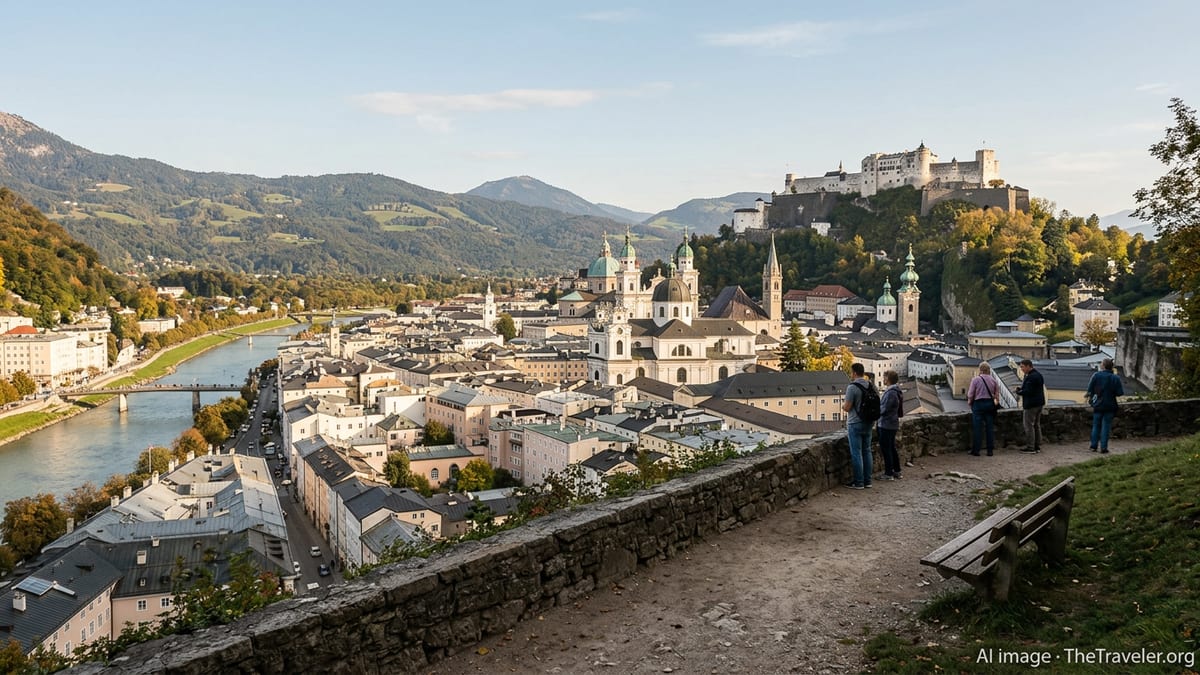
High above Salzburg’s baroque spires and the slow curve of the Salzach River, the Mönchsberg cliff forms a green backdrop that locals treat as their in-town escape. For visitors, it offers something even more compelling: a remarkably easy cliffside walk with some of the finest views of Salzburg’s Old Town, Hohensalzburg Fortress and the surrounding Alps. The Mönchsberg Salzburg walk is not a wilderness hike, but a scenic, largely paved ridge trail that lets you slip away from the crowds in minutes while never losing sight of the city you came to see.
What Makes the Mönchsberg Walk Special
The Mönchsberg is one of Salzburg’s “city mountains,” a wooded limestone ridge that rises directly behind the Old Town. Unlike the more demanding peaks outside the city, this walk combines low effort with dramatic payoff. Within a short climb or a 30‑second elevator ride, you are strolling along a clifftop promenade, looking straight down on baroque church domes, the Cathedral quarter and medieval lanes that most travelers only see from street level.
The experience is more like an elevated balcony around Salzburg than a wilderness trail. You pass secluded viewpoints with park benches, the lawns of historic villas, sections of old fortification walls and occasional contemporary art installations. Yet the city is constantly in view: you might spot the green copper roof of the Franciscan Church one moment and the arches of the Staatsbrücke bridge the next. It is this combination of urban proximity and quiet greenery that makes the Mönchsberg walk especially appealing for first-time visitors.
Photographers prize the route for its classic postcard angles. From the terrace near the Museum der Moderne, you can frame the Old Town in one sweep: the Salzach River in the foreground, the Cathedral and Kollegienkirche in the middle distance, and Hohensalzburg Fortress anchoring the skyline. Farther along toward the viewpoints known locally as Franz-Josefs-Höhe and König-Ludwig-Fernsicht, the panorama opens to include the distant peaks of the Berchtesgaden Alps on a clear day. Even travelers with only a few hours in Salzburg can fit this walk between museum visits or a concert.
Because the trail runs along a broad ridge rather than a narrow crest, it feels relaxed and unthreatening. You will see Salzburg residents jogging, walking dogs or pushing strollers alongside visitors carrying cameras and guidebooks. The route rarely feels remote; at several points you can exit back down into the city within 10 to 15 minutes, making it easy to adapt the walk to your energy level, the weather, or a dinner reservation.
Access: How to Get Up to the Mönchsberg
There are two main ways to reach the top of the Mönchsberg: by elevator or on foot. The quickest is the MönchsbergAufzug, a cliffside lift whose lower station is tucked behind the Old Town on Gstättengasse. A glass-fronted cabin carries you up about 60 meters in around half a minute, emerging beside the Museum der Moderne. A single ride ticket for adults typically costs a few euros per direction, with slightly reduced fares for children, seniors and groups. If you hold a Salzburg Card, one round-trip ride is normally included, so it is worth checking your pass before paying.
The elevator is especially convenient if you are short on time, traveling with small children, or visiting during a hot summer afternoon when the idea of a steep climb feels less than appealing. From the upper station you step almost directly onto a terrace with one of the finest views over the Old Town, and the cliffside walking path begins just beyond. An on-site ticket machine and staffed counter keep queues moving, but on busy August weekends you may still wait a few minutes for your turn.
For those who prefer to earn their views, several walking paths climb the Mönchsberg from different sides of the city. One well-used option starts near Toscaninihof behind the Festival district, where a paved path zigzags up through trees to reach the ridge in roughly 10 to 15 minutes. Another approach begins near the Sigmundstor tunnel on the Riedenburg side, combining a short residential section with stone steps into the woods. These climbs are moderately steep but short; most reasonably fit travelers in comfortable shoes manage them without difficulty.
If you are already near Hohensalzburg Fortress, you can also join the Mönchsberg trail network from that side by following signs toward the “Mönchsberg” or the viewpoints bearing the names of Franz Josef and Elisabeth. This approach works well if you are combining a fortress visit with a walk, though it involves some stairs and can be confusing without paying attention to waymarks. In all cases, sturdy everyday footwear is sufficient; hiking boots are not necessary unless conditions are icy or snowy.
Route Overview: A Classic Cliffside Circuit
The full Mönchsberg ridge is longer than most visitors realize, but the classic cliffside section with the best Old Town views can comfortably be explored in one to three hours, depending on how many detours and photo stops you add. Many travelers start at the Mönchsberg lift upper station near the Museum der Moderne, then walk the ridge toward Hohensalzburg Fortress before looping back or descending a different way into town.
From the museum terrace, the path heads southeast, immediately skirting the cliff edge with railings and open viewpoints. After only a few minutes you arrive at the first broad terrace, often used in promotional photos of Salzburg: rows of baroque facades below, the Cathedral dome in the center, and the fortress looming to your right on its own spur of rock. Benches here are popular for a mid-morning coffee stop; locals often bring a takeaway cup from a café in the Old Town and ride the elevator up just for this view.
Continuing along, the route alternates between shaded woodland and more exposed stretches on old defensive walls. Detours lead to signed viewpoints such as the Franz-Josefs- und Elisabeth-Höhe, a lookout that commemorates the Habsburg imperial couple and offers an elevated angle on the Cathedral district. Another spur leads to the König-Ludwig-Fernsicht, where interpretive plaques sometimes identify distant peaks on the southern horizon. These side paths add only a few minutes each and are worth the slight diversion for photographers.
As you near the fortress, the atmosphere changes subtly. The quiet parkland gives way to thicker walls, small bastions and occasional tour groups heading to or from Hohensalzburg’s funicular. From certain angles on this approach you can frame the fortress towers rising from behind trees, with the Old Town and river falling away below. Many visitors choose to end the Mönchsberg section here, descending by the fortress funicular or walking down to the Cathedral square. Others continue further along the ridge, eventually dropping down to districts such as Mülln, where the Augustiner Bräu beer hall provides an appealing reward for your efforts.
Time, Distance and Difficulty
The Mönchsberg trail network is flexible, but a typical cliffside walk from the Mönchsberg lift to near the fortress and back clocks in at roughly 3 to 4 kilometers, with only modest ups and downs once you have gained the ridge. Walking this section without major stops takes around 60 to 90 minutes at a relaxed pace. If you add side spurs to the main viewpoints, a photo session at the museum terrace, and perhaps a drink at a hilltop café or beer garden at the far end, it becomes an easy half-day outing.
Difficulty is best described as easy to moderate. The initial ascent on foot can feel steep if you are not used to hills, but it is short and on good surfaces. Once you are on top, the main route is mostly paved or on compact gravel, with a few staircases and short steeper ramps. Families regularly push robust strollers along the broader sections, though some narrow or stepped parts require brief detours. Travelers with limited mobility may prefer to use the elevator up and down and confine themselves to the flattest stretches near the museum terrace, where benches are frequent.
Compared with Salzburg’s other city mountain, Kapuzinerberg on the opposite side of the river, the Mönchsberg path feels less strenuous and more continuous in its views. Kapuzinerberg’s forest trails can be steeper and more enclosed, while Mönchsberg offers long, open vistas along the cliff. For context, local hiking platforms list the full ridge circuit at roughly 3.5 to 6 kilometers, depending on how far you extend it toward districts like Mülln and Leopoldskron, with a total walking time of 1.5 to 2 hours for the extended version.
For most visitors, the main limitation is not fitness but time and weather. The route is exposed in places, so on very hot afternoons you may appreciate the shade of the wooded sections and the occasional drinking fountain. In winter, snow and compacted ice can linger in corners even when the Old Town streets are clear. In those conditions, footwear with good grip and a bit more caution at viewpoints close to the edge are sensible precautions.
Best Viewpoints and Photo Spots
While almost every clearing on the Mönchsberg seems to reveal a new angle on Salzburg, a few spots are especially rewarding. The terrace directly above the Mönchsberg lift is the most instantly gratifying. Step out of the elevator and the Old Town is laid out in front of you, with the Salzach curving gently to the left and the fortress perched on its own rock to the right. This is a classic sunrise and early morning location in summer, when the first light hits the facades along the river and the air is still relatively cool.
Walking southeast, you soon reach viewpoints that bring the Cathedral and Residenzplatz into fuller view. From here, long lenses in the 70–200 mm range are useful if you want to pick out details like the green patina of church domes or the crowds around the Cathedral steps. Smartphone photographers need only tap to adjust exposure; the contrast between bright sky and shadowed streets can be high, especially when the sun is low. On hazy days, you can lean into the mood by embracing softer silhouettes of the fortress and distant hills.
The Franz-Josefs-Höhe and König-Ludwig-Fernsicht viewpoints reward those who wander a bit farther. From these platforms you can often see beyond the city to the foothills and higher mountains, making it easier to understand Salzburg’s setting in the wider landscape. On very clear autumn days, the ridges of the Berchtesgaden Alps appear sharply outlined on the southern horizon, giving a sense of depth that photographs struggle to capture. These spots also tend to be quieter than the museum terrace, making them ideal places to pause with a snack or simply watch the city life unfolding far below.
Near the fortress side of the walk, several breaks in the trees offer dramatic compositions of Hohensalzburg rising above the rooftops. If you time your visit for late afternoon or the “golden hour” before sunset, the stone walls glow warmly and the city lights begin to flicker on below. Amateur photographers often find that a basic travel zoom lens or the standard lens on a modern smartphone is entirely adequate here; the strength of the images comes from the vantage point rather than exotic equipment.
When to Go and What to Expect in Each Season
The Mönchsberg walk is accessible year-round, but its character shifts with the seasons. In spring, usually from April into early June, new leaves soften the outline of the cliff and the city’s parks below come into bloom. Temperatures are comfortable for walking most of the day, and you may find yourself peeling off layers as you climb from the cooler riverfront into the sunnier ridge. Rain showers are common, so packing a light waterproof jacket or umbrella is wise.
Summer brings longer daylight and a busier trail. From late June through August, the Mönchsberg becomes a favorite escape for both visitors and locals during Salzburg’s festival season. Expect more runners in the early morning and more people strolling with ice creams or cold drinks in the late afternoon. Midday can be hot and bright on the exposed viewpoints, so many travelers plan the walk for before 11 am or after 4 pm, combining it with a museum visit or a leisurely lunch in the Old Town.
Autumn is arguably the most atmospheric time to experience the walk. In October and early November, the trees on the ridge turn shades of gold and rust, framing the Old Town in seasonal color. The air is usually clear and cool, ideal for photography and longer circuits along the ridge. You may need a warm jacket and gloves for early morning or evening, especially as the breeze can feel stronger along the exposed cliff sections.
Winter conditions vary from year to year. In December you might find only a dusting of snow on the Mönchsberg while the Christmas markets glow below in the Old Town squares. In colder spells, compacted snow and icy patches can make some slopes and stairs slippery. The elevator generally operates throughout the year according to posted hours, but daylight is short, and the walk feels most pleasant in the middle of the day. When snow settles on the rooftops and fortress walls, the views from the terrace take on a storybook quality that rewards those willing to bundle up.
Practical Tips: Safety, Facilities and Combining Sights
Although the Mönchsberg walk is straightforward, a few practical considerations help make the experience smoother. First, footwear: sturdy sneakers or walking shoes with decent grip are usually enough, but avoid smooth-soled fashion shoes, especially if the ground is wet from recent rain. Some sections near the edge have protective railings, yet common sense still matters when leaning for photos, particularly if you are traveling with children.
Facilities are scattered rather than constant. At the Museum der Moderne near the lift, you will find restrooms and a café-restaurant with indoor and outdoor seating. A few drinking fountains appear along the ridge, but not at regular intervals, so carrying a reusable bottle is a good idea. Benches and low walls suitable for sitting are frequent; locals use them for everything from reading a book to eating a simple picnic of bakery pretzels and fruit bought in the Old Town below.
The walk combines naturally with several of Salzburg’s headline sights. One popular circuit is to start in the Old Town, ride the Mönchsberg lift up, follow the cliffside trail toward Hohensalzburg, then descend to the Cathedral square either on foot or by funicular from the fortress. Another possibility is to walk the opposite direction, continuing along the ridge until you can descend toward Mülln and reward yourself with a visit to Augustiner Bräu, a traditional beer hall and garden where you choose your own stein size, rinse it at a fountain, and have it filled straight from the barrel.
Public transport plays only a small role in this walk, since all main access points lie within a 10 to 20 minute stroll from Salzburg’s central sights. If you are staying near the main train station, it takes around 20 to 25 minutes on foot to reach the Mönchsberg lift via the riverfront, or you can use a trolleybus line to the Old Town and continue from there. Taxis and ride services can drop you close to the lift entrance or the fortress funicular if you prefer to save your energy for the views on top.
The Takeaway
For many visitors, the Mönchsberg walk quietly becomes the defining memory of Salzburg. It requires no special gear, advanced planning or athletic ability, yet it delivers the kind of sweeping, cinematic perspective on the city that travelers usually associate with long hikes in the Alps. In little more than an hour, you can step out of the busy lanes of the Old Town, rise above its rooftops, and trace the curve of the river as if reading a map from the sky.
Whether you ride the elevator up for a quick look between museum visits or commit to a longer ramble past the imperial viewpoints and fortress walls, the route offers a rare combination of accessibility, history and natural beauty. You see how the medieval city pressed against the cliff, how the fortress dominated its surroundings, and how the green belt of the Mönchsberg still shapes Salzburg’s silhouette today.
If your time in the city is short, this is one experience to prioritize. Plan for comfortable shoes, a flexible hour or two, and perhaps a takeaway drink or snack to enjoy on a bench at the edge of the cliff. With those simple preparations, the Mönchsberg Salzburg walk will reward you with some of the best views of Old Town you can find anywhere in the city.
FAQ
Q1. How long does the Mönchsberg Salzburg walk take?
The main cliffside section with the best Old Town views usually takes 60 to 90 minutes at a relaxed pace, not counting longer photo stops or café breaks.
Q2. How difficult is the walk and is it suitable for children?
The walk is generally easy to moderate. The initial climbs can be steep, but they are short. Once on the ridge, the path is mostly gentle, and many families with children complete it without problems.
Q3. Do I need special hiking gear for the Mönchsberg trail?
No special gear is required. Comfortable walking shoes with decent grip, weather-appropriate clothing and a small water bottle are usually sufficient for most seasons.
Q4. Is the Mönchsberg walk free, and what about the elevator cost?
Walking on the Mönchsberg itself is free. The only cost is if you choose to use the Mönchsberg elevator, which charges a small fee per ride, with discounts and card inclusions available.
Q5. What is the best time of day to do the walk?
Morning and late afternoon are ideal. Light is softer for photos, temperatures are more comfortable in summer, and the city below tends to feel less crowded.
Q6. Can I combine the walk with a visit to Hohensalzburg Fortress?
Yes. Many visitors walk along the Mönchsberg toward the fortress, explore the castle, then descend by funicular or on foot into the Cathedral square, creating a varied half‑day itinerary.
Q7. Is the trail accessible for people with limited mobility?
Sections near the Mönchsberg elevator and museum terrace are relatively flat, and the lift avoids the steep climb. However, some parts of the trail have stairs or uneven surfaces, so access can be limited.
Q8. Are there places to eat or drink along the way?
At the Museum der Moderne you will find a café‑restaurant, and at the far end near Mülln there are traditional spots such as Augustiner Bräu. Many walkers also bring simple snacks or picnics.
Q9. Is the Mönchsberg walk safe to do alone?
Yes. The route is well used by locals and visitors throughout the day, and it stays close to the city. As always, basic precautions apply, especially if walking in low light or winter conditions.
Q10. Can I do the Mönchsberg walk in winter?
It is possible in winter, but conditions vary. Snow and ice can make some sections slippery, so appropriate footwear and checking the weather before setting out are important.