

Florida is easy to enjoy, but its money habits can surprise first-time visitors. From contactless payments at theme parks to cash tips on Miami Beach, knowing how Floridians actually pay, withdraw, and tip can save you money and awkward moments. This guide explains how money works on the ground in Florida today so you can relax and focus on the sunshine.
What Kind of Money You Will Use in Florida
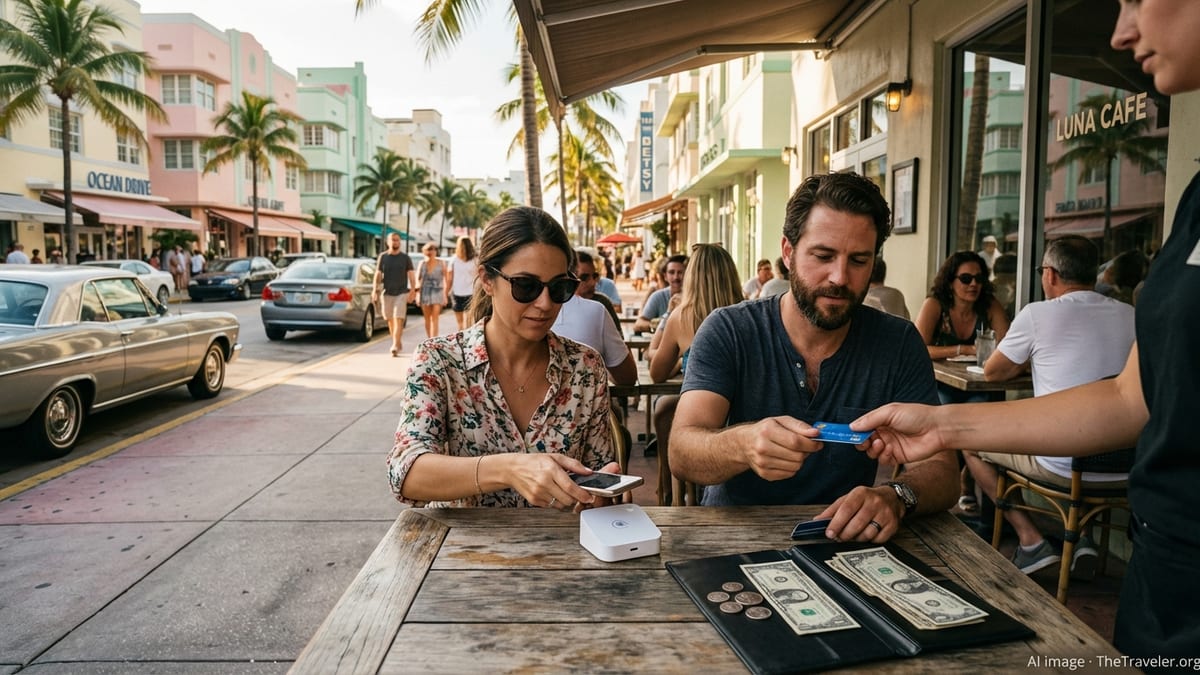
Florida uses the United States dollar, and virtually every visitor relies primarily on bank cards rather than cash. Major credit card networks are widely accepted across the state, especially Visa and Mastercard. American Express and Discover are also common in cities and tourist destinations, though they may be declined at some small, independent businesses. Contactless payments are now standard at supermarkets, pharmacies, gas stations, and most restaurants, and mobile wallets work almost everywhere cards are accepted.
Outside big cities, you will still find rare businesses that only accept cash or strongly prefer it, particularly small food trucks, local markets, and some independent motels. In these cases, having a small amount of cash on hand prevents frustration. However, international visitors rarely need to carry large amounts. In practice, a combination of one or two widely accepted credit cards, a debit card for ATM withdrawals, and a modest cash cushion covers almost every situation.
If you arrive with foreign currency, you will find that dedicated exchange offices are less common than in some other destinations. Airports and a few tourist areas do have currency desks, but they often come with weaker rates and additional charges. Most visitors instead withdraw dollars directly from ATMs using a home-bank card, which usually provides a more competitive effective rate after fees.
Florida’s larger cities have a thriving international tourism industry, especially Orlando, Miami, Tampa Bay, and the Florida Keys. Staff in hotels, theme parks, and major attractions are accustomed to foreign visitors, so presenting an international card is entirely normal. Just be prepared to show photo ID when making larger in-person purchases, particularly with a foreign-issued credit card.
Card Payments, Mobile Wallets, and Practical Fees
Card payments dominate everyday transactions in Florida. Supermarkets, pharmacies, big-box stores, restaurants, ride-hailing services, ticketing kiosks, toll-road accounts, and parking apps are designed around card or digital wallet payments. Tap-to-pay terminals are widespread, so you can usually pay by simply holding your card or phone over the reader. Chip-and-signature is still common with some cards, and you may be asked to sign on paper or on an electronic screen for larger purchases.
Mobile wallets such as Apple Pay and Google Pay are increasingly popular in Florida. They are accepted at most chains and many independent venues, especially in urban and resort areas. Using a wallet adds a layer of security, because merchants never see your full card number. For travelers, it also reduces the number of times you need to hand your physical card to staff. If possible, load at least one major credit card into your phone or smartwatch before you travel.
Foreign visitors should be aware of the fees that can accompany card use. Many banks charge a foreign transaction fee when a transaction is processed outside your home country, usually a small percentage of the total. Some travel-focused cards waive this fee entirely, which can produce meaningful savings over a longer trip. In addition, some Florida merchants and payment terminals offer “dynamic currency conversion,” inviting you to pay in your home currency instead of dollars. This almost always uses a poor exchange rate, so it is generally better to choose to be charged in U.S. dollars and let your own bank handle the conversion.
Florida’s tourism economy is highly digital, but occasional outdated terminals still exist, especially in rural areas. Carry at least one physical card with a visible magnetic stripe and chip, because some older fuel pumps and ticket machines still rely on swiping. If a small shop has trouble processing your contactless payment, ask if inserting or swiping the card works better before switching to cash.
Finding and Using ATMs in Florida
ATMs are extremely common in Florida, from airport terminals and hotel lobbies to supermarket entrances and standalone machines in gas stations or convenience stores. Most banks operate their own branded machines, and independent companies place additional ATMs in high-traffic tourist zones. Using your debit card to withdraw dollars is straightforward, but costs and safety vary widely depending on where you insert your card.
ATMs belonging to major banks usually offer the most reliable experience. They clearly display withdrawal fees before you confirm the transaction and generally provide competitive exchange rates through your own bank. Independent ATMs, particularly those in bars, small shops, or tourist strips, often charge noticeably higher flat fees and may impose lower withdrawal limits, pushing you toward multiple charged transactions. Whenever possible, prioritize machines located inside or directly outside recognized banks or large supermarkets.
For international cards, you will almost always be asked whether you want to accept a conversion to your home currency as part of the withdrawal. As with card payments, this service tends to carry a weaker exchange rate than your bank would offer. Selecting to be charged in U.S. dollars and declining the on-screen conversion usually results in a more favorable overall cost. You may also face an out-of-network ATM fee charged by your own bank. If you hold a card that reimburses these fees, review its conditions before your trip so you know which machines are best to use.
Florida has also seen rapid growth in cryptocurrency ATMs, particularly in gas stations and convenience stores. These machines allow users to convert cash into digital assets, but they lack the consumer protections of traditional bank ATMs and have been heavily targeted by scammers. Visitors should avoid using crypto ATMs to pay any bill or fine, no matter how urgent the request seems. Legitimate government agencies, hotels, and utilities do not demand payment in cryptocurrency, and any such instruction is a strong sign of fraud.
Cash, Local Rules, and When You Really Need Bills
In Florida, cash is still accepted widely, but it is not always required. There is currently no statewide law forcing businesses to take cash, and some private companies choose to operate as card-only for speed and security. For example, certain modern stadiums, entertainment venues, or boutique shops post clear notices that they do not accept banknotes. That said, many everyday businesses such as diners, small grocery stores, and neighborhood bars are happy to accept both cash and cards.
There are also local regulations that matter. Miami-Dade County, for instance, has rules requiring most brick-and-mortar retail businesses to accept cash for in-person transactions, with a limited set of exceptions. This was introduced to protect people who cannot easily get bank accounts or digital payment methods. If you prefer to pay in cash and encounter a refusal in that county, it may be worth politely asking whether the policy complies with local rules. Elsewhere in the state, the choice rests largely with the individual business.
Even in an increasingly cash-light environment, visitors will find certain situations where small bills are far more convenient. Tipping hotel housekeepers, bell staff, valet drivers, and tour guides is much easier with a few dollar notes at hand. Paying for inexpensive items at beach kiosks, buying produce at farmers’ markets, or dropping a dollar into a tip jar at a casual coffee stand also tends to be quicker with cash. In busy bars, bartenders often appreciate a tip in cash after each round, which can also lead to faster service.
A reasonable strategy for most travelers is to keep a core amount of cash in a secure place and carry only a small working supply day to day. Ten to thirty dollars in smaller bills is typically enough for tips and small purchases, while larger expenses such as restaurant meals, attraction tickets, and rides are comfortably handled by card or mobile wallet. This approach limits the potential loss if a wallet is misplaced while ensuring you are never caught short in a setting that expects cash.
Understanding Tipping Culture in Florida
Florida follows broader United States tipping customs, and tips form a significant share of income for many service workers. In restaurants with table service, it is considered standard to tip based on the pre-tax amount of your bill. Around the country, typical gratuities in full-service restaurants cluster between roughly 18 and 20 percent, with Florida falling close to that national pattern. Leaving less than 15 percent in a sit-down restaurant is widely interpreted as a sign of unhappiness with service rather than a neutral choice.
At bars, tipping is equally important. Many guests either tip around 20 percent of the tab or use a simple rule of one to two dollars per standard drink, adding more for complex cocktails. If you open a tab and settle at the end of the evening, you can add an appropriate tip to the final bill. When paying per drink, leaving each tip in cash on the bar is common practice. In busy nightlife areas such as Miami Beach or downtown Orlando, regular tipping also tends to result in noticeably more attentive service.
Casual and counter-service venues present more nuance. Coffee shops, bakeries, and fast-casual restaurants often display digital tipping prompts on their payment screens, suggesting percentages for staff who prepare your order but do not provide full table service. Many locals regard these tips as optional and reserve higher amounts for situations where staff spend extra time or accommodate special requests. If you are uncertain, a small round-up or a one-dollar tip at a counter is friendly but not strictly required, while table service remains firmly in the “expected to tip” category.
It is also worth noting that recent national policy changes have removed federal income tax on tip earnings, but this has not eliminated the underlying reliance on tips among Florida’s hospitality workers. The base hourly wage for tipped staff in many venues remains relatively low compared with non-tipped roles, so gratuities still play a central role in their overall pay. For visitors, this means that tipping retains its social importance even as technology and tax rules evolve.
How Much to Tip in Common Florida Travel Situations
For restaurants with table service, a practical rule for visitors in Florida is to treat 18 to 20 percent of the pre-tax bill as the normal tip when service is satisfactory. If the service is truly exceptional, many diners add more. Some restaurants automatically include a service charge or gratuity for large groups or on major holidays. This is usually mentioned on the menu or printed on the bill. If you see such a charge, you are not expected to tip the full amount again on top, though some guests still add a smaller extra amount for outstanding service.
In hotels and resorts, tipping is spread across several roles. Housekeeping staff generally receive a few dollars per occupied night, left daily rather than at the end of the stay so that the right person benefits. Bell staff often receive one to two dollars per bag, adjusted upward for particularly heavy luggage or special assistance. Valet drivers usually receive a small tip when the car is returned, and concierge staff may be tipped when they secure hard-to-get restaurant reservations or tickets. Florida’s beach resorts sometimes add extra service charges to pool or beach drink orders, so checking the bill helps you understand whether an additional tip is expected.
For taxis and ride-hailing services such as Uber and Lyft, common practice is to tip around 15 to 20 percent of the fare, with higher amounts for heavy traffic, very early or late rides, or exceptional assistance with luggage. Many visitors find it easiest to add the tip through the app after the journey, which removes the need for cash. On guided tours and excursion boats, it is customary to tip guides and crew if you enjoyed the experience. Amounts vary, but many guests think in terms of a percentage of the tour price or a modest per-person amount handed to the main guide at the end.
Florida’s tipping culture also extends to personal services such as haircuts, spa treatments, and nail salons, where around 15 to 20 percent of the total cost is typical. If multiple people assist you, some guests choose to tip the main stylist more and an additional smaller amount in cash to the assistant. At casual venues such as coffee counters or food trucks, tipping is more discretionary. Placing one or two dollars in a jar after friendly and efficient service is appreciated but not mandatory.
Taxes, Service Charges, and Reading Your Bill
Understanding what appears on a Florida bill helps you avoid double tipping. Most retail and restaurant purchases are subject to sales tax, which in Florida combines a statewide rate with additional local amounts. The final tax percentage varies by county, and tourist-heavy jurisdictions sometimes add special local taxes. On a restaurant bill, tax is usually listed as a separate line. Tipping norms are based on the pre-tax subtotal rather than the grand total, although many digital payment terminals offer tip suggestions calculated on the full amount.
Some restaurants, especially in busy tourist areas or with large groups, add an automatic gratuity or service charge. This can range around the level of a standard tip, and is often labeled as “gratuity,” “service,” or “service fee.” In these situations, many diners simply sign for the total without adding a further tip. If you feel service was truly exceptional, you might still leave an extra small amount, but it is not an obligation. If the bill already includes a service line and you are unsure what it covers, a quick, polite question to your server is entirely acceptable.
Hotel bills can include resort fees, facility charges, and taxes that are not tips. A daily resort fee usually covers access to amenities such as pools, gyms, or Wi-Fi rather than staff gratuities. Similarly, a facility fee at a spa or all-inclusive resort may not fully replace individual tips for therapists, attendants, or restaurant staff. Reading the fine print on your reservation confirmation and any in-room information helps you determine whether tips are included or still expected.
Across Florida’s major attractions, especially theme parks and large entertainment complexes, payment systems are increasingly integrated and cash-light. Room keys, wristbands, or app-based wallets sometimes allow you to charge meals and purchases to a central account. These systems typically include tipping options within the digital interface. Before you finalize charges, review the summary to see whether a tip has already been applied or whether you need to select one manually.
Staying Safe and Avoiding Money Scams
Millions of travelers use Florida’s payment systems safely every year, but taking a few sensible precautions reduces the risk of fraud. Whenever possible, use ATMs that are attached to banks or situated inside well-lit buildings, and inspect the card slot and keypad for anything loose or unusual before you insert your card. If a machine looks tampered with or behaves oddly, cancel the transaction and move to another location. Cover the keypad with your hand while entering your PIN, and avoid counting cash in public view after a withdrawal.
Contactless payments and mobile wallets are among the safest ways to pay, because they rely on unique digital tokens rather than exposing your full card details. When using a physical card, try to keep it in sight, especially in smaller establishments. In restaurants, where your card may briefly leave the table, check the amount carefully before entering your PIN or signing, and retain receipts so you can compare them with your account statements later. Many visitors also set up transaction alerts with their banks, receiving immediate notifications of card use by text or app.
Florida’s authorities have highlighted a rise in scams involving unusual payment requests. Government agencies, law enforcement, or reputable businesses do not demand payment in gift cards, cryptocurrency, or instant transfers to unfamiliar accounts. If someone pressures you to use a crypto ATM, wire funds immediately, or read out card numbers over the phone, treat it as a warning sign. Step back from the situation, contact the organization using an official phone number you find through your own search, and ask a trusted person for a second opinion before sending money.
Street-level scams also appear in busy tourist corridors. Be wary of anyone who insists on “helping” you with an ATM or ticket machine, especially if they suggest using a specific device or divert your attention while you enter a PIN. On beaches and around nightlife districts, keep wallets and phones in front pockets or secure bags, and avoid flashing large quantities of cash. Florida is no more dangerous than many other major tourist regions, but basic awareness of your surroundings will go a long way toward keeping your money secure.
The Takeaway
Money in Florida is straightforward once you understand how locals actually pay and tip. Cards and contactless wallets handle most purchases from the airport to the theme parks, while a small supply of cash makes tipping easier in hotels, bars, and on guided tours. ATMs are plentiful, but machines linked to established banks generally offer better value and security than independent devices scattered around tourist strips or gas stations.
Tipping remains a central part of Florida’s service economy, especially in restaurants, hotels, transportation, and personal services. Visitors who aim for roughly 18 to 20 percent in sit-down restaurants, tip hotel and transport staff for personal assistance, and approach counter-service prompts with flexibility will be well within local expectations. Reading bills carefully, watching for mandatory service charges, and declining poor exchange rates on dynamic currency conversion help protect your budget.
With a little preparation, you can move confidently through Florida’s diverse payment landscape. By mixing cards, digital wallets, and modest amounts of cash, respecting tipping norms, and following basic safety habits, you can focus less on small financial details and more on enjoying Florida’s beaches, cities, and theme parks.
FAQ
Q1. Do I need to carry a lot of cash in Florida?
Most visitors do not need large amounts of cash in Florida. Cards and mobile wallets are accepted almost everywhere, and a small supply of bills for tips, markets, and small purchases is usually enough.
Q2. Are foreign credit cards widely accepted in Florida?
Yes. Visa and Mastercard are broadly accepted, and American Express and Discover are common in larger cities and tourist areas. Some small businesses may only take certain networks, so carrying at least two different cards is helpful.
Q3. How much should I tip at restaurants in Florida?
In full-service restaurants, tipping around 18 to 20 percent of the pre-tax bill is considered standard for good service. Leaving less than 15 percent usually indicates dissatisfaction.
Q4. Do I have to tip when ordering at a counter or coffee shop?
Tips at counter-service venues and coffee shops are generally optional, even if a digital screen suggests amounts. Many people leave a small tip only when staff provide extra help or particularly friendly service.
Q5. Are ATMs safe to use in Florida?
Bank-operated ATMs in branches, malls, and supermarkets are typically safe and transparent about fees. Avoid suspicious or poorly lit machines, and be extra cautious about crypto ATMs, which are commonly exploited by scammers.
Q6. Should I pay in my home currency if a card terminal offers that option?
It is usually better to choose to pay in U.S. dollars and let your bank handle the conversion. On-screen conversions to your home currency often use unfavorable exchange rates.
Q7. Is it rude not to tip taxi or rideshare drivers in Florida?
Yes, it is generally expected to tip taxi and rideshare drivers, usually around 15 to 20 percent of the fare. Not tipping is seen as a sign of dissatisfaction with the service.
Q8. Are tips included in hotel and resort fees?
Hotel resort or facility fees usually cover amenities, not staff gratuities. You are still expected to tip housekeepers, bell staff, and other employees separately unless your booking information clearly states that tips are included.
Q9. Can I tip using a card, or should I always use cash?
You can often add a tip directly to a card or mobile wallet payment, especially in restaurants, bars, and ride-hailing apps. Cash is still useful for housekeeping, bell staff, and other situations where digital tipping is not available.
Q10. What should I do if someone asks me to pay a bill using a crypto ATM or gift cards?
Treat it as a likely scam. Legitimate organizations in Florida do not demand payment with cryptocurrency ATMs or gift cards. Stop the transaction, verify the request independently, and contact local authorities if needed.