

Planning a trip to Greece means thinking about island-hopping routes, ancient ruins and tavernas by the sea. It also means understanding how money works on the ground: what currency you need, how to get cash without paying unnecessary fees, whether cards are widely accepted and how much to tip. With recent changes to ATM rules and a rapid shift toward digital payments, knowing the basics will save you stress and potentially a lot of money once you land.
The basics: currency and everyday prices in Greece
Greece uses the euro as its official currency. You will see prices marked with the euro symbol and coins and notes are the same as elsewhere in the eurozone. Other currencies such as US dollars or British pounds are not generally accepted for everyday transactions, even in tourist areas, so you will need euros for almost all on-the-ground spending.
Cash remains a familiar part of daily life, particularly in small towns, villages and on some of the quieter islands. However, electronic payments are now firmly embedded in Greek commerce. Shops, supermarkets, hotels and many restaurants in cities and established resorts routinely accept major debit and credit cards. American Express is less widely accepted than Visa and Mastercard, so it is wise not to rely on Amex as your only card.
Prices in Greece vary by region and season, but many visitors find everyday costs moderate compared with other popular Mediterranean destinations. Snacks, coffee to go and simple meals can be relatively affordable, while high-end dining, beach clubs and luxury resorts can quickly increase your daily budget. Having a mix of payment methods allows you to adapt to everything from inexpensive bakery breakfasts to splurge dinners with a sea view.
Because Greece is part of the eurozone, your bank or card issuer decides your exchange rate and any foreign transaction fees. You will not negotiate exchange rates with local businesses; instead, you will benefit most by choosing accounts and cards with favorable terms before you travel.
ATMs in Greece: availability, fees and best practices
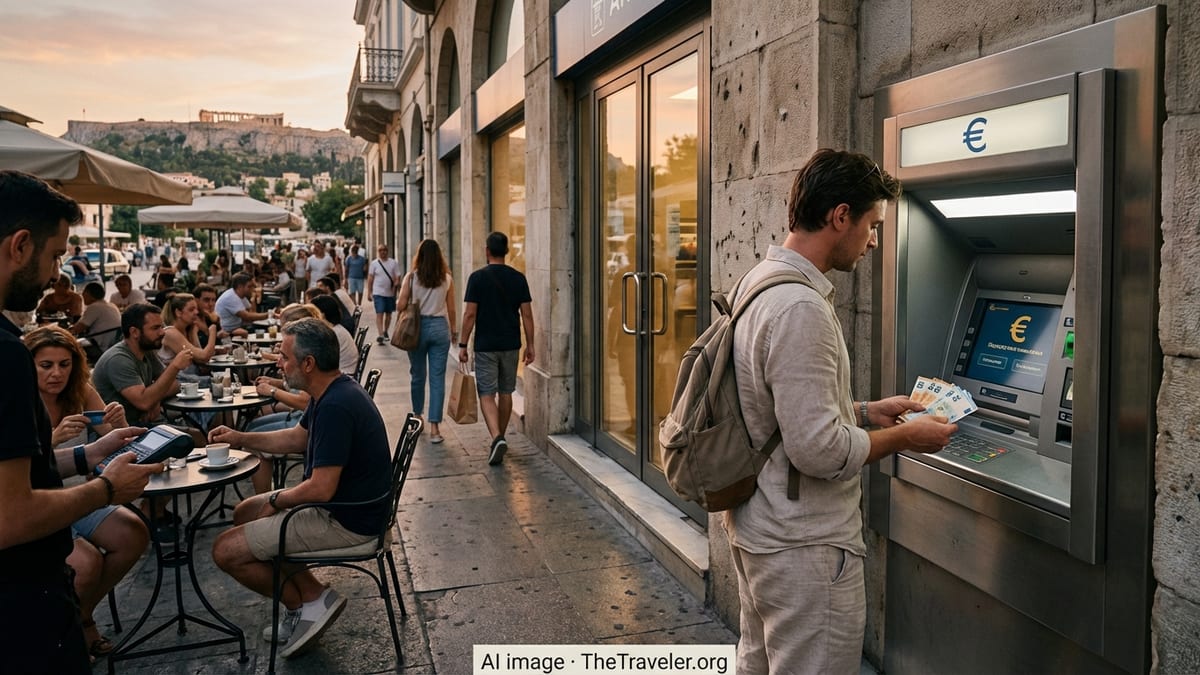
Greece has a dense network of ATMs in cities, large towns and popular islands. You will find machines operated by major Greek banks such as Alpha Bank, National Bank of Greece, Eurobank and Piraeus Bank, as well as independent providers often placed in tourist zones. At airports, ports and busy plazas, it is common to see several ATMs within a short walk.
Since August 11, 2025, Greece has overhauled ATM pricing for consumer withdrawals. Cash withdrawals at ATMs operated by Greek banks are no longer subject to local ATM commissions within the domestic banking network. In practice, this means Greek-regulated bank machines do not add a separate local withdrawal fee on top of what your own bank may charge. Independent or third-party ATMs in Greece are now subject to a legal cap, with withdrawal fees limited to a modest amount per transaction. Your home bank can still apply its own fee or currency markup, so those charges remain important to check before departure.
Even with the new rules, many travelers prefer to use ATMs operated by well-known Greek banks rather than independent machines. Bank ATMs typically offer clearer fee information, more reliable connections and straightforward withdrawal processes. Independent ATMs in heavily touristed areas sometimes highlight a “guaranteed” exchange rate on screen. If you are offered a choice between being charged in your home currency or in euros, choosing euros and letting your own bank handle the conversion is usually the more economical option.
To minimize hassle, withdraw moderate amounts of cash rather than many small sums, but avoid carrying more than you are comfortable losing. ATMs in central districts and around busy squares tend to be refilled regularly, though occasional outages can occur on smaller islands or during holiday periods. If you are visiting remote villages, it is sensible to withdraw in advance in a larger town and keep some backup notes for unexpected situations.
Card payments, contactless tech and mobile wallets
Card payments are now routine in much of Greece, especially in urban centers such as Athens and Thessaloniki and on major holiday islands including Santorini, Mykonos, Rhodes and Crete. Hotels, chain stores, supermarkets, car rental agencies and many mid-range and high-end restaurants have card terminals at the table or cashier. Smaller family-run tavernas and kiosks increasingly accept cards as well, particularly as authorities require more sectors to provide electronic payment options.
Contactless payments using tap-to-pay cards and mobile wallets are widely supported. Many Greek banks have upgraded their terminals and ATMs to work seamlessly with Apple Pay, Google Pay and similar services. In some branches, ATMs are shifting away from traditional card slots, allowing customers to authenticate using near-field communication through smartphones instead of inserting a physical card. As a visitor, you can still generally use a standard chip-and-PIN card, but having a contactless card or mobile wallet often speeds up small everyday purchases such as metro tickets, coffee, snacks and tolls.
Although card acceptance is broad, it is not absolutely universal. Some very small businesses may technically have a card terminal but prefer cash for low-value transactions or might impose informal minimums for card use. Connectivity issues on islands or in mountainous regions can occasionally knock terminals offline, turning what should have been a quick tap into a request for cash instead. This is why carrying some euros alongside your cards remains important even in 2026.
Before you travel, inform your bank that you will be using your cards in Greece to reduce the risk of automated fraud blocks. Check whether your cards charge foreign transaction fees or high markups on currency conversion. If possible, bring at least one debit card and one credit card from different issuers, in case one is declined or lost. Cards with no foreign transaction fees and competitive exchange rates can significantly reduce the cost of your trip.
Cash culture, tipping and when euros still matter
Despite a push toward digital payments, cash still plays a visible role in Greek daily life. In many small villages, simple tavernas and rural cafés, paying in cash is expected or at least appreciated. Street vendors, small bakeries, beach kiosks, open-air markets and public toilets often operate on a cash-only or cash-first basis. On smaller islands, occasional power cuts or slow internet can temporarily disable card terminals, leaving cash as the reliable backup.
Tipping in Greece is customary but not as rigid as in some other countries. There is rarely an automatic service charge on restaurant bills, so if you are satisfied with the service it is courteous to leave something. Visitors commonly round up the bill or add an amount in the range of about 5 to 10 percent in casual restaurants and tavernas for good service, with more in fine dining settings if you choose. For cafés and bars, rounding up or leaving small coins is often enough. Taxi drivers may appreciate a small round-up or a euro or two added for good service or help with luggage.
Hotel tipping is also appreciated. A few euros for housekeeping after a multi-night stay, a similar amount per bag for porters in higher-end hotels and a modest tip for concierge staff who go out of their way can all be appropriate. In most cases, these tips are best given in cash, even if you pay the main bill by card. Because lower-denomination notes and coins are useful for this, it pays to break larger notes earlier in your trip by using them for restaurant bills or supermarket purchases.
There is no strict obligation to tip in every situation, and you should never feel pressured to tip for poor service. Greeks themselves do not leave large, automatic percentages on every bill. A modest, thoughtful tip, offered in cash when you genuinely feel it is deserved, aligns well with local practice and is likely to be warmly received.
Avoiding unnecessary fees and money traps
Although Greece has recently limited or abolished local ATM withdrawal charges at bank-operated machines, travelers can still encounter avoidable costs. The most significant of these usually come from foreign transaction fees, unfavorable currency conversions and independent ATMs in tourist-heavy areas that rely on confusing on-screen options.
The first step in avoiding surprises is to understand your own bank’s fee structure. Many standard debit and credit cards charge a foreign transaction fee on every purchase, sometimes a few percent of the total, as well as additional charges for ATM withdrawals abroad. If you travel regularly, you may wish to open an account with a provider that offers low or no foreign transaction fees and reimburses some ATM costs. Multi-currency or travel-focused cards can let you hold euros directly, which may simplify budgeting and help you avoid steep markups.
Independent ATMs in very touristy neighborhoods, ports or near cruise terminals can present a particular challenge. These machines often function legitimately but may default to dynamic currency conversion, offering to charge your card in your home currency at a poor exchange rate. You can usually decline this and insist on being charged in euros instead. Where possible, look for ATMs attached to recognized Greek banks or located inside or directly outside bank branches, as they generally provide clearer terms and avoid aggressive conversion prompts.
Be wary of any merchant who offers to charge your card in your home currency rather than in euros. While this may sound convenient, it typically involves a conversion rate chosen by the merchant’s payment provider, which can be significantly worse than what your bank would apply. When in doubt, request that card payments be processed in euros and keep your receipts so you can check the final amounts once you review your statement.
Practical safety tips for carrying and using money
Greece is generally considered safe for travelers, but as with any popular destination, petty crime can occur in crowded areas. Sensible precautions go a long way in protecting your cash and cards and ensuring that money concerns do not intrude on your holiday.
When using ATMs, choose machines in well-lit, busy locations or inside bank branches whenever possible. Shield your hand as you enter your PIN and be alert to any unusual devices attached to the card slot or keypad. While the shift toward contactless and app-based ATM access aims to reduce card skimming, it is still prudent to monitor your accounts regularly during your trip so that you can quickly spot and report any unfamiliar transactions.
Divide your money and cards rather than keeping everything in one wallet or bag. Some travelers like to carry a small day wallet with limited cash and one card, while leaving a backup card and some reserve cash in the hotel safe or a secure, separate location. This way, losing a wallet or having a bag stolen does not instantly leave you without access to funds. Carry a written or securely stored digital record of your card numbers and your bank’s emergency contact details so that you can block cards promptly if needed.
As you move around busy areas such as metro stations, ferries, ports and crowded sightseeing spots, keep wallets in front pockets, crossbody bags zipped and backpacks closed. Pickpocketing is more likely in packed queues and on public transport, particularly in major cities at peak times. Most visitors experience no problems at all, but taking these modest steps helps keep your trip focused on sunsets and ruins rather than on calls to your bank.
Planning your budget and choosing how much cash to bring
Working out how much cash to bring to Greece depends on your travel style, itinerary and comfort level with using cards. If you expect to rely mainly on cards in cities and resort areas, you may only need a modest amount of euros in hand for the first day or two, plus a plan to use bank ATMs once you arrive. In contrast, if your trip centers on smaller islands, rural stays or off-season visits where some businesses may be closed or operating with reduced staff, having more cash available can be reassuring.
Many visitors arrive with a small amount of euros purchased at home and then top up through ATMs in Greece. Buying large sums of foreign currency from airport exchange counters or high-street bureaus is rarely necessary and often comes with less favorable rates or extra commissions. Because bank-operated ATMs in Greece no longer add domestic withdrawal fees, withdrawing euros locally using a low-fee card is typically an efficient approach, as long as your home bank’s charges are reasonable.
As a rough approach, you might consider carrying enough cash to cover at least a couple of days of expenses, including meals, local transport and small purchases, while planning to pay for accommodation, car rental and larger restaurant bills by card whenever possible. This balance limits how much cash you are carrying at any one time while still giving you flexibility if a card terminal fails or a taxi prefers cash.
When traveling as a family or group, it can be helpful for at least two adults to have separate cards and access to funds. Decide in advance how you will handle shared expenses, whether by rotating who pays, using a joint travel card or settling up periodically with transfers or cash. Clear arrangements reduce confusion and make it easier to track your actual spending as the trip progresses.
The Takeaway
Greece has moved decisively into the era of digital payments while still retaining a strong cash culture in everyday life. Visitors benefit from the convenience of widespread card acceptance in cities and major resorts, as well as from recent reforms that reduce or remove local ATM withdrawal fees at Greek bank machines. At the same time, cash remains essential in smaller establishments, markets, rural areas and as a practical backup when networks falter.
If you arrive with at least one reliable debit card, one credit card, a small supply of euros and a basic grasp of how to avoid dynamic currency conversion and unnecessary fees, managing money in Greece should be straightforward. Combine that with sensible safety habits, a few low-denomination notes for tipping and small purchases and the flexibility to adapt to local preferences, and you will be well equipped to focus on what really matters: exploring ancient sites, relaxing on beaches and enjoying Greek hospitality.
By preparing your cards, understanding how ATMs work under the latest rules and keeping a modest mix of cash and electronic options, you can make your travel budget stretch further. The result is a smoother, more relaxed experience in one of Europe’s most compelling destinations.
FAQ
Q1. What currency is used in Greece, and can I pay in dollars or pounds?
Greece uses the euro for all everyday transactions. Shops, hotels and restaurants expect payment in euros, and other currencies such as US dollars or British pounds are not normally accepted at the register. You may be able to exchange foreign cash at banks or exchange offices, but for spending you should plan to use euros, cards or mobile payments.
Q2. Are ATMs easy to find in Greece, and do they still charge high withdrawal fees?
ATMs are widely available in cities, larger towns and popular islands, and many are operated by major Greek banks. Since August 2025, Greek rules have removed local withdrawal fees at bank-operated ATMs and placed a cap on fees at independent machines. Your own bank at home may still charge its own withdrawal or foreign transaction fees, so it is important to check those terms before traveling.
Q3. Should I use independent ATMs in tourist areas or only bank ATMs?
You can often use either, but many travelers prefer bank ATMs because they tend to be more transparent and less aggressive with currency conversion offers. Independent ATMs in very touristy spots sometimes push dynamic currency conversion at poor rates. Where possible, choose an ATM attached to a well-known Greek bank and, if you are offered a choice, select to be charged in euros rather than in your home currency.
Q4. How widely are credit and debit cards accepted in Greece?
Cards are broadly accepted in cities, major islands and established tourist areas, especially at hotels, supermarkets, chain stores and many restaurants. Smaller cafés, rural tavernas, street vendors and some local services may still prefer cash or have unreliable terminals. It is wise to carry at least some euros alongside your cards, particularly when exploring villages or less-visited islands.
Q5. Is contactless and mobile phone payment common in Greece?
Contactless payments are now very common in Greece, and many terminals support tap-to-pay cards and mobile wallets such as those offered by major phone providers. Several Greek banks have also upgraded ATMs to support contactless access. As a visitor, you can typically pay with a standard chip-and-PIN or contactless card, and having a mobile wallet set up can make small, frequent purchases even more convenient.
Q6. How much cash should I carry day to day in Greece?
There is no single right amount, but many visitors are comfortable carrying enough cash to cover a day or two of local spending on food, transport and small purchases, while using cards for hotels and larger bills. On smaller islands or rural itineraries, you may want a bit more cash because ATMs or card terminals can be less reliable. Try not to carry more than you are comfortable losing and replenish from ATMs as needed.
Q7. What is the tipping etiquette in Greek restaurants, taxis and hotels?
Tipping is appreciated but not mandatory. In casual restaurants and tavernas, many people round up the bill or leave roughly 5 to 10 percent for good service. In cafés and bars, rounding up or leaving small coins is common. Taxi drivers often receive a small round-up or a euro or two extra, and hotel staff such as housekeepers and porters may be given a few euros in recognition of good service. Tips are usually given in cash.
Q8. Is it better to pay in euros or in my home currency when using my card?
In almost all cases, it is better to pay in euros. If a terminal or ATM offers to charge you in your home currency, that usually involves a conversion rate set by a third party, which can be significantly worse than the rate your bank would apply. Choosing euros and letting your own bank handle the conversion is generally the more cost-effective option.
Q9. Are there any safety concerns when using ATMs and carrying money in Greece?
Greece is broadly safe, but you should take normal precautions. Use ATMs in well-lit, busy areas or inside bank branches, shield your PIN, and avoid machines that look tampered with. Keep wallets and phones secure in crowded places and divide cash and cards between different pockets or bags so that losing one item does not leave you without access to funds.
Q10. Should I exchange money before I travel or wait until I arrive in Greece?
Many travelers bring a small amount of euros for immediate expenses and then use ATMs in Greece to withdraw additional cash as needed. Exchanging large sums at airport counters or high-commission exchange offices is rarely necessary and can be expensive. With local ATM withdrawal fees at Greek bank machines now removed and a suitable low-fee card, withdrawing euros after arrival is often a practical and cost-effective approach.