

The Netherlands is one of Europe’s easiest countries for day to day payments, but visitors are often surprised by details like where cash is still useful, how tipping really works, and why tourist taxes can noticeably increase the final price of a hotel stay. Understanding these basics before you land will help you budget accurately and avoid awkward moments at checkout, in restaurants, and at your accommodation.
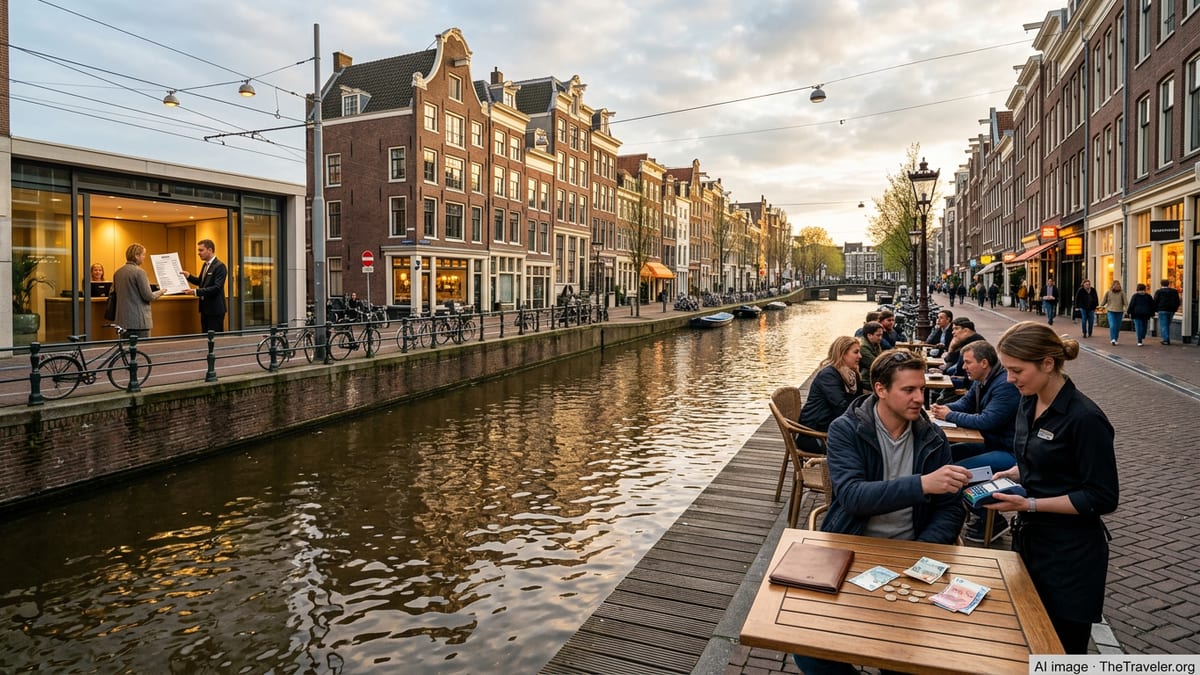
How the Dutch Pay: Cards First, Cash as Backup
The Netherlands is a strongly card first society, and visitors will notice this from the moment they arrive. Contactless payments are the default in supermarkets, cafes, public transport and attractions. Most locals pay with a debit card linked to a Dutch bank account, but major international credit and debit cards are increasingly accepted, especially in cities and tourist areas.
Visa and Mastercard branded debit and credit cards are widely usable in hotels, chain restaurants, museums, train stations and larger shops. Smaller neighborhood businesses may still display a “PIN only” or “no credit cards” sign, which usually means they accept Dutch style bank debit cards but not foreign credit cards. This is less common than it used to be, but travelers should still expect an occasional refusal of foreign credit cards in small, independent shops or very local bars.
Contactless payments are extremely common. Many terminals will prompt you to tap rather than insert your card, and mobile wallets such as Apple Pay and Google Pay are widely supported where Visa or Mastercard are accepted. For higher value transactions you may be asked to enter your PIN after tapping. It is wise to carry at least one physical card with chip and PIN capability as not every terminal is set up to accept mobile wallets from foreign banks.
While cards dominate, the government and central bank have stressed that cash should remain an option. In practice that means almost all supermarkets, chain stores and transport ticket desks still accept euro notes and coins. There are a few fully cashless venues, particularly trendy cafes or small urban businesses that have deliberately gone card only, so it is safest to assume you will use cards for most purchases and keep a small amount of cash for edge cases.
Using Foreign Cards and ATMs
As a visitor, your foreign debit or credit card will usually work in Dutch payment terminals as long as it is enabled for international use and has a chip. Visa and Mastercard generally function reliably. American Express has more limited acceptance and is often refused at supermarkets and smaller venues, though it is more likely to be accepted at international hotel chains and upscale restaurants. Discover and other niche networks are hit or miss and should not be relied upon as a primary card.
ATMs in the Netherlands are modern and straightforward to use. Most independent bank branches no longer operate their own branded machines on the street. Instead, you will see a national network of bright yellow “Geldmaat” machines, which are shared by the major Dutch banks. These ATMs are designed to be neutral and to reduce the number of different machines in towns and cities. Geldmaat ATMs generally do not charge a direct withdrawal fee, but your home bank may apply its own foreign ATM and currency conversion fees, so it is important to check your card conditions before traveling.
To withdraw cash, insert or tap your card, select your language, and follow the prompts. The machine will ask how much you want in euros and, for some international cards, may offer to convert the transaction to your home currency. This “dynamic currency conversion” usually comes with a poor exchange rate. For a better deal, decline conversion and choose to be charged in euros, letting your own bank or card provider handle the currency exchange.
Cash withdrawals are available both in cities and in most medium sized towns, but machines can be scarcer in very small villages or purely residential areas. It is a good habit to withdraw cash in central locations when you see an ATM, rather than waiting until late at night or when you are far from a town center. Withdraw slightly larger amounts less frequently to reduce the impact of any flat ATM fees your home bank may charge.
Where Cash Still Matters
Even though cards have become dominant, there are still moments when cash is useful in the Netherlands. Some very small businesses, such as local market stalls, small independent snack bars, or rural campsites, may prefer cash or have unreliable card terminals. Public toilets in train stations or city centers sometimes charge a small fee that can be paid by card, but in a few cases exact coins remain the simplest option.
Having a modest reserve of euro notes and coins is also helpful during technical outages. On rare occasions card networks go down or a particular terminal stops working. In a cafe or bar, being able to pay your bill in cash avoids waiting around while staff try to fix the machine or direct you to an ATM. For small social situations, such as pooling money with friends for a shared expense, cash can also be more convenient than multiple card payments.
For visitors staying in apartments or smaller guesthouses, some owners may request city tourist tax or final cleaning fees in cash, particularly if they do not have a full point of sale system. While this practice is less common than in the past, it still occurs, so it is sensible to confirm payment methods with your host in advance. Overall, however, the amount of cash most travelers need is limited. Many visitors are comfortable carrying between 50 and 150 euros in mixed denominations and topping up at an ATM only occasionally.
When you pay with cash, expect your change to be accurate down to the cent. Dutch prices already include tax and are not rounded up at the register in the way some countries do. Coins of 1 and 2 euro cents are rarely used in physical transactions, so in shops that still price using these small increments, the final bill may be rounded to the nearest 5 cents. This rounding is applied fairly and does not affect the base prices displayed on shelves.
Public Transport, Taxis, and Everyday Services
Public transport in the Netherlands is closely integrated with modern payment systems. On most domestic trains, trams, buses and metros you can check in and out using a contactless debit or credit card or a compatible mobile wallet. Gates and validators are clearly marked and respond quickly. Travelers who prefer a dedicated transit card can still purchase the national OV chip card, but increasing numbers of visitors simply tap their bank card directly and let the system calculate the fare.
In taxis and ride services, card payment is normal and often preferred. Official taxis in major cities are required to accept card payments. Drivers will usually present a handheld terminal that supports chip and contactless transactions. It is polite to mention your intention to pay by card at the beginning of the ride, although in urban centers this is so common that most drivers assume it. If you are traveling in a rural area or using a small local taxi firm, it can be useful to confirm card acceptance when booking or when you get in.
At restaurants and cafes, bill settlement usually happens at the table with a portable terminal or at a central register near the bar. Staff may ask “together or separate” and are comfortable splitting bills between several people. Each person can pay their share by card, which is a normal and accepted practice. In some fast casual venues or coffee bars, you order and pay at the counter first, then receive your food or drink; in these cases, card payment is again the default.
Other everyday services, such as bike rentals, museum tickets and guided tours, have also migrated heavily to card and online payments. Many ticket machines and self service kiosks do not accept cash at all. Buying advance tickets online with a card can streamline your experience and sometimes unlock time slot reservations for popular attractions. When you do encounter a cash only situation, it will typically be clearly posted and tied to small, local operators rather than major attractions.
Tipping in the Netherlands: Custom, Not Obligation
Tipping in the Netherlands can be confusing for visitors from countries with strong tipping cultures. Service staff are generally paid at least a legal minimum wage rather than depending on tips for their income. As a result, tipping is seen as a voluntary expression of appreciation for good service, not an automatic surcharge on every bill. Not leaving a tip is not considered rude in the same way it might be in North America, although in full service restaurants it is increasingly common to leave something small when the experience has been pleasant.
In sit down restaurants, a typical tip for good service is to round up the bill or add around 5 to 10 percent, depending on your budget and how satisfied you feel. For example, if your bill is 47 euros, you might simply pay 50 euros, or on a larger bill of 120 euros, leaving an extra 5 to 10 euros is considered generous but not excessive. Leaving nothing at all after a relaxed meal with attentive service may subtly signal that you were not entirely happy, though staff will rarely comment directly.
In cafes and bars, tipping is more relaxed. Many people round up to the nearest euro or add a small amount, especially if they have ordered table service or spent a long time at a terrace. At the counter, tip jars near the register are common, but there is no expectation that you must contribute every time you buy a coffee or a single drink. It is perfectly acceptable to pay the exact amount due and offer no tip, particularly for quick, casual purchases.
For taxis, rounding up to a convenient amount is standard practice rather than calculating a precise percentage. On a 19 euro ride, you might pay 20 euros; on a longer trip of 70 euros, adding a few euros if the ride was smooth, the car was clean, and the driver was helpful with luggage is appreciated but not required. In hotels, small tips for housekeeping or porters are welcome but modest. One or two euros per bag for a porter or a few euros per stay for housekeeping is perfectly adequate.
Digital Tipping Prompts and Local Attitudes
In recent years, card terminals and ordering apps in the Netherlands have started to display tipping suggestions more prominently, especially in areas popular with tourists. When you pay by card, you may see preset percentages or euro amounts appear on the screen before you enter your PIN or complete the tap. These prompts can feel familiar to North American travelers but surprise those who know the Dutch tradition of low pressure tipping.
Local attitudes to this change are mixed. Many Dutch residents still view tipping as something you decide quietly rather than something you are asked about on every small purchase. Online discussions and local commentary frequently express discomfort with aggressive tipping prompts at take away counters or for very simple service. Visitors should understand that, despite these digital nudges, the cultural expectation remains moderate. You can always choose “no tip” on a terminal without feeling that you have broken an unwritten rule.
When you do want to tip by card, you usually have two options. In some places, the staff will ask if you would like to add a tip before they enter the total, and you can simply state an amount. In others, the terminal will list percentages such as 5, 10 or 15 percent. Choosing a lower option is perfectly acceptable and more in line with local norms than the higher percentages common in some other countries. If tipping by card feels awkward, carrying a bit of cash and leaving coins or a small note on the table after paying the bill is equally fine.
The key is to follow your own comfort and the quality of service you receive. Friendly, efficient service in a country where staff are generally paid a living wage does not require large tips to be considered respectful. A small, thoughtful gesture is plenty. If your budget is tight, you should never feel forced to match automatic suggestions that do not reflect Dutch habits.
Tourist Taxes Across the Netherlands
Tourist taxes have become a significant part of travel costs in the Netherlands, especially in major cities. Municipalities are allowed to levy a nightly tax on visitors who stay in hotels, hostels, holiday parks, campsites and short stay rentals. The revenue is used to support local services, manage tourism impacts and maintain infrastructure that residents and visitors use. Rates vary widely between municipalities and are adjusted regularly, so your total cost can differ noticeably from one town to another.
The most visible example is Amsterdam, which has some of the highest hotel tourist taxes in Europe. As of 2026, the city charges a percentage based tax on the net room price before national value added tax is applied. This means the more expensive your hotel, the higher the absolute amount you pay per night in tourist tax. Visitors also encounter separate charges if they arrive by cruise ship for a day visit, reflecting the city’s effort to manage large visitor flows from the water as well as overnight stays.
Elsewhere in the country, many municipalities charge a flat per person, per night amount, often only a few euros. Beach towns, nature areas and popular historic cities may set higher rates, while some smaller municipalities still choose not to levy any tourist tax at all. However, the overall trend in recent years has been upward. Local councils have increasingly used this tax as a tool to help fund public services and to respond to the pressures of growing visitor numbers.
Because tourist tax is municipal rather than national, it is very difficult to predict a precise nightly amount without knowing exactly where you will stay. When comparing accommodation, look carefully at the pricing notes. Many booking platforms and hotels list tourist tax separately from the room rate, either as a percentage or a fixed amount. Including this in your mental calculations will give you a more accurate picture of the real cost of each night’s stay.
How Tourist Tax Affects Your Budget
For travelers, the main impact of tourist tax is on the final bill rather than on daily spending. A hotel that looks attractively priced at first glance may end up significantly more expensive once city taxes are added. This effect is particularly strong in Amsterdam, where the percentage based tax can add the rough equivalent of a budget dinner for one or two people for every night of a mid range hotel stay.
To avoid surprises, budget minded travelers should pay attention to whether tourist tax is included in the price shown during booking or listed as “to be paid at the property.” Some websites now incorporate estimated city taxes in the total cost, but others still display them separately until the final stages of booking. If you are constructing a daily budget, it may help to treat tourist tax as part of your accommodation cost and divide the total by the number of nights, rather than thinking of it as a separate expense.
Cruise passengers should also be aware that day visitor tourist taxes are often collected at the level of the cruise operator rather than directly from individuals. The cost is typically embedded in the overall cruise fare or port fees instead of appearing as a separate line item during your short stay in the city. While you may not pay this tax directly at a counter, it still forms part of the overall cost of visiting the Netherlands by ship.
Families and groups should consider that per person, per night taxes can add up quickly. In destinations that charge a flat rate per guest, a family of four staying several nights will pay significantly more than a solo traveler on the same dates. When comparing accommodation types, a slightly more expensive room in a municipality with a lower tourist tax can sometimes work out cheaper overall than a cheaper looking room in an area with a higher rate.
Practical Money Tips for Visitors
With a bit of preparation, managing money in the Netherlands is straightforward. Before departure, inform your bank that you will be traveling and confirm that your cards are enabled for international use and contactless payments. Ask about foreign transaction fees and ATM withdrawal charges so you can decide whether to favor card spending or occasional cash withdrawals. If you have both a debit card with low foreign fees and a credit card with higher ones, using the debit card for routine purchases can save money.
On arrival, withdraw a modest amount of cash from a reputable ATM, ideally the national yellow Geldmaat machines or ATMs inside bank branches or major transport hubs. Avoid any standalone cash machines that appear to be run by independent operators in highly touristy areas, as they may apply high fees or offer poor exchange rates. When the ATM or a card terminal offers to charge you in your home currency instead of euros, decline this option to avoid unfavorable rates.
As you travel, favor card payments for most expenses and keep cash for small, informal or unexpected situations. Store your cards securely and consider using mobile wallets for tap payments, which can add a layer of convenience and reduce the number of times you take your physical card out of your wallet in crowded areas. Monitor your accounts regularly during your trip to spot any unusual charges quickly.
Finally, approach tipping and tourist taxes with awareness rather than anxiety. Remember that tipping is discretionary and modest in the Netherlands, and that service staff do not depend on large tips to survive. Treat tourist tax as a normal part of the cost of accommodation rather than an unwelcome surprise. With expectations set correctly, you can relax and focus on enjoying Dutch cities, landscapes and culture without worrying about misunderstandings over money.
FAQ
Q1. Do I need to carry a lot of cash in the Netherlands?
Most visitors do not need much cash because card payments are widely accepted. A small amount of euros for markets, small purchases or emergencies is usually enough.
Q2. Will my American credit card work in Dutch shops and restaurants?
Visa and Mastercard generally work well in cities and tourist areas. Some small local businesses may not accept foreign credit cards, so carry a debit card and a little cash as backup.
Q3. Is it rude not to tip in Dutch restaurants?
It is not considered rude in the same way as in strong tipping countries, but in full service restaurants it is customary to leave a small tip or round up for good service.
Q4. How much should I tip in a cafe or bar?
In casual places, people often round up to the nearest euro or leave a very small amount. There is no expectation to tip on every coffee or single drink.
Q5. Why is my hotel bill higher than the room rate I saw online?
The difference is often tourist tax, which many municipalities charge on top of the room price. In some places it is a percentage, in others a per person, per night fee.
Q6. Can I pay tourist tax in cash instead of by card?
Most hotels and official accommodations add tourist tax to your bill and accept the same payment methods as for the room, usually cards. Some small guesthouses may prefer or accept cash.
Q7. Are ATMs easy to find in Dutch cities?
Yes, ATMs, especially the yellow Geldmaat machines, are common in city centers, transport hubs and shopping streets. They are less frequent in small villages, so plan ahead.
Q8. Should I accept dynamic currency conversion when paying by card?
It is usually better to decline conversion and pay in euros. Let your own bank handle the exchange rate, which is often more favorable than the rate offered at the terminal.
Q9. Do taxis and rideshares accept card payments?
In major cities, taxis normally accept cards and contactless payments. It is still wise to confirm at the start of the ride, especially in smaller towns or with local firms.
Q10. Are tourist taxes only charged in Amsterdam?
No, many Dutch municipalities charge tourist taxes, though rates vary widely. Amsterdam is one of the highest, but popular coastal and historic towns also levy their own fees.