

Montana authorities are warning travelers to brace for deadly avalanche conditions and fast-changing winter weather this week, as a broader cold-season emergency ripples across the United States, snarling transport networks and stretching emergency services from the northern Rockies to the East Coast.
Fresh Snow, Rising Winds and a Volatile Mountain Snowpack
Forecasters in western Montana say a volatile mix of recent snowfall, gusty winds and a complex mountain snowpack has created the ingredients for dangerous avalanches across popular travel corridors and backcountry terrain. While early winter in much of Montana was marked by patchy snow and unseasonably warm spells, a series of colder systems moving across the northern Rockies in mid-February has rapidly reloaded high-elevation slopes with new, dense snow layered over weaker faceted crusts below.
National Weather Service offices in Missoula and Great Falls have issued Winter Weather Advisories for several key routes in northwest Montana through Tuesday, citing 1 to 3 inches of snow in valleys and 4 to 8 inches in the surrounding ranges, along highways including U.S. 93, U.S. 2 and state routes near Libby, Eureka and Whitefish. Avalanche specialists caution that even modest new accumulations, when paired with strong winds that drift snow onto leeward slopes, can tip an already unstable snowpack toward failure, especially on slopes steeper than 30 degrees.
In the backcountry beyond ski area boundaries, danger levels can escalate quickly as storms roll through. Fresh slabs of wind-deposited snow, barely bonded to hardened layers beneath, are particularly prone to human triggers from skiers, riders and snowmobilers seeking powder stashes just off established trails. Officials emphasize that many of the most treacherous slopes loom directly above mountain passes, scenic turnouts and trailhead parking areas that attract winter visitors.
Although no major fatal avalanche has been confirmed in Montana so far this February, emergency managers insist that the pattern mirrors other deadly seasons across the West, where a quiet start to winter has been followed by sudden, intense storms and a spike in close calls and deadly slides once recreation and holiday travel increase.
Travel Routes at Risk as Mountain Highways Thread Avalanche Terrain
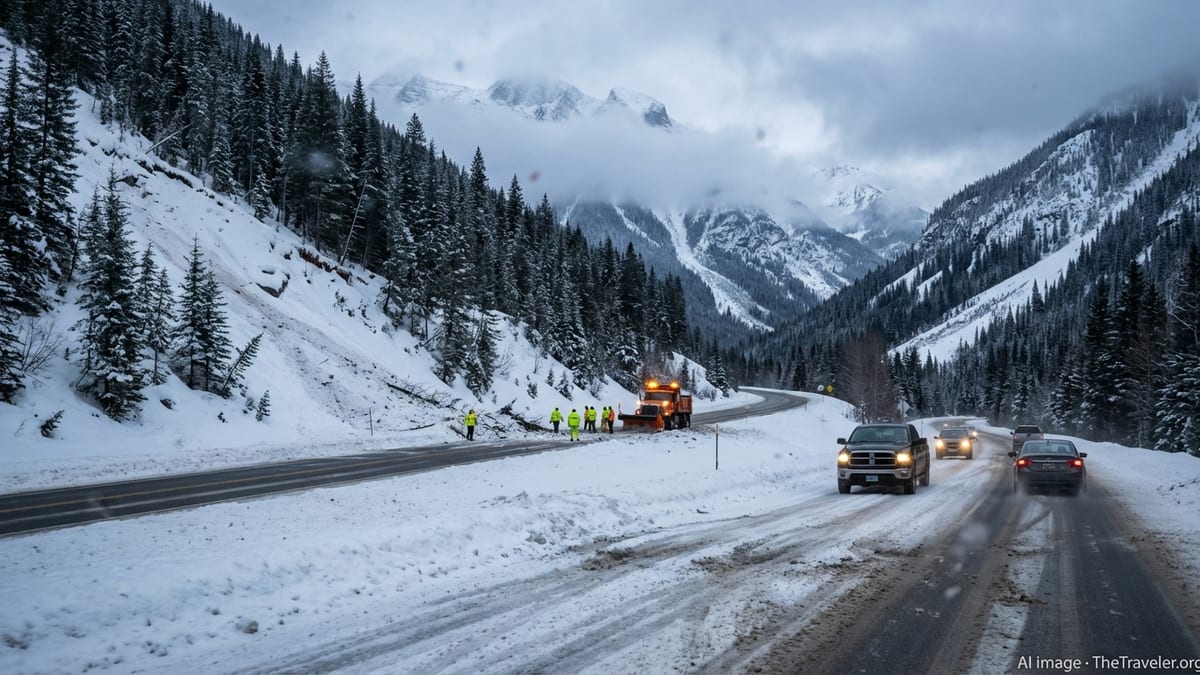
For travelers, the most immediate concern is the network of mountain highways that snake through avalanche terrain in western and southwestern Montana. Steep canyon walls, narrow river valleys and exposed passes make roads inherently vulnerable when unstable snow clings to surrounding slopes. While Montana Department of Transportation crews regularly monitor conditions and conduct avalanche control where infrastructure allows, many stretches remain subject to natural slides with little warning during active weather.
Several major routes, including segments of U.S. 93 north of Missoula, U.S. 2 between Kalispell and Libby, and regional passes that serve as gateways to recreation hubs and small communities, are expected to see periods of reduced visibility, drifting snow and ice through at least Tuesday evening. With snow continuing at higher elevations and rain or mixed precipitation in some valleys, drivers can encounter radically different conditions within a few miles, complicating efforts to judge risk from behind the wheel.
Montana already designates a handful of high-elevation roads, such as the Beartooth Highway and Skalkaho Pass, as seasonally closed due to deep snow and avalanche exposure; these routes are off limits until late spring. But many lower and mid-elevation corridors stay open through winter, providing crucial links for residents, freight operators and winter tourists. When natural slides reach the roadway, they can temporarily trap motorists, block emergency vehicles and sever access to isolated communities until heavy equipment can safely reach and clear debris.
State officials urge anyone planning to drive in the region to check real-time road condition maps and highway advisories before departure, build extra time into itineraries, and be prepared to turn back if conditions deteriorate. For visitors unfamiliar with mountain driving, local authorities recommend staying on main interstates and federal highways when possible, avoiding unplowed backroads and not relying on navigation apps that may route vehicles onto seasonally closed or poorly maintained tracks.
National Winter Emergency Amplifies Pressure on Transport Networks
Montana’s localized avalanche risk is unfolding against the backdrop of a wider winter emergency across much of the United States. The Federal Motor Carrier Safety Administration this month extended a regional emergency declaration for dozens of states, including Montana, in response to severe winter storms and prolonged cold snaps that have disrupted the flow of essential goods and strained utility networks.
From blizzards sweeping the northern Plains to freezing rain events in the Midwest and heavy mountain snows in the West, transport systems have been under sustained stress since late January. Long-haul truckers hauling fuel, heating supplies and groceries are navigating a patchwork of icy interstates, wind-prone mountain passes and intermittent road closures. While the federal declaration relaxes certain hours-of-service rules for commercial drivers engaged in emergency relief efforts, it does not lessen the physical risks they face when black ice, whiteout conditions and avalanche-prone corridors converge.
Passenger travel has also been disrupted. Airlines have issued repeated weather waivers for hubs in Denver, Salt Lake City and other western gateways, with knock-on effects for regional airports in Montana’s ski and gateway towns. Rail operators face snow-choked mountain segments and frozen switches, while intercity bus routes that connect rural communities may be suspended during the worst weather, leaving some residents proportionally more isolated.
Emergency managers warn that as winter storms continue to march across the country, the pressure on ambulance crews, search-and-rescue teams and highway patrol units is compounding. Each avalanche rescue or winter roadway crash diverts limited resources, forcing agencies to triage calls and coordinate across jurisdictions to maintain coverage during peak demand.
Backcountry Tourism and a Shifting Climate Raise the Stakes
Montana’s appeal as a winter destination has grown steadily, fueled by a surge in backcountry skiing and snowmobiling, as well as increased interest in national parks, hot springs and small-town winter festivals. That boom in cold-season tourism has coincided with a period of volatile winter weather patterns in the northern Rockies, where climate scientists and hydrologists report that snowpacks are increasingly shaped by swings between warm, wet storms and colder, high-intensity snow events.
Recent assessments by Montana hydrologists note that while some high-elevation basins entered February with above-average snow reserves, mid-elevation zones in parts of western Montana have lagged, with more precipitation falling as rain than snow during early winter. Such patterns can leave weak layers buried deep in the pack when colder systems finally arrive, setting the stage for persistent slab avalanches that are difficult to predict and slow to stabilize.
For recreationists, the implications are stark. Trails and slopes that locals considered relatively reliable in past decades can now present complex, spatially variable hazards from one week to the next. The allure of powder stashes and untouched bowls just beyond ski area boundaries can mask the fact that avalanche forecasters design their bulletins around broad zones, and even a “moderate” rating can still imply the possibility of large, destructive slides on specific aspects and elevations.
Tourism boards and outdoor industry groups are increasingly working with avalanche centers, guide services and gear retailers to promote a “know before you go” ethic. That message emphasizes checking official avalanche forecasts, carrying proper rescue equipment, and recognizing that some days the safest choice is to stay on groomed resort runs, low-angle glades or designated snowmobile routes rather than venturing into complex alpine terrain.
Local Officials Balance Safety, Access and Economic Realities
For local governments and business owners, the current avalanche warning period is another test of how to balance safety with the economic importance of winter tourism. Hotels, outfitters and restaurants in western Montana depend heavily on visitors who come to ski, ride snowmobiles or explore iconic parks and forests during the cold season. Abrupt closures and travel advisories can cut into already narrow profit margins, particularly in small towns that rely on a compressed high season.
Yet mayors, county commissioners and emergency managers are clear that they cannot afford to downplay hazards when slopes above roads and trailheads are unstable. Many communities now maintain close working relationships with National Weather Service offices and regional avalanche centers, participating in daily coordination calls during active storm cycles and amplifying safety messages through social media, visitor centers and hotel front desks.
Some ski areas and guide services have adopted more conservative operating protocols after recent fatal avalanches elsewhere in the West prompted scrutiny of decision-making in high-risk conditions. That can mean temporarily closing advanced terrain, restricting out-of-bounds access or canceling guided trips on short notice when red flags such as recent slides, cracking in the snowpack or rapid loading from new snowfall emerge.
Residents interviewed in mountain towns across Montana describe a growing acceptance that flexibility is now part of winter life. Locals are more likely to keep well-stocked pantries, adjust work commutes around major weather events and help visitors understand that a day spent exploring in-town cultural attractions or soaking in a hot spring can be a safer alternative when avalanche hazard spikes in the nearby peaks.
Safety Guidance for Drivers and Winter Recreation Travelers
Authorities across Montana are using the latest storm cycle and avalanche warnings as an opportunity to reiterate core safety principles for anyone traveling through the state in winter. Highway officials urge drivers to avoid nonessential travel during active storms, to slow down on snow- or ice-covered roads, and to leave generous following distance for sudden stops. Motorists are advised to equip vehicles with winter tires, maintain at least half a tank of fuel, and carry a cold-weather emergency kit stocked with blankets, warm clothing, food, water and a flashlight.
Before departure, travelers should clear all snow and ice from their vehicles, including roofs and hoods, to prevent sudden loss of visibility or hazards to other drivers. Black ice remains a particular danger across Montana’s long stretches of rural highway, especially before sunrise and after dark, when meltwater refreezes into an almost invisible glaze. Officials stress that even roads that appear merely wet may in fact be coated with thin ice, and that the safest speed in such conditions may be significantly lower than posted limits.
For those heading into the mountains for recreation, avalanche educators say the avalanche forecast is as essential as the weather forecast. Parties venturing into unmanaged terrain should carry, and know how to use, avalanche transceivers, probes and shovels, and should travel in small groups with clear communication and spacing on steep slopes. Simple terrain choices, such as favoring slopes under 30 degrees, avoiding the runout zones beneath known avalanche paths, and steering clear of convex rollovers and wind-loaded gullies, can dramatically reduce exposure.
Guides emphasize that the decision to turn around or select lower-risk objectives is a mark of experience, not weakness. In a season when the snowpack is sending mixed signals, the safest strategy is often to adopt a conservative mindset, assume that buried weak layers are present unless proven otherwise, and recognize that no single day in the mountains is worth a lifetime of consequence.
What This Winter Signals for Future Mountain Travel
As this winter’s storms continue to test Montana’s transportation systems and outdoor community, experts say the lessons extend beyond the current avalanche warning. Hydrologists, climate scientists and public safety planners widely expect that the combination of more variable winter temperatures, intense storm bursts and shifts in snow and rain patterns will make mountain travel more complex in the years ahead.
For state agencies, that outlook is already shaping investment decisions, from upgrading remote weather and snowpack monitoring stations to reassessing avalanche control infrastructure along vulnerable road corridors. Transportation planners are considering whether additional seasonal closures or new real-time warning systems may be needed to keep motorists safe on routes that thread beneath steep avalanche paths.
In the tourism sector, operators are exploring how to diversify winter offerings so that communities are less dependent on the precise timing and quality of snow. That could include promoting shoulder-season cultural events, investing in indoor attractions, or highlighting year-round draws such as wildlife viewing and local food scenes that are less sensitive to daily avalanche risk.
For travelers, the emerging reality is that a successful winter trip to Montana, or any mountain destination in the West, will increasingly require flexibility, preparedness and close attention to both weather and avalanche information. Whether navigating a remote highway or contemplating a backcountry descent, the message from authorities this week is consistent: respect the power of snow, build extra margins of safety into every decision, and be ready to adjust plans as conditions evolve.