

More news on this day
Montemaria in Batangas City, long known as a Marian pilgrimage site overlooking Batangas Bay, is rapidly evolving into a multi-layered destination where faith-focused travel now meets thrill attractions and winter-style family experiences.
Get the latest news straight to your inbox!
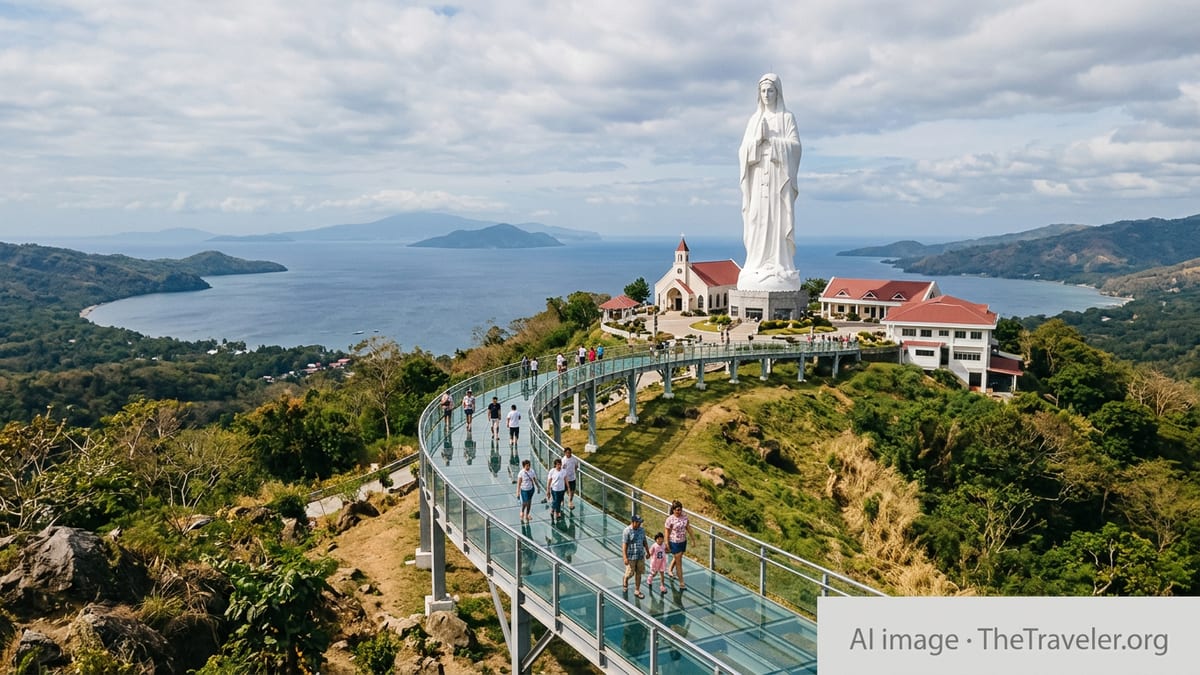
A Pilgrimage Landmark Reinventing Itself
Montemaria, formally the Montemaria International Pilgrimage and Conference Center in Barangay Pagkilatan, has been on the tourism radar for years as the home of the Mother of All Asia – Tower of Peace, regarded in publicly available references as the tallest statue of the Virgin Mary in the world. Rising high above Batangas Bay, the complex has traditionally drawn pilgrims, parish groups and faith tourists, particularly during Holy Week and major Marian feast days.
Recent coverage of domestic tourism trends indicates that Montemaria’s operators and partners are now positioning the site not only as a place of reflection but as a broader lifestyle and leisure destination. Reports highlight expanded dining options, improved access roads and upgraded devotional areas such as modernized Stations of the Cross, geared toward visitors who may combine religious observance with sightseeing and short breaks from Metro Manila.
This shift reflects a wider pattern in Philippine faith tourism, where pilgrimage centers increasingly incorporate attractions that appeal to multi-generational groups. For Montemaria, the surrounding sea views, hillside terrain and existing religious infrastructure offer a natural stage for new experiences that complement, rather than replace, its spiritual core.
Montemaria Miracle Walk: Glass Above the Bay
The most visible example of Montemaria’s reinvention is the newly opened Montemaria Miracle Walk, described in recent reports as the first glass walkway of its kind in the Philippines. Publicly available information from local tourism offices and lifestyle outlets notes that the structure stretches about 118 meters, supported by three-inch-thick glass panels and reinforced with imported metal components.
The walkway is reported to hover roughly 45 meters above ground level within the pilgrimage complex, offering unobstructed views of Batangas Bay and, on clear days, the wider Verde Island Passage. Visitors walk across a transparent floor, creating a sensation of floating over the coastal landscape while still surrounded by the recognizable silhouettes of the Tower of Peace and other religious features of the site.
Early coverage frames the Miracle Walk as an attraction intended to broaden Montemaria’s appeal to thrill seekers, casual sightseers and younger travelers who might otherwise choose purely leisure destinations. It adds a new layer to the experience of visiting the shrine, pairing contemplative spaces with an engineered rush that is still anchored in the same hillside overlooking Batangas’s maritime corridor.
Faith Meets Winter-Inspired Wonder
Alongside the glass walkway, Montemaria is part of a growing movement among Philippine destinations to create winter-themed attractions in a tropical setting, particularly around the Christmas season. While the country does not experience natural snowfall, a range of parks and villages nationwide have successfully used artificial snow effects, light installations and themed décor to evoke a temperate-climate holiday atmosphere.
Reports on seasonal attractions in the Philippines describe how snow shows, Christmas villages and nativity-focused displays have proven popular with families looking for an immersive holiday outing without traveling overseas. These concepts often blend familiar Christian imagery with playful winter motifs such as snowflakes, frosted trees and light tunnels, creating a hybrid environment that feels both devotional and festival-like.
Within this context, tourism commentators increasingly position Montemaria as well suited to a similar fusion. Its identity as a Marian pilgrimage site aligns naturally with nativity scenes, choir performances and candlelit processions, while its elevated coastal setting and open plazas lend themselves to light projections, faux-snow spectacles and evening viewing areas. The idea of a “winter wonder” overlay on a faith destination taps into a demand for experiences that are visually striking yet still grounded in religious tradition.
A New Magnet for Day Trips From Metro Manila
Montemaria’s location roughly a few hours’ drive from Metro Manila places it within the same weekend-trip orbit as many of Batangas’s beach and diving destinations. Travel features on the province increasingly mention the shrine and its surrounding attractions in lists of alternatives for road trippers seeking a change from the usual coastal itineraries.
Publicly available travel advice points to a pattern in which visitors combine a morning pilgrimage or shrine visit with afternoon stops at nearby beaches, cafes or city restaurants. The addition of the Miracle Walk, and any winter-style programming during the Christmas period, strengthens Montemaria’s position as a standalone highlight, potentially encouraging travelers to devote more of their itinerary to the hilltop complex itself.
Local tourism materials also underline recent investments in access roads and on-site facilities, improvements that aim to make trips smoother for both private vehicle owners and organized tour groups. As more images of the glass walkway and festive night scenes circulate on social media, Montemaria is expected to feature more prominently in day-tour packages marketed in Metro Manila and neighboring provinces.
Balancing Devotion, Safety and Visitor Experience
As Montemaria’s profile grows, attention is turning to how the site balances its dual role as a place of worship and an entertainment hub. Reports on the Miracle Walk’s specifications emphasize engineering considerations, including the thickness of the glass and the use of heavy-duty supports, as part of efforts to reassure visitors about safety while delivering a dramatic experience.
Faith-oriented commentators and travel writers alike note that the success of such hybrid attractions often rests on careful zoning and programming: quiet chapels and prayer areas need to remain protected from crowd noise, while thrill and winter-style features are typically clustered in designated sections and time slots. This approach helps preserve the contemplative character that drew pilgrims in the first place, even as the site hosts more diverse activities.
For Montemaria, the coming peak seasons will likely serve as a test of how effectively it can manage this blend of devotion, spectacle and crowd flow. If early reactions to the glass walkway and the broader interest in winter-themed attractions are any indication, Batangas’s emerging fusion of faith and winter wonder may soon become one of the country’s most talked-about short-break experiences.