

Set on the edge of the St. Lawrence River in Old Montreal, the Montreal Science Centre blends a classic portside setting with forward-looking, hands-on science.
It is one of the city’s most family-friendly attractions, a place where children can scramble, build and experiment while adults explore thoughtful exhibits about the human body, the Arctic, and the technologies reshaping everyday life. Whether you are visiting with young kids, teens, a school group or just your curiosity, knowing what to expect helps you make the most of a day here.
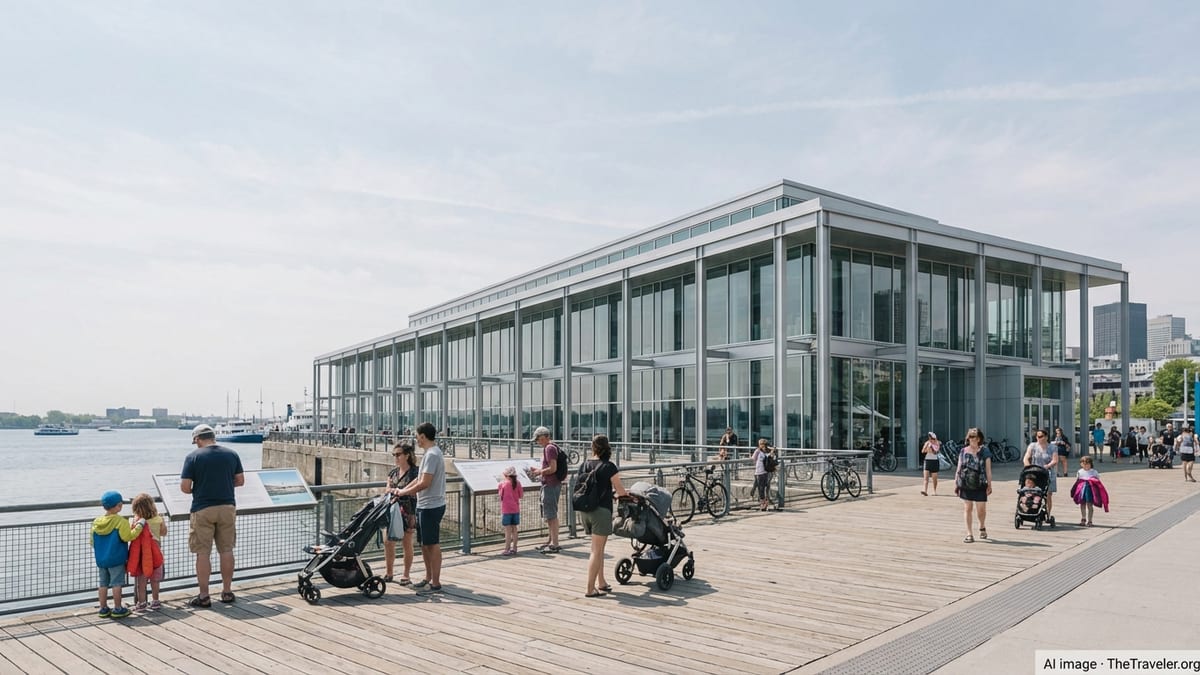
The Montreal Science Centre at a Glance
The Montreal Science Centre occupies a long, low-slung building on the Old Port waterfront, just steps from the cobblestone streets of Old Montreal. Inside, the industrial shell contains bright, flexible galleries designed for interactive exhibits rather than static display cases. Visitors come less to stare at objects than to touch, build and play their way through scientific ideas. Exhibits are presented in both French and English, and staff are generally comfortable shifting between the two, reflecting the bilingual character of the city.
For travellers, the centre’s location is one of its strongest assets. It sits within walking distance of downtown hotels, the Place-d’Armes metro station and riverfront promenades, making it easy to fold into a broader day of sightseeing. Many families pair a visit here with a stroll through Old Montreal or a ride on the nearby observation wheel. Indoors, the climate-controlled galleries offer a welcome refuge during winter cold snaps and humid summer afternoons, which helps explain why the site remains popular year-round.
From a practical standpoint, the Science Centre is relatively straightforward to navigate. Ticketing and information desks sit just inside the main entrance, with exhibition halls branching off on either side. The IMAX TELUS Theatre, a separate but closely connected attraction, anchors one end of the complex. Signage is clear and colour coded, and there are plenty of open areas where groups can regroup, plan their visit or simply let children burn off a little energy before heading into the next gallery.
While it is easy enough to wander at will, a little advance planning pays off, especially on weekends, school holidays and during Quebec’s late-February spring break, when families and school groups often fill the building. Checking current opening hours and film schedules before you arrive helps you decide whether to begin with a timed IMAX screening, focus on a particular exhibition or leave things open and follow your interests once inside.
Permanent Exhibitions: Hands-on Science for All Ages
The heart of the Montreal Science Centre lies in its permanent exhibitions, which are designed to be touched, tested and occasionally broken and rebuilt. These galleries aim to turn scientific concepts into physical experiences, allowing visitors to feel the weight of forces, observe the effect of variables and see complex systems reduced to playable form. Rather than hurrying from label to label, most visitors find themselves drawn into one or two spaces that match their interests or the age of their group.
Explore, one of the flagship galleries, focuses on fundamental phenomena such as motion, air, light, water, matter and geometry. Spread across large, open zones, it invites visitors to spin wheels, channel water, manipulate light and experiment with code at digital stations. Younger children tend to respond to the immediate cause and effect, while older kids and adults can dig into the underlying physics and principles of engineering. It is the kind of space where a quick stop can unexpectedly stretch into an hour as one experiment leads naturally to the next.
Human, another major permanent exhibition, shifts the focus to biology and evolution. Here the subject is the human body, from its long arc of transformation over thousands of years to the way it changes over a single lifetime. Interactive modules allow visitors to test reflexes, explore brain function and consider how genetics, environment and lifestyle intersect. The exhibit balances playful activities with more reflective content, touching gently on themes such as aging and health without becoming overly technical or clinical.
The centre’s newest permanent addition, Nanualuk: Northern Expedition, turns the spotlight on Canada’s Arctic and the lives of the Inuit communities who call it home. Developed in close collaboration with Inuit partners and launched to coincide with the centre’s 25th anniversary, it presents the North not as a distant abstraction but as a lived environment. Visitors take on missions that might involve learning to read sea ice, navigating by stars or understanding how wildlife and people adapt to extreme conditions. For international visitors unfamiliar with northern Canada, it offers a vivid and respectful entry point into a region that looms large in the country’s identity.
Mini Mondo and Fabrik: Paradise for Curious Kids
For families with young children, two spaces in particular tend to dominate the visit: Mini Mondo and Fabrik. Mini Mondo is designed specifically for children up to about seven years old and shrinks the world down to a scale they can manage. It recreates elements of everyday life, from city streets and homes to natural habitats, in a way that encourages role play and exploration. Children can pretend to shop, care for animals or run little experiments with water and sand, all while absorbing gentle messages about environmental protection and community.
The design of Mini Mondo reflects a growing awareness that toddlers and preschoolers learn science best by doing rather than by being told. Instructions are minimal and intuitive, with sturdy, tactile elements that invite independent play. Parents and caregivers, meanwhile, will appreciate that the space is enclosed and relatively easy to supervise. Thoughtful seating allows adults to rest while keeping sightlines across the room, and there are usually staff nearby to keep things running smoothly.
Fabrik, sometimes described as a creative workshop on overdrive, appeals to a broader age range that includes older kids, teens and even adults. Here the emphasis is on invention and problem solving. Visitors are presented with open-ended challenges, such as building a structure that can withstand a particular stress or devising a mechanism that performs a specific task, using bins of odd materials and components. The atmosphere is closer to a makerspace than a traditional museum gallery.
Because Fabrik relies on collaboration and iteration, it is especially rewarding for families and groups who enjoy working together. Siblings can divide tasks, parents can quietly steer younger children toward workable solutions or step back and let them take the lead. There is no single “right” answer, which means visitors are free to try, fail, laugh and try again. For many, this room becomes the unexpected highlight of the day, a place where abstract notions about engineering and design become tangible through trial and error.
IMAX TELUS Theatre: Big-Screen Science and Nature
At one end of the complex, the IMAX TELUS Theatre offers a different kind of immersion. Its screen rises to the height of a multi-storey building, and the theatre is equipped with modern laser projection technology and a multi-channel sound system designed for clarity as much as volume. Seats are steeply raked to preserve sightlines, and the overall effect is enveloping without feeling claustrophobic. Visitors who have only experienced standard cinema often comment on the sheer scale of the image and the precision of the audio.
The programming leans heavily toward documentaries and large-format films on themes such as wildlife, dinosaurs, deep oceans, astronomy and extreme landscapes, aligning with the Science Centre’s educational mission. Recent lineups have included productions about the life and behaviour of Tyrannosaurus rex, as well as journeys through Asian ecosystems and other natural environments. Running times tend to be shorter than mainstream feature films, which makes them manageable even for younger viewers or those unaccustomed to long screenings.
For many out-of-town visitors, pairing a film with a visit to the exhibitions turns the Science Centre into a full-day outing. A common strategy is to book a morning or early afternoon screening, then explore the galleries before or after, taking advantage of the fact that the theatre and museum share the same building. During peak times such as school holidays and spring break, it is prudent to check showtimes in advance and consider purchasing tickets early, since popular films and time slots can fill quickly with school groups and day camps.
The IMAX TELUS Theatre also serves as a venue for events and special screenings, occasionally hosting premieres or themed days that tie into current exhibitions. While information about these events tends to change regularly, travellers who are particularly interested in big-screen science experiences may wish to look at upcoming programming when planning a visit. Even without a special event, however, the theatre offers one of Montreal’s most impressive cinematic experiences and is especially appealing to teens and adults who might be less interested in hands-on exhibits but still enjoy grand visual storytelling.
Visitor Experience: Practicalities, Comfort and Accessibility
On a practical level, the Montreal Science Centre is designed to be as accessible and comfortable as possible for a broad audience. The building is step-free, with elevators and ramps linking all public levels, and it holds a certification recognizing its accessibility for visitors with physical limitations. Wheelchairs are available on loan in limited numbers for ticket holders, which can make a significant difference for visitors who face mobility challenges yet still wish to experience the exhibits at close range.
The Centre pays attention to sensory and communication needs as well. The IMAX TELUS Theatre offers assistive listening systems, including frequency-modulated signals suitable for visitors who bring their own compatible devices. Exhibitions feature bilingual signage in French and English, and staff are accustomed to assisting international visitors who may be navigating both the language and the science content at once. At certain times, the centre has introduced dedicated periods with softer lighting and sound for visitors who are particularly sensitive to overstimulation, although these offerings can vary and are worth confirming closer to your visit.
Families should be aware that food and drink are not permitted inside the main exhibition halls, a rule that helps protect the interactive components and keep spaces clean. Designated lunch areas exist, and during weekdays school groups are typically given priority access to these rooms. It can be wise to time snacks and meals around gaps in your visit, particularly with younger children who may not want to leave a favourite gallery once they have settled into play. Restrooms are distributed throughout the building, which keeps breaks from becoming major interruptions.
Parking is available in adjacent lots along the Old Port, with fees that reflect the central location and can add a noticeable amount to the overall cost of the day. For that reason, many visitors opt for public transportation or a combination of metro and walking, especially in the warmer months. The riverside setting, however, means that arriving on foot or by bike is a pleasant option, offering views of the city skyline and waterfront that underscore how the centre fits into the broader fabric of Montreal’s urban life.
Who the Montreal Science Centre Is Best For
While the Montreal Science Centre welcomes visitors of all ages, certain groups will find it particularly rewarding. Foremost among them are families with children ranging from toddlers to early teens. Mini Mondo provides a safe, stimulating environment for the youngest visitors, while Explore, Human, Fabrik and Nanualuk give older children and their parents plenty to investigate together. Exhibits are deliberately layered, with simple, intuitive activities that yield more complex insights if you pause to read the accompanying panels or discuss what you are seeing.
The centre is also a strong choice for school and youth groups, thanks to its educational programming and flexible spaces. Many of the installations are aligned, at least in spirit, with curriculum themes in science and technology, from basic physics and biology to environmental science and coding. Teachers and group leaders can build structured learning around the visit or use it as a broader introduction to scientific thinking and problem solving. The staff’s experience with managing large, energetic groups is evident in clear rules and well-signposted gathering points.
Tourists with limited time in Montreal may wonder whether the Science Centre deserves a place on a short itinerary. The answer depends on interests and travel companions. For visitors fascinated by interactive museums or travelling with children, it can easily justify half a day or more, especially when combined with a walk through Old Montreal or a riverside picnic. Adults travelling without children who have a deep interest in science communication, the Arctic or human biology will also find plenty to absorb, particularly in the Human and Nanualuk exhibitions and at the IMAX TELUS Theatre.
Those seeking quiet contemplation or traditional art and history collections might be better served by the city’s fine arts or archaeology museums. The Science Centre is lively, sometimes loud and unabashedly geared toward participation. Its strengths lie in movement, noise and discovery rather than hushed galleries. Understanding this in advance helps you decide whether its style matches your mood and the kind of experience you want from your time in Montreal.
Planning Your Visit and Making the Most of It
To get the most out of the Montreal Science Centre, it helps to think about your visit in phases. Many travellers aim to arrive close to opening time, when the building is quieter and popular areas such as Mini Mondo and Fabrik are less crowded. Starting with your top-priority exhibition means you see it at a relaxed pace, with more room to experiment at each station. As the day progresses and the centre fills up, you can shift to galleries that handle higher visitor flows more easily or take a break outdoors along the river.
Keeping expectations realistic is equally important. The depth and variety of interactives mean it is difficult to see absolutely everything in a single visit, especially with children who may fixate on particular areas. Instead of racing from hall to hall, consider letting each family member choose one must-see space and plan your route accordingly. This approach reduces friction and ensures that everyone feels their interests have been heard. If you are staying in Montreal for several days, you may even decide to return for a second visit, treating different exhibits as separate experiences rather than a single checklist.
International visitors should keep Montreal’s seasons in mind. In winter, the Science Centre can be a welcome indoor anchor around which to build a day outdoors in the snow-lined Old Port. In summer, it offers cool respite from the heat and humidity, with the added benefit of outdoor terraces and river views just steps from the exit. Spring and autumn bring school field trips and local families on weekends, which can make weekdays the calmer option for travellers seeking a quieter environment.
Finally, leave a little unstructured time in your schedule. Some of the most memorable moments at the Science Centre come not from carefully planned stops but from serendipitous discoveries: a coded message that suddenly clicks for a child in Explore, an unexpectedly moving audio testimony in Nanualuk or a shared laugh as a family-built contraption in Fabrik collapses and inspires a better version. By allowing space for these small surprises, you align your expectations with the centre’s spirit of curiosity and experimentation.
The Takeaway
The Montreal Science Centre is more than an attraction to tick off a list. It is a space where complex ideas are rendered graspable, where children can test the rules of the physical world and where adults are invited to rediscover the pleasure of asking questions. Set against the historic backdrop of Old Montreal, it provides a striking contrast between the city’s past and its aspirations for the future.
Its exhibitions span the intimate and the vast, from the cells and systems of the human body to the sweeping landscapes of the Arctic and the dramatic stories told on a giant IMAX screen. The emphasis on interaction ensures that a visit is shaped as much by what you choose to do as by what has been installed, giving each visitor a slightly different experience. Accessibility measures, bilingual content and a deliberate focus on inclusivity broaden its appeal to locals and international visitors alike.
For families and curious travellers, the Montreal Science Centre offers a full, rewarding day that fits easily into a broader exploration of the city. By arriving with a basic understanding of its layout, exhibits and strengths, you can tailor your visit to your interests and those of your companions. In doing so, you will likely leave not just with tired legs and a few photos but with renewed appreciation for the power of playful discovery.
FAQ
Q1. How much time should I plan for a visit to the Montreal Science Centre?
Most visitors spend between three and five hours, depending on how many exhibitions they explore and whether they add an IMAX film. Families with young children often stay longer, especially if kids become absorbed in Mini Mondo or Fabrik.
Q2. Is the Montreal Science Centre suitable for very young children?
Yes. Mini Mondo is specifically designed for children up to about seven years old, with soft, scaled-down environments and intuitive activities. Strollers are common, and there is plenty of space for families to move around comfortably.
Q3. Are exhibits and information available in English?
All major exhibitions are bilingual, with text and instructions in both French and English. Staff are accustomed to assisting English-speaking and international visitors, so language is rarely a barrier to enjoying the experience.
Q4. Do I need separate tickets for the IMAX TELUS Theatre?
Yes. Access to the IMAX TELUS Theatre generally requires a separate or combined ticket that includes a specific film and time. It is wise to check showtimes in advance and consider booking early during busy periods.
Q5. Is the Montreal Science Centre accessible for visitors with reduced mobility?
The building is step-free and includes elevators, ramps and adapted restrooms. Wheelchairs are available in limited numbers for ticket holders, and the IMAX TELUS Theatre offers assistive listening systems for visitors who need them.
Q6. Can we bring food and eat inside the exhibitions?
Eating and drinking are not allowed in the exhibition halls to protect the installations. Designated lunch and snack areas are available, and school groups usually have priority in certain rooms during weekdays.
Q7. When is the best time to visit to avoid crowds?
Weekday mornings outside of school holidays are generally quieter. Weekends, rainy days and Quebec’s spring break can be busy, with many local families and school groups visiting at the same time.
Q8. Is the Montreal Science Centre a good choice for adults without children?
Adults with an interest in science, technology, the human body or the Arctic will find plenty to engage them, especially in Human, Explore and Nanualuk, as well as at the IMAX TELUS Theatre. Those seeking a quieter, more traditional museum atmosphere may prefer Montreal’s art and history museums.
Q9. How easy is it to get to the Montreal Science Centre by public transport?
The centre is a short walk from downtown Montreal and the Place-d’Armes metro station. Many visitors combine the metro with a stroll through Old Montreal, avoiding parking fees and enjoying the waterfront setting along the way.
Q10. Can I leave and re-enter the Science Centre on the same day?
Same-day re-entry is often possible with a valid ticket, allowing visitors to take breaks along the Old Port or have a meal nearby before returning. It is still sensible to confirm the re-entry policy at the ticket desk on arrival.