

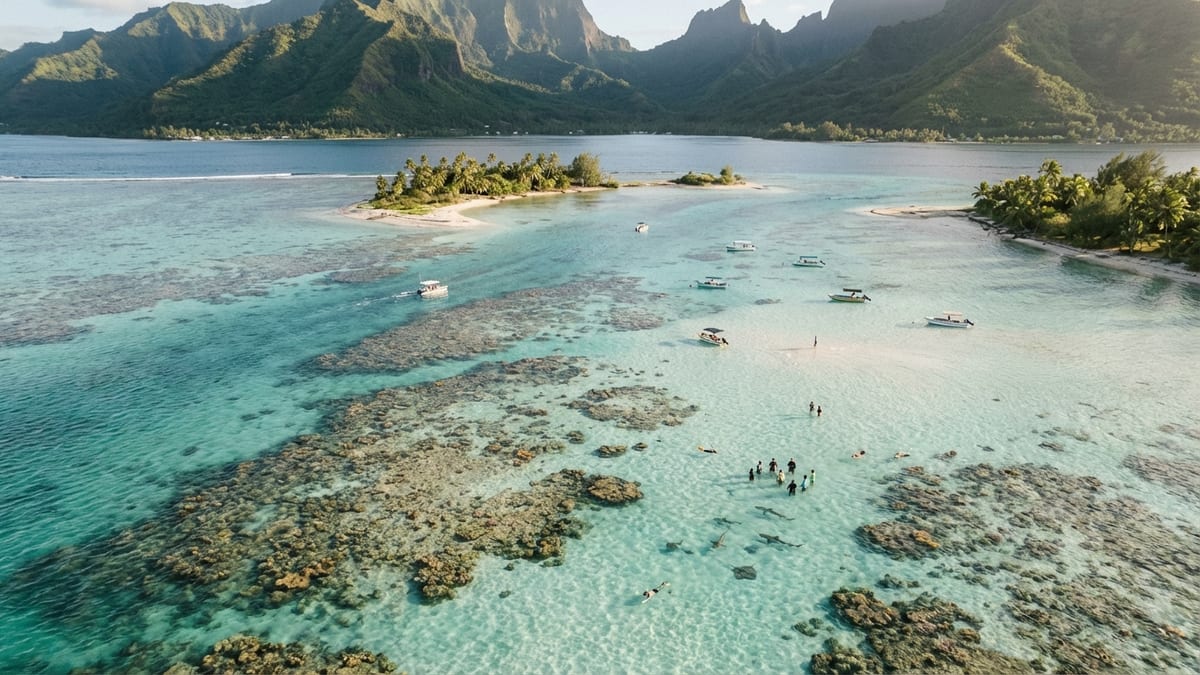
The lagoon that encircles Moorea is as iconic as the island’s jagged volcanic peaks. Glass-clear shallows, white sandbanks and coral gardens create a natural aquarium where rays, reef sharks and clouds of butterflyfish are part of daily life. For travelers, this lagoon is the heart of Moorea, and snorkeling it is often the highlight of a trip to French Polynesia. From shallow coral gardens you can drift over on your own to sandbanks only reachable by boat, Moorea offers a spectrum of experiences that remain surprisingly accessible while still feeling wild.
Understanding Moorea’s Lagoon
Moorea sits just northwest of Tahiti, ringed by a barrier reef that forms a calm lagoon between the island and the open Pacific. Passes through the reef concentrate tidal currents and bring nutrients into the lagoon, which helps sustain dense coral growth and attracts fish, rays and reef sharks. The mix of shallow sand, coral bommies and deeper channels is what makes Moorea such a rich snorkeling destination, with different micro-environments often only a short swim apart.
Key parts of the lagoon are structured around bays and passes. To the north and northwest, the reef is punctuated by channels near Tiahura and the small islets known locally as motu, where currents create ideal conditions for coral gardens and regular encounters with blacktip reef sharks and stingrays. On the northeast side, the reef off Temae Beach shelters extensive coral gardens close to shore. Around Opunohu Bay and Cook’s Bay, the lagoon deepens, but near their mouths you still find accessible reefs, sea-grass beds and sand flats that host turtles and schooling fish.
The lagoon is largely protected from big ocean swells, making conditions generally calm and clear for much of the year. Trade winds can, however, pick up in the afternoon, churning up exposed areas and making it harder for beginners. This is why many local guides time their lagoon tours for the morning, when the water is usually at its smoothest and visibility is at its best.
In recent years, Moorea operators have put more emphasis on low-impact snorkeling and wildlife encounters. Lagoon cruises now commonly limit group sizes, avoid feeding wildlife or use reduced bait, and stick to designated areas to reduce stress on sharks and rays. Visitors are encouraged to wear reef-safe sunscreen and to avoid standing on coral, small changes that help preserve the lagoon’s health in the face of growing tourism.
Top Snorkeling Areas: From Temae to Tiahura
Several stretches of Moorea’s lagoon have become known worldwide among snorkelers, not because they are exclusive, but because they combine easy access with consistently rich marine life. On the northeast coast, Temae Beach offers one of the island’s best shore-accessible coral gardens. Entering from the public beach and swimming toward the Sofitel overwater bungalows, snorkelers encounter healthy coral heads and anemone gardens sheltering clownfish, wrasses and delicate butterflyfish in remarkably clear water.
On the northwest coast, the shallow lagoon off Tiahura Beach and the nearby islets Motu Tiahura and Motu Fareone are equally celebrated. Here the lagoon is shallow, turquoise and dotted with coral bommies, making it ideal for long, relaxed snorkels. Between the motu lies what many visitors refer to simply as “the Coral Garden,” a network of coral outcrops where hard corals form intricate shapes and soft corals sway with the current, surrounded by parrotfish, surgeonfish and occasionally sea turtles moving between the bommies.
Further offshore lies the Sharks Sandbank, a shallow area of bright white sand about a few hundred meters off Tipaniers Beach. This is one of the most popular sites for seeing blacktip reef sharks and stingrays in clear, waist-deep water. While access is possible by kayak for confident paddlers, most travelers visit as part of a guided lagoon tour that includes safety briefings and close supervision in the water.
Elsewhere on the island, Taahiamanu (also called Opunohu or Mareto Beach) offers good snorkeling not far from shore, particularly along the drop-off where the shallow lagoon gives way to deeper water. Here, fish life can be abundant, though corals may be less vibrant than at Temae or the Tiahura coral gardens. Still, the setting at the foot of Moorea’s steep, jungle-clad mountains is spectacular, and the site is a favorite for travelers combining beach time with casual snorkeling.
Rays and Sharks: What to Expect
For many visitors, Moorea’s lagoon is synonymous with close encounters with rays and reef sharks. The most commonly seen sharks are blacktip reef sharks, which are slender, fast-swimming and easily identified by the black markings on the tips of their dorsal and tail fins. In the lagoon they are typically less than five feet long, and they are considered harmless to humans when treated with respect. They are curious and often circle at the edge of groups, occasionally coming closer in hopes of a handout where feeding occurs.
Stingrays, particularly Tahitian stingrays, are abundant in a few specific sandbanks and shallow areas. Over time, some rays have become habituated to tour boats and may glide directly up to snorkelers, brushing against legs or circling in very close proximity. While these rays are generally placid, they are still wild animals. Guides often emphasize that visitors should avoid stepping on rays, grabbing them or attempting to ride them, both for the animals’ welfare and for personal safety.
Encounters usually take place at designated ray and shark spots, such as shallow sandbanks near Tiahura or the Sharks Sandbank off Tipaniers Beach. Boats typically anchor in shallow water, and guests enter slowly with masks and snorkels. The water here is often waist to chest deep, which makes the experience accessible even to those who are not strong swimmers. Some tours still use small quantities of bait or fish scraps to draw animals closer, while others rely on the fact that the rays and sharks already associate the site with boats and people.
Beyond these star attractions, snorkelers can sometimes spot eagle rays gliding gracefully along drop-offs, and in deeper channels, occasional lemon sharks may be seen from the boat. While large pelagic species are rarer inside the lagoon, the blend of rays and reef sharks against a backdrop of bright coral and white sand provides a reliably memorable experience, even on shorter tours.
The Coral Gardens: Where and How to Explore
Moorea’s coral gardens are scattered throughout its lagoon, but the term is most often used for the shallow, current-swept areas between Motu Tiahura and Motu Fareone on the northwest coast, and for the coral zone off Temae Beach on the northeast shore. In both places, snorkelers can drift slowly above dense coral fields in water that is often only chest deep, giving a close-up view without the need to dive down.
At Tiahura’s Coral Garden, coral heads rise from a sandy bottom, separated by narrow sandy channels. Many lagoon tours stop here, often anchoring in a patch of sand at the edge of the garden. Snorkelers can then follow their guide along a gentle route, weaving between coral clusters and watching as schools of damselfish, surgeonfish and goatfish dart among the branches. The setting is particularly photogenic, with sunlight penetrating easily to the bottom and illuminating both coral and fish in vivid color.
The Coral Garden can also be reached independently by renting a kayak or paddleboard from shore at spots like Tipaniers Beach or Tiahura. Paddling out, however, requires awareness of wind, currents and boat traffic. Travelers who choose this option are usually advised to go early in the morning when conditions are calmer and to wear brightly colored gear so they are visible to passing boats. Once at the garden, it is crucial to anchor only on sand and never on coral, as anchoring directly on the reef can cause significant damage.
On the eastern side of the island, Temae’s coral gardens are unusual in that they can be explored simply by swimming out from the public beach. After a short stretch of sand and seagrass, coral heads start to appear, becoming denser and more varied as you swim toward the deeper outer section of the lagoon. Here too, currents can be present, but many snorkelers are drawn by the mix of soft corals, anemones and fish life that gather in and around the coral. The accessibility of this site makes it a favorite for repeat sessions at different times of day.
Going With a Guide vs Snorkeling on Your Own
Travelers to Moorea face an early decision: explore the lagoon entirely on their own, or join one of the many dedicated lagoon and snorkeling tours. In practice, most visitors do a combination of both, using guided trips to reach remote sandbanks and learning the layout of the lagoon, then exploring beach-accessible spots independently on other days.
Guided lagoon tours typically last three to four hours and combine several activities. A common itinerary includes a scenic cruise past Opunohu Bay and Cook’s Bay, a stop to watch or snorkel near sea turtles in a pass, time at a stingray and shark sandbank, and a session in a coral garden. Some tours include fruit tastings, music on board or a picnic on a motu. Groups are often limited to around a dozen passengers, and equipment such as masks, snorkels and fins are provided and maintained by the crew.
For first-time visitors or less confident swimmers, the oversight and local knowledge of a guide can be invaluable. Guides choose sites based on daily conditions, watch for changing currents and provide safety briefings before each swim. Many operators now emphasize responsible practices, from reminding guests not to stand on coral to moderating wildlife interactions and following local regulations regarding approach distances and feeding.
Independent snorkeling, meanwhile, suits those who prefer a slower pace or want to return to favorite sites multiple times. From public beaches such as Temae, Tiahura, Taahiamanu and others, you can enter directly from shore and stay within your comfort zone. Renting a kayak to reach outer reefs and sandbanks offers greater flexibility but also demands more skill and judgment, particularly when the wind rises or when boat traffic increases near popular sites.
Safety, Conditions and Responsible Practices
Although Moorea’s lagoon is generally calm, it is still a dynamic marine environment and deserves the same respect as any open-water setting. Conditions can change quickly, especially in and around passes where tidal currents accelerate. Even in apparently tranquil shallows, waves driven by afternoon trade winds can reduce visibility and make it harder to stay together as a group. Guides frequently schedule their trips for mornings, when winds are lighter and the sun is already high enough to illuminate the seabed.
Basic precautions can significantly enhance safety. Wearing a well-fitted mask and snorkel, along with fins, helps maintain control in mild current and reduces fatigue. Many travelers also choose to wear a buoyancy aid or snorkeling vest, particularly if they are less experienced swimmers. Staying aware of boat traffic is critical, especially near channels and popular sandbanks; using a brightly colored float or dive flag when snorkeling independently is recommended in these areas.
Wildlife encounters should always be approached with caution and respect. While stingrays and blacktip reef sharks in Moorea’s lagoon are generally habituated and non-aggressive, they are not pets. It is wise to avoid sudden movements, not to corner animals and never to attempt to lift, ride or pin a ray. Stepping carefully in shallow water helps avoid unintentional contact with rays or stonefish that may be resting on the bottom. Guides often advise guests to shuffle their feet rather than take big steps in sandy areas.
Responsible snorkeling also means taking steps to minimize environmental impact. Standard sunscreens often contain chemicals that can damage corals, so reef-safe products are strongly encouraged, and wearing long-sleeved rash guards can reduce the amount of product needed. Standing or walking on coral can crush fragile structures and kill living tissue, so snorkelers are urged to float rather than stand when over any kind of reef. Litter, including plastic packaging or discarded gear, should never be left on beaches or in boats where it can blow into the water.
Practical Tips for Planning Your Lagoon Days
Planning a snorkeling-focused visit to Moorea starts with timing. The island can be visited year-round, but the drier, cooler months from roughly May to October tend to offer more stable weather, lower humidity and often clearer visibility in the lagoon. The wetter summer months from November to April can bring heavier showers and occasional storms, but also fewer crowds and warmer water. Within any season, morning sessions are generally the best choice for snorkeling because winds and boat traffic are lighter.
Most lagoon and snorkeling excursions operate daily throughout the year, with slight variations in schedule depending on daylight and demand. Half-day tours typically depart in the morning, returning around midday or early afternoon, while some operators offer shorter early-morning or late-afternoon outings focused on snorkeling plus sunrise or sunset views. Reserving ahead is recommended during peak travel periods, especially if you want a small-group or private tour that caters to specific interests such as photography or marine biology.
Equipment can make a big difference in comfort. While almost every tour operator provides masks, snorkels and fins, travelers with sensitive skin or particular fit preferences may prefer to bring their own. A light wetsuit top or rash guard helps prevent sunburn, while water shoes can be useful when entering or exiting the water from rocky shorelines. For independent explorations, renting a kayak or paddleboard near popular beaches allows you to reach coral gardens and sandbanks at your own pace, with many rental stands providing dry bags and basic instructions.
Transport around Moorea’s perimeter road is straightforward, and many beaches and departure points are signposted. Public parking is available at major beaches, though spaces can fill quickly at midday. Some travelers choose to stay near their favorite snorkeling area, such as Temae or Tiahura, so they can walk directly to the water. Others prefer to rent a car and explore multiple sites over several days, taking advantage of different conditions around the island and revisiting standout spots when the light and tides align.
The Takeaway
Moorea’s lagoon is a rare combination of drama and accessibility. The island’s steep mountains and deep bays provide a striking backdrop, but it is the shallow, sheltered waters of the lagoon that leave the deepest impression on most visitors. Snorkeling here is not an isolated, once-off activity but something that can shape the entire rhythm of a trip, from quick dawn swims on a quiet beach to half-day cruises through coral gardens dotted with rays and reef sharks.
Choosing between guided tours and independent explorations is less an either-or decision than a question of balance. Local guides open up remote sandbanks, share insights into lagoon ecology and Polynesian culture, and help ensure that encounters with wildlife remain safe and respectful. At the same time, the ease of access from public beaches means you can return to your favorite spots whenever the light, mood or tide seems right.
As tourism continues to grow, the lagoon’s future will depend on the choices made by both operators and visitors. Wearing reef-safe sunscreen, refusing to stand on coral and treating rays and sharks as wild animals rather than props are small steps that, multiplied by thousands of travelers, can help keep Moorea’s lagoon thriving. For those who approach it with care, the reward is an underwater world of unusual clarity and life, a place where even a simple snorkel can feel like slipping into a living postcard.
FAQ
Q1. Is snorkeling in Moorea safe for beginners?
Snorkeling in Moorea is generally safe for beginners because many sites are shallow, calm and close to shore, especially in the mornings. Joining a guided lagoon tour for your first outing is a good way to gain confidence under the supervision of experienced crew and to learn basic techniques and safety practices.
Q2. Do I need to be a strong swimmer to snorkel with rays and sharks?
You do not need to be a strong swimmer to visit the most popular ray and shark sandbanks, as the water is often waist to chest deep and flotation devices are usually available. However, being comfortable in the water, listening carefully to your guide and staying within designated areas are all essential for a relaxed and safe experience.
Q3. What is the best time of year to snorkel in Moorea?
You can snorkel in Moorea year-round, but many travelers prefer the drier, cooler period from about May to October, when weather and sea conditions are typically more stable. Within any season, mornings usually offer the calmest seas and clearest visibility, making them ideal for lagoon tours and independent snorkeling sessions.
Q4. Can I snorkel the coral gardens without a tour?
Some coral gardens, such as those off Temae Beach, can be reached easily from shore without a tour. The famous Coral Garden between Motu Tiahura and Motu Fareone can also be reached by kayak or paddleboard from the coast, although this requires awareness of currents, wind and boat traffic. First-time visitors often choose a guided trip before attempting independent excursions.
Q5. Are blacktip reef sharks in Moorea dangerous?
Blacktip reef sharks in Moorea’s lagoon are generally considered non-aggressive toward humans and are accustomed to the presence of boats and swimmers. They should still be treated with respect: avoid chasing them, do not attempt to touch them and follow any instructions from your guide. Incidents are extremely rare when basic guidelines are observed.
Q6. What kind of marine life can I expect to see?
In addition to blacktip reef sharks and stingrays, Moorea’s lagoon hosts a wide range of reef fish such as parrotfish, butterflyfish, damselfish, wrasses and surgeonfish. In coral garden areas you may see clownfish in their anemones, while seagrass beds and channels can shelter sea turtles, eagle rays and occasional larger visitors like lemon sharks viewed from the boat.
Q7. Do I need to bring my own snorkeling equipment?
Most lagoon tour operators provide masks, snorkels and fins as part of their excursions and maintain the gear regularly. If you are particular about fit or plan to snorkel frequently from shore, you may prefer to bring your own mask and snorkel for comfort and hygiene. Lightweight fins or short travel fins are convenient and adequate for lagoon conditions.
Q8. How can I protect the coral while snorkeling?
You can help protect the coral by never standing or walking on reef structures, keeping a safe distance when swimming above shallow bommies and avoiding contact with the reef with your fins or equipment. Wearing a rash guard and using reef-safe sunscreen reduce chemical impacts, and securing loose items prevents accidental littering in the water.
Q9. Are there age restrictions for lagoon tours?
Age policies vary by operator, but many lagoon cruises accept children as young as three or four years old when accompanied by a parent or guardian. Young children often stay on the boat during deeper-water stops and may only enter the water at very shallow sandbanks. It is important to confirm specific age and safety requirements with the operator when booking.
Q10. Can I still snorkel if the weather is cloudy or rainy?
Light cloud cover usually has little effect on snorkeling conditions, although colors underwater may appear slightly muted. Heavy rain, strong wind or storms, however, can reduce visibility, create surface chop and increase current strength. In such cases, responsible operators may modify itineraries, move to more sheltered sites or cancel trips altogether in the interest of safety.