

More news on this day
Air travel across Europe faced another day of heavy disruption as airports in Spain, Germany, England, Denmark, Türkiye, and the Netherlands collectively recorded 1,619 delayed flights and 39 cancellations, tangling schedules for Lufthansa, Vueling, British Airways, KLM, Ryanair, Turkish Airlines, and other carriers at key hubs including Berlin, Copenhagen, Madrid, and Istanbul.
Get the latest news straight to your inbox!
Storms, Staffing Strains, And Knock-On Congestion
Publicly available flight-tracking data and regional media coverage indicate that the latest wave of disruption is part of a broader pattern of springtime instability in European aviation, with poor weather, congested airspace, and local operational issues combining to slow traffic across multiple countries.
Recent days have seen named storm systems sweeping across northern and western Europe, bringing high winds and heavy rain to the United Kingdom, Germany, Denmark, and surrounding regions. These conditions have reduced runway capacity at several major hubs and forced airlines to impose temporary flow restrictions, contributing to rolling delays that ripple through the network long after the worst weather passes.
Industry analysis shows that when traffic is already near capacity, even a short‑lived storm or local staffing shortage can quickly translate into widespread disruption. Aircraft and crew end up out of position, turnaround times lengthen, and subsequent departures from cities such as Berlin, Copenhagen, Madrid, and Amsterdam push deeper into delay territory, driving up the regional totals now visible in the latest figures.
Observers note that the current situation follows a winter and early spring marked by repeated weather‑driven slowdowns at major European hubs, leaving airlines operating with limited flexibility as they ramp up schedules for the busy tourism season.
Major Hubs From Madrid To Copenhagen Under Pressure
The latest tracking data show that the disruption is concentrated at some of Europe’s most important transfer points. In Spain, Madrid’s Adolfo Suárez Madrid‑Barajas Airport has reported sustained levels of delayed departures and arrivals, mirroring recent days in which more than 200 services in a single day have run late as schedules buckled under regional storms and airspace constraints.
In Germany, Berlin’s main international gateways have recorded significant knock‑on delays, particularly on routes connecting to northern Europe and the United Kingdom, where strong winds and changing weather systems have further squeezed capacity. Frankfurt and Munich, already coping with earlier rounds of disruption this month, have also contributed to the elevated delay totals reported across the country.
Denmark’s Copenhagen Airport has emerged as one of the focal points of the current episode. Operational problems combined with adverse wind conditions over the past several days have repeatedly pushed the number of affected flights well into triple digits, and the new figures on delays and cancellations suggest that recovery remains fragile as airlines work to restore normal rotations.
In Türkiye, Istanbul’s role as a bridge between Europe, the Middle East, and Asia means that local delays quickly send shockwaves through the wider network. Even a relatively modest number of cancellations can trigger missed connections and extended layovers for passengers traveling onward to destinations across Europe, the Gulf, and beyond.
Flag Carriers And Low-Cost Giants Hit Alike
The latest disruption has cut across airline business models, affecting Europe’s traditional network carriers and its largest low‑cost operators at the same time. Lufthansa, British Airways, Turkish Airlines, and KLM have all reported delayed operations on regional and long‑haul services, with banked waves of departures from their main hubs particularly vulnerable when earlier flights arrive late.
Low‑cost airlines including Ryanair and Vueling have also been heavily exposed. With tight turnarounds and dense schedules designed to maximize aircraft utilization, these carriers often have limited slack in their systems. Once the first rotations of the day slip, subsequent legs can accumulate delays, leading to a higher share of late operations even if cancellations remain comparatively limited.
Sector analysts point out that many airlines entered 2026 with ambitious growth plans in response to strong leisure and visiting‑friends‑and‑relatives demand, especially on intra‑European routes. That expansion has increased the number of flights funneled through already‑busy hubs in Spain, Germany, England, Denmark, and the Netherlands, reducing the margin for error when weather or staffing issues arise.
Recent on‑time performance studies also highlight persistent structural challenges, such as air traffic control bottlenecks in parts of western Europe and ongoing recruitment gaps at some ground‑handling and security providers, which can turn localized disturbances into region‑wide delays.
Passenger Impact And Travel Advice
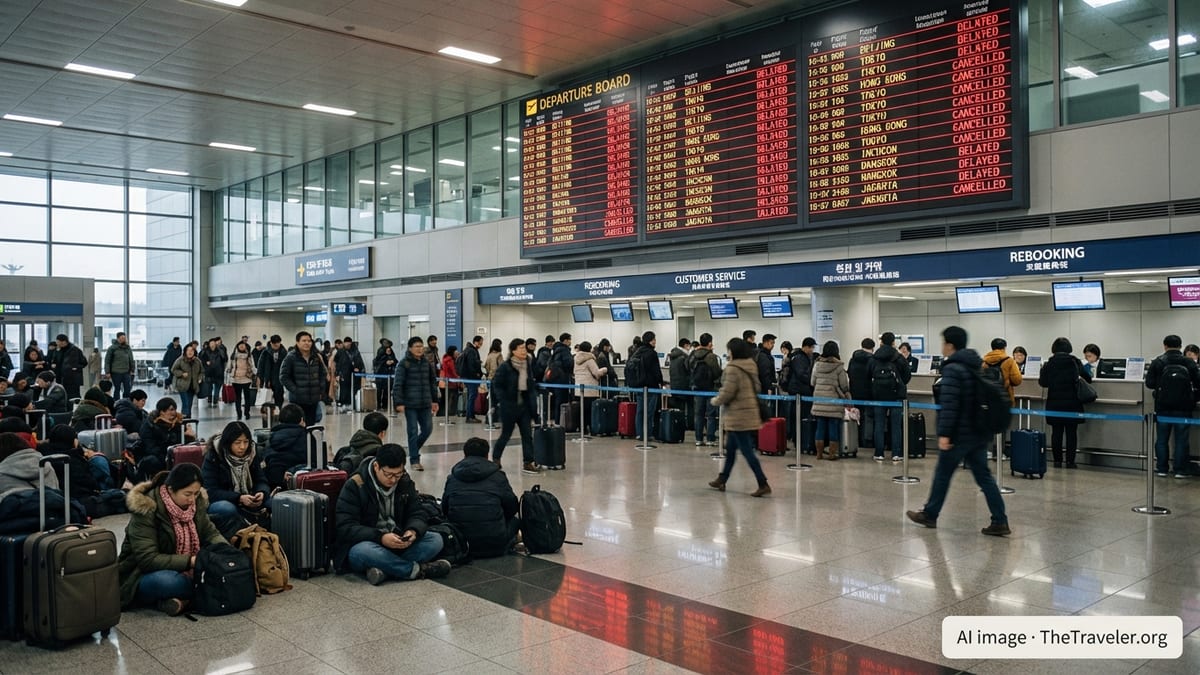
The immediate impact for travelers has been crowded terminals, long queues at check‑in and security, and departure boards dominated by orange and red delay indicators. With 1,619 flights delayed and 39 cancelled in the latest count across the affected countries, tens of thousands of passengers are facing missed connections, shortened city breaks, and disrupted business trips.
Publicly available guidance from passenger‑rights organizations emphasizes that travelers booked on affected flights should closely monitor airline apps and airport information screens, and be prepared for last‑minute gate or schedule changes. Keeping documentation of boarding passes and receipts for food, transport, or emergency accommodation is also widely recommended for those seeking reimbursement or compensation under applicable regulations.
Consumer advocates note that even when cancellations remain relatively small in number compared with delays, disruption can snowball throughout the day. A cancelled early‑morning rotation on a carrier such as Lufthansa, British Airways, or Turkish Airlines may cascade through onward legs, leading to further missed connections in Berlin, London, or Istanbul later in the schedule.
Travel planners suggest that passengers who have not yet departed consider building extra buffer time into itineraries that require tight same‑day connections, especially when traveling through hubs in Spain, Germany, England, Denmark, Türkiye, or the Netherlands during this unsettled period.
What Today’s Turbulence Signals For The Summer
For aviation analysts and tourism stakeholders, the latest spike in European delays is a warning sign for the upcoming summer high season. With flight numbers climbing back toward or above pre‑pandemic levels on many routes, the current pattern of weather‑driven disruptions and operational strains raises questions about how resilient the system will be once peak holiday traffic begins.
Recent industry data underline that, even in years with relatively few outright cancellations, delay levels can remain stubbornly high across major European markets. Spain, Germany, and the United Kingdom in particular have seen elevated proportions of late arrivals and departures, reflecting both infrastructure limitations and complex air traffic flows over some of the continent’s busiest corridors.
Airports and airlines have announced ongoing investments in staffing, technology, and contingency planning, yet the latest figures from hubs such as Madrid, Berlin, Copenhagen, Amsterdam, and Istanbul show that recovery from each new disruption can still be slow. Travel organizations are therefore urging passengers to stay informed, allow more time at airports, and remain flexible about routing options when possible.
As Europe moves deeper into the spring travel period, all eyes will be on whether weather patterns stabilize and whether operational improvements can keep pace with rising demand. For now, the 1,619 delayed flights and 39 cancellations spanning Spain, Germany, England, Denmark, Türkiye, and the Netherlands illustrate how quickly a combination of storms and strained resources can unsettle even the continent’s most vital air corridors.