

I went up Kilimanjaro three different ways on three different trips: Option A, the Machame route; Option B, the Lemosho route; and Option C, the Marangu route. By the end I had slept in both tents and mountain huts, queued on the Barranco Wall behind a conga line of trekkers, waded through wet socks in the rainforest, and spent more than I expected on park fees and tips.
What surprised me most was not the altitude or the cold, but how different each route felt in terms of atmosphere, value, and sheer daily experience. If you are staring at route maps and glossy operator photos, I have been there. The reality on the ground is more nuanced, more crowded in places, and sometimes less romantic than the brochures suggest.
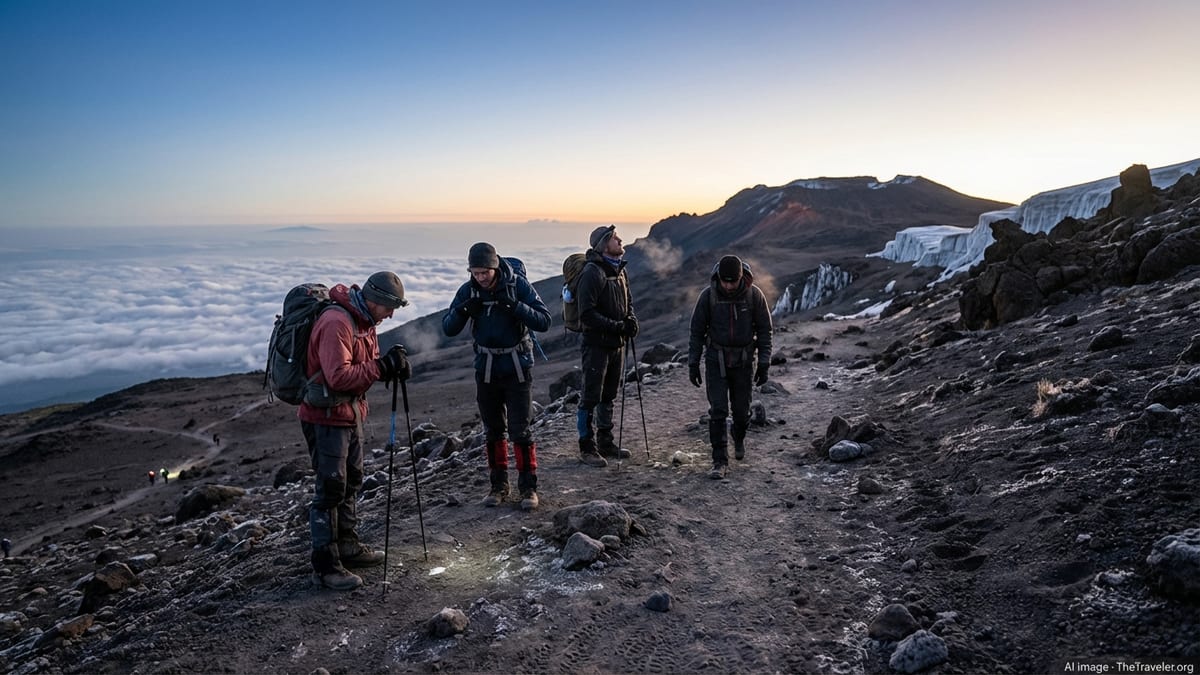
What I Thought I Wanted vs What Actually Mattered
When I booked Option A (Machame), I thought I wanted “the classic camping route with great views.” Machame starts from the south at Machame Gate and usually runs 6 to 7 days, covering roughly 62 km from gate to gate. On paper it looked perfect: strong acclimatization profile, big scenery days like the Shira Plateau and Barranco Wall, and lots of departure dates. I was convinced the key decision was choosing the prettiest trail. Halfway through the climb, slogging up to Barafu Camp in thin air, I realized I had underweighted a far more important factor: how my body would handle altitude and how every extra acclimatization day dramatically changed how miserable or enjoyable the climb felt.
By the time I tried Option B (Lemosho), which starts further west and takes 7 to 8 days on most itineraries, I cared much less about the label “most beautiful route” and much more about how gentle the elevation gain would be and how much time I actually had to sleep and eat between hiking days. Lemosho does in fact add gradual acclimatization and typically offers success rates around 85 to 90 percent on 7 to 8 day itineraries, but the real difference I noticed was psychological. I was less rushed, less anxious about making the next camp, and far more present for the views that had looked like stock photography the first time because I was simply too tired to appreciate them.
Option C (Marangu) was the route I had promised myself I would never do. It is the oldest route, the one everyone calls “the Coca-Cola route,” with basic huts instead of tents and a reputation for being overcrowded and “too easy.” The marketing line is that it is the least technical and the only one with huts. The less advertised truth is that the standard Marangu itinerary is only 5 to 6 days for about 72 km, which means a faster, steeper ascent profile and noticeably lower summit success rates when people opt for the shorter version. I picked it on my third trip because I wanted to experience the huts and see if the negative reputation was justified. On summit night, battling a headache under fluorescent lights in Kibo Hut, I would have traded every plank of wood for one more acclimatization day.
In hindsight, what actually mattered most across all three options was not the supposed difficulty rating or even the views, but a combination of acclimatization time, group size, and how each route handled crowds at bottlenecks like the summit push. The mountain is the same height in every photo. The difference is how you feel getting there and whether you remember the sunrise from Uhuru Peak as magic or as something you endured through gritted teeth.
The Real Difference in Cost and Value
Before my first climb, I spent hours trying to reverse-engineer “cheap but safe” packages for Option A (Machame). The park itself is not cheap. Conservation fees alone are currently around 70 USD per person per day for foreign adults, with mandatory rescue fees and either camping or hut fees on top. Camping fees are about 50 USD per person per night on routes like Machame and Lemosho, while hut fees on Option C (Marangu) come in a bit higher, around 60 USD per person per night. Taken together, just the park line items quickly hit several hundred dollars regardless of which route you choose, and that is before a single porter is hired or a tent is pitched.
On Machame and Lemosho, I found that typical mid-range operators now cluster in the 2,400 to 3,000 USD range for a 7 to 8 day climb, including pre- and post-trek hotel nights. When I lined up departure calendars across a few reputable companies for 2025 and 2026, Machame 7-day group climbs frequently hovered around 2,400 to 2,700 USD, while Lemosho 7- or 8-day itineraries often ran a couple of hundred dollars more per person. A similar Marangu 6-day trip usually came in slightly cheaper than Lemosho but sometimes similar to Machame, in the 2,000 to 2,600 USD band. The pattern I kept seeing was not so much “route X is expensive, route Y is cheap,” but “every extra day you add costs money, regardless of the route.”
My first real decision moment was whether to shave a day off Machame to save a few hundred dollars. Operators reassured me that 6 days was “fine if you are fit.” In reality, that extra cash was the best altitude insurance money I could have spent. When I finally did Machame over 7 days, I felt the benefit of the additional acclimatization day at Karanga Camp immediately. By contrast, on Marangu I gambled on the standard 5 nights in the huts, mainly because the package priced out lower and the operator schedule did not easily allow a 7-day hut-based itinerary on my dates. I summited, but it felt much more like a narrow escape than a confident climb.
In terms of value, Option B (Lemosho) quietly won. It was usually the most expensive of my three choices on any given calendar, but the lower early-stage crowding, longer acclimatization, and more varied scenery made the extra outlay feel justified. Option A (Machame) sat in the middle: not the cheapest, not the most expensive, but with a good balance of price to success rate. Option C (Marangu) only felt like a bargain on paper. By the time I factored in that I urgently wished I had added a day and that I was paying hut fees for fairly spartan dorms, the low per-day price did not feel like a big win.
Location and Logistics in Practice
All three routes start within a couple of hours of Moshi or Arusha, so at first I dismissed “location” as a non-factor. That was naïve. On Option A (Machame), the drive to Machame Gate is relatively short, and you step straight into dense rainforest. The first morning was chaotic: porters distributing loads, last-minute gear checks, a queue at the park gate as climbers signed in and fees were reconciled. The upside was simplicity. The same company that picked me up at Kilimanjaro Airport dropped me at the Machame Gate, and in one morning I was walking uphill into a cloud forest. The downside was that everyone else doing Machame that day was funneled through the same single entry point.
Option B (Lemosho) introduced more logistical friction. The Lemosho trailhead, accessed via the Londorosi Gate area on the western side of the mountain, required a longer drive on sometimes rough roads. We first stopped at the main gate for registration, then continued to the actual starting point. This split process meant more waiting around for paperwork to clear and more time in the vehicle. It felt like a wasted day until the trail itself opened up into quieter forest paths, and suddenly the extra hour of driving made sense. For the first two days, I saw far fewer other groups than on Machame, which changed the entire mood of the climb.
Option C (Marangu) was logistically the cleanest. Marangu Gate is straightforward to reach on the eastern side of the mountain, and the registration process felt more streamlined, probably a function of how long this route has been operating. There are established hut bookings and a set number of beds per night, so there is less ambiguity about where you are sleeping. That said, I only got one of those hut beds because I booked several months in advance for a high season window. Hut space can sell out, especially around peak dry-season months like late June to October and the New Year period, and last-minute planners are sometimes surprised to learn that the “easy hut route” is simply not available on their dates.
The second major decision moment for me was how much time to allocate before and after the climb. With Machame and Lemosho, where camping is the norm, I strongly recommend arriving at least a full day before your trek for gear checks and any last-minute rentals, and leaving at least one buffer day after in case of transport disruptions or a delayed descent. On Marangu, the fixed hut bookings and more rigid itineraries leave a bit less flexibility; if you are not at the gate on the right morning, you risk missing your slot. I underestimated just how immovable those hut schedules are, and it made the start of that trip more stressful than it needed to be.
Comfort, Noise, and Sleep Quality
When people talk about tents versus huts, it sounds like a simple tradeoff: private camping discomfort on Machame and Lemosho, versus solid walls and beds on Marangu. In reality, comfort on Kilimanjaro is more complicated, and my sleep quality did not always match what I expected. On Option A (Machame), I slept in decent dome tents with foam mattresses provided by the operator. The real challenge was not the tent itself but the campsites. Places like Barafu Camp are rocky and sloped, and even with good mats I often woke up sliding to one side. At lower camps, the nocturnal soundtrack included voices from dozens of other tents, clattering cooking gear, and the occasional porter singing. It was atmospheric, but it was not quiet.
Option B (Lemosho) uses many of the same upper camps as Machame once the trails join, so the tent experience is similar at altitude. Where Lemosho felt more comfortable was in the first half of the route. Western camps like Mti Mkubwa and Shira 1 were less crowded on my departure, which meant more choice of tent pitches and slightly less noise at night. Another subtle but real difference was the daily walking time; because Lemosho’s profile is longer and more gradual, I arrived at camp earlier more often. That gave me more daylight to sort gear and get ready for bed, which translated into better sleep. I did not expect “what time do you typically reach camp” to affect comfort, but it did.
Option C (Marangu) theoretically promised the highest comfort with beds and permanent structures. In practice, the huts are basic, shared dormitories with thin mattresses and snorers you did not choose. Mandara and Horombo Huts were manageable, if a bit crowded. Kibo Hut before summit night was a different story. The long, echoing dorm felt clinical, and the bright lights, footsteps, and nervous chatter of other groups made it hard to get any meaningful rest before a midnight wake-up. Unlike in a tent, where I could at least control my own light and zip myself into a small bubble, the hut environment felt more like a hostel corridor than a mountain refuge.
If I had to rank them purely for sleep quality, Option B (Lemosho) came out best simply because I had more time and slightly quieter camps early on. Option A (Machame) was fine, if a bit crowded in peak season, and Option C (Marangu) was not the comfort upgrade I had hoped for. For light sleepers, I would actually lean toward a good operator with quality tents over the promise of a cot in a dorm. Earplugs were indispensable on all three routes, but on Marangu they felt like survival gear.
Food, Amenities, and What Is Actually Included
Food on Kilimanjaro is rarely gourmet, and that is true across all three options. What matters more is consistency, safety, and whether you are getting enough calories and fluid each day. On Option A (Machame), meals were served in a mess tent with simple but hearty fare: soups, rice, stews, vegetables, and fruit. Water was boiled and filtered at camp. While every operator brochure promises abundant meals, the reality is you need to ask precise questions before booking. Is there a dedicated dining tent? Are tables and chairs included? Are special diets handled properly? On my first Machame climb, “dining tent” turned out to mean sharing with another group, which made already cramped campsites feel even busier.
Option B (Lemosho) did not change the menu dramatically, but it did highlight the difference between operators that invest in amenities and those that do not. On my Lemosho trip, the operator provided a private toilet tent, which meant I did not have to use the public long-drop toilets at every camp. This sounds like a minor luxury until you have visited a heavily used camp toilet at 4,600 meters. It became one of those things I would pay extra for every time. Some companies explicitly include these amenities in their Lemosho and Machame pricing, while others treat them as add-ons. Reading the fine print saved me from an unpleasant surprise.
Option C (Marangu) offered fixed dining halls at the huts, which at first felt like a major step up. Sitting on a bench at a proper table under a solid roof while it rained outside was a genuine comfort. What I did not appreciate beforehand was that sharing these communal spaces with many groups also meant slower service, noisier rooms, and more competition for hot water and charging outlets where they existed at lower huts. Also, the huts do not include bedding you would call generous. You still need a good sleeping bag. I met trekkers who had assumed “bed in a hut” meant they could bring less gear; they spent cold nights proving themselves wrong.
Another subtle cost factor that cut across all three options was tipping. Current guidance from many reputable operators suggests a combined tip pool for guides, assistant guides, porters, and cooks that adds several hundred dollars per person to the total bill, depending on group size and route length. Longer routes like Lemosho mean more days of wages to recognize, and some itineraries employ larger support teams. None of this is a reason not to go, but if you ignore it when comparing a “cheap” 6-day Machame to a “pricey” 8-day Lemosho, you are not comparing real totals. I learned on my first climb that ignoring these soft costs only leads to awkward envelope-stuffing at the end.
Crowds, Atmosphere, and Who You Will Be Surrounded By
On paper, the number of people summiting Kilimanjaro each year looks manageable. On the mountain, those people compress into specific choke points, and the atmosphere changes route by route. Option A (Machame) is currently one of the most popular choices, and it showed. Machame Gate was busy, the lower camps were crowded in the main dry seasons (roughly January to early March and June to October), and signature features like the Barranco Wall turned into single-file traffic jams. The upshot was a lively social scene; I met climbers from all over the world, swapped stories at camp, and never felt isolated. The downside was that moments which could have felt remote instead felt like a well-organized outdoor festival.
Option B (Lemosho) starts quietly. For the first two or three days from the western side, I walked through forest and moorland with only a handful of other tents visible at camp. It felt more like the solitary wilderness trek I had imagined. However, Lemosho inevitably merges with Machame higher on the mountain, and from that point onward, camps like Barranco and Barafu were just as crowded as they had been on Machame. The psychological benefit was front-loaded: I had a calmer start to the climb, built a rhythm with my group, and enjoyed the sense of space before joining the masses.
Option C (Marangu) concentrated crowds in a different way. Because everyone stays in the same hut complexes each night, the feeling is less “scattered tents on a hillside” and more “mountain village.” The dining halls were loud, especially in high season, with multiple groups packing into limited seating. Summit night departure from Kibo Hut felt like a conveyor belt of headlamps. I do not regret experiencing it, but I would only recommend it to someone who is very comfortable sharing space and does not mind minimal privacy. If you are imagining a quiet mountain refuge, adjust your expectations.
The atmosphere also differed by route in terms of trekker profile. On my Machame climbs I met a wide mix: charity groups, gap-year travelers, older trekkers ticking off a bucket-list peak, and first-time multi-day hikers who had trained on treadmills. Lemosho attracted a slightly more trekking-experienced crowd, people who seemed to have researched routes more deeply and were willing to spend a bit extra to avoid the busiest starting gate. Marangu had a noticeable contingent of people drawn by the promise of an “easier” hut route, some of whom underestimated the altitude challenge. That mix does not define your experience, but it does color the conversations you have at dinner and how your group copes with bad weather or tough days.
Booking Reality, Rules, and Seasonal Gotchas
Before climbing, I naively assumed that booking any Kilimanjaro route would be a simple matter of picking dates, paying a deposit, and showing up. In reality there are more constraints, especially on Option C (Marangu) with its limited hut capacity. Hut beds are finite, and park rules restrict how many people can occupy them each night. In peak months, popular departure dates for Marangu can sell out several months in advance, forcing you either to shift your entire trip or choose a camping route instead. My third major decision moment was whether to rearrange my travel dates to secure a Marangu hut space or give up and repeat Machame with a different operator. I ended up shifting dates, but it took more flexibility than I would have liked.
On Options A and B (Machame and Lemosho), the main constraints were seasonal weather and operator group sizes. The ideal periods for these routes are the drier stretches from roughly January to early March and June to October. I did Machame once in late February and once in September. February brought more afternoon rain and mud in the forest sections but fewer people; September was clearer, colder, and busier. Most operators were upfront that shoulder months like April, May, and November are wetter and can mean slick trails and cloudier views. They still run climbs then, but you need to accept more discomfort for the benefit of quieter camps and sometimes lower prices.
Another less obvious rule that matters in practice is that the Western Breach approach, which some older Machame and Lemosho itineraries used for a more direct but steeper summit attempt, has experienced closures in recent years due to rockfall and safety concerns. As of early 2024, official sources noted renewed closure of that section following heavy El Niño-related erosion. On my climbs, all three routes used the standard Barafu or Kibo summit approaches, and I am glad they did. If you see an operator aggressively promoting the Western Breach as a shortcut or “adventurous alternative,” I would ask very specific questions about current park regulations and safety assessments before considering it.
Lead times for booking are another reality check. For my Machame climb, I secured a spot about three months in advance for a June departure and still had several group options. For Lemosho at a similar time of year, 6 to 9 months out gave me far more choice of exact itinerary length. For Marangu huts in July, I was pushing my luck booking three months ahead, and I would not cut it that fine again. If you have fixed holiday dates and a strong preference for Option B or C, early commitment is your friend. Waiting for a last-minute discount on a specific route in peak season is not realistic.
The Moments That Changed My Mind
All three routes had pivot points where my theoretical preferences collided with reality. The first came on Option A (Machame) at Lava Tower. Our itinerary followed a classic “climb high, sleep low” pattern, ascending to around 4,600 meters at Lava Tower before dropping back down to Barranco Camp. I had read about this altitude strategy in blogs, but actually standing there with a mild headache, looking across at the Southern Icefields, I understood why routes like Machame and Lemosho have higher success rates when extended to 7 or 8 days. That day convinced me that I would always choose a longer profile over saving a day’s park fees.
Another turning point came during the first two days of Option B (Lemosho). We walked through quiet forest, sometimes seeing only one other group for hours. I realized that what I wanted from Kilimanjaro had subtly changed. On my first climb, the festival-like atmosphere of Machame Camp had energized me. On my second, I craved more solitude and a sense of journey. Lemosho delivered that in its opening stages. When the route later merged with Machame and the busy camps returned, I was glad I had had those quieter days. It made me more tolerant of the crowds later on, because I felt I had already had “my” mountain time.
The most sobering moment came on Option C (Marangu) on summit night. Leaving Kibo Hut around midnight, the line of headlamps ahead of me snaked up the scree. The slope is never technical, but it is a long, cold trudge, and the faster ascent profile of Marangu had clearly hit some people hard. I passed two trekkers being escorted down with severe nausea and one sitting on a rock, insisting he could not go on. The guides handled it professionally, but it was clear that some of them had started this route underestimating the altitude. Watching that play out, I understood why Marangu’s shorter itineraries have a lower overall success rate and why huts do not compensate for lack of acclimatization. If I repeated Marangu, I would insist on adding a seventh day to slow that ascent.
One final, quieter realization came at the end of my Lemosho climb, descending through Mweka Gate with dust on my boots and a summit certificate in my hand. I compared that feeling to my Machame and Marangu exits. On Machame, I had been elated but physically wrung out. On Marangu, I had been mostly relieved it was over. On Lemosho, I felt the most balanced: tired, yes, but not broken, and I remembered the route itself rather than just the summit push. That balance, more than any brochure tagline, is what has stuck with me.
Who Each Option Is Best For
Having walked all three, I would now recommend Option A (Machame) to people who want a strong mix of scenery, decent acclimatization, and social energy, and who are comfortable camping. It is a solid first Kilimanjaro route provided you choose a 7-day version and go in aware of the crowds. If you are on a moderate budget and want a proven formula without paying a premium, Machame is a sensible middle ground. Just accept that you will line up on the Barranco Wall and share camps with many others in the main seasons.
Option B (Lemosho) is the one I point serious first-time summit hopefuls toward now, especially those who know they struggle with altitude or who value a more gradual, quieter start. The extra cost is real, but so is the additional acclimatization and the early-days solitude. If you are willing to spend on a 7 or 8 day itinerary and you like the idea of easing into the climb rather than plunging straight into busy camps, Lemosho is worth it. For photographers or anyone who wants the “full” experience of Kilimanjaro’s different ecological zones without constant crowds from day one, this is the sweet spot.
Option C (Marangu) has a narrower ideal audience than its marketing suggests. I would recommend it to people who are genuinely more comfortable in basic hut accommodation than tents and who either add an extra acclimatization day at Horombo or already know they acclimatize quickly from previous high-altitude treks. It can also work for trekkers who are short on gear and do not want to rent a full camping setup, although you still need a proper sleeping bag and warm clothing. I would not recommend Marangu purely because it is perceived as “easier.” The altitude does not care whether you slept on a mattress or in a tent.
Across all options, one of the most important takeaways is that none of these routes is a walk in the park. The success statistics you see quoted by operators are heavily influenced by itinerary length and client selection. A 7 or 8 day Lemosho or Machame has a very different likelihood of success than a 5 day Marangu, even though both might be marketed as suitable for first-timers. If I were advising my past self today, I would say: pay for the extra day, pick a route profile that suits your temperament, and do not chase the cheapest headline price.
The Takeaway
If I had to reduce three Kilimanjaro climbs into one conclusion, it would be this: route choice is less about “which is best” and more about what kind of suffering and pleasure you are willing to sign up for. Option A, the Machame route, gave me the archetypal Kilimanjaro camping experience: beautiful, busy, sometimes chaotic, but with a strong acclimatization profile when done over seven days. Option B, the Lemosho route, refined that experience into something calmer and more measured, with a longer approach that treated my body and mind more gently and justified its higher price in ways I did not fully appreciate until summit day. Option C, the Marangu route, challenged my assumptions that huts equal comfort and that “easier” on paper translates to easier in practice. It delivered a unique social atmosphere and logistical simplicity, but only when matched with a realistic respect for altitude and crowding.
If you are deciding right now, my candid advice is simple. Choose Option B (Lemosho) if you want the best balance of success rate, scenery, and early-days solitude and are willing to pay and plan for a 7 or 8 day itinerary. Choose Option A (Machame) if you want a slightly cheaper, very popular classic route with big views and a strong sense of shared adventure, and make sure you book a 7 day version, not the shortest one on the menu. Consider Option C (Marangu) only if huts are genuinely important to you, and then push hard for a longer schedule and book early enough that you are not fighting for beds in peak season.
On all three routes, what made the difference for me was not the color of the trail line on the map but the quiet decisions made months earlier: paying for an extra acclimatization day, asking blunt questions about group size and amenities, and matching my expectations to the reality of a heavily visited high-altitude mountain. Kilimanjaro is still worth it on any of these paths, but it is far more rewarding when the route you choose matches who you are, not who the brochure assumes you want to be.
FAQ
Q1. Is Machame really harder than Lemosho or Marangu?
In my experience, Machame felt moderately challenging but not technically hard. It has some steeper sections and the Barranco Wall scramble, yet its 7 day version offers good acclimatization. Lemosho felt similar in difficulty but more gradual at the start. Marangu is often called “easier” because of the huts and a steady trail, but the standard shorter itinerary actually made it feel tougher on summit night due to faster ascent and less acclimatization.
Q2. How many days should I plan for each route?
After trying them, I would personally not do less than 7 days for Machame or Lemosho and would add an extra acclimatization day if possible. For Marangu, I would push for at least 6 days on the mountain, ideally 7, even if operators advertise 5 nights in huts as standard. Every additional day you can afford gives your body a better chance to adapt and makes the experience more enjoyable.
Q3. Which route had the best scenery?
All three had great views, but Lemosho stood out. The longer western approach gave me quieter forest, big panoramas over the Shira Plateau, and more time to appreciate the changing landscapes. Machame shares many of the same upper mountain viewpoints and is also very scenic, especially around Lava Tower and Barranco. Marangu felt a bit more enclosed and direct, with less variety compared to the other two, though the views from Horombo Hut are still impressive.
Q4. Are the Marangu huts worth choosing over tents?
The huts were interesting to experience but not the comfort upgrade I imagined. They are basic dormitories with thin mattresses, shared toilets, and plenty of noise. In a good tent with a proper mat, I slept just as well or better on Machame and Lemosho. If huts make you feel psychologically safer or you dislike tents, Marangu can make sense, but I would not choose it purely because I thought huts would be luxurious.
Q5. How far in advance should I book each route?
For popular dry-season dates, I would aim to book Lemosho 6 to 9 months in advance to have choice of itinerary length and operator. Machame can sometimes be booked closer, around 3 to 6 months ahead, but the best dates and group sizes still fill up. Marangu huts are the most constrained; for prime months like July, August, and around New Year, I would not be comfortable booking less than 4 to 6 months in advance if I wanted specific dates.
Q6. Which route felt safest overall?
All three routes felt safe when run by a responsible operator, but the longer profiles of Lemosho and a 7 day Machame gave me more confidence about altitude. Guides on each route monitored us regularly, but on Marangu’s shorter schedule I saw more people struggling with symptoms of altitude sickness on summit night. For me, safety on Kilimanjaro is less about the trail itself and more about how much time you give your body to adapt and how conservative your operator is with turn-around decisions.
Q7. What about toilets and hygiene on each route?
Public toilets at camps on Machame and Lemosho were usable but heavily worn and often unpleasant, especially at busy sites. On my best Lemosho trip, the operator included a private toilet tent, which made a huge difference. Marangu’s huts had fixed toilets that were slightly more structured but not inherently cleaner. I now factor in whether an operator includes private toilets and how they handle water treatment when choosing any route, because hygiene had a big impact on my comfort.
Q8. Does fitness level change which route I should choose?
Good baseline fitness helps on every route, but it does not replace acclimatization. If you are reasonably fit but not an experienced high-altitude trekker, I would lean toward a longer Lemosho or Machame itinerary rather than a short Marangu one. Very strong hikers sometimes pick Machame for its slightly more compact profile, but I still found extra days worth it. Regardless of fitness, none of these routes is painless at nearly 6,000 meters.
Q9. When is the best time of year to climb each route?
The main dry seasons, roughly January to early March and June to October, worked best on all three routes in terms of trail conditions and summit chances. My February Machame trip had more rain in the forest but fewer people, while my September Lemosho climb had clearer skies and colder nights with more traffic. Marangu huts were noticeably busier in the mid-year dry period. If you can tolerate more rain, shoulder months can be quieter and occasionally cheaper, but you need to be ready for muddier trails and less predictable views.
Q10. If I can only climb Kilimanjaro once, which route would I pick now?
Knowing what I know after three ascents, I would choose a 7 or 8 day Lemosho itinerary. It gave me the best overall balance of acclimatization, early-route solitude, big mountain scenery, and reasonable comfort. Machame would be my second choice, particularly if budget or timing made Lemosho difficult. I would only pick Marangu for a once-in-a-lifetime climb if huts were a non-negotiable preference and I could secure a longer schedule to slow the ascent.