

More news on this day
Manila’s long-awaited MRT-7 rail line is edging closer to reality, with transportation planners targeting the opening of six stations in the coming phase of partial operations, raising hopes for faster and more reliable commutes across northern Metro Manila.
Get the latest news straight to your inbox!
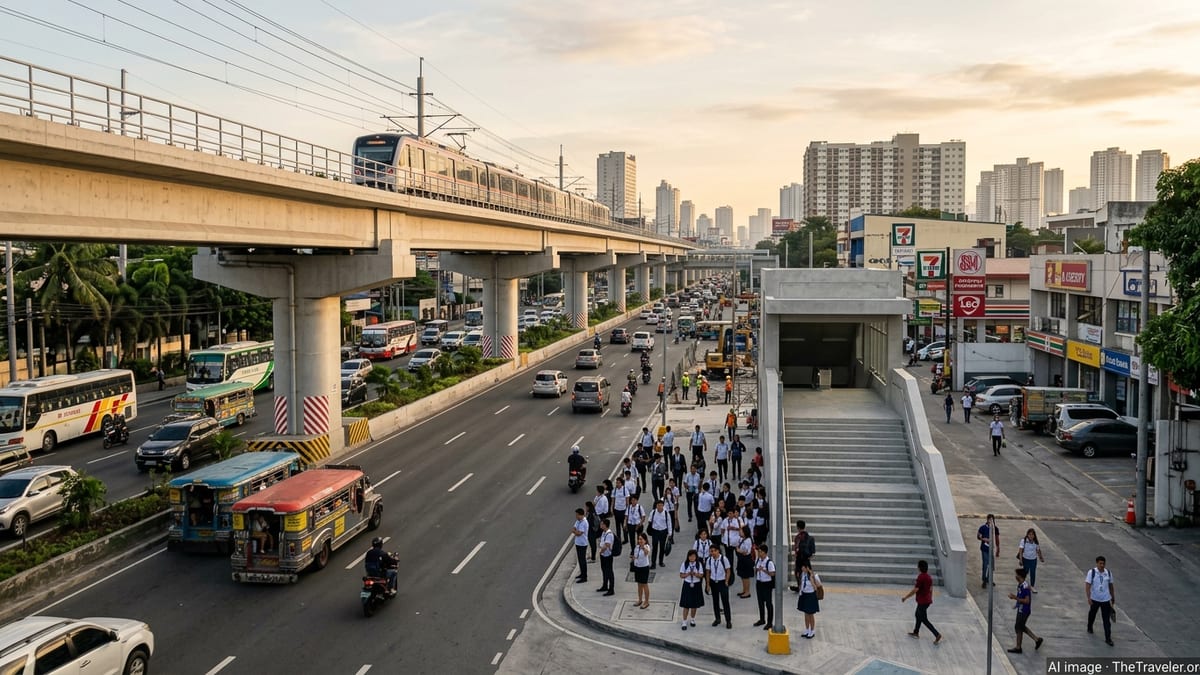
Six-Station Opening Seen as Breakthrough for Gridlocked Corridors
Recent updates from publicly available transport briefings and local media coverage indicate that the next milestone for MRT-7 is a partial launch covering six stations between Sacred Heart in Caloocan City and Tandang Sora in Quezon City. This section traverses some of the most congested roads in the metropolis, where commuters often endure more than an hour in traffic for journeys that span only a few kilometers.
The planned six-station stretch sits within the larger 22 to 23 kilometer MRT-7 corridor designed to link San Jose del Monte in Bulacan to the North Triangle Common Station in Quezon City. Reports show that civil works and systems installation along this middle segment are among the most advanced on the line, making it a logical candidate for early operations while remaining sections continue construction.
Publicly available information from project updates suggests that MRT-7 is now more than 80 percent complete overall, with several stations in Quezon City structurally finished and track installation largely in place. The targeted six-station opening is framed as a test bed that will allow operators to refine systems, safety procedures and passenger handling before the line scales up to a wider service footprint.
For commuters who rely on buses, jeepneys and UV Express vans along Quirino Highway and Commonwealth Avenue, the prospect of boarding a modern rapid transit line within this corridor has become a symbol of long-delayed change. Social media posts and community discussions already describe the six-station launch as a potential “pressure valve” for some of Metro Manila’s most notorious chokepoints.
From Sacred Heart to Tandang Sora: A New Spine Through the North
The six stations earmarked for early operations are expected to cover a continuous stretch from Sacred Heart in Caloocan toward Tandang Sora in Quezon City, cutting across densely populated residential areas and major institutional hubs. Existing project documentation lists intermediate stops that include Quirino Highway and Mindanao Avenue, where elevated viaducts now dominate the skyline.
This corridor forms a critical middle spine of MRT-7, linking communities in northern Quezon City and Caloocan to the broader rail network that will ultimately converge at the North Triangle Common Station. Once connected, passengers will be able to transfer between MRT-7, MRT-3 and LRT-1, shifting from road-based trips on EDSA and Commonwealth Avenue to a rail-based journey that bypasses surface congestion.
Urban transport observers note that the six-station segment has particular strategic importance because it can demonstrate how MRT-7 redistributes demand from road to rail. Even before the full line opens to San Jose del Monte, a functioning core segment through Quezon City and Caloocan is expected to showcase shorter travel times and more predictable headways compared with existing bus and jeepney services.
Local coverage also highlights the potential impact on nearby neighborhoods, where station access points are prompting new commercial activity and changes in land use. Small retailers and informal businesses along the viaduct alignments are already adjusting to anticipated commuter flows, treating the six early stations as anchors for future foot traffic.
Timelines Shift, But Commuter Expectations Keep Rising
MRT-7 has become one of the Philippines’ most closely watched transport projects after years of revised completion dates and shifting targets for partial operations. Earlier projections, widely reported in past administrations, pointed to initial services as early as 2019 and then 2021, followed by new goals centered on the mid-2020s as right-of-way issues and construction challenges emerged.
More recent public briefings indicate that full operations of MRT-7 are now broadly associated with 2027, aligning the completion of the main 14-station alignment with the readiness of the North Triangle Common Station and related systems. Within that larger horizon, the six-station partial opening has been framed as a nearer-term step that could begin prior to full integration of the entire line.
Despite the shifting timelines, expectations among commuters have only grown more intense as elevated structures and station shells become visible along major corridors. Photos of test trains on the tracks and the arrival of new rolling stock, widely circulated in local news and social media, reinforce the sense that MRT-7 is advancing from blueprint to operational reality, even if precise opening dates remain subject to construction progress and systems testing.
Transport analysts caution that partial operations require careful staging, from signaling and power integration to passenger safety systems. However, they also note that starting with a six-station segment is consistent with how large urban rail projects often phase in service, using early sections to validate technology, staff readiness and maintenance routines.
Daily Travel Could Be Transformed Along Commonwealth and Quirino
For the hundreds of thousands who traverse Commonwealth Avenue and Quirino Highway each day, the true measure of MRT-7’s impact will be felt in door-to-door journey times and the reliability of reaching work, school or appointments on schedule. Publicly available ridership projections suggest that the line, once fully open, could eventually serve several hundred thousand passengers daily, significantly shifting the mode share away from private cars and informal public transport.
Even a limited six-station service is expected to shave substantial minutes off peak-hour travel within northern Metro Manila. Commuters who currently transfer between tricycles, jeepneys and buses to cross Quezon City and Caloocan could replace multiple segments with a single rail trip, reducing both travel uncertainty and out-of-pocket costs associated with long, fragmented journeys.
The design of MRT-7 as an elevated line also offers resilience against common causes of road delays, such as flooding, intersections and traffic incidents. For students and workers who routinely budget extra time to account for such disruptions, the predictability of fixed headways and separated right-of-way is viewed as one of the project’s most important benefits.
Local transport planners further point to the potential of MRT-7 to support a broader rebalancing of road space. If a sizable portion of current bus and jeepney passengers along the corridor migrates to rail, authorities may gain more flexibility over time to reorganize lanes, improve pedestrian safety and enhance feeder services that connect neighborhoods to station entrances.
Linking Bulacan, Quezon City and the Wider Rail Network
While the upcoming six-station opening focuses on the central portion of the line, MRT-7’s long-term significance lies in its role as a bridge between Bulacan and Metro Manila’s growing urban rail grid. Project documents describe a route that begins in San Jose del Monte, Bulacan, passes through northern Caloocan and Quezon City, and terminates at the common station complex in North Triangle, where passengers can interchange with existing lines.
Public information from the Philippine Information Agency and other outlets has emphasized how the line is expected to support both daily commuters and longer-distance travelers from Bulacan, offering a rail alternative to heavily congested highways leading into the capital. The future integration of MRT-7 with planned intermodal terminals and expressway links is designed to position the corridor as a northern gateway into Metro Manila.
As construction advances on remaining stations and depot facilities, attention is increasingly turning to operations and maintenance. Coverage of the project notes that an agreement with a major Korean railway operator aims to guide pre-operations, system stabilization and long-term upkeep, aligning MRT-7’s practices with international standards in signaling, safety and asset management.
For now, all eyes are on the six stations slated for the first wave of passenger service. Their opening will mark the point at which MRT-7 shifts from a long-running construction saga into a functioning part of daily life in Manila, offering residents a tangible preview of how a fully connected line could reshape travel across the metropolis and into neighboring Bulacan.