

More news on this day
MSC Armonia’s latest departure from South American waters, following the close of its 2024–2025 season, is reshaping expectations for cruise travel in the region as lines rebalance ships, routes, and capacity across competing global markets.
Get the latest news straight to your inbox!
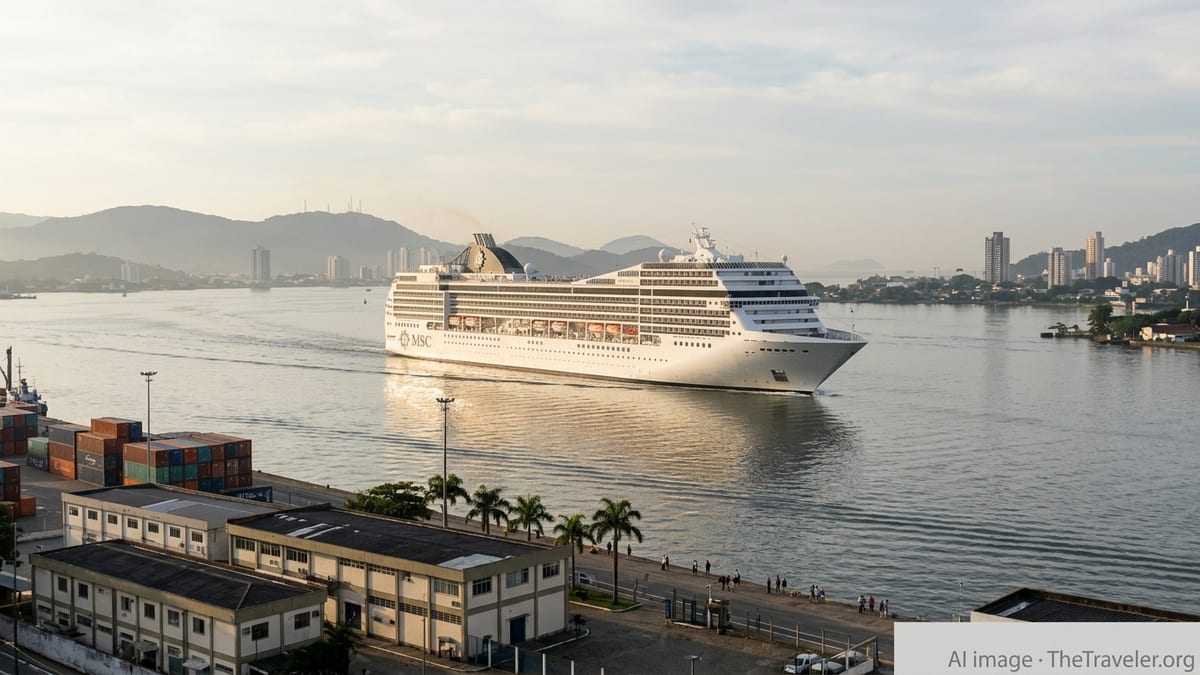
Armonia Concludes Another South American Season
Publicly available deployment data shows that MSC Armonia wrapped up a series of three to seven night sailings in South America at the end of March 2025, before beginning a repositioning voyage back to Europe. Cruise industry reports describe the 2001 built vessel as one of several MSC ships that had been dedicated to the continent for the 2024–2025 southern summer, serving primarily Brazilian and regional guests from ports such as Santos and Rio de Janeiro.
In South America, Armonia has traditionally focused on shorter, resort style itineraries, combining marquee beach destinations with city calls in Brazil, Uruguay, and Argentina. The end of its most recent season comes at a moment when MSC Cruises is fine tuning how many ships it bases in the region each year, and which homeports they serve, in response to evolving demand and port infrastructure.
While Armonia’s exit for the European summer follows a familiar seasonal pattern, it is increasingly framed within a broader repositioning strategy. The ship’s movements now intersect with new plans for its deployment in Africa and the Mediterranean, signaling a more dynamic role for the vessel in MSC’s global network than in past years when its South American program was more fixed.
Fleet Redeployments Reshape Regional Capacity
Industry schedules for upcoming seasons indicate that MSC Armonia will not be anchored exclusively to South America in the years ahead. After spending summers in the Eastern Mediterranean, the vessel is slated to debut in South Africa for the 2026–2027 local cruise season, replacing a sister ship that has traditionally homeported in Durban. That move will shift one of MSC’s classic ships into a new source market while easing reliance on South America for its winter deployment.
At the same time, MSC has outlined expanded capacity in South America through other vessels. Announcements for the 2025–2026 and 2026–2027 southern summers reference multiple ships, including larger Fantasia and Seaview class vessels, assigned to Brazilian and River Plate itineraries. Travel trade coverage notes that these ships are expected to operate from ports such as Santos, Rio de Janeiro, Buenos Aires, and Montevideo, effectively compensating for any reduced presence by Armonia herself.
This pattern reflects a broader cruise industry trend in which older, mid sized ships like Armonia are rotated between emerging markets, while newer and larger ships consolidate in key hubs. South America remains strategically important to MSC’s portfolio, but the specific mix of hardware in the region is changing from year to year as the company weighs yields, operating costs, and port readiness.
Impacts on Itineraries, Homeports, and Travelers
The conclusion of Armonia’s South American season, and its subsequent absence from some future local programs, is already influencing itinerary design along the Atlantic coast. Published sailing calendars show other MSC ships taking on routes that Armonia once operated, particularly shorter cruises from Santos that connect popular Brazilian beach towns and island stops. In some cases, itineraries are being lengthened or combined to better match the capacities of newer vessels.
For travelers, the shift means fewer chances to sail on Armonia herself in South American waters, but more options overall in terms of ship size, onboard amenities, and route diversity. Larger ships assigned to the region typically offer expanded entertainment spaces, family focused facilities, and enhanced balcony inventory, elements that appeal both to local residents and to international guests seeking warm weather getaways during the northern winter.
Travel agents and cruise specialists in Brazil and Argentina are adapting by steering some guests who favored Armonia toward comparable itineraries on different ships. Publicly available information from booking platforms suggests that the region continues to see strong interest in mini seasons built around holidays such as New Year, when itineraries featuring Rio de Janeiro’s Copacabana and other high profile coastal celebrations are especially sought after.
South America Competes in a Global Cruise Network
Armonia’s redeployment illustrates how closely South America’s fortunes are tied to the wider cruise network. The same ship that carried guests between Brazilian ports in early 2025 is scheduled to spend future summers in the Mediterranean and winters in South African waters, linked by long repositioning voyages that themselves attract a dedicated following among cruise enthusiasts.
Analysts following cruise deployment patterns note that this kind of rotation allows MSC to smooth out seasonal swings while testing new markets with familiar tonnage. In South America, the result is a more varied line up of ships, even as some long standing vessels move on. Capacity is increasingly concentrated on ships that can deliver strong onboard spending and appeal to multi generational groups, aligning South America with company wide commercial priorities.
The region also faces growing competition from other winter destinations such as the Caribbean, the Canary Islands, and the Middle East. As the company adds new LNG powered and World class ships elsewhere, the decision to send Armonia to South Africa rather than back to Brazil in 2026–2027 underscores how global considerations now shape local cruise offerings along the Atlantic coast of South America.
Future Seasons Point to Diversification, Not Retreat
Despite Armonia’s evolving role, current announcements for upcoming seasons suggest that South America is entering a period of diversification rather than contraction. Deployment plans for 2026–2027 outline several MSC ships dedicated to the region, supplemented by world cruise calls and transatlantic repositioning voyages that bring additional international guests to major ports like Rio de Janeiro and Buenos Aires.
These plans indicate that MSC is using Armonia’s departure as an opportunity to rebalance rather than reduce its presence, adjusting which ships serve which markets while keeping overall capacity broadly stable or slightly higher. For local tourism economies that depend on cruise calls, this approach offers continuity even as familiar silhouettes such as MSC Armonia become less common sights on the horizon.
As the current decade progresses, South America’s cruise landscape is likely to be marked by regular ship swaps and itinerary adjustments, with vessels rotating through the region rather than remaining there year after year. Armonia’s latest voyage out of South America encapsulates that shift, highlighting how a once regionally focused ship is now part of a far more fluid, globally integrated deployment strategy.