

More news on this day
In the turquoise waters of The Bahamas, MSC Cruises is turning its Ocean Cay MSC Marine Reserve into a living laboratory for reef restoration, placing coral science and marine conservation at the center of the Caribbean cruise experience.
Get the latest news straight to your inbox!
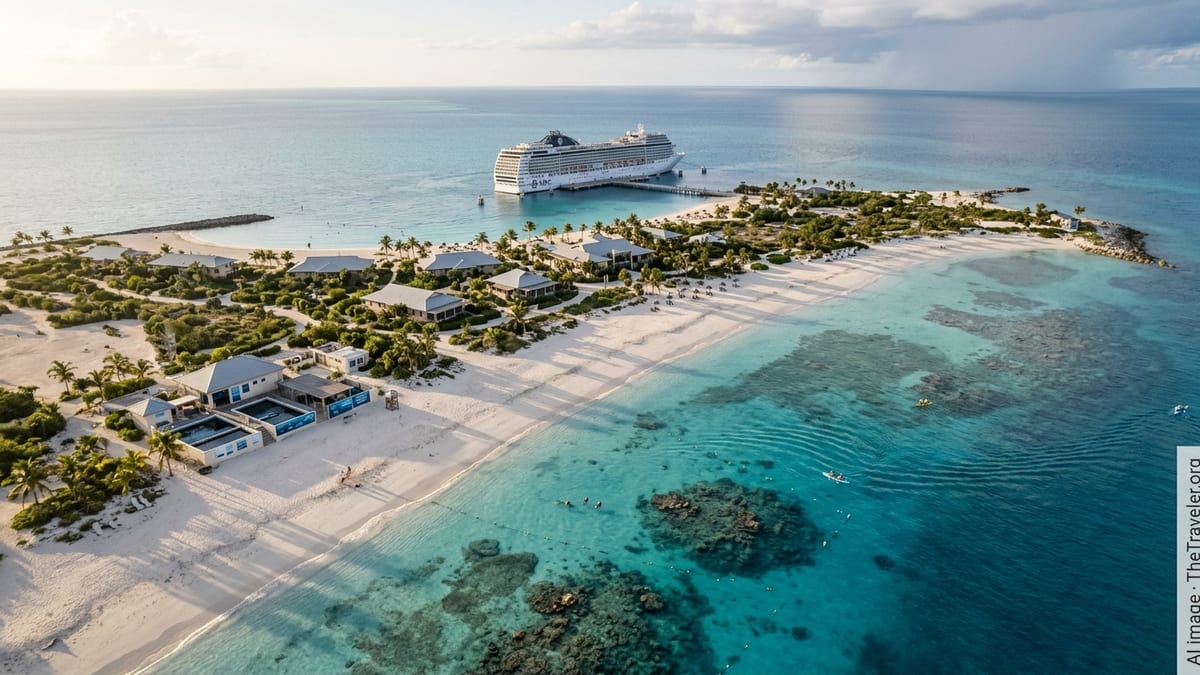
From Industrial Sand Pit to Living Marine Reserve
Less than a decade ago, Ocean Cay was a disused industrial sand extraction site, ringed by damaged seabeds and scarred shorelines. Publicly available information shows that MSC Cruises committed hundreds of millions of dollars to strip out heavy machinery, remove large quantities of scrap metal and restore native vegetation before opening the island as Ocean Cay MSC Marine Reserve in 2019. The project was framed as both a new private destination and a model for how cruise tourism might help repair, rather than simply exploit, fragile marine environments.
Reports indicate that Ocean Cay now sits within a wider protected zone that includes seagrass meadows, patch reefs and habitat for species such as green turtles and Caribbean reef fish. Environmental overviews released by the company describe restrictions on anchoring, controls on artificial light and sound, and efforts to minimize run-off from the island into surrounding waters. The stated goal is to let marine life recover while welcoming thousands of visitors each week.
The redevelopment of Ocean Cay is often cited in industry coverage as a case study in how private islands can be repositioned from purely commercial playgrounds toward more conservation-focused, low-impact operations. That repositioning is central to MSC’s broader strategy in the Caribbean, where the line is competing to attract travelers increasingly attentive to the ecological footprint of their holidays.
Super Coral and a New Marine Conservation Center
At the heart of MSC’s reef ambitions is the MSC Foundation’s Super Coral Reefs Programme, launched in 2019 to support restoration of coral ecosystems around Ocean Cay. According to information released by the foundation and partner scientists, the initiative focuses on identifying coral genotypes that show higher tolerance to warming seas and other stressors, then propagating them in nurseries for outplanting on nearby reefs. The approach mirrors experimental work elsewhere in the region that aims to boost resilience rather than simply replace lost coral cover.
In April 2025, the MSC Foundation opened a dedicated Marine Conservation Center on Ocean Cay to scale up this work. The facility, described in foundation fact sheets, includes land-based coral aquaria, wet labs and space for visiting researchers and graduate interns. It serves as the operational hub for the Super Coral Reefs Programme, allowing controlled experiments on growth rates, thermal tolerance and restoration techniques before corals are transferred back to natural reef structures.
Reporting from recent conservation workshops in The Bahamas indicates that the center is also intended as a platform for collaboration with local and international marine scientists. Recommendations emerging from these meetings call for expanded coral nurseries, more systematic monitoring of reef health and greater engagement with Bahamian stakeholders, with Ocean Cay presented as one of several nodes in a wider national reef recovery effort.
Early updates shared around World Environment Day 2024 highlighted that the Super Coral initiative was recording promising survival rates despite episodes of elevated sea temperatures, suggesting that selective propagation may help build pockets of resilience. While researchers caution that such projects cannot offset global climate pressures alone, Ocean Cay’s program is increasingly referenced in discussions about how tourism-backed restoration can contribute to regional reef strategies.
Reimagining the Caribbean Cruise Experience Around Conservation
Ocean Cay’s transformation is reshaping how MSC markets its Caribbean itineraries. Destination materials emphasize the island’s marine reserve status, its dark-sky policies to protect nesting turtles, and snorkeling areas where guests can see recovering reef structures and growing fish populations. The island’s design, according to environmental summaries, aims to keep built infrastructure set back from sensitive zones, with low-rise structures, native landscaping and limited paved surfaces to reduce erosion.
Onshore activities are being curated around this conservation narrative. Public descriptions of the guest experience highlight guided nature walks, educational displays about coral biology and climate change, and opportunities to observe restoration work from visitor-accessible areas. The Marine Conservation Center, while primarily a research facility, is designed with viewing galleries and interpretive features that translate complex science into accessible stories for cruise passengers.
Industry analysts note that this strategy aligns with a broader shift in traveler expectations. Recent tourism and sustainability studies suggest that visible, on-the-ground environmental initiatives by private operators can influence destination choice and visitor satisfaction. By allowing travelers to witness coral propagation tanks, talk with educators and snorkel over monitored reef sites, MSC is betting that conservation can be woven into the appeal of a Caribbean beach stop without sacrificing the relaxed holiday atmosphere.
The balance remains delicate. Some visitor accounts portray Ocean Cay as, above all, a serene day at the beach, with conservation elements in the background rather than dominating the experience. Nonetheless, the integration of scientific infrastructure into a mainstream cruise itinerary marks a notable evolution in how large-scale tourism interfaces with threatened marine ecosystems.
Decarbonization and the Wider Eco-Friendly Travel Agenda
MSC’s reef initiatives in The Bahamas sit alongside a wider decarbonization and sustainability agenda that is reshaping the cruise sector. The company’s most recent sustainability reporting outlines a long-term pathway toward net-zero greenhouse gas emissions by 2050, in line with emerging international frameworks for maritime transport. Key measures include investments in more efficient hull designs, advanced wastewater treatment, shore power capabilities and lower-carbon fuels.
External reports on the wider group’s activities note pilot voyages using biofuel blends and the deployment of energy-saving technologies such as air lubrication systems and waste heat recovery on new ships. One flagship vessel completed a highly publicized voyage demonstrating net-zero greenhouse gas emissions on a life-cycle basis using a combination of low-carbon fuels and offsets, a move framed as a proof of concept rather than a permanent operating model.
For Caribbean routes, these technical changes are paired with operational adjustments, such as optimized itineraries to reduce fuel consumption and partnerships with ports to expand the availability of cleaner shore power. While independent assessments point out that cruising remains carbon intensive compared with many land-based holidays, they also acknowledge that incremental efficiency gains and fuel shifts are beginning to bend the sector’s emissions curve.
Ocean Cay’s reef restoration work effectively provides a visible, place-based counterpart to these shipboard measures. Together, they form a narrative in which the journey and the destination are both sites of environmental intervention, reinforcing MSC’s positioning as a carrier seeking to align with the emerging norms of eco-friendly travel.
What Reef Recovery Means for the Future of Caribbean Holidays
The stakes for Caribbean reefs are high. Scientific assessments underscore that coral ecosystems across the region have suffered steep declines from warming waters, disease and pollution, with knock-on effects for fisheries, coastal protection and tourism. As one of the world’s most cruise-dependent regions, the Caribbean is increasingly viewed as a bellwether for how mass tourism can adapt to these ecological limits.
Within this context, MSC’s Ocean Cay experiment is drawing attention from policymakers, academics and competing travel operators. United Nations briefings on ocean partnerships list the Marine Conservation Center and Super Coral Reefs Programme among examples of private investment in restoration that could be replicated or scaled in other small island and coastal settings. The focus on climate-resilient coral strains, structured monitoring and public engagement is viewed as particularly relevant as bleaching events become more frequent.
There are clear challenges. Restoration work is labor-intensive and expensive, and success at the scale of a single private island does not guarantee recovery across the wider Bahamian archipelago, let alone the broader Caribbean basin. Critics of cruise expansion also point to continued pressures from ship traffic, coastal development and greenhouse gas emissions that cannot be offset by local projects alone.
Even so, observers note that the visibility of initiatives like those at Ocean Cay can influence traveler expectations and industry norms. As guests increasingly seek itineraries that combine leisure with environmental awareness, the line between conservation site and tourist attraction is blurring. MSC’s decision to foreground coral science and marine recovery in its Caribbean offering suggests that the future of eco-friendly travel in the region may hinge not only on where ships sail, but on how actively they help restore the waters they traverse.