

More news on this day
MSC Cruises has launched an emergency air operation from Dubai to get more than 1,500 passengers of MSC Euribia safely home, after regional conflict in the Middle East closed key airspace and the Strait of Hormuz, abruptly cutting short the ship’s winter itineraries.
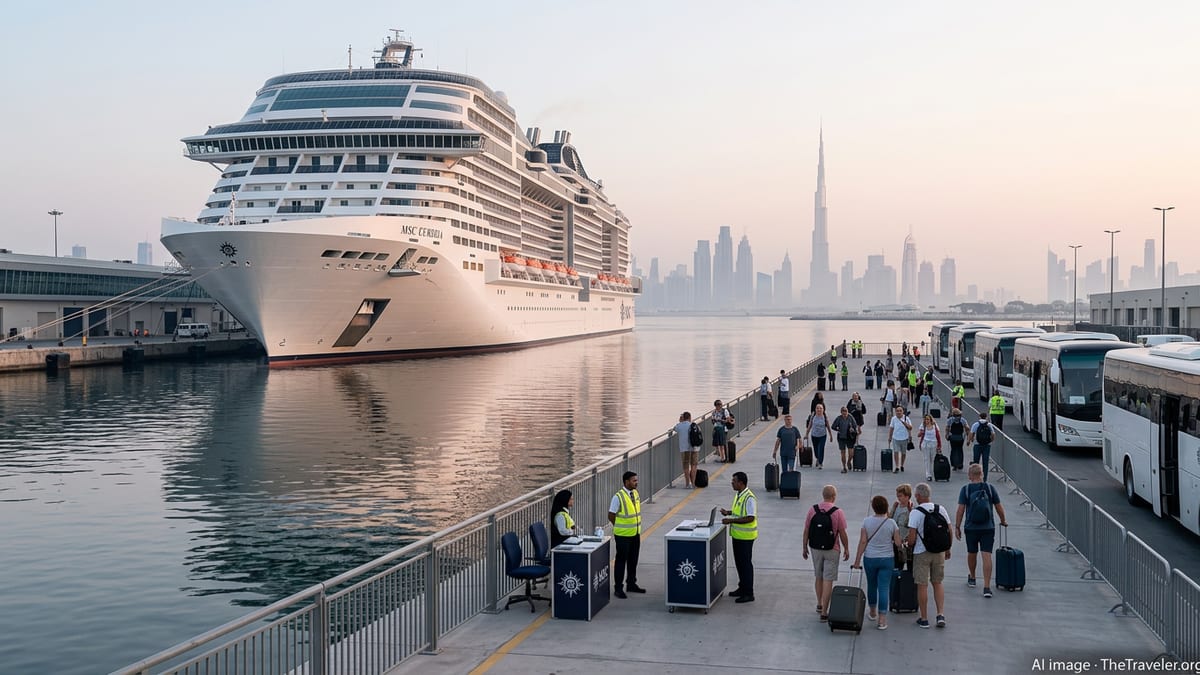
How the Crisis in the Gulf Left a Flagship Stuck in Dubai
The 6,300-passenger MSC Euribia arrived in Dubai at the end of a round-trip Arabian Gulf sailing just as a sharp escalation in the conflict involving the United States, Israel and Iran triggered airspace closures and a de facto shutdown of the Strait of Hormuz. The ship has remained alongside in Dubai under instructions from regional military authorities, which have asked large passenger vessels not to attempt to leave port while the situation remains volatile.
With the narrow waterway effectively impassable and many commercial flights out of the United Arab Emirates, Qatar and Oman cancelled or severely reduced, thousands of cruise guests across several brands suddenly found themselves stranded. MSC Cruises was among the hardest hit, with more than 1,500 guests still on or associated with MSC Euribia in Dubai and unable to continue their cruise or travel home as planned.
In response, MSC cancelled the remaining Gulf departures scheduled for March from Dubai, notifying guests that the winter Middle East season for MSC Euribia had ended early. The company moved quickly from itinerary planning to crisis management, redeploying shoreside teams and bringing senior management into daily coordination calls to focus on repatriation.
For guests onboard, the abrupt shift from holiday to holding pattern has been jarring, but the ship has effectively become a floating hotel in Dubai while flight options are secured. Public venues, dining rooms and children’s facilities remain open, with extra entertainment and activities scheduled to keep passengers occupied as they await news of onward travel.
Charter Flights, Airline Deals and a Dedicated Repatriation Hub
To get guests home as quickly and safely as possible, MSC Cruises has created what it describes as a dedicated flight programme out of the Gulf. The line is working closely with regional carriers, particularly Emirates and Etihad Airways, to secure blocks of seats on the limited commercial services still operating from Dubai and Abu Dhabi. At the same time, it has moved ahead with a series of charter flights designed specifically for stranded cruise passengers.
According to MSC and trade reports, at least five charter flights were initially confirmed out of the region, with the first departures operating from March 5. Within days, a total of seven flights carrying MSC guests had already left the Gulf, reducing the number of passengers still waiting in Dubai and nearby hubs.
Dubai has effectively been turned into the central coordination point for the line’s repatriation effort. MSC teams on the ground are liaising with local authorities, airport operators and ground handlers to manage transfers from the port to the airport, baggage handling and departure processing for large cruise groups moving on chartered aircraft.
With scheduled airline capacity constrained and demand for seats spiking as other cruise lines and tour operators mount their own evacuation efforts, MSC has stressed that it is continually adding capacity where possible, including exploring additional charters from nearby airports such as Abu Dhabi and Muscat if needed.
Passenger Care Onboard While Flights Are Arranged
While the flight operation ramps up, day-to-day life for guests still on MSC Euribia has become a test of the line’s contingency planning. The ship’s officers and crew are following enhanced security protocols dictated by regional authorities but have been instructed by the company to keep the onboard experience as comfortable and familiar as possible in the circumstances.
Cabin assignments have been maintained for guests required to stay on past their original disembarkation dates, with housekeeping and dining services continuing largely as normal. MSC has confirmed that essential services, including medical care and access to prescription medications where possible, remain available around the clock.
Food and beverage operations have been adjusted to cater to a more fluid passenger count, as some guests depart on short notice when flight seats become available. Meals are being offered on a flexible basis to accommodate changing schedules, with particular attention paid to families with young children, elderly travellers and those with mobility or health issues.
Onboard communications have also been stepped up. Guests are receiving daily briefings from the ship’s command and hotel management, along with printed updates and announcements in multiple languages. Shoreside call centres and digital channels are supporting those who disembarked earlier in the region but are still struggling to secure flights home independently.
Refunds, Cancellations and What Affected Guests Can Expect
The repatriation effort sits alongside a broad package of commercial measures designed to compensate guests for cancelled cruises and disrupted itineraries. MSC has officially cancelled the remaining March sailings of MSC Euribia from Dubai and is contacting all impacted passengers through travel agents or directly, depending on how the original booking was made.
Guests whose upcoming cruises were cancelled are being offered full refunds of their cruise fare. In several markets, the line has indicated that future cruise credits or discounted rebooking options may also be available, though the exact terms vary by country and booking channel, in line with local consumer protections and package travel rules.
For those currently stranded in Dubai or who were forced to cut their sailing short, MSC has reiterated that the cost of the additional charter and rebooked flights is being absorbed by the company. In practice, that means passengers booked onto the organised repatriation services are not expected to pay extra for the replacement flights arranged as part of the operation.
Travel insurance and national financial protection schemes may come into play for ancillary costs such as independently arranged flights, hotels or tours that could not be used, with guests advised to keep all receipts and documentation. MSC has encouraged passengers to work with their original booking channel to file any applicable claims once they return home.
What This Means for Future Middle East Cruises
The sudden end to MSC Euribia’s Gulf season underscores how quickly geopolitical tension can reshape cruise deployment plans. MSC is not alone in pulling out of the region. Other major brands, including Celestyal and TUI Cruises, have also announced the early suspension of Arabian Gulf itineraries and are focusing on repatriating guests and crew.
For the remainder of the winter season, MSC has confirmed that its large-scale cruise operations in the Gulf are effectively paused, with no indication that voyages will resume before the security outlook improves and the Strait of Hormuz is once again reliably open to passenger shipping. The line is expected to reposition affected tonnage to alternative regions for upcoming summer and winter programmes.
Prospective Gulf cruise passengers booked for later in 2026 are being urged to monitor direct communications from MSC and their travel advisors. While the company is emphasising that safety remains its primary concern, it has not yet issued a long-range schedule adjustment for the 2026 to 2027 season, which may depend on how the conflict evolves over the coming months.
For now, the focus remains firmly on the more than 1,500 guests whose winter sun holidays abruptly became a complex international evacuation. As charter flights continue to depart and the passenger count on MSC Euribia steadily falls, MSC Cruises is working to demonstrate that, even in one of the most challenging security crises the modern cruise industry has faced, large-scale repatriation can be managed in a structured and transparent way.