

More news on this day
A new collaboration between the MSC Foundation and the Perry Institute for Marine Science is accelerating efforts to restore vulnerable Caribbean coral reefs, positioning Ocean Cay in The Bahamas as a testbed for techniques that could help safeguard marine ecosystems across the region.
Get the latest news straight to your inbox!
Strategic Partnership Focused on Super Coral and Reef Recovery
Publicly available information on recent project updates indicates that the MSC Foundation’s Super Coral Reefs Programme at Ocean Cay is now closely aligned with the Perry Institute for Marine Science’s long-standing fieldwork in Bahamian and wider Caribbean waters. The Perry Institute, which has been working for more than five decades on coral reef science and conservation across the region, brings a network of restoration sites, monitoring programmes and local partnerships that complement MSC’s investment in infrastructure and research capacity at its private marine reserve in The Bahamas.
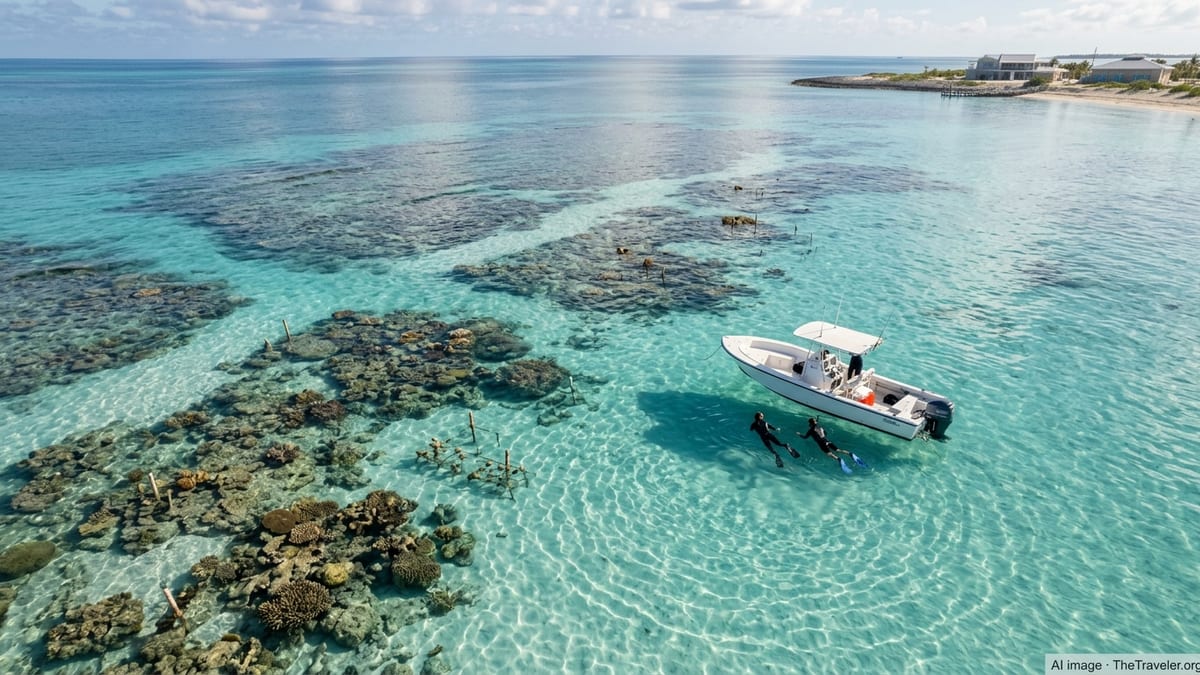
According to published coverage, the partnership has moved beyond planning into hands-on reef rehabilitation. The MSC Foundation has been cultivating heat-tolerant and resilient coral genotypes in an offshore nursery at Ocean Cay since 2022, and recent project reports describe how these nursery-grown corals are now being used to rebuild degraded reef structures in surrounding waters. Working alongside Perry Institute scientists, teams are trialling ways to select, propagate and outplant corals that are better able to withstand marine heatwaves and disease outbreaks that have devastated reefs across the Caribbean.
The collaboration forms part of a broader strategy to turn Ocean Cay into a living laboratory for coral conservation. The site, once an industrial sand excavation zone, has been reclassified as a marine reserve and Mission Blue Hope Spot, and the new partnership is being positioned as a model that could be replicated at other vulnerable reef systems in the Bahamas and beyond. Observers note that the shared focus on science-based restoration and community-linked education reflects a shift in the cruise and tourism sector toward more measurable ecosystem recovery efforts rather than stand-alone sustainability campaigns.
Ocean Cay Marine Conservation Center Becomes a Regional Hub
In April 2025, the MSC Foundation formally opened its Marine Conservation Center at Ocean Cay, creating a dedicated base for coral science, training and public engagement. The facility includes a land-based bio lab, a lecture and training space, and a complex of aquaria and coral tanks designed to support both research and active restoration. Project descriptions emphasise that the center serves as headquarters for the Super Coral Reefs Programme and as a platform for collaborations with regional scientific partners, including the Perry Institute.
Reports on the center’s development describe a multi-year construction effort aimed at transforming the former industrial island into a destination where tourism and conservation are deliberately intertwined. Coral nurseries offshore hold multiple species and genotypes of reef-building corals, while the onshore aquaria provide controlled conditions for experiments on resilience, growth and reproduction. The Perry Institute’s experience with Caribbean nurseries and outplant sites is cited as an important asset in guiding which restoration techniques are scaled up in the waters around Ocean Cay.
The Marine Conservation Center is also emerging as a focal point for visiting students, early-career researchers and marine professionals from The Bahamas and abroad. Publicly available information shows that the MSC Foundation is working with Bahamian institutions and non-profit partners to offer internships, field courses and technical training in coral restoration and marine monitoring. Within this framework, the Perry Institute’s regional field teams and long-term data sets help connect what happens at Ocean Cay to wider trends in coral health across the Caribbean basin.
From Coral Nurseries to Outplanted Reefs
Recent project updates highlight a significant milestone for the joint work between the MSC Foundation and the Perry Institute: the commencement of reef outplanting using nursery-grown corals cultivated at Ocean Cay. According to these updates, more than one hundred coral fragments from several reef-building species have already been transplanted to natural reef sites near the island, at depths selected to match each species’ ecological needs.
The process begins in the offshore nursery, where coral fragments are grown on structures designed to maximise water flow and reduce sediment build-up. Once they reach a suitable size and show signs of resilience, the fragments are carefully attached to selected reef locations using marine-safe adhesives and hardware. Perry Institute scientists, who manage and advise a network of coral nurseries and restoration projects across The Bahamas, are reported to be closely involved in site selection, species mix and post-outplant monitoring.
Field teams are now tracking survival rates, growth patterns and responses to temperature spikes at the new outplant sites. The data collected will help refine which coral genotypes and restoration methods deliver the best results under real-world Caribbean conditions. Project documents indicate that this information will be shared with other Caribbean reef initiatives, with the goal of accelerating learning and avoiding duplication of effort across national boundaries.
Safeguarding Marine Ecosystems and Coastal Communities
The collaboration between the MSC Foundation and the Perry Institute is unfolding against a backdrop of escalating stress on coral reefs worldwide. Scientific assessments referenced in recent MSC and Perry Institute publications describe how Caribbean reefs, while covering less than one percent of the ocean floor, provide habitat for a quarter of marine species and underpin fisheries, tourism and coastal protection for millions of people. Rising sea temperatures, coral disease outbreaks, pollution and storms are putting those benefits at risk.
Within this context, the work at Ocean Cay is being framed as both a conservation effort and an investment in climate resilience for local communities. Healthy reefs act as natural breakwaters that reduce wave energy, helping to protect low-lying islands from storm surge and erosion. They also support fish populations and other marine life that are vital to food security and livelihoods. By focusing on corals that have demonstrated higher tolerance to warming seas, the partnership aims to rebuild reef structures that can continue to provide these services even as ocean conditions change.
Publicly available information from the Perry Institute notes that the organisation has helped plant tens of thousands of corals and manage dozens of nurseries across the Caribbean, while the MSC Foundation’s marine conservation portfolio is increasingly centred on measurable ecosystem outcomes. Observers of the collaboration suggest that combining large-scale private investment with regional scientific expertise could offer a blueprint for similar initiatives in other tourism-dependent archipelagos.
Education, Citizen Engagement and the Future of Reef Tourism
The partnership between the MSC Foundation and the Perry Institute is not limited to laboratory and field science. Both organisations are placing growing emphasis on education, outreach and opportunities for visitors to engage responsibly with restoration efforts. At Ocean Cay, interpretive exhibits, guided activities and structured learning experiences at the Marine Conservation Center are designed to help cruise passengers and other guests understand the role reefs play in sustaining marine life and coastal economies.
According to programme descriptions, student exchanges, training courses and joint research projects are being developed with Bahamian universities and technical institutes, with Perry Institute specialists contributing curriculum content and mentorship. These initiatives aim to build national capacity in marine science and reef management, so that more of the expertise needed to sustain restoration work is based within the Caribbean itself.
Travel industry analysis suggests that such initiatives may also help reshape what visitors expect from island tourism. Rather than viewing coral reefs solely as scenic backdrops for snorkeling and diving, guests are increasingly being invited to see themselves as participants in long-term ecosystem recovery. If the MSC Foundation and Perry Institute collaboration continues to show measurable gains in coral cover and reef resilience around Ocean Cay, observers indicate it could influence how other Caribbean destinations integrate conservation partnerships into the core of their tourism strategies.