

More news on this day
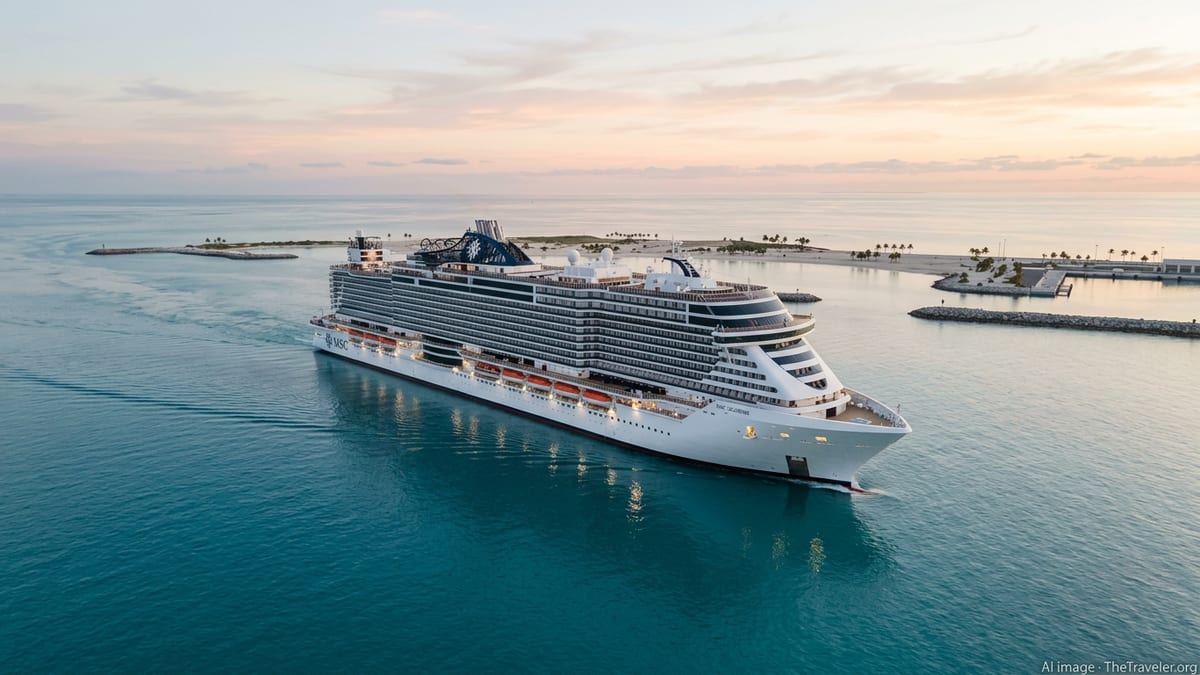
An overnight report of a man overboard from MSC Seashore as the cruise ship sailed away from Ocean Cay in the Bahamas prompted a rapid emergency response on March 10, 2026, before surveillance checks and a shipwide headcount confirmed the scare was a false alarm.
Get the latest news straight to your inbox!
Early-Morning Alarm Halts Bahamas Cruise
The incident unfolded in the early hours of March 10, shortly after MSC Seashore had departed MSC’s private island, Ocean Cay Marine Reserve, at the end of a late-night call during a four-night Bahamas sailing from Port Canaveral. According to passenger accounts shared on social media and cruise forums, word began circulating shortly after midnight that a male guest might have gone overboard from Deck 8.
Guests reported that the 170,000-gross-ton ship, carrying more than 4,500 passengers at full capacity, slowed and altered course while crew members initiated man-overboard protocols. Many passengers, some still awake after a full day on Ocean Cay, stepped onto their balconies to watch as the vessel’s powerful searchlights swept across the dark water.
For a period of time, the ship maintained a holding position near the private island while bridge officers coordinated the search effort and monitored sea conditions in what witnesses described as pitch-black waters with visible current.
Crew Launch Full Man-Overboard Protocols
As soon as the possible overboard was reported, MSC Seashore’s crew moved quickly to implement established emergency procedures. Searchlights were trained on the sea surface, the ship’s speed was reduced, and navigational adjustments were made to retrace the area where a fall was believed to have occurred.
Onboard announcements advised guests that the crew was responding to a potential man-overboard situation, and that safety protocols were in progress. Public areas near the reported location on Deck 8 were temporarily restricted while officers and security staff reviewed the scene and checked for physical evidence.
In line with common practice during such events, the ship prepared its rescue resources as a precaution while bridge and security teams coordinated with authorities ashore. From passengers’ vantage points, the most visible signs of the operation were the bright beams of light cutting across the waves and the noticeable slowing of the vessel’s forward motion.
Passenger Headcount Confirms No One Missing
Once the initial search pattern had begun, attention turned to confirming whether any guest or crew member was actually unaccounted for. MSC Seashore’s team initiated a shipwide verification, asking guests to return to their staterooms while cruise cards were scanned and cross-checked against the manifest.
At the same time, surveillance footage from cameras covering Deck 8 and surrounding areas was reviewed to determine whether anyone had been captured on video going over the side. Reports from passengers onboard indicate that crew members later announced there was no video evidence of a person falling into the water.
After the card scans and muster checks were completed, officers confirmed that all passengers and crew were present. The suspected overboard was formally deemed a false alarm, and an announcement was made to inform guests that no one was missing and operations would return to normal.
Relief Among Guests After Tense Night
The clarification brought a palpable sense of relief across the ship. Many guests had spent more than an hour watching the search unfold, some describing the atmosphere as tense and sobering as they contemplated the possibility of a genuine tragedy at sea.
Once the false alarm was confirmed, entertainment and onboard activities gradually resumed, and MSC Seashore adjusted its speed to remain on schedule for the planned sea day on March 10. Industry analysts noted that because the ship was in open waters between Ocean Cay and its next port, it had sufficient flexibility to make up for the time spent conducting the search.
Passengers posting after the event largely praised the crew’s quick response and adherence to safety protocols, even though the report ultimately proved unfounded. For many onboard, the incident served as a stark reminder of the risks associated with overboard events and the complex, time-critical operations they trigger.
Spotlight on Cruise Safety and False Alarms
While rare, false overboard alarms are not unprecedented in the cruise industry. Visual misperceptions at night, reflections, debris in the water, or misinterpreted sounds can all prompt a guest or crew member to report a suspected fall. In such cases, operators are expected to act on the side of caution and assume the report is genuine until proven otherwise.
Maritime safety experts note that man-overboard responses are intentionally disruptive, involving course alterations, speed reductions, watch stander reassignments, and in some cases the launch of rescue craft. However, they emphasize that any delay in acting on a credible report could significantly reduce the chances of survival if a person were actually in the water.
The MSC Seashore incident highlights how current practices blend technology, including extensive CCTV coverage and tracking of keycards, with traditional methods such as manual headcounts and visual searches. Although dedicated automated overboard detection systems are not yet universal across the global fleet, the cruise sector has faced growing scrutiny to improve monitoring and response capabilities.
For MSC Seashore and its guests, the Bahamian night scare ended as the best possible outcome in a man-overboard alert: a comprehensive emergency response, no one missing, and a cruise allowed to continue with heightened awareness of the safety procedures that quietly underpin life at sea.