

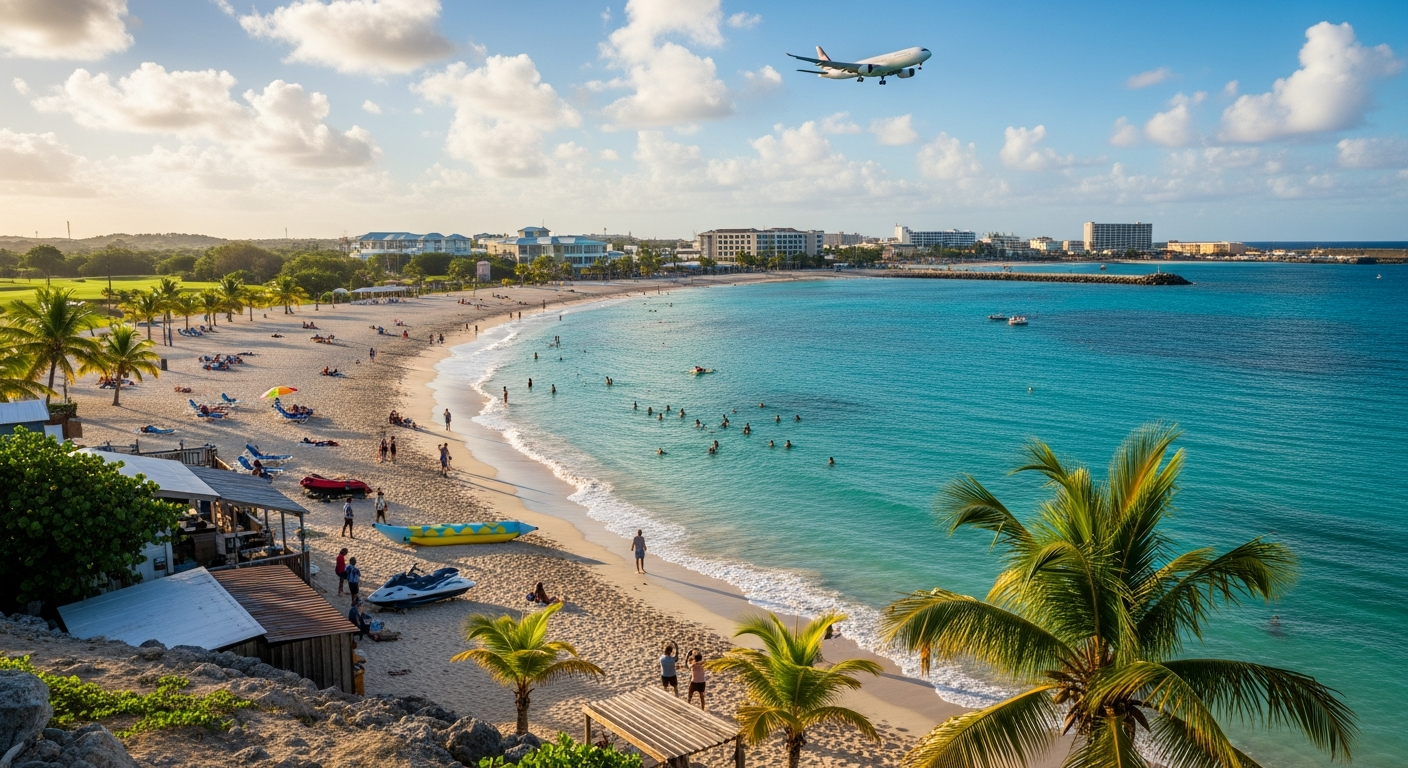
Mullet Bay Beach and Maho Beach sit within minutes of each other on the Dutch side of St Maarten, yet they deliver two completely different Caribbean experiences. One is a broad, palm framed bay with rolling surf, casual beach shacks and a laid back local vibe.
The other is one of the most photographed stretches of sand on earth, where wide body jets skim what feels like just above your head as they land at Princess Juliana International Airport.
For travelers trying to decide where to base a beach day, or which one deserves space on a tight island itinerary, understanding how these beaches compare in setting, atmosphere, safety and amenities is essential.
Overview: Two Beaches, Two Very Different Personalities
Mullet Bay Beach is often described by tourism authorities and marine trade groups as one of the most awarded and beloved beaches on St Maarten. Curving along the island’s only 18 hole golf course, it offers soft white sand, turquoise water and a mix of gentle swimming conditions on calm days and lively surf when swells arrive.
Locals favor it for weekend gatherings and picnics, and recent destination features highlight its combination of natural beauty and easy access to low key food stalls and watersports.
Maho Beach, by contrast, is not famous primarily for its sand or swimming. It is legendary because the runway of Princess Juliana International Airport ends directly behind it, making it one of the few places in the world where commercial jets pass less than roughly 100 feet above beachgoers as they land.
Tourism boards, aviation media and travel guides continue to spotlight Maho as a global plane spotting mecca, drawing cruise passengers and aviation enthusiasts who come specifically for the adrenaline charged spectacle.
Despite their differences, the two beaches are close neighbors. You can drive between them in a few minutes or even walk in roughly 15 to 20 minutes if the weather is not too hot.
Both are on the Dutch side of the island, both are free to access and both have benefited from post hurricane recovery and renewed visitor interest. The question for most travelers is not whether to visit at all, but which one better matches the type of beach day they want.
Setting and Scenery
In terms of classic Caribbean scenery, Mullet Bay Beach has a clear edge. The bay is broad and crescent shaped, with a deep sweep of sand backed by palms and sea grape trees. To one side, low rocky headlands offer pretty viewpoints over the bay. To the other, the manicured green of the golf course sits just beyond the sand, giving the area an open and almost park like feel.
On many days the water grades from pale aquamarine in the shallows to deeper blues farther out, and because there are no large concrete structures on the sand itself, the setting feels relatively unspoiled.
Maho Beach sits in a much more built up environment. The strip of sand is narrower and has been eroded in places by storms and jet blast, and it is framed on both ends by bars, restaurants and resort buildings. Just beyond the road that runs behind the beach, the airport fence and runway dominate the scene.
The water is still a striking Caribbean blue, but visually your eye is constantly drawn to the aircraft lining up to land or depart. For some visitors that mixture of beach and aviation is uniquely dramatic; for others, it can make Maho feel more like a novelty attraction than a place to relax in nature.
If uninterrupted horizon views, space to spread out and photogenic turquoise water are the priority, Mullet Bay is generally the better choice. It features regularly in destination photography and beach of the week style features precisely because it looks like a postcard.
Maho delivers a different kind of iconic image: a jet looming low over sunbathers or silhouetted against sunset skies. Both scenes are memorable, but they appeal to different tastes.
Swimming Conditions and Safety
Both Mullet Bay and Maho are officially open public beaches, and environmental organizations have categorised them as safe for swimming when normal conditions prevail. However, the character of the water can be very different at each spot, and visitors should be aware of both natural and man made risks before deciding where to swim or bring children.
Mullet Bay’s waters can be calm and inviting, especially outside the Atlantic hurricane season, and large areas near shore are shallow enough for casual wading and floating. At the same time, local marine groups and tourism sites point out that from roughly June through November the bay often sees bigger waves and stronger surf.
On such days the beach attracts bodyboarders and surfers, but currents can be stronger and less experienced swimmers should be cautious, especially where the bottom drops off more quickly. After major storms, debris and sharp rocks may occasionally be present, and water shoes can be a sensible precaution.
Maho’s main safety concerns are less about swimming conditions and more about the proximity of powerful jet engines. The water there is often suitable for a quick dip or paddle, but the beach is narrow and the nearshore area can feel crowded.
Official warnings on site stress that standing close to the airport fence or on the road during takeoff can expose people to intense jet blast, which has previously caused injuries and at least one fatality when a visitor was thrown into a solid surface.
Aviation focused travel guides published in 2024 and 2025 reiterate that watching landings from the sand, a bit back from the waterline, is generally low risk, but positioning yourself directly in line with departing jets is not advisable.
For families with younger children or anyone prioritising relaxed, lower risk swimming, Mullet Bay is usually the more suitable option. There is more room to enter the water away from crowds, and you can choose calmer sections of the bay depending on where swell is breaking.
Maho can still work for a quick swim paired with plane watching, but it is best treated as a short, controlled dip rather than a full day of carefree water play, especially when large aircraft are operating frequently.
Atmosphere and Crowd Patterns
On a typical weekday outside peak holiday periods, Mullet Bay Beach tends to have a mellow, local leaning atmosphere. Students from the nearby medical university, island residents and independent travelers often mingle under the trees and at the beach shacks.
You are likely to hear a mix of languages, with music drifting faintly from speakers but rarely at nightclub volume. The vibe is unhurried. People read on loungers, snorkel along the rocks or chat at plastic tables over grilled fish and ice cold beers. It can feel busy yet uncommercial compared with some more resort dominated beaches.
Weekends and heavy cruise ship days are different. Taxi drivers and tour operators frequently bring groups to Mullet Bay because it offers both beauty and amenities without the intense crowds of smaller urban bays.
On those days the beach can fill with rental loungers, and the calm northern end that feels almost secluded on a Tuesday might be full of families and barbecue smoke on a Sunday afternoon. Even then, the longer shoreline usually allows you to find a quieter pocket by walking five or ten minutes along the sand.
Maho Beach, in contrast, regularly cycles between quiet and frenzied in direct response to the flight schedule. When no major landings are due, the beach can feel surprisingly ordinary, with a scatter of sunbathers near the water and patrons at neighboring bars.
As the time for a big jet arrival approaches, people pour in from taxis, buses and nearby resorts, clustering in the central section of sand or lining the water’s edge with cameras raised. After the landing, crowds often thin again until the next highlight. This can make the atmosphere feel more like an event than a day at the beach.
Cruise days amplify that effect. Excursion buses may arrive just before a block of scheduled landings, leading to a dense pack of visitors all trying to stake out the same vantage points. Bars crank up the music, staff announce incoming flights on microphones and the energy becomes boisterous and highly social.
Travelers who enjoy that kind of spectacle often rate Maho as a trip highlight. Those seeking serenity may find it overwhelming and short lived, reinforcing Mullet Bay’s reputation as the more restful stop.
Amenities, Food and Activities
Both beaches have basic amenities, but they differ in style and scale. At Mullet Bay, services are clustered around a couple of simple beach bars and the base of watersports operators. Visitors can rent loungers and umbrellas, buy freshly grilled meats or seafood, and order standard Caribbean drinks without leaving the sand.
Menus tend to be informal and moderately priced, with an emphasis on ribs, burgers, fried fish, johnny cakes and cold beer rather than elaborate cocktails. Portable restrooms and basic changing facilities may be available, but you should not expect the infrastructure of a large resort.
In recent seasons, Mullet Bay has also become a small hub for water based adventure. A dedicated watersports outfit based directly on the beach offers jet ski rentals and tours, rides on inflatables like banana boats, kayaks, floating mats and snorkeling gear.
This makes Mullet particularly attractive to groups looking to mix classic beach lounging with bursts of activity. Surf conditions, when right, add another layer for those comfortable in rougher water.
Maho Beach benefits from its immediate proximity to Maho Village and several sizable resorts, which translates into a denser concentration of restaurants, bars and facilities right behind the sand. Well known spots advertise dedicated plane watching decks, publicise arrival boards and mix the beach scene with a sports bar atmosphere.
You can order full meals, cocktails and snacks from a variety of venues, often with shaded seating that still offers front row views of the runway. Restrooms, changing spaces and access to taxis are typically more straightforward than at more isolated bays.
In terms of structured activities, Maho is primarily about the aviation experience. Some visitors combine plane spotting with casino time, spa access or day passes at nearby all inclusive resorts, making the beach just one component of a wider entertainment zone.
There are fewer in water rental options directly on the sand, because the beach is narrow and a significant portion of visitor attention is focused upward rather than on paddling or snorkeling. For people who want a classic beach day with ancillary activities like jet skiing, Mullet is usually more convenient. For those who want a full day of bars, gaming and nightlife tied to the airport, Maho offers more variety a short walk away.
Accessibility and Logistics
Reaching either Mullet Bay or Maho Beach is straightforward from major tourist hubs such as Philipsburg and Simpson Bay, but there are small differences that can matter depending on how you travel. Both beaches sit on or just off Rhine Road in the lowlands, with clear taxi zones and regular minibus services that locals and budget conscious visitors use.
Travel blog accounts and marine trade information suggest about 30 to 45 minutes by taxi from the cruise pier to this part of the island, longer in heavy traffic.
Maho Beach is the slightly more visible and signposted destination, simply because it sits directly at the end of the airport runway and adjacent to a compact commercial center. Taxi drivers know it instantly, and many ship based excursions offer Maho as a dedicated stop.
Once you arrive, the beach is a short walk from the road, and bars and shops surround you almost immediately. This convenience makes Maho an easy choice for people with very limited time or mobility concerns who want a quick look at the famous planes without committing to a long stay.
Mullet Bay requires a small additional effort. Drivers follow the same general route toward Maho but turn off slightly earlier to reach parking areas behind the golf course and trees. From there you walk a few minutes along sandy paths to the open beach.
Public buses heading to Maho and Cupecoy commonly stop on the main road near Mullet as well, making it accessible even without a private transfer. Once you know the turnoff it is simple, but first time visitors who arrive without a guide should pay attention to local signage or map apps to avoid overshooting the entrance.
Because the two beaches are so close, many visitors sensibly combine them in one outing. A typical pattern is to start with a more relaxed morning at Mullet Bay, enjoying swimming and lunch, then walk or take a short ride to Maho ahead of the afternoon’s busier flight schedule.
This lets you enjoy the best of both environments without feeling rushed. If you are traveling with a mixed group in which some people want pure beach time and others crave the aviation spectacle, planning logistics this way can satisfy both camps.
Which Beach Is Better for Different Types of Travelers
Deciding whether Mullet Bay or Maho is “better” depends less on any objective ranking and more on what you personally value in a beach day. For many repeat visitors to St Maarten, Mullet Bay emerges as the favorite for its balance of natural beauty, relative space and authentic local flavor.
If you picture yourself lingering under a tree with a paperback, wading out slowly into clear water and hearing more waves than engines, Mullet almost certainly aligns with your expectations.
Families with young children, couples seeking a romantic afternoon and photographers focused on seascapes rather than aircraft often gravitate toward Mullet Bay as well. The wide shoreline allows kids to play without constantly bumping into other groups, and it is easier to find a quieter pocket away from speakers or large crowds.
For honeymooners or travelers marking a special occasion, the long curve of sand and sunset views can feel more intimate and timeless than Maho’s urbanized backdrop.
Maho, on the other hand, is unbeatable for travelers who prioritise unique experiences and storytelling value over pure relaxation. Aviation fans, photographers who enjoy action shots and cruise passengers with just a few hours to create a standout memory often place Maho at the top of their list.
The visceral thrill of a wide body jet descending apparently just overhead while you stand in the surf is difficult to replicate anywhere else in the world, and for some people that single moment justifies the entire stop in St Maarten.
Groups of friends looking for a lively atmosphere, bar hopping options and easy movement between beach, casino and restaurant venues are also well served by Maho. They may accept the narrower sand and shorter swim sessions as a trade off for high energy fun and convenience.
In practice, many visitors end up appreciating both beaches for what they offer. A balanced view is to treat Mullet Bay as the superior traditional beach, and Maho as a world class specialty attraction that also happens to have sand and sea.
The Takeaway
When comparing Mullet Bay Beach and Maho Beach, the core distinction is clear. Mullet Bay is the better classic Caribbean beach, with a sweeping sandy bay, a more natural setting, ample room to relax and a calm to moderate water environment that suits swimming on most days.
It comes with enough food, drink and activity infrastructure to be comfortable without losing its easygoing charm. For a full length beach day that feels unhurried and immersed in the island’s coastal landscape, Mullet is the stronger choice.
Maho Beach, in contrast, is the better choice if your priority is seeing something you cannot easily experience elsewhere. Its proximity to Princess Juliana International Airport creates a spectacle that blends aviation with leisure in a way that continues to capture global attention.
The trade off is a narrower, more crowded shoreline and the need to pay close attention to safety around jet blast and heavy traffic. Many visitors sensibly treat Maho as a must see stop for an hour or two rather than the sole destination for their entire beach day.
With their close proximity, there is no need to choose strictly between them. A well planned visit to St Maarten can include both: a languid morning of swimming, strolling and perhaps watersports at Mullet Bay, followed by an afternoon transfer to Maho timed for the day’s most dramatic landings.
Approached this way, the question of which beach is better becomes less about rivalry and more about complementarity. Together they showcase two sides of St Maarten’s appeal, from serene tropical bay to adrenaline charged icon.
FAQ
Q1. Is Mullet Bay Beach or Maho Beach better for families with young children?
Mullet Bay Beach is usually better for families with young children because it has more space to spread out, areas of calmer water on many days and a quieter overall atmosphere. Maho can be fun for a brief visit to see planes, but the narrow sand, crowds and jet blast risks make it less ideal for a full day with small kids.
Q2. Can I visit both beaches in one day?
Yes, visiting both in a single day is very manageable. Many travelers spend the morning and early afternoon relaxing and swimming at Mullet Bay, then head to Maho later in the day to watch a few key landings. The beaches are only a short drive apart, and some visitors even walk between them if heat and time allow.
Q3. Do I need to be concerned about jet blast at Maho Beach?
You should treat jet blast with respect. Watching planes land from the sand is generally safe as long as you stay away from the airport fence and do not stand directly in line with departing jets. Local authorities post warning signs and have added extra fencing for a reason, so obey posted guidance and avoid crowding the fence during takeoff.
Q4. Which beach has better food and drink options?
Maho Beach has more numerous and varied bars and restaurants immediately behind the sand, including venues with dedicated plane watching decks. Mullet Bay offers simpler beach shacks and casual eateries serving local dishes and drinks right on the sand. If you want variety and nightlife, Maho wins; if you prefer straightforward, feet in the sand lunches, Mullet is very satisfying.
Q5. Is snorkeling good at Mullet Bay or Maho?
Snorkeling is generally better at Mullet Bay. The rocky edges of the bay can hold some marine life, and rental operators often provide basic snorkel gear. Maho’s narrow, wave affected shoreline and focus on aviation mean it is not known as a snorkel destination, and underwater visibility can be disturbed by frequent activity near shore.
Q6. How crowded do the beaches get on cruise ship days?
On busy cruise ship days both beaches can see a sharp increase in visitors, but the pattern differs. At Mullet Bay, crowds build more gradually and spread along the long shoreline. At Maho, crowds peak around major flight arrivals, with dense clusters of people converging just before and after each big landing. Planning your visit early in the morning or later in the afternoon can help you avoid the worst congestion.
Q7. Are there public facilities like restrooms and showers?
Maho Beach benefits from its location next to commercial establishments, so restrooms, changing facilities and access to services are generally easier to find via nearby bars, restaurants and resorts. At Mullet Bay, facilities are more basic and may be limited to what the beach shacks and watersports operators provide, so you should not expect fully built changing complexes or extensive public showers.
Q8. Is it safe to walk from Maho Beach to Mullet Bay Beach?
It is possible and common for visitors to walk between the two beaches using local roads and paths around the golf course. The walk can take around 15 to 20 minutes depending on your pace. As with any roadside walk, pay attention to traffic, stay alert at crossings and consider the heat and sun exposure, especially in the middle of the day.
Q9. Which beach is more photogenic?
The answer depends on what you want in your photos. Mullet Bay is more traditionally photogenic, with a wide arc of sand, palm trees and turquoise water that create classic Caribbean scenes. Maho produces more dramatic and unusual images, with jets appearing just above the beach. For travel magazine style seascapes, Mullet excels. For eye catching social media shots of planes over people, Maho is unmatched.
Q10. If I only have a few hours on St Maarten, which beach should I choose?
If your time is very limited and you want an experience you cannot easily find elsewhere, Maho Beach is the better single stop, because the plane watching is unique and located close to the cruise and airport transport routes. If you care more about a relaxing swim in a scenic bay and are less interested in aviation, using those few hours at Mullet Bay will likely be more satisfying.