

More news on this day
Mumbai’s Chhatrapati Shivaji Maharaj International Airport (CSMIA) has been crowned Asia-Pacific’s Best Airport for Departures in the over 40-million passengers category, a fresh accolade that underscores the hub’s rapid evolution into one of the region’s most efficient and passenger-focused gateways.
Asia-Pacific Recognition Driven by Passenger Experience
The latest honour comes from Airports Council International’s 2025 Airport Service Quality Customer Experience Awards, where CSMIA topped the departures rankings for Asia-Pacific airports handling more than 40 million passengers annually. The award is based entirely on year-round surveys of departing travellers, reflecting real-time sentiment about how well the airport delivers at every stage of the outbound journey.
The departures category measures performance across terminal access, check-in, security screening, boarding efficiency, ambience, retail and dining, cleanliness and staff responsiveness. For a high-density, slot-constrained airport such as Mumbai, leading this segment highlights how operational discipline and targeted investments can transform an inherently complex environment into a smoother, more predictable experience for travellers.
CSMIA’s operator has framed the recognition as a validation of its strategy to treat departures as a critical first chapter of the travel experience rather than a purely procedural phase. With passenger volumes growing and peak-hour pressure intensifying, the airport has pursued a mix of physical upgrades, digital tools and service-oriented initiatives to keep queues short, processes intuitive and the atmosphere calm even during heavy traffic.
Digital Gateway and Self-Service Culture Redefine Departures
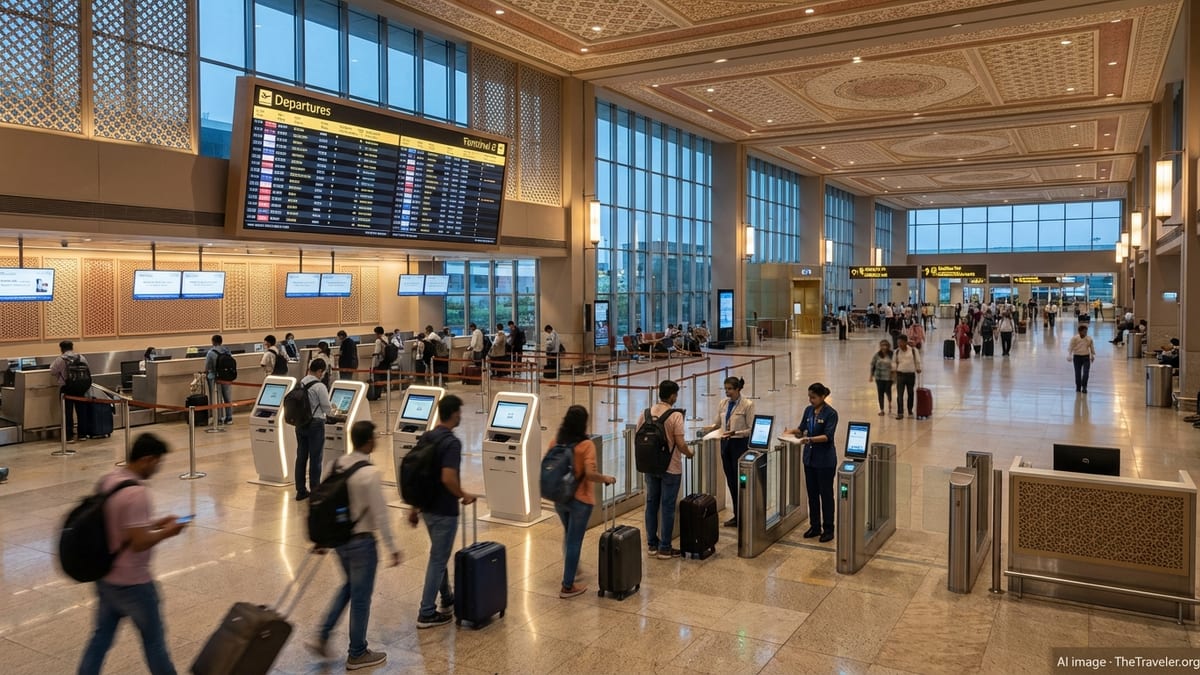
At the heart of Mumbai’s departure success is a sweeping digital transformation program branded as the airport’s “digital gateway.” In recent phases, the airport has expanded its bank of terminal entry e-gates from a few dozen to one of the largest kerbside deployments in India, dramatically increasing landside processing capacity and helping cut average entry wait times to under a minute even in peak periods.
These e-gates are integrated with DigiYatra biometric authentication as well as conventional document checks, allowing both enrolled and non-enrolled passengers to move through the terminal quickly. Once inside, travellers encounter a growing ecosystem of self-service options, from check-in kiosks and self-baggage drop machines to digital payment systems at car parks and retail outlets, designed to reduce friction and give passengers more control over their timelines.
Adoption of these tools has accelerated over the past two years, with millions of passengers shifting to self-check-in and automated bag drop for domestic and international departures. Airport managers say this has allowed staff to be redeployed from routine counters to passenger assistance roles in the hall and at security, improving both throughput and the perceived quality of human interactions.
Behind the scenes, CSMIA has also commissioned a next-generation Airport Operations Control Centre that fuses live data feeds from airside operations, terminals, security and ground transport. The integrated platform supports real-time decisions on queue management, gate allocation and disruption handling, helping departures stay on schedule even when weather, congestion or external events add pressure to the system.
Infrastructure Upgrades Support Record Traffic and Efficiency
The digital push is unfolding alongside a broader capacity and infrastructure upgrade designed to future-proof Mumbai’s status as a leading Asia-Pacific hub. In the terminals, expansion projects are focused on increasing handling capacity while rebalancing passenger flows, including the redevelopment of Terminal 1 and enhancements at Terminal 2 to accommodate more passengers without sacrificing comfort.
The strategy is already being tested at scale. In late 2025, CSMIA handled over 1,036 air traffic movements in a single day, surpassing its previous record and underscoring how closely packed departure and arrival slots have become. On its busiest days, the airport now facilitates travel for around 170,000 passengers, with outbound flows carefully orchestrated to avoid bottlenecks at check-in, security and boarding gates.
Planned airside works in coming years, including runway re-carpeting and new taxiway and apron configurations, are aimed at further sharpening punctuality and departure reliability. While some of this work will temporarily affect freighter operations, airport planners argue that the long-term gain will be a more resilient runway and more efficient aircraft movements, ultimately benefiting scheduled passenger departures.
As domestic and international networks continue to rebuild and expand, Mumbai’s role as a key connector between India and global markets is strengthening. The ASQ recognition signals that the airport is not only handling the volume but doing so in a way that passengers perceive as organised, efficient and increasingly premium.
Premium Services, Comfort and Cleanliness as Differentiators
Where CSMIA seeks to stand apart is in the qualitative aspects of departure, from terminal ambience to relaxation options for time-pressed business travellers and families. The airport has expanded lounge capacity, refreshed retail and dining mixes, and invested in more natural light and clear wayfinding to help terminals feel less crowded even at the height of outbound banks.
Cleanliness and hygiene have been elevated into a core part of the premium promise. The airport has deployed advanced robotic scrubber-dryers in Terminal 2, capable of autonomously cleaning large floor areas while using less water and electricity than conventional methods. These robots operate alongside trained housekeeping teams, allowing cleaning schedules to be more frequent and less intrusive for passengers rushing to departures.
Mental comfort has also entered the equation. One of Mumbai’s more distinctive initiatives is an emotional support dog programme at Terminal 2, where trained therapy dogs are stationed in key areas during busy evening hours. The programme is designed to reduce travel anxiety for nervous flyers or families with young children, subtly positioning the airport as a space that recognises the emotional dimensions of modern air travel.
These softer elements complement the technology and infrastructure upgrades, creating an overall profile that aligns with the expectations of premium and frequent flyers who value efficiency but also appreciate thoughtful touches in the hours before departure.
Sustainability and Future Readiness Shape the Next Phase
As it consolidates its position as Asia-Pacific’s leading departures hub in its category, CSMIA is also framing its evolution through the lens of sustainability and long-term resilience. Terminal retrofits and new-build projects incorporate energy-efficient design, from LED lighting and daylight harvesting to improved façade systems that reduce heat gain and trim cooling demand at busy departure halls.
The airport has invested steadily in on-site solar generation and water conservation, complementing its operational efficiency gains with reductions in resource intensity per passenger. Waste segregation initiatives, expanded recycling and efforts to cut single-use plastics are increasingly visible in departure concourses, signalling to environmentally conscious travellers that the journey to a greener footprint starts on the ground.
With passenger numbers in India projected to rise sharply over the next decade, Mumbai’s challenge will be to continue scaling up without diluting the service quality that has now earned it top honours in Asia-Pacific departures. For now, the 2025 ASQ award cements the airport’s reputation as a benchmark-setter in outbound travel, blending digital innovation, infrastructure investment and human-centred design into a departure experience that resonates with both first-time flyers and seasoned global travellers.