

More news on this day
Mumbai’s Chhatrapati Shivaji Maharaj International Airport was thrown into turmoil on March 1 as at least 57 flights were abruptly cancelled amid rapidly escalating tensions in the Middle East, shutting key air corridors and severing some of the city’s most popular long-haul routes to London, New York, Paris and other major hubs.
Middle East Crisis Shuts Key Air Corridors
The cancellations at Mumbai followed an urgent advisory from India’s aviation regulator directing airlines to avoid large swathes of airspace across the Middle East and the Gulf, including routes over Iran, Israel, Saudi Arabia, the United Arab Emirates and several neighbouring states through March 2. With multiple flight levels effectively out of bounds, long-haul services from India to Europe and North America that typically overfly the region suddenly became difficult or impossible to operate on their usual tracks.
As geopolitical tensions between Iran, Israel, the United States and regional actors intensified, temporary airspace closures and military activity raised the risk profile for civilian flights. Airlines and regulators responded by pulling back services and rerouting where possible, triggering a wave of knock-on disruptions across Asia, Europe and North America. Mumbai, one of India’s busiest international gateways, was among the hardest hit as carriers scrambled to comply with the new security guidance.
By early evening local time, airport officials reported that 57 arrivals and departures involving both domestic and international airlines had been cancelled at Mumbai alone, with more disruptions expected as the situation evolved. Operational constraints were compounded by limited options for diversion and parking, with the airport warning airlines that it could not accept additional diverted aircraft overnight because stands were already full.
Flag Carrier Cuts London, New York, Paris and Other Long-Haul Routes
India’s flag carrier Air India moved swiftly to axe a broad slate of international flights touching Mumbai, bowing to airspace security concerns and extended routing times that would have pushed some missions beyond crew duty limits and fuel planning margins. Among the cancellations were marquee services linking Mumbai with London Heathrow, New York’s John F. Kennedy International Airport, Newark Liberty, Frankfurt and other high-demand destinations.
Services between Delhi, Mumbai and London, New York, Newark, Chicago, Toronto, Frankfurt and Paris were either suspended or heavily curtailed for March 1, as the airline conducted what it described as a rolling risk assessment of the evolving situation. Routes such as Mumbai–London and Mumbai–New York, which anchor the carrier’s premium long-haul portfolio and are popular with business travelers and the Indian diaspora, were abruptly pulled from the schedule.
Air India said it was notifying affected passengers and attempting to accommodate them on later flights once conditions allow operations to resume, but acknowledged that capacity constraints and the scale of the cancellations meant many travelers would endure significant delays. Other Indian carriers, including IndiGo, Air India Express and Akasa Air, also suspended services to various Gulf and Middle Eastern destinations, further shrinking connectivity from Mumbai to the west.
Passengers Stranded, Rebookings Hard to Find
For thousands of passengers who arrived at Mumbai airport expecting a routine departure, the cascading cancellations translated into confusion and long waits at check-in counters and airline help desks. Many international travelers reported receiving short-notice text messages or app alerts indicating that their flights had been scrubbed, often after they had already left for the airport or cleared security.
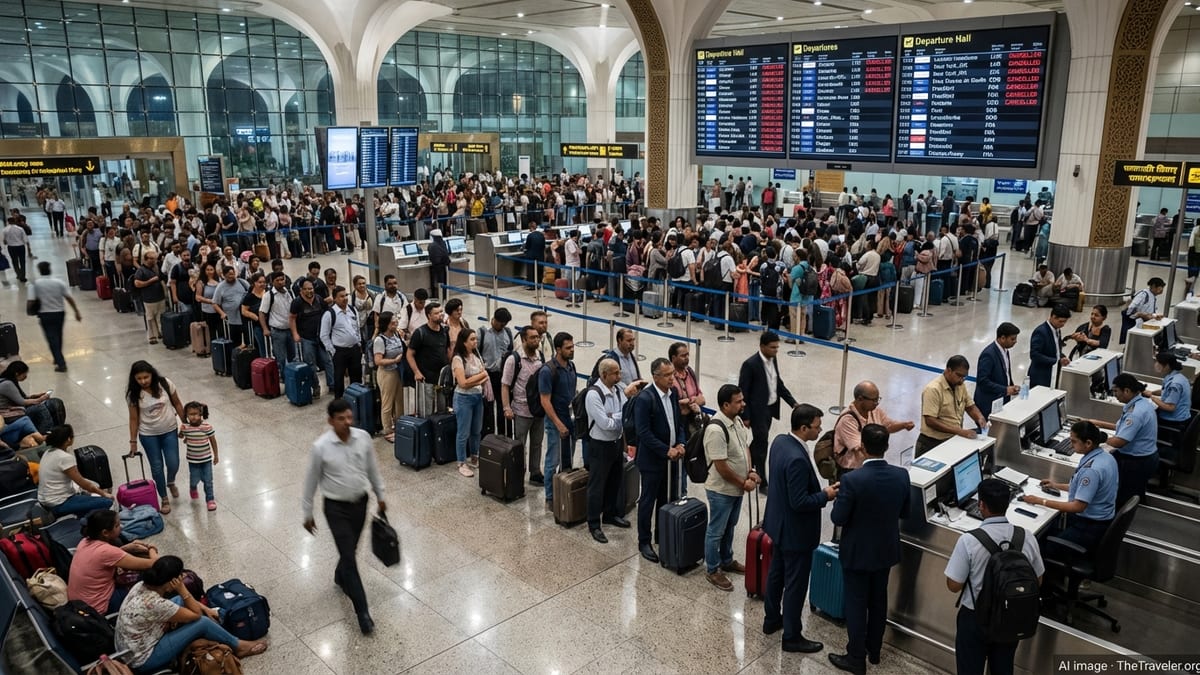
Inside the terminal, snaking queues formed as passengers sought rebooking, refunds or hotel accommodation. Families bound for school terms abroad, corporate travelers with time-sensitive meetings and tourists on tight itineraries all converged on the same limited pool of agents. With alternative flights also reliant on air corridors currently restricted by security advisories, options out of Mumbai were quickly exhausted.
Travel agents said availability on remaining westbound flights from other Indian gateways such as Delhi and Bengaluru vanished within hours, while some passengers began exploring complicated multi-stop itineraries via Southeast Asia or Africa to bypass the affected airspace. Even those routes were subject to change as more carriers adjusted operations to respond to the unfolding crisis.
Fare Surge and Limited Workarounds Add to Pain
As capacity evaporated, fares on the few remaining seats to Europe and North America spiked sharply. One-way economy tickets from India to London for March 1 surged into the upper bands of their typical price range, with some listings exceeding what passengers would normally expect to pay for a flexible return fare. Similar jumps were reported on routes to New York and other major hubs still being served via longer, more circuitous paths.
Industry analysts noted that with so many of India’s primary westbound corridors intersecting Middle Eastern airspace, airlines had limited flexibility to reshape their networks in the short term. Extended routings via Central Asia or the far northern tracks increase flying time and fuel burn, eroding the economics of certain services even when safety and regulatory constraints can be met. That calculus, combined with the immediate security concerns, left carriers with little choice but to ground dozens of flights at short notice.
The spike in last-minute demand has also affected onward connections for travelers trying to salvage their plans from other global hubs. Seats on transatlantic legs from European cities such as London and Paris, already constrained at the start of a busy spring travel period, became harder to secure once Indian-origin passengers began rebooking from afar. The result is a complex web of disruptions likely to ripple through schedules for several days.
Airlines and Regulators Emphasize Safety as Uncertainty Persists
Aviation authorities and carriers have repeatedly stressed that safety and security remain paramount as they navigate the mounting challenges. India’s Directorate General of Civil Aviation has urged operators to steer clear of designated conflict-affected airspace and is monitoring compliance as well as the operational impact on the wider network. Airlines, in turn, are coordinating closely with their operations control centers, international regulators and air traffic services to evaluate each route in real time.
Executives acknowledge that the measures are deeply disruptive for passengers but argue that any risk to aircraft operating near areas of active military activity leaves little room for compromise. Past incidents in conflict zones have prompted the industry to adopt a far more conservative posture when missiles or air defense systems are in use, particularly along high-altitude corridors normally crowded with commercial traffic.
For travelers passing through Mumbai in the coming days, the advice from airlines and travel experts is to stay in close contact with carriers, monitor flight status frequently and allow extra time for last-minute schedule changes. With tensions in the Middle East still fluid and airspace restrictions subject to rapid revision, the timing for a full restoration of Mumbai’s long-haul schedule to London, New York, Paris and other key cities remains uncertain, leaving passengers and the aviation industry braced for further turbulence.