

More news on this day
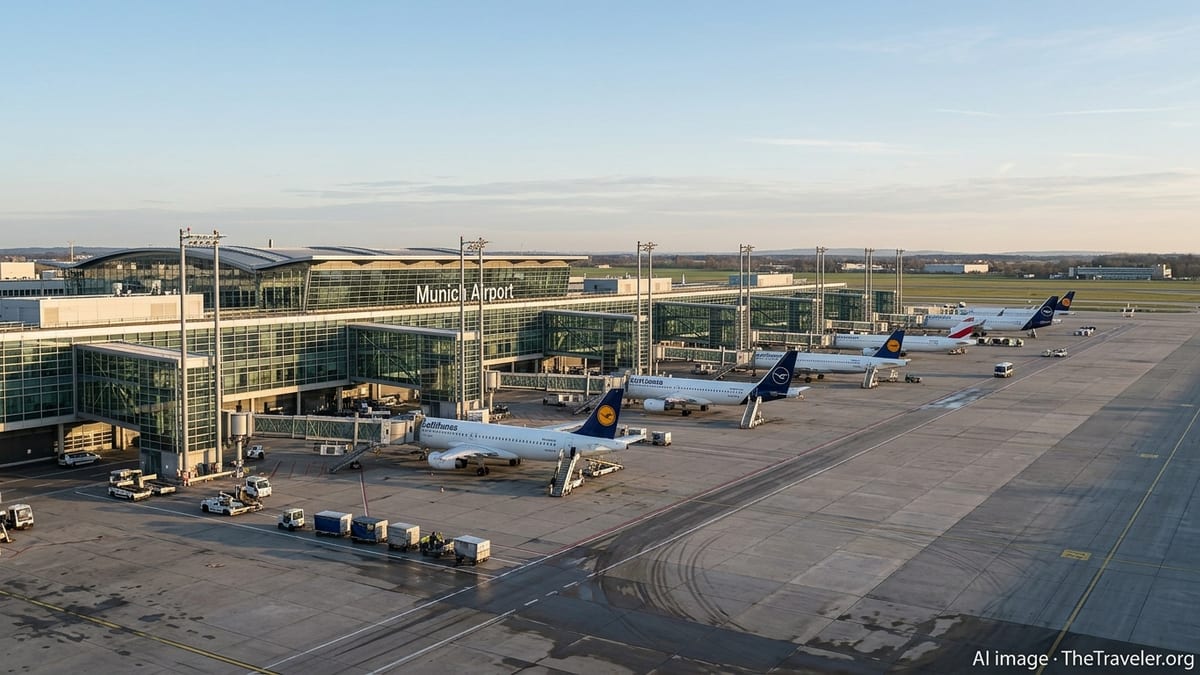
Germany’s Munich Airport has reinforced its status as one of Europe’s premier aviation hubs, earning a series of top accolades at the 2026 World Airport Awards and highlighting the airport’s rapid post-pandemic recovery, passenger-focused investments and growing global profile.
Get the latest news straight to your inbox!
Standout performance in global rankings
The latest World Airport Awards place Munich Airport among the world’s leading hubs, with the Bavarian gateway rising in the overall global rankings and consolidating its position near the top of the European league table. Recent rankings have consistently listed Munich in or around the global top ten, confirming its role as a key competitor to larger hubs across the continent.
Industry coverage of the 2026 awards indicates that Munich Airport again secured the title of Best Airport in Central Europe, an honor it has held on multiple occasions. The recognition reflects a long-standing record of strong survey scores from international passengers who rate the airport highly for comfort, connectivity and ease of use.
Munich’s latest success builds on a track record that includes repeated appearances near the top of European rankings over the past decade and a reputation as Europe’s first five star airport under widely cited international rating schemes. These cumulative results are seen by analysts as evidence of consistent quality rather than a one-off performance.
Aviation observers note that the World Airport Awards remain a closely watched barometer of passenger sentiment, as they are based on large-scale global surveys conducted across many months. Munich’s strong showing in 2026 therefore signals both sustained satisfaction among frequent flyers and growing appeal among connecting travelers looking for alternatives to the largest European hubs.
Passenger experience at the heart of Munich’s success
Munich Airport’s recognition at the 2026 awards is closely linked to its emphasis on the passenger experience, from check in through security and on to departure gates. Travelers regularly highlight clear wayfinding, logical terminal layouts and comparatively short walking distances, factors that can significantly influence satisfaction scores in global surveys.
The airport’s terminals are widely described in industry reports as bright, spacious and designed with extensive natural light, creating a calmer atmosphere than is typical at high traffic hubs. Seating areas, business zones and quiet spaces have been expanded over recent years, giving passengers more choice over how they spend dwell time between flights.
Retail and food offerings have also been an important element of Munich’s appeal. A mix of international brands and regional Bavarian concepts provides both familiarity and local flavor, while a broad range of price points aims to serve business travelers and leisure passengers alike. Observers note that this balance has helped the airport score strongly in categories related to comfort, amenities and sense of place.
Digital services have further supported Munich’s performance. The airport has rolled out upgraded wayfinding tools, real time flight and queue information and enhanced Wi Fi connectivity, all of which contribute positively to passenger perception. Industry commentators suggest that these incremental improvements, rather than a single high profile project, underpin the latest awards success.
Operational recovery and growth underpin recognition
Behind the awards, Munich Airport’s operational indicators show a robust return of traffic and continued growth. Publicly available traffic data for 2024 and 2025 point to passenger numbers surpassing 40 million annually, narrowing the gap to pre pandemic levels and securing Munich’s place among Europe’s busiest airports.
As Germany’s second largest hub after Frankfurt and a key connecting point for southern Germany, Austria and parts of Central and Eastern Europe, Munich has seen a steady expansion of its network. Airlines have restored long haul routes and added new destinations in North America, the Middle East and Asia, feeding additional transfer passengers through the airport’s terminals.
Observers note that this recovery has been managed while maintaining relatively high standards of punctuality and baggage handling compared with many peer airports. This operational stability during a period of strong demand recovery is frequently cited as a factor influencing positive survey scores in global awards programs.
With additional capacity and schedule adjustments planned for the coming seasons, Munich appears positioned to handle further growth without the prolonged disruptions experienced at some other European hubs. Analysts suggest that this balance between expansion and reliability is central to the airport’s strong performance in the 2026 awards cycle.
Sustainability and innovation support long term appeal
Reports on Munich Airport’s recent development highlight sustainability and innovation as key pillars of its long term strategy, elements that increasingly shape how global awards programs assess leading hubs. The airport has publicized ambitious climate and energy goals, including long range plans to significantly reduce emissions from its own operations.
Initiatives at Munich include investments in more efficient ground support equipment, expanded use of renewable energy and modernized building systems designed to cut consumption. Terminal upgrades and infrastructure projects are increasingly evaluated through a sustainability lens, aligning the airport with broader European climate objectives.
Innovation efforts extend beyond environmental measures. Munich has been active in testing digital solutions for resource planning, passenger flows and airport security processes. According to industry conference presentations, the airport has also explored partnerships around new mobility concepts and improved connections to rail services that link the airport with Munich and the wider Bavarian region.
These moves contribute to an image of Munich as a forward looking hub prepared for structural shifts in aviation, from evolving environmental regulation to changes in traveler expectations. The 2026 World Airport Awards, which increasingly highlight sustainability and innovation, appear to reflect this strategic direction in the recognition granted to the airport.
What the 2026 awards mean for travelers
For travelers, Munich Airport’s performance at the 2026 World Airport Awards offers a practical signal of what to expect when routing through Germany’s second largest hub. Strong marks in passenger experience categories suggest that connections are likely to be relatively straightforward, with clear signage, reliable information displays and a generally comfortable terminal environment.
The combination of extensive European and intercontinental networks means passengers have a broad choice of one stop itineraries via Munich to destinations across Asia, the Middle East and North America. Travel industry commentary notes that, for some itineraries, routing via Munich can offer shorter connection times and a calmer experience compared with busier mega hubs.
Frequent flyers also point to the airport’s consistent performance over many years, arguing that such stability across multiple awards cycles can be more meaningful than a single high ranking in one year. Munich’s run of recognitions, culminating in its standout results at the 2026 World Airport Awards, fits this pattern of long term reliability.
As airlines continue to rebuild networks and add capacity, the visibility that comes with prominent awards can further enhance Munich’s position within Europe’s competitive hub landscape. For international travelers planning future itineraries, the latest honors offer one more reason to consider a connection through Bavaria’s flagship airport.