

More news on this day
Munich Airport is preparing a major capacity boost at its Lufthansa hub, with plans for a new T‑shaped pier at Terminal 2 that aims to handle up to ten million additional passengers annually and reinforce the Bavarian gateway’s position among Europe’s leading transfer airports.
Get the latest news straight to your inbox!
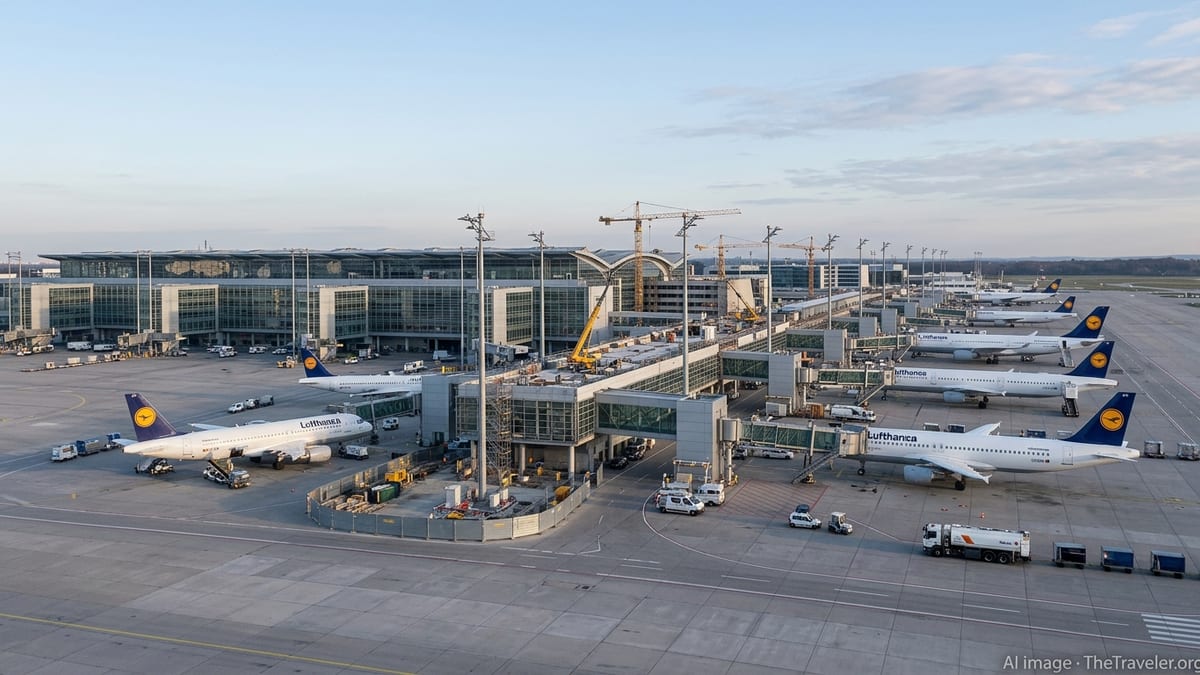
Strategic Expansion At One of Europe’s Busiest Hubs
Publicly available information shows that Munich Airport and Deutsche Lufthansa AG have agreed in principle to extend the Terminal 2 system with a new pier built at right angles to the existing satellite facility. The project, often described as a T‑pier because of its geometry, is conceived as an integral part of the joint Terminal 2 operation shared by the airport operator and Lufthansa.
Munich handled more than 40 million passengers in 2024, making it Germany’s second‑busiest airport and a key long‑haul gateway for southern Germany and Central Europe. Forecasts cited in recent airport reporting indicate that demand on Lufthansa and Star Alliance routes is expected to keep rising over the next decade, putting sustained pressure on the existing Terminal 2 complex, which today manages a large share of the hub’s transfer flows.
The T‑pier is designed to relieve those bottlenecks by adding new contact stands and gate areas tailored to hub operations. Planning documents referenced by Lufthansa’s earlier communications on the project describe the goal of increasing the overall Terminal 2 system’s capacity by up to ten million passengers per year once the pier is fully operational.
Design, Layout And Passenger Capacity
While detailed architectural drawings have not been released publicly, available descriptions indicate that the new structure would branch out from the east side of the existing satellite, creating a T‑shaped configuration on the eastern apron. This geometry is intended to maximise aircraft parking positions along both sides of the new concourse, similar in concept to other high‑throughput European hub projects.
Industry analyses of the Munich expansion programme suggest that the T‑pier will focus on international and transfer traffic aligned with Lufthansa’s network strategy. Additional contact gates are expected to accommodate a mix of narrow‑body and wide‑body aircraft, providing more flexibility during peak bank waves when arrivals and departures are tightly clustered.
The target of up to ten million extra passengers annually reflects both new capacity and operational efficiencies from shorter taxi times, more jet‑bridge positions and streamlined gate allocation. Airport planning material indicates that the pier would be closely integrated with existing Terminal 2 check‑in, security and baggage systems, limiting the need for duplicated infrastructure and allowing passengers to move between concourses within a single, coherent hub environment.
Integration With Munich’s Wider Investment Programme
The T‑pier project is advancing alongside a separate, large‑scale expansion of Terminal 1, where a new non‑Schengen pier is under construction and scheduled to open in 2026. That facility will concentrate long‑haul and transfer traffic for non‑Star Alliance airlines and is projected to add several million passengers of annual capacity to the western side of the airport.
Taken together, the Terminal 1 pier, ongoing modernization works in existing concourses, and the planned T‑pier at Terminal 2 form a multi‑year investment cycle aimed at future‑proofing the airport. Munich Airport’s integrated reports emphasise that the strategy is to expand infrastructure in line with demand while maintaining the service standards that have repeatedly placed the hub among the top‑rated airports in international customer surveys.
The Lufthansa partnership is central to that approach. Terminal 2 and its satellite are operated by a joint venture in which the airport company holds a majority stake and Lufthansa a significant minority share. The proposed T‑pier would extend that model, deepening the airline’s role in shaping gate layout, transfer flows and passenger amenities that are specifically tuned to hub‑and‑spoke operations.
What Passengers Can Expect From The New T‑Pier
For travellers, the most visible impact of the T‑pier would be an expanded choice of contact gates for Lufthansa and Star Alliance flights, reducing the need for bus boardings during busy periods. Based on how existing Terminal 2 facilities are configured, the new concourse is expected to include spacious gate waiting areas, extensive window frontage over the apron and direct access to airside retail and dining.
Munich Airport’s recent construction and design materials place strong emphasis on improving the quality of stay through natural daylight, clear wayfinding and shorter walking distances. It is therefore likely that the T‑pier will follow similar principles, with wide circulation areas, upgraded seating, and digital information systems intended to make tight connections more predictable for transfer passengers.
Although definitive timelines for construction and opening have not yet been formally announced, the project is framed as a medium‑term development following the completion and stabilisation of ongoing works at Terminal 1. Travellers using Munich over the next several years can expect a phased transformation, with the Terminal 1 pier coming on stream first and the Terminal 2 T‑pier following later in the decade.
Sustainability, Efficiency And Long‑Term Outlook
Munich Airport and Lufthansa have both highlighted climate and resource efficiency as guiding principles for new infrastructure at the hub. Earlier communications on the T‑pier concept indicate that the extension is intended to align with the partners’ environmental strategies, which include more efficient use of apron space, optimised energy consumption in terminal buildings and improved public transport connectivity.
By concentrating additional capacity within the existing Terminal 2 footprint rather than building a separate standalone terminal, planners aim to limit land take and enable more efficient use of shared systems such as baggage handling, security and aircraft ground services. This can reduce the per‑passenger environmental footprint while also supporting smoother operations during peak times.
For Munich, the T‑pier would mark another step in its evolution from a regional gateway into a high‑capacity, globally connected hub. As airlines continue to rebuild and expand long‑haul networks, the additional ten million passengers of potential throughput at Terminal 2 are positioned to play a significant role in how traffic flows between Europe, North America and Asia in the next decade.