

More news on this day
Passengers transiting through Muscat are facing mounting disruption as Oman Air, Gulf Air and several other regional carriers cancel or reroute flights, particularly on services connecting Seeb International Airport with Bahrain and neighboring Gulf hubs.
Get the latest news straight to your inbox!
Regional tensions feed into Bahrain and Muscat flight cancellations
According to published coverage and aviation data, the latest disruptions at Muscat’s Seeb International Airport are unfolding against a backdrop of wider airspace closures and rerouted traffic across the Gulf. Since late February 2026, multiple Gulf states have imposed temporary airspace restrictions in response to heightened security concerns, prompting airlines to thin out or suspend some of their most heavily used regional corridors.
Publicly available tracking information shows that flights linking Muscat and Bahrain have been particularly affected. Gulf Air, Bahrain’s flag carrier, has shifted a significant part of its operation to Saudi Arabia, with recent advisories highlighting temporary network operations from King Fahd International Airport in Dammam and adjusted procedures for passengers whose journeys were tied to Bahrain’s airspace. These changes have reduced the number of direct options for travelers hoping to move between Bahrain and Oman.
Operational decisions by Gulf Air are being mirrored by other carriers across the region. Reports indicate that Qatar Airways, Flydubai, Air Arabia and other airlines serving Gulf points have cut back frequencies or canceled services, either because of airspace closures at their home hubs or because connecting flows through Bahrain and Doha have become more difficult to sustain. The knock-on effect is now clearly visible in Muscat, where aircraft rotations and crew positioning have become harder to manage.
Specialist industry bulletins describe a patchwork of restrictions rather than a blanket closure of Omani airspace. While Oman’s skies remain technically open, some international routes have been temporarily suspended, and incoming services from neighboring Gulf countries are constrained by closures over their own territories. This has left Seeb International Airport in the paradoxical position of being open on paper, but short of the flights that usually make it a key regional waypoint.
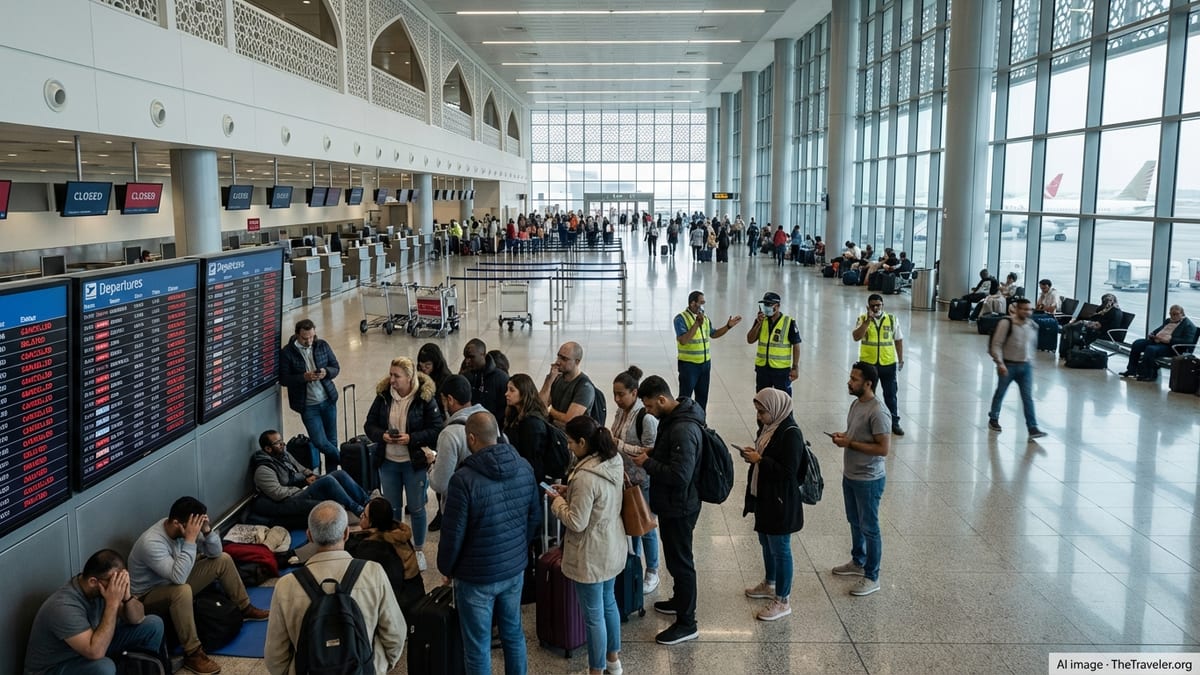
Scenes at Seeb International Airport as passengers face extended waits
Recent travel reports and on-the-ground accounts describe crowded terminals, long queues and weary passengers at Seeb International Airport as cancellations ripple through departure and arrival boards. Coverage from regional travel news outlets indicates that thousands of travelers have been affected over the past several days, with some stranded overnight or longer as they wait for rebooked flights or alternative routings.
Oman Air, Gulf Air and other carriers operating in and out of Muscat have been forced to consolidate schedules, resulting in last-minute cancellations and significant delays. Data from flight-status platforms shows multiple Muscat to Bahrain services being marked as canceled, while some onward connections to Europe, South Asia and other Gulf states have either disappeared from timetables or been pushed back by many hours.
For passengers already in transit, the disruption has translated into missed connections, altered itineraries and uncertainty about when they will reach their final destinations. Published coverage notes that some travelers bound for India, Qatar, the United Arab Emirates and other key markets have been left waiting in terminal areas or nearby hotels after finding their onward flights removed from departure boards.
Observers following the situation emphasize that the disruption is not limited to one airline or route. Instead, the pressure on Muscat reflects the interconnected nature of Gulf aviation, where a closure or constraint in one state can quickly reverberate through nearby hubs. With Bahrain’s operations curtailed and other Gulf hubs managing their own restrictions, Muscat has seen both reduced inbound capacity and limited options for rerouting passengers onward.
How Oman Air and Gulf Air are adjusting networks and ticketing
Publicly available airline notices and industry advisories show Oman Air and Gulf Air making a series of tactical adjustments intended to keep parts of their networks functioning while regional constraints persist. Oman Air has reportedly suspended or reduced certain services from Muscat to nearby Gulf gateways, including flights to Bahrain and some connections into the United Arab Emirates, as it reshapes its schedule around open air corridors.
Gulf Air, meanwhile, has extended its temporary operation from Dammam, allowing some passengers to connect via Saudi Arabia rather than Bahrain. Company advisories circulating through travel trade channels outline revised ticketing and refund procedures for travelers whose journeys were disrupted by the closure of Bahrain’s airspace, including options to reroute, claim refunds or obtain travel credits, depending on the original fare conditions.
Reports from travelers and regional aviation forums indicate that in some cases flights have not only been canceled but also significantly rescheduled, with departures moved by several days or replaced by services involving extended layovers. Passengers have described receiving short-notice notifications of schedule changes, followed by delays in seeing those changes reflected in online booking systems, adding to confusion about which flights are actually operating.
Travel industry updates suggest that airlines are prioritizing core trunk routes and essential connectivity while trimming secondary frequencies. This can mean that less busy departures are merged into a single daily service, or that flights are temporarily funneled through a different hub, such as Dammam, Jeddah or Riyadh, rather than Bahrain. For Muscat-based travelers, the net effect is fewer direct options, more complex routings and a higher risk of last-minute changes.
Wider Middle East aviation context and what it means for Muscat
The disruptions at Muscat are part of a broader pattern that has affected many of the Middle East’s best-known carriers. Recent international coverage notes that Emirates, Etihad Airways, Qatar Airways and other major players have all experienced sharp declines in flight numbers since late February, as parts of the region’s airspace became constrained and airlines reassessed overflight risks and insurance exposure.
Industry analysts point out that Gulf hubs like Dubai, Doha, Abu Dhabi and Bahrain typically function as high-frequency connectors between Europe, Asia and Africa. When one or more of these nodes is forced to cut back operations, neighboring airports such as Muscat are quickly drawn into the disruption, either through diverted aircraft and passengers or through the loss of connecting flows that sustain certain routes.
In Oman’s case, Seeb International Airport has benefited in recent years from steady growth in passenger traffic and a stronger domestic network. Latest statistics from regional business media highlight an increase in domestic flights and passengers through 2025 and into early 2026. The current wave of cancellations and schedule changes, however, underscores how vulnerable even growing secondary hubs can be to shocks in the wider regional system.
Travel risk advisories published this month warn that the situation across Gulf airspace remains fluid, and that airline schedules may continue to change at short notice. For Muscat, this means that periods of apparent stability could still be followed by sudden clusters of cancellations if geopolitical tensions escalate or new restrictions are introduced.
What affected travelers through Muscat need to know now
For passengers planning to travel through Muscat in the coming days, publicly available guidance from airlines, travel agents and consular advisories converges on a few key points. Travelers are being urged to check their flight status repeatedly in the 24 to 48 hours before departure, as timetables are being updated frequently and some services are disappearing from schedules with limited warning.
Reports indicate that many airlines are waiving change fees or offering flexible rebooking options on affected routes, particularly for tickets involving Bahrain or other Gulf states that have experienced recent airspace restrictions. In some cases, passengers may be able to reroute via alternative hubs in Saudi Arabia or further afield, even if it means longer travel times or overnight layovers.
For those already at Seeb International Airport, airport and airline updates suggest that disrupted travelers are being re-accommodated on the next available services, subject to seat availability and the evolving network constraints. However, with several carriers cutting back operations simultaneously, seats out of Muscat can be scarce, especially on peak travel days and on key regional trunk routes.
Travel industry commentators note that prospective visitors to Oman, as well as residents planning outbound trips, should build additional flexibility into their plans, including allowing more time for connections and considering the possibility of unexpected stopovers. Until regional air traffic patterns stabilize, Muscat’s role as a reliable stepping stone between Bahrain, the wider Gulf and longer-haul destinations is likely to remain under pressure.