

More news on this day
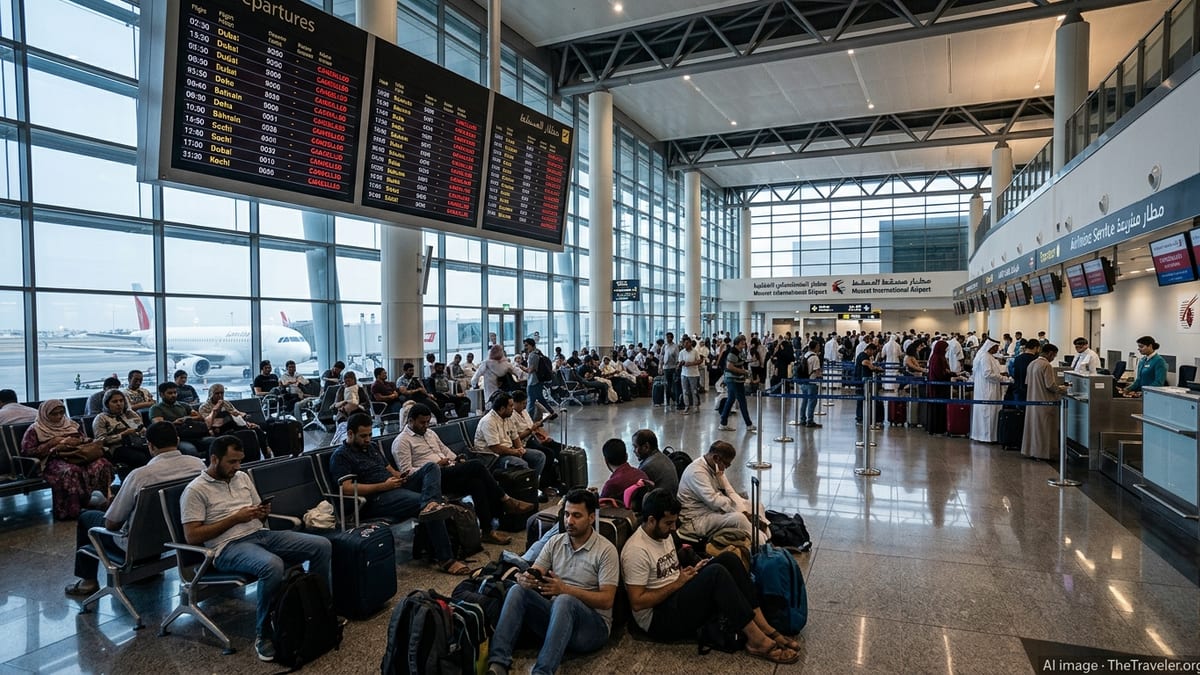
Passengers across the Gulf and the Indian Ocean rim are facing cascading disruption as Muscat International Airport sees widespread schedule upheaval, with dozens of services to Dubai, Bahrain, Doha and Kochi reduced, rerouted or cancelled amid an evolving regional airspace crisis.
Get the latest news straight to your inbox!
Regional Airspace Shockwaves Hit Muscat
Publicly available travel advisories and aviation noticeboards show that a rolling series of airspace restrictions across West Asia has triggered severe disruption to short haul links that normally connect Muscat with major hubs such as Dubai, Bahrain and Doha, as well as high demand routes to Indian cities including Kochi. While Muscat International Airport itself has generally remained open, regional closures and operational caps at neighboring hubs have sharply reduced the number of viable corridors, forcing airlines to trim or cancel services at short notice.
Recent risk assessments for the Middle East describe an environment of heightened security concerns, with some Gulf airspace corridors intermittently shut and others operating under limited capacity. In this context, even when departures from Muscat are technically permitted, flights that rely on onward connections through Dubai, Doha or Bahrain are frequently withdrawn from schedules, leaving passengers scrambling for alternatives or stranded in transit.
For travelers, the practical impact is a pattern of last minute cancellations, rolling delays and complex rebookings that are particularly acute on popular Muscat to Dubai and Muscat to Kochi sectors. Reports indicate that same day options are often unavailable, with many passengers pushed several days ahead or advised to route via less affected cities when seats can be found.
Dubai, Bahrain and Doha Links Squeezed
The tight clustering of major hubs around the Gulf has amplified the shock. Published coverage on regional operations shows that Bahrain’s airspace has been particularly constrained, with its flag carrier experiencing prolonged grounding and connections via Bahrain International Airport largely off the table. This has immediate knock on effects for Muscat, where Bahrain bound and Bahrain connecting services are among those most commonly removed from departure boards.
Dubai and Doha, normally two of the world’s busiest international gateways, have also seen waves of temporary suspensions and phased resumptions as they navigate missile and drone incidents, air defense activations and precautionary closures. Travel advisories describe partial service at Dubai International and heavily curtailed commercial operations at Doha’s Hamad International, with priority given to limited evacuation and cargo movements rather than standard passenger traffic.
When these hubs scale back, Muscat’s role as an alternate gateway becomes more prominent, but it also becomes more fragile. Airlines must juggle aircraft availability, crew duty limits and safe routing around restricted skies, which means that Muscat departures to Dubai, Doha and Bahrain can be confirmed one day and withdrawn the next, sometimes within hours of scheduled departure.
Indian Routes and Kochi Passengers Caught in the Crossfire
The disruption is particularly painful for India bound traffic, where Gulf stopovers form the backbone of travel between the subcontinent and Europe, North America and East Asia. According to airline bulletins on West Asia operations, carriers serving Muscat have repeatedly adjusted their India schedules, concentrating limited capacity on key cities while suspending or thinning out others.
Press notes from major Indian airlines outline how Kochi, a crucial origin and destination point for Gulf based expatriates, has been affected in multiple ways. Some Kochi services that would normally transit through Bahrain or Doha have been suspended entirely, while others have been reconfigured to operate via alternative hubs or with reduced frequency. In several cases, Muscat appears as a substitute stopover or relief point, but capacity is often insufficient to accommodate the large number of passengers displaced by cancellations elsewhere.
For Kochi travelers starting or ending their journeys in Muscat, the situation can be confusing. One day may bring additional special flights laid on to clear backlogs; the next may see ad hoc operations withdrawn as regional conditions shift. Passengers with multi segment itineraries that combine Muscat, Gulf hubs and Indian destinations are especially vulnerable to broken connections and long involuntary layovers.
What Travelers Through Muscat Need to Know Right Now
Given the fluid conditions, publicly available information from airlines, airports and independent travel risk firms consistently emphasizes preparation and flexibility for anyone planning to use Muscat as a gateway. Schedules are being treated as provisional, with carriers reserving the option to cancel or reroute even close to departure if airspace access changes or if transit hubs such as Dubai, Bahrain or Doha impose new limits.
Passengers holding tickets for Muscat services touching Dubai, Bahrain, Doha or Kochi are generally being offered a mix of no fee date changes, rerouting via alternative gateways where possible, or full refunds when flights are canceled outright. However, processing can be slow as contact centers, airport counters and online systems absorb unprecedented demand, and not all travelers are able to secure like for like alternatives within their original travel window.
Travel risk advisories advise building in additional time, favoring itineraries that avoid multiple Gulf transit points where possible, and monitoring flight status frequently on the day of travel. Muscat bound passengers are also encouraged to check visa rules and entry conditions in case an interrupted connection forces an unplanned overnight stay in Oman or another intermediate country.
Outlook: Volatile Conditions and a Slow Path to Stability
Looking ahead, aviation analysts and regional risk specialists quoted in open reports describe a highly uncertain short term outlook. The pattern of sudden closures and partial reopenings across Gulf and adjacent airspace suggests that the current wave of cancellations affecting Muscat’s links to Dubai, Bahrain, Doha and Kochi could continue in bursts, even if some corridors stabilize temporarily.
Airlines are gradually layering in additional services as soon as conditions permit, with special repatriation style flights and one off rotations appearing alongside limited scheduled operations. Muscat’s relatively stable local operating environment means the airport is well placed to handle extra traffic when regional skies allow, but its dependence on neighboring hubs and overflight permissions means it cannot fully insulate itself from wider turbulence.
For now, travelers using Muscat as a stepping stone between the Gulf and South Asia or onward long haul destinations should expect a stop start recovery rather than a quick return to normal timetables. The scale of recent cancellations has created a rolling backlog of passengers, and until airspace and hub operations across Dubai, Bahrain, Doha and key Indian gateways settle into a predictable pattern, Muscat’s schedules are likely to remain volatile and subject to abrupt change.