

More news on this day
Finnair passengers stranded between Dubai and Helsinki in the wake of mass flight cancellations across the Middle East have been handed a crucial lifeline, with the airline confirming it will operate special services from Muscat, Oman, starting March 10, 2026.
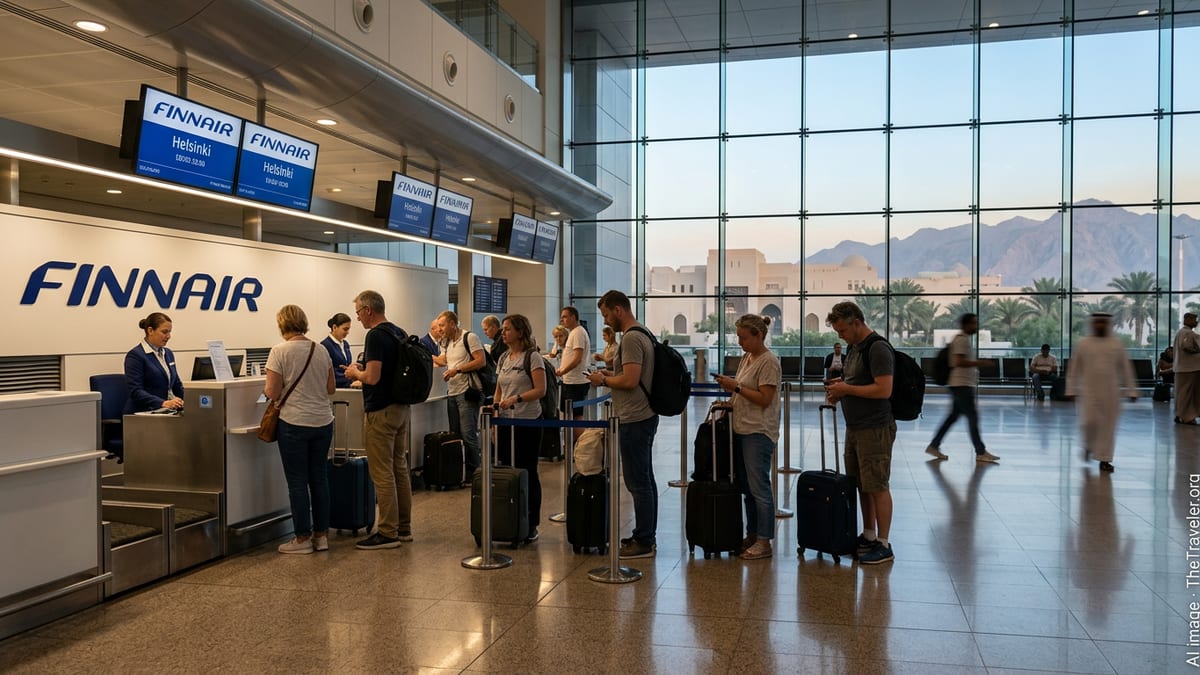
Muscat Emerges as a Strategic Escape Route
With key Gulf hubs still operating under tight restrictions following regional conflict and airspace closures, Muscat has rapidly become one of the few stable gateways for long-haul travelers. While Dubai and Abu Dhabi continue to see heavily curtailed schedules and a patchwork of repatriation services, Oman’s capital has remained broadly operational for select commercial and relief flights.
Finnair confirmed on Friday that it is preparing a series of special flights from Muscat to Helsinki to bring home customers whose Dubai–Helsinki services were cancelled at short notice. The first of these flights is designed to carry around 300 passengers, targeting those whose journeys were disrupted between February 28 and March 9, 2026, as the security situation deteriorated and airspace across parts of the region abruptly shut.
For many travelers, the news finally provides a clear route out after days of uncertainty, mounting hotel bills and long queues at airline desks in the United Arab Emirates. Muscat, four to five hours by road from Dubai, now represents a critical staging point in a wider network of evacuation and relief operations that governments and airlines are scrambling to assemble.
According to Finnair’s latest update, additional Muscat–Helsinki flights are planned to follow the initial operation, with capacity scaled to demand and subject to evolving airspace permissions. The airline is coordinating closely with Finnish authorities, who have been working in parallel on a government-organised repatriation flight from the region.
From Mass Cancellations to Patchwork Repatriations
The new Muscat link is the latest chapter in a fast-moving disruption that has shaken the travel industry and exposed the vulnerability of global air networks to regional conflict. Since late February, successive airspace closures across Iran, Iraq and parts of the Gulf have forced airlines to ground or divert thousands of flights, particularly through major hubs such as Dubai, Abu Dhabi and Doha.
Finnair was among the first European carriers to announce sweeping changes on its Middle East routes, suspending Doha flights and cancelling Dubai services for the remainder of the winter season. Those decisions left several thousand customers, including a large number of Finns, effectively marooned in the United Arab Emirates and neighboring countries, dependent on rapidly devised contingency plans.
As the situation worsened, airlines across Asia, Europe and the Middle East pivoted to emergency operations. Emirates, Etihad, Qatar Airways and others have mounted limited repatriation flights with priority given to passengers whose original journeys were cancelled. At the same time, carriers such as Air India and Oman Air have added special services via safer corridors, often using Muscat or Riyadh as staging points, while warning that schedules remain highly fluid.
For passengers bound between Dubai and Helsinki, the combination of Finnair cancellations, constrained Gulf hub operations and volatile airspace left few viable options. Many have reported days spent refreshing airline apps, rebooking repeatedly or, for those with deeper pockets, chartering private jets at extraordinary cost. The announcement of structured Muscat–Helsinki services marks a shift from ad hoc improvisation to a more predictable, if still limited, evacuation pipeline.
How the Muscat–Helsinki Operation Will Work
Finnair’s special flights from Muscat are expected to run as non-stop services to Helsinki, using long-haul aircraft normally deployed on Asian and North American routes. The initial rotation, scheduled from March 10, will prioritize customers whose original tickets were for cancelled Dubai–Helsinki flights, and who have registered with the airline or through consular channels.
Passengers selected for the operation will be contacted directly with instructions on how to reposition from Dubai to Muscat, either via overland transfer or limited commercial links that remain available. Travelers are being urged not to travel to airports without a confirmed seat, as capacity on both the repositioning journeys and the Muscat–Helsinki flights is tightly controlled for safety and logistical reasons.
Finnair has said that customers who secured seats on a separate Finnish government repatriation flight from the region can seek reimbursement for that journey if they were originally booked on the cancelled commercial services. The airline is also maintaining flexible rebooking and refund policies for those who prefer to postpone their trips until regular Dubai operations resume, currently slated no earlier than the end of March.
Operational details, including exact flight numbers and departure times, are being adjusted in real time as airspace restrictions ease or tighten along the route. Industry analysts note that the Muscat corridor may allow safer northbound routing that avoids the most sensitive regions, though longer flight times and fuel burn are likely as aircraft detour around closed or high-risk areas.
Stranded Travelers Weigh Risk, Cost and Timing
For stranded passengers, the decision to seize a seat on the first available Muscat–Helsinki flight or to wait for broader normalisation of schedules is far from simple. Hotel expenses in Dubai have mounted quickly, particularly for families and those without comprehensive travel insurance, while availability near the airport has tightened as more travelers seek to stay within easy reach of a potential departure.
Some passengers have already made their own way to Muscat or Riyadh to catch scarce long-haul flights to Europe, often paying inflated last-minute fares. Others have chosen to stay put in the United Arab Emirates, cautious about crossing land borders in a volatile security environment or wary of being stranded a second time in a different country if plans change again.
Travel agents in both Finland and the Gulf report a surge in requests for guidance on the relative safety of various routings, as well as confusion over overlapping offerings from airlines and governments. The Muscat–Helsinki operation is expected to absorb a significant share of Finnair’s backlog, but not all customers will be able to secure seats immediately, especially those with more complex itineraries or onward connections beyond Finland.
Despite the uncertainty, the announcement has injected a measure of optimism into what has been a bleak week for many travelers. For thousands of people caught between their lives in Europe and an abruptly shuttered Gulf gateway, a confirmed date and route home, even from a different airport several hours away, represents progress after days in limbo.
Industry Braces for Lasting Impact on Gulf–Europe Travel
The Dubai–Helsinki disruptions and the improvised Muscat lifeline highlight the broader challenges facing airlines that rely heavily on Gulf hubs to connect Europe with Asia and Africa. Even as some carriers signal plans to restore capacity in the coming days, executives acknowledge that demand patterns, risk assessments and network planning may be reshaped well beyond March.
Finnair has already been recalibrating its long-haul strategy in recent years, rerouting Asian services and experimenting with new partnerships and stopovers after earlier geopolitical shocks. The current crisis will likely accelerate that process, with Muscat and other secondary hubs gaining prominence as flexible fallbacks when primary gateways are compromised.
For Gulf carriers, the episode underlines both their centrality and their exposure. Airlines that built their business models on seamless transfers through Dubai, Doha or Abu Dhabi are now being tested on how swiftly they can pivot to point-to-point relief flights and rebuild passenger trust once normal timetables resume. Regulators and insurers, in turn, are reassessing assumptions about acceptable overflight risks and contingency planning for large-scale airspace closures.
For now, the focus for stranded Dubai–Helsinki passengers is more immediate: securing a seat, reaching Muscat safely and finally boarding a flight north. If the first services on March 10 operate smoothly, they may serve as a template for how airlines and governments can collaborate to reconnect disrupted corridors when conventional hub-and-spoke patterns suddenly fail.