

I had seen so many photos of Notre-Dame Basilica in Montreal before I finally walked through its doors that I half-expected to feel nothing. Overly Instagrammed places sometimes have that effect on me.
But my visit turned out to be a mix of awe, frustration, quiet moments of beauty, and a few practical annoyances that I wish I had known about in advance. This is my honest account of what it was really like and what I took away from the experience.
Arriving With High Expectations
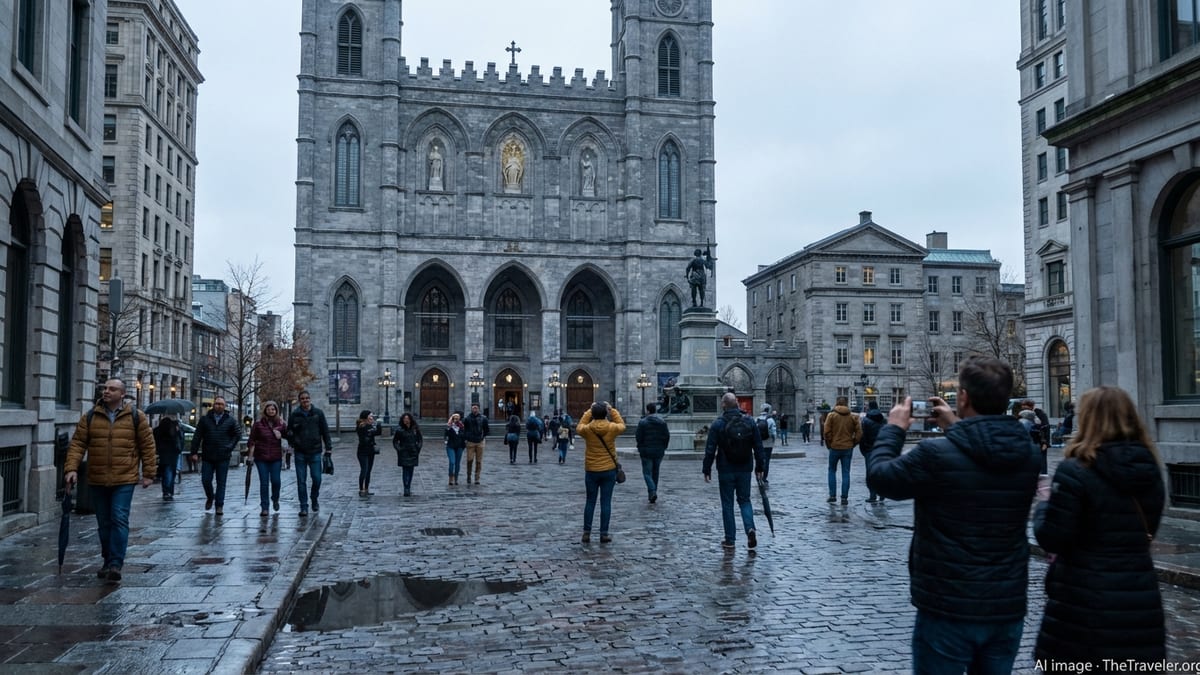
By the time I reached Place d’Armes, I already “knew” the facade from a hundred travel articles and social media posts. In person, the exterior of Notre-Dame Basilica struck me as more restrained than romantic. The twin towers and grey stone looked slightly severe against the sky, especially compared to the saturated interiors I had seen online. I would not call the outside breathtaking, but it did have a quiet authority that made me slow down and take it in.
My expectations were high. Notre-Dame is often described as one of the most beautiful churches in North America, a must-see, a non-negotiable stop in Old Montreal. That reputation works both ways. On one hand, it creates excitement. On the other, it primes you to hunt for flaws the moment reality doesn’t align perfectly with the fantasy. As I approached the entrance and saw the line of visitors, I could feel both impulses kicking in.
The queue itself was not terrible when I arrived, but it was long enough to remind me that this is not a quiet neighborhood parish. This is a major paid attraction with the crowd to match. I had to reset my mindset from “I’m stepping into a place of worship” to “I’m entering a popular, fairly commercialized heritage site that still functions as a church.” That mental shift became one of the themes of my visit.
The Practicalities: Tickets, Timing, and Crowds
Before going, I had looked up the basic logistics. As of my visit, there was a set admission fee for daytime sightseeing, with separate, higher-priced tickets for the evening AURA light-and-sound experience. I opted for a standard daytime visit and bought my ticket on-site, mostly because I wanted to see how much hassle that actually involved.
The line moved reasonably quickly, but I still spent long enough in it to notice a few things. First, the area just outside the basilica can feel congested. Tour groups gather, people stop suddenly to take photos, and it becomes a bit of an obstacle course, especially if you are not a fan of jostling or tight crowds. Second, there is a small but noticeable gap between the basilica’s spiritual aura and the practical reality of ticket scanning and crowd control. Staff were efficient and polite, but the whole process felt more like entering a museum than stepping into a sanctuary.
In hindsight, I would have timed my visit more carefully. Late morning and early afternoon appeared to be peak hours, with large groups and a noisy, constant shuffle. If I had to do it again, I would aim for right after opening on a weekday or closer to the end of the afternoon, when the flow seemed a bit calmer. Notre-Dame is not a place you want to rush, and the density of visitors can make it hard to slow down the way the space deserves.
First Impressions Inside: Overwhelmed in a Good and Bad Way
Stepping into the nave was the moment everything I had seen in photos suddenly made sense. The deep blue ceiling dusted with gold stars, the carved wood, the glow of blues and golds around the high altar: it is undeniably dramatic. My first instinct was simply to stop and stare. No camera, no notes, just a quiet internal “wow.” Any skepticism I had about the basilica’s reputation dissolved in those first few seconds.
But almost immediately after that, something else hit me: the noise. Dozens of conversations layered on top of one another, the shuffle of feet, whispered commentary from guides that did not always remain whispers. The basilica is large enough that sound does not become deafening, but it is rarely truly quiet during busy hours. I found myself torn between being moved by what I saw and slightly irritated by the constant background hum.
It took me a few minutes to adjust. I had to accept that this was not going to be a hushed, contemplative experience from start to finish. Once I let go of that expectation, I began to pick out impressions in smaller pockets of stillness: the way the light hit the side chapels, the intricate details in the wood carvings, the careful layering of color and shadow that gives the main altar its depth. Even in the midst of the crowd, there were moments that felt almost intimate if I focused hard enough.
The Architecture and Atmosphere: Beauty With a Busiest-Attraction Feel
Architecturally, Notre-Dame Basilica is as rich and theatrical as everyone says. The interior design, influenced by French Gothic revival, leans into saturated colors and elaborate ornamentation. The blue ceiling with gold stars feels almost like a night sky pulled indoors. The high altar is a complex sculptural composition, with carved figures, pointed arches, and layered illumination that changes subtly as you move around the nave.
What surprised me most was how much of the experience depends on where you stand. From the center aisle, the basilica feels grand and almost overwhelming. Move to the side, and you start noticing quieter details: small statues, delicate patterns, stained-glass panels that illustrate episodes from local religious history instead of the more expected biblical scenes. The building rewards patience and close looking, but the foot traffic pattern does not always encourage that.
There is a slight tension between the atmosphere the architecture tries to create and the energy of a high-traffic attraction. On one hand, the dim lighting, the candles, and the visual density invite contemplation. On the other, the constant movement of people, the occasional flash of a phone screen, and the visible presence of staff and signage keep pulling you back into the reality that you are part of a continuous flow of tourists. I found myself wishing for more clearly designated quiet zones or time slots specifically oriented toward reflection rather than sightseeing.
The Self-Guided Visit: Informative but Not Always Intimate
The basilica promotes a self-guided visit with designated points of interest, and I made an effort to follow the suggested route. Overall, the information is solid. You get a sense of the building’s history, its connection to Montreal’s development, and the choices behind its interior design. For someone who values context, this added a lot to my understanding of what I was looking at.
That said, the experience felt somewhat uneven. Some points were well marked and easy to engage with. Others were harder to access because of bottlenecks created by groups or because the signage blended into the visual noise of the interior. At times, I found myself reading quickly and moving on simply to avoid blocking the flow of people behind me, which is not exactly the kind of pace that encourages deep appreciation.
There were also moments where I wished for more human interaction. Staff were present and helpful when approached, but the overall format leans heavily on passive consumption: read a sign, take a photo, move on. Compared with a guided tour in a smaller church or a conversation with a local volunteer in a quieter parish, this felt more curated and less personal. It is not a dealbreaker, but anyone expecting a more intimate connection with the spiritual or community life of the basilica may come away slightly unsatisfied.
The Side Chapel and Quieter Corners
One of my favorite parts of the visit was stepping into the more modern side chapel, which is notably different from the main nave. Here the design is bolder, with a contemporary altar and a different approach to light and space. It felt like walking into another chapter of the basilica’s story, one that acknowledges that religious architecture continues to evolve.
This chapel, and a few smaller corners of the basilica, also offered something I was craving: relative quiet. The crowd thinned a bit, voices lowered, and I finally managed to sit in stillness for a few minutes. In those short stretches, the building’s spiritual dimension came forward more clearly. I could imagine what the space must feel like during a weekday Mass with fewer visitors around, when the focus shifts from sightseeing to worship.
If you visit and find yourself overwhelmed by the main nave, I recommend deliberately seeking out these side spaces. They are not completely empty, but they often feel more human-scaled and less like you are part of a moving procession of cameras. For me, these quieter moments balanced out some of the more hectic parts of the visit and kept the experience from feeling purely transactional.
Commercialization, Cost, and Value
It would be dishonest to ignore the financial side of visiting Notre-Dame Basilica. This is a paid attraction for daytime sightseeing, and the evening AURA show carries an even higher price tag. When you add this to the gift shop and the constant flow of people, it is hard not to notice the commercial dimension of the visit.
Personally, I had mixed feelings about this. On one hand, maintaining a historic building of this scale is expensive, and visitor fees help cover restoration, staffing, and operations. Paying an admission fee did not feel unreasonable as long as I reminded myself that I was contributing to the upkeep of a cultural and religious landmark. On the other hand, the transactional aspect can chip away at the sense of sacredness, especially when your first interaction is buying a ticket and your last is passing displays of souvenirs.
Was it worth the cost? For me, yes, but with qualifications. The interior is extraordinary and unlike anything else in Montreal. If you care about architecture, art, or religious history, the value is there. However, if you are traveling on a tight budget or have already visited several major churches and cathedrals elsewhere, you might find yourself comparing and questioning whether the admission price and time investment match what you personally gain from the experience.
AURA Light Show: Why I Skipped It (and What I Noticed Anyway)
I decided not to purchase a ticket for the AURA evening experience, partly because of the added cost and partly because I wanted to focus on the basilica as a space rather than as a performance venue. However, talking to other visitors and observing the setup gave me a sense of how the basilica is used after dark.
From what I could gather, AURA transforms the interior with projections and music, highlighting architectural details in a way that standard daylight viewing does not. Some people I spoke with were enthusiastic, calling it magical and unforgettable. Others felt it crossed the line into spectacle, arguing that it made the basilica feel more like a stage than a church. Without having seen it myself, I cannot fairly judge the show, but I can say that I was wary of blurring that boundary.
If I return to Montreal, I might give AURA a chance on a separate evening, treating it clearly as an artistic event rather than as a spiritual or contemplative experience. I would not recommend doing both in the same day unless you are deeply interested in the building and willing to accept that it plays different roles for different audiences.
What I Would Do Differently Next Time
Looking back, there are several things I would change about how I visited Notre-Dame Basilica. The first is timing. I would go earlier in the day or later in the afternoon to avoid the heaviest crowd periods. Even shaving off a few dozen people from the nave can dramatically change how the space feels and how easily you can move around and read the interpretive materials.
Second, I would give myself more intentional quiet time. Instead of trying to see everything in a straight line, I would consciously build in pauses: sit in a side pew, spend a few extra minutes with one stained-glass window rather than trying to photograph them all, or find a corner where I can simply look and listen. The basilica rewards slowness, but the default pace of the crowd is fast, so you have to resist the current a bit.
Finally, I would more clearly separate my expectations. I would go in acknowledging that this is simultaneously a place of worship, a major tourist attraction, and a revenue-generating cultural site. Holding all three truths at once makes it easier to accept the ticket prices, the lineups, and the gift shop without feeling that they cancel out the building’s spiritual or artistic value. It is not a pure, untouched sanctuary, but it is also not just a backdrop for photos.
The Takeaway: Who It Is For and When It Is Worth It
My visit to Notre-Dame Basilica in Montreal did not unfold like the quiet, transcendent experience I had secretly hoped for, but it also did not disappoint in the ways I feared. Instead, it landed somewhere in the middle: visually stunning, occasionally overcrowded, thoughtfully interpreted, and inevitably shaped by its popularity.
If you love architecture, sacred spaces, or the layered history of cities, I would say the basilica is absolutely worth your time and the price of admission. Go with realistic expectations, choose your timing carefully, and give yourself permission to ignore the crowd for a few minutes at a time. In those pauses, the building’s power becomes clear.
If you are less interested in churches or have already visited many grand cathedrals elsewhere, you may find the experience impressive but not life-changing. In that case, I would still recommend going, but I would treat it as one important stop in Old Montreal rather than the emotional centerpiece of your trip. It may not transform you, but it will likely give you at least a few moments of genuine wonder.
In the end, my biggest takeaway is that Notre-Dame Basilica is at its best when you meet it halfway: accepting the crowds and commercialization without letting them define the entire experience, and making the effort to carve out your own small pockets of stillness amid the flow. Under those conditions, it remains one of Montreal’s most compelling places to step back, look up, and feel something larger than yourself, even if only for a moment.
FAQ
Q1. Is Notre-Dame Basilica in Montreal still an active church or only a tourist attraction?
It is both. Regular religious services are held there, but during the day it also functions as a major paid visitor attraction with large numbers of tourists.
Q2. How much time should I plan for a visit?
Based on my experience, about one hour is enough for a basic self-guided visit, but 90 minutes allows you to slow down, read displays, and sit quietly for a bit.
Q3. Is it necessary to buy tickets in advance?
I was able to buy a ticket on-site, but lines can form at busier times. If your schedule is tight or you dislike waiting, advance tickets can add peace of mind.
Q4. When is the best time of day to visit to avoid crowds?
I found late morning and early afternoon the busiest. I would aim for shortly after opening on a weekday or later in the afternoon for a calmer experience.
Q5. Is the visit suitable for children?
Yes, but it depends on the child. The interior is visually striking and may captivate them, but they will need to be reminded to stay quiet and respectful, and there is limited space to move freely.
Q6. Do I need to attend the AURA light show to appreciate the basilica?
No. A standard daytime visit is enough to appreciate the architecture and atmosphere. AURA is an optional evening experience that some people love but is not essential.
Q7. Is Notre-Dame Basilica accessible for visitors with reduced mobility?
The basilica is partially accessible. There are some accommodations in place, but not every area is easy to reach, so it is wise to check current accessibility details before you go.
Q8. Can I take photos inside?
During my visit, photography without flash was generally allowed for personal use, but it is important to avoid disrupting services or other visitors and to follow any posted rules.
Q9. What should I wear when visiting?
There is no strict dress code, but I recommend modest, respectful clothing suitable for a place of worship. Comfortable shoes also help, as you will be standing and walking on hard floors.
Q10. Is the admission price worth it if I have seen many other famous churches?
For me, the distinctive interior and its place in Montreal’s history justified the cost, but if you are on a tight budget and have seen many similar sites, you may want to weigh your priorities carefully.