

I stayed at the historic Gellért Hotel on the Buda side of Budapest knowing full well that it was in a strange in‑between state: the famous thermal baths were already closed for long‑term renovation, the hotel itself was running on borrowed time before its own overhaul, and reviews were all over the place.
Still, the idea of sleeping inside one of the city’s most iconic Art Nouveau landmarks, right at the foot of Gellért Hill, tempted me enough to book. What I found was a property with undeniable character and a genuinely superb location, but also frayed around the edges, inconsistent in comfort, and clearly nearing the end of its current life cycle.
Booking, Check In, and First Impressions
I booked the Gellért primarily because of its history and setting rather than any promise of luxury. I went into it expecting something slightly faded but atmospheric, with the bonus of having direct access to the baths. The second part of that expectation turned out to be outdated: by the time I arrived, the Gellért Thermal Bath complex had already shut for a multi‑year renovation, and the internal corridors that used to connect hotel guests to the spa were blocked off. In other words, staying at the hotel no longer meant rolling down in a robe to the pools. Any marketing that still hints at that experience is now misleading.
Check in was functional rather than warm. Staff spoke decent English and handled the basics quickly, but there was no particular enthusiasm in explaining that the spa was closed and no compensating offer beyond a generic suggestion to try other baths across the river. I had the sense that front desk staff had given that same disappointing speech many times and had lost the energy to cushion it. The process was efficient, but it set a slightly flat tone.
My first impression of the building itself was more positive. The exterior is still striking: a grand façade facing the Danube, topped with green copper domes and intricate stonework. Inside, the lobby retains its early 20th‑century bones, with high ceilings, marble details, and the kind of worn elegance that you either find charming or tired. I felt both reactions at once. It was beautiful, but it also felt like a set that had not been properly maintained for years.
The Room: Between Old‑World Charm and Neglect
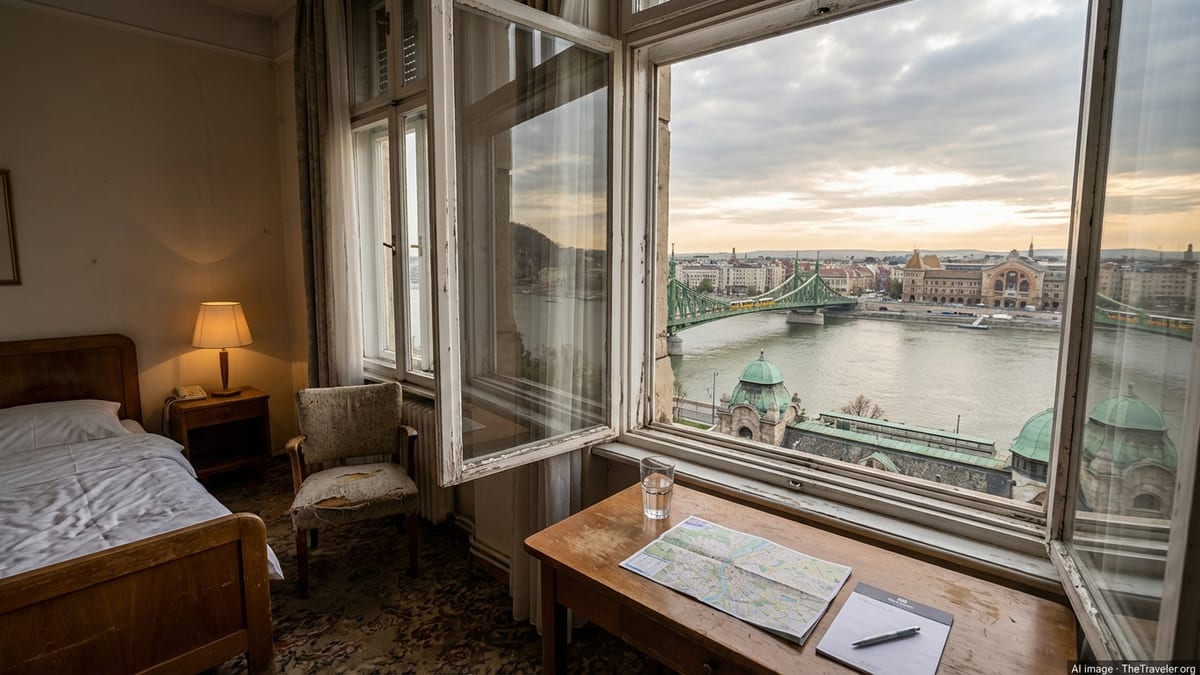
My room was one of the “Danube view” categories, which I chose specifically hoping that the river panorama would help offset any shortcomings in the hardware. In that sense, it partly worked. From the window I could see the Liberty Bridge, trams crawling along the embankment, and Pest glowing across the river in the evening. That view genuinely elevated the experience and was the one element that consistently felt special.
Everything inside the room, however, showed its age. The layout itself was generous by modern city‑hotel standards. There was plenty of floor space, high ceilings, and a proper writing desk. But the furniture looked like it had survived several stylistic eras. The bed frame was heavy and old‑fashioned, the chairs were mismatched in style and wear, and the carpet bore stubborn stains that no recent cleaning attempt had conquered. I did not feel that the room was dirty, but it did feel neglected and overdue for a comprehensive renovation.
The bed was a mixed experience. The mattress leaned toward the soft side and had visible sagging on one half, suggesting long‑term use without replacement. Despite that, I actually slept reasonably well, but more because I was tired than because the bed was objectively comfortable. Pillows were flat and synthetic, and the linens, while clean, had that slightly rough texture you associate with older stock that has seen many cycles in industrial washing machines. If you are accustomed to modern four‑star bedding, this will feel like a downgrade.
The bathroom was where the age of the property felt least charming. The layout was cramped, with a narrow tub‑shower combination and a clingy plastic curtain. Taps and fixtures had that dull, slightly pitted metal look that comes from decades of hard water. Water pressure was adequate but not generous, and it took a while to find a stable temperature. The small wall‑mounted hairdryer belonged to another decade. Toiletries were basic and unremarkable. Functionally, everything worked, but it felt like staying in a mid‑range Eastern European hotel from the 1990s rather than in a grand spa hotel of international standing.
Atmosphere: Faded Grandeur and Ghost of the Spa
What makes the Gellért difficult to judge is that its atmosphere is genuinely unique. Even in its worn state, the building is impressive. Shared spaces still hint at the hotel’s glory days: long corridors, decorative railings on staircases, stained glass details, and the sense that the place has witnessed a century of travelers. Walking the hallways at night, I felt that faint thrill of staying somewhere that is part hotel, part historical artifact.
At the same time, that atmosphere is undercut by the reality that the property is now in limbo. The closure of the thermal baths removed the living heart of the complex. Where there used to be a natural flow of guests padding in robes, coming and going between rooms and pools, there is now a palpable stillness. Signage still points to spa areas that are closed off. Doors that once led to tiled corridors are now shut and sometimes taped. It feels a little like inhabiting a once‑grand ship whose main salon has been sealed.
The guest mix during my stay was mostly foreign tourists, many clearly drawn by the reputation of the baths. I heard more than one frustrated comment at reception from people who had not realized the spa was closed until arrival. That collective disappointment added a slightly strained tone in the lobby, particularly at peak check‑in times. On the other hand, because the property was no longer drawing local day‑visitors to the baths, the hotel areas felt calmer and less chaotic than descriptions from previous years suggest.
Noise levels varied. Street‑facing rooms toward the bridge can pick up tram noise, especially when windows are old single‑glazed units, which is the case in much of the building. The hum of traffic and the occasional squeal of rails were noticeable but not unbearable to me. If you are a light sleeper, you would want a room higher up and perhaps away from the main road, though that would mean giving up some of the prized Danube views.
Services, Food, and Day‑to‑Day Practicalities
Service at the Gellért felt pared back, almost as if the hotel was operating in a holding pattern ahead of major works. Housekeeping did the essentials but not much more. My room was made up daily, bins were emptied, and fresh towels appeared when requested, but turndown did not exist and details such as a half‑used glass left by the window would sometimes stay there surprisingly long. Staff were polite when I interacted with them but did not go out of their way to be proactive.
Breakfast was served in one of the main dining rooms, a space with tall windows and an appealingly vintage feel. The food itself was adequate rather than memorable. The buffet covered the basics: scrambled eggs, sausages, cold cuts, cheese, bread, cereals, some pastries, and fruit. Quality was inconsistent. Some items, like the fresh bread and certain local pastries, were enjoyable; others, such as the lukewarm eggs and overcooked sausages, felt like standard mass‑catering fare. Coffee was from machines and tasted accordingly flat. If breakfast were not included in my rate, I would have considered eating elsewhere after the first morning.
Other food options on site were limited during my stay. Formerly, the hotel had multiple outlets connected to the spa and terrace areas, but several were shuttered. The main restaurant offered a short menu of Hungarian and international dishes at prices that leaned on the hotel’s reputation more than on the actual culinary experience. I had one dinner there and found it perfectly serviceable but not compelling enough to repeat when the city’s broader dining scene is just across the bridge.
On the practical side, Wi‑Fi coverage worked reliably in my room and in the lobby, although speeds were not especially fast during peak hours. The hotel’s elevators showed their age but functioned, albeit a bit slowly. Air conditioning was another weak point: the system in my room was noisy and not very responsive, more akin to an older central setup than to independent climate control. In shoulder season this is a mild inconvenience; in high summer, it could be a deal‑breaker for some guests.
Location: Where the Gellért Still Shines
The single greatest asset of the Gellért Hotel, and the main reason I do not fully regret staying there, is its location. The building sits right at the foot of Gellért Hill on the Buda side, directly facing the Liberty Bridge and the Danube. This means that, step out of the front door, and you have instant access to trams, the M4 metro at Szent Gellért tér, and riverside strolls with some of the best views in the city. You are close enough to the central districts of Pest to walk across the bridge, yet you are technically staying in quieter, greener Buda.
For exploring Budapest, this base worked extremely well. I could walk to the Central Market Hall in minutes, then continue into the bustling pedestrian streets on the Pest side. In the other direction, paths up Gellért Hill started almost behind the hotel, leading to viewpoints and, more recently, to the refurbished Citadella area overlooking the city. That combination of urban convenience and immediate access to a hilltop park is rare in a European capital.
The catch is that the location used to be amplified by the presence of the functioning thermal baths. Without them, you are essentially paying a premium for position and heritage rather than for access to on‑site wellness facilities. That is an important shift in value. If your main reason for choosing the Gellért is the idea of soaking in ornate indoor pools under Zsolnay tiles, you will currently be disappointed. Other baths remain open elsewhere in the city, but they require a tram or metro ride, and the entire selling point of effortless robe‑to‑pool living no longer applies.
That said, I liked returning to the quieter Buda side in the evenings. Pest can feel hectic and tourist‑packed, especially around peak seasons. Gellért, even in its diminished state, offered a sense of stepping back slightly from the frenzy while still being extremely well connected. If you value that balance of connectivity and relative calm, the location continues to justify itself.
Expectations vs. Reality: Spa Closure and Renovation Limbo
Before my stay, I had read that the Gellért Bath would be closing for several years for a major renovation and safety‑driven overhaul. By the time I arrived, that closure was already in effect, and construction planning around both the bath and the hotel was clearly influencing the hotel’s day‑to‑day operations. In practice, that meant certain wings were unused, some common areas felt stripped back, and there was a lingering sense that the property was running at minimum viable settings until the next chapter begins.
I knew in advance that I would not be able to use the spa, but I still underestimated how much its absence would affect the overall feel of the place. The Gellért is not just a hotel attached to a bath; the bath and the hotel are functionally and historically intertwined. Remove half of that equation, and you are left with a structure that feels incomplete. The hotel on its own does not currently deliver enough comfort or polish to stand entirely independent of the spa’s magic.
Looking ahead, the multi‑year renovation plans for the bath and, eventually, for the hotel suggest that both will return in upgraded form. That is encouraging, but it also raises the question of whether it is worth staying there in the interim period. Personally, I felt like I was catching the last act of a long‑running show, with sets and costumes visibly fraying. That has a certain appeal if you appreciate urban patina and like to see iconic places before they are remade. If you are expecting a classic spa‑hotel experience, though, reality will fall well short of that expectation for the next few years.
It also affected value perception. My room rate was not low, especially when compared with more modern Budapest hotels offering freshly renovated rooms, efficient climate control, and strong breakfast offerings. When I factored in what I actually received at the Gellért during this transitional phase, the price felt high for the comfort level. You are paying a surcharge for history and location rather than for tangible amenities.
Would I Stay Again and What I Would Do Differently
If I were planning the same trip again, with the hotel and baths in their current state, I would probably not book the Gellért as my primary base in Budapest. Instead, I would choose a more modern and comfortable hotel in the city center or another area, and then, once the renovations are complete in the future, consider returning to the Gellért specifically for the renewed combined hotel‑and‑spa experience.
If, for some reason, I did stay again under similar conditions, I would change a few things. I would be more selective about room category, perhaps trading the Danube view for a quieter, recently refreshed room if such a category exists at the time. I would skip the hotel breakfast after the first morning and explore the city’s cafés instead, which offer far better value and character. I would also mentally reframe the stay as sleeping in a beautiful but slightly worn shell of a historic building, not as checking into a functioning luxury spa hotel.
Managing expectations is key. As it is now, the Gellért rewards guests who actively seek out its quirks and who are willing to overlook clear shortcomings in exchange for history, architecture, and location. It does not suit travelers whose priorities are flawless upkeep, contemporary design, and a fully loaded set of amenities. I found enough to appreciate that I do not regret the stay, but I would not recommend it blindly to first‑time visitors who might simply end up frustrated.
The most honest way I can put it is that I felt like a temporary witness to a turning point. The Gellért in its current form is disappearing; soon it will give way to a refurbished, likely more polished version of itself. My experience was colored by that awareness, for better and for worse. That may be appealing if you like the idea of seeing a place in its final pre‑renovation incarnation, but it is a very specific kind of travel interest.
The Takeaway
My stay at the Gellért Hotel left me with mixed feelings that do not resolve easily into a simple recommendation or warning. I loved waking up to the Danube and watching trams cross the Liberty Bridge. I appreciated the sense of age in the corridors and the way the building still whispers stories from older eras of Budapest. I enjoyed being on the Buda side yet a short walk away from Pest’s energy. Those elements justified, at least in part, the decision to stay there.
At the same time, the shortcomings were significant. Rooms felt dated beyond charm, edging into plain tiredness. The closed thermal baths removed the defining feature that, for decades, had set the Gellért apart. Service and food were adequate but not competitive with what is now available in many other parts of the city. Comfort was inconsistent, and value for money depended heavily on how much you personally care about staying inside a historic monument versus simply enjoying Budapest as easily and comfortably as possible.
So who is the Gellért still worth it for in its current phase? I would say it suits travelers who are actively interested in old hotels, who can tolerate flaws in exchange for narrative and setting, and who understand that they are stepping into a place between eras. If you are drawn to atmospheric decay, you might even find its worn edges photogenic. If you are a first‑time visitor simply wanting a smooth, comfortable base to explore the city, there are better options elsewhere until the full renovation is finished and the Gellért reinvented.
Ultimately, I am glad I stayed once, but it is not an experience I would repeat in the same way. I will be curious to see how the hotel and baths emerge after their overhaul. When the Gellért returns as a fully restored complex, combining historic Art Nouveau beauty with modern comfort and a revived spa, I would be keen to come back and write a very different review. Until then, my advice is to weigh your priorities carefully: choose the Gellért now only if its story matters more to you than its present‑day polish.
FAQ
Q1: Is the Gellért Thermal Bath currently open if I stay at the hotel?
The thermal bath complex attached to the Gellért is closed for a long‑term renovation, so staying at the hotel does not currently give you access to the historic pools or wellness facilities.
Q2: Are the rooms at the Gellért Hotel modern and recently renovated?
No. During my stay, rooms felt dated and showed visible wear, from sagging mattresses to aged carpets and fixtures. They were functional but far from modern in design or condition.
Q3: How is the location of the Gellért Hotel for sightseeing?
The location is excellent. It sits on the Buda side of the Danube by the Liberty Bridge, with easy access to trams, the metro, the Central Market Hall, and walking routes both into central Pest and up Gellért Hill.
Q4: Is it noisy at night because of the bridge and tram lines?
There is some noise from trams and traffic, especially in rooms facing the main road and river. I found it noticeable but tolerable; light sleepers might prefer higher floors or rooms away from the street.
Q5: Is breakfast at the hotel worth including in the room rate?
In my experience, breakfast was basic and inconsistent in quality. It covered the essentials, but I would not pay a high supplement for it when Budapest’s cafés offer more character and often better value.
Q6: Does the Gellért still feel special even without the spa?
Yes and no. The building and location are undeniably special, and the sense of history is strong, but the absence of the working spa significantly diminishes the overall experience the hotel can offer right now.
Q7: How was the cleanliness of the rooms and public areas?
Cleanliness was generally acceptable. My room and the public areas did not feel dirty, but age and wear, such as stains in carpets and tired fixtures, sometimes created an impression of neglect.
Q8: Would you recommend the Gellért Hotel for a first visit to Budapest?
Only with caveats. For a first visit, most travelers would be happier in a more comfortable, recently renovated hotel and visiting other open baths in the city, rather than dealing with the Gellért’s current compromises.
Q9: Is the hotel good value for money at the moment?
For me, value felt marginal. You pay primarily for location and history rather than for comfort or amenities. If those intangible factors matter more to you, the price may feel acceptable; otherwise, it may seem high for what you get.
Q10: Under what conditions would you stay at the Gellért Hotel again?
I would consider staying again after the full renovation of both the baths and the hotel, when historic character is combined with modern comfort. In its current transitional state, I would choose other accommodation and wait for the Gellért’s next chapter.