

I spent a long weekend at Huntsville State Park in Texas trying to answer a simple question for myself: is this actually a place I’d come back to regularly for lake views, trail time, and some quiet away from Houston, or is it one of those parks that looks better in photos than it feels on the ground? Going in, I had reasonably high hopes.
The park is often recommended as an easy escape from the city, with a reputation for tall pines, a calm lake, and family friendly camping. What I found was a solid but imperfect state park: scenic in pockets, frustrating in others, occasionally crowded, and very much shaped by the fact that it is close to a lot of people. My experience was mixed, but not in a bad way. It just was not quite the serene lake-and-trails retreat I had pictured when I reserved my day pass.
Planning, Reservations, and First Impressions
Before I ever saw a pine tree, I met the modern reality of popular Texas state parks: reservations and capacity limits. Huntsville State Park is open daily from 6 a.m. to 10 p.m., and the entrance fee is currently 7 dollars per person aged 13 and up, with kids 12 and under free. The park strongly recommends reservations for both day use and camping because they hit capacity, especially from roughly mid February through Thanksgiving. I went on a weekend in that busy window, and I was glad I reserved my day pass in advance. By mid morning, the entrance station staff were clearly managing a steady stream of cars, and I saw a few hopeful vehicles turned away because the park was at capacity.
The reservation process itself is functional rather than pleasant. I booked online a few days ahead, and while the system did its job, it also reminded me that outdoor recreation is no longer as simple as just driving to a park. Between picking a time slot, entering my vehicle details, and confirming that the day use fee was on top of any camping costs, it felt a bit transactional. I understand why the system exists, but it also takes away some spontaneity. If I lived closer, I might just keep an eye on weekday availability and avoid weekends altogether.
Driving in from Interstate 45, the approach is not particularly romantic. You exit the highway, pass the usual mix of roadside clutter, and then suddenly turn onto Park Road 40, where the pines start to appear. There is no dramatic arrival moment, but there is a subtle shift as the forest closes in and the traffic noise drops away. At the entrance station, the staff checked my reservation, handed me a map, and reminded me about quiet hours and the alligator signs near the lake. It was efficient, but very much like checking into a managed campground rather than slipping into the woods.
My first impression once inside was that Huntsville State Park wears its popularity on its sleeve. Parking areas, picnic pavilions, playgrounds, restrooms, and a visible network of roads and loops give it a developed, almost suburban-park feel in the main core. If you are expecting a wild, undeveloped forest, this will probably disappoint you. If you are expecting a well equipped recreation area with some nature wrapped around it, the scene makes sense.
Lake Raven: Pretty in Places, Busy in Reality
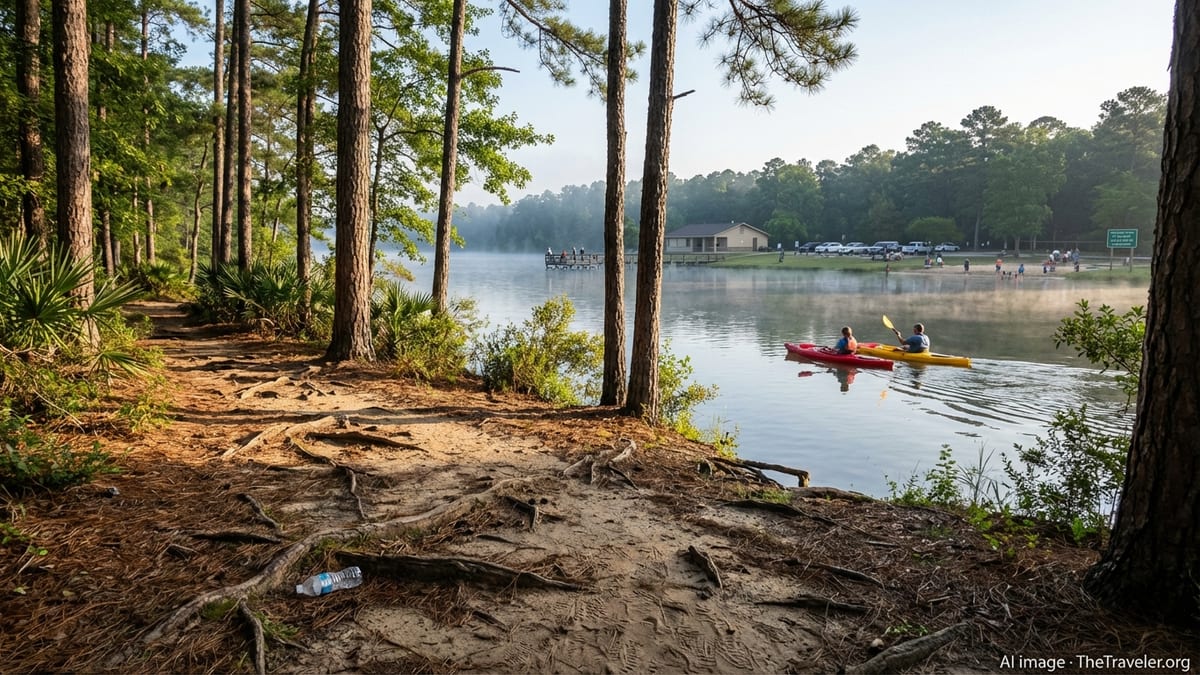
Lake Raven is the visual centerpiece of the park, and a lot of Huntsville’s personality revolves around it. I had seen pictures of mirror calm water framed by tall pines, and there are definitely moments where the lake lives up to that image. In the early morning, before the day users and most campers are active, the lake can be almost glassy. I watched light fog lift off the water while a couple of kayakers moved silently along the shoreline, and for a brief time, it felt like the quiet, contemplative state park experience I wanted.
As the day wore on, though, the lake shifted from tranquil to active. Canoes, kayaks, and small fishing boats fanned out, anglers clustered on the fishing piers and banks, and families set up along the designated swimming area. The park does not allow personal motorboats with large gas engines on Lake Raven, which helps keep the noise down, but there is still a lot of human activity. The swimming area feels more like a small lakeside beach than a wild shoreline, with a roped off section, a sandy-muddy mix underfoot, and a constant soundtrack of kids playing. If you come for a quiet, meditative lakeside sit during peak hours, you will probably be disappointed.
Visually, the lake is attractive but not jaw dropping. The shoreline is mostly pine and hardwood forest with a few marshy inlets. That backdrop is pleasant, and the repeated views from different points along the road and trails give you a sense of being wrapped around water. At the same time, some areas near the main day use zone feel worn. You can see compacted dirt where grass has given up under heavy foot traffic, exposed roots along the bank, and bits of litter that the park staff are clearly fighting a constant battle to manage. None of this ruins the experience, but it does undercut the idyllic brochure image.
I was also aware of the park’s constant reminders that alligators live in and around Lake Raven. Signs warn you not to feed or approach them and to keep pets on leash. I did not see any during my visit, but the possibility shapes the experience, especially along the edges of the lake and near the marshy spots. For some people, that might add a little thrill. For others, particularly those with small children or dogs, it could be a point of anxiety. The swimming area felt controlled enough that I did not worry, but I found myself looking twice at any log-shaped object in the water when I was out walking near secluded coves.
On the Trails: Pine Forest, Roots, and Crowds
Part of what drew me to Huntsville State Park was the promise of miles of trails winding through East Texas pine forest and skirting the lake. The trail map is indeed respectable, with loops of various lengths and a mix of lakeside and forest routes. On paper, it looked like a perfect day of hiking. On the ground, the experience was a blend of real natural charm and practical compromises.
I started on one of the popular loops that partially circles the lake. The first section near the main trailheads was the least inspiring: wide, heavily used, and threaded with exposed roots and patches of sand and mud. It felt like a path that has carried many thousands of feet and is just holding on. Once I pushed a bit farther away from the central area, things improved. The forest closed in, the sound of traffic faded, and I finally got that intimate pine woods feeling, complete with the smell of warm needles and the sight of filtered sunlight through tall trunks.
The trails at Huntsville are not difficult in terms of elevation, but they are not perfectly groomed either. Expect uneven footing, roots, and occasional muddy stretches, especially after rain. There were sections where I had to watch every step. For me, that felt natural and appropriate for a state park, but it is worth noting if you imagine a smooth, almost urban greenway. Signage was mostly adequate, though I did encounter a couple of intersections where the blazes were faded or where it was not obvious which direction completed the intended loop. Having the map handy on my phone helped avoid a couple of minor wrong turns.
Crowds were an ongoing factor. Even on a day that was not a major holiday, several of the lakeside trails had a steady flow of hikers, joggers, and people walking dogs. There were moments when I had the forest to myself, but they were shorter than I had hoped. If you are used to busier suburban parks, this will not bother you. If you are chasing solitude, you may find yourself constantly stepping aside or listening to conversations carry down the trail. I caught myself wishing I had come on a weekday just to let the landscape breathe a bit more.
Camping, Facilities, and the Tradeoff Between Comfort and Quiet
I did not camp overnight on this particular visit, but I spent time walking through the campground loops, visiting restrooms, and talking to a few campers. Huntsville State Park offers a range of sites, from full hookup RV spots to more basic tent sites and screened shelters. The variety is a clear strength. It makes the park accessible whether you are rolling in with a big rig, pitching a simple tent, or trying a more sheltered setup with kids.
The downside is density. In several of the camping loops, sites are placed relatively close together. During my visit, on a busy weekend, that meant a sense of neighborhood more than wilderness. You could hear other people’s conversations, smell their grills, and see their lanterns glowing through the trees at night. If your ideal state park camping experience is social and convenient, with easy access to restrooms and paved roads, this setup is perfect. If you want privacy and deep quiet, the reality is less appealing. I found myself thinking that this would be a good base camp for families or first time campers, but not the place I’d go when I craved solitude.
As for the facilities, they are broadly functional with a few noticeable blemishes. The restrooms and showers I checked were serviceable: running water, flushing toilets, and showers that worked. They were not spotless. There were the usual campground signs of life: muddy footprints, the lingering smell of damp, and some wear and tear on fixtures. I have seen worse at comparable parks, but I have also seen better. I did appreciate that several restroom buildings are conveniently located so you do not have to make a long trek from most campsites.
Parking near trailheads and lake access points was adequate early in the day but began to fill by late morning. The main lots near the swimming area and piers became crowded, with cars circling for spots. This is one of those practical frustrations that pull you out of whatever “nature mood” you might be building. Instead of watching the trees, you are strategizing about parking. On a return trip, I would either arrive right at opening or target a weekday to avoid that whole dance.
Atmosphere: Family Park, Not Wilderness Escape
Over the course of the day, I realized that my initial expectations were a bit mismatched with what Huntsville State Park actually is. I had pictured a semi wild lake and forest, but the park’s atmosphere is much more like a robust community recreation area that happens to be wrapped in pines. Families cooking at picnic tables, kids racing on bikes, groups gathered under pavilions, anglers chatting on the pier, and dogs sniffing their way along trails all contribute to a lively, human centered environment.
This is not a criticism as much as a clarification. If I had arrived already understanding that Huntsville is a social park more than a meditation retreat, I might have felt more at ease from the start. The park clearly caters to day trippers who want to swim, paddle, grill, and spend a few hours outside with relatives or friends. The infrastructure, from playgrounds to group pavilions, reflects that purpose. The tradeoff is that any sense of quiet immersion in nature is fragile and often short lived on a busy day.
Noise was a recurring theme. Generators hummed in some RV loops, music drifted from a couple of campsites, and the general chatter and laughter of a full park created a constant background. There were times when the sound felt cheerful and communal, and times when it felt intrusive. When I found a quieter corner of a trail, the contrast was striking. It reminded me that Huntsville does have pockets of real calm, but you have to seek them out and accept that they may not last long.
At the same time, there is a friendliness and accessibility to the atmosphere that I appreciated. This does not feel like a gatekept outdoor space where you need specialized gear or experience. I saw people of different ages and backgrounds enjoying the park in whatever way made sense for them, from simple shoreline fishing to serious trail running. That kind of democratic access to nature matters, even if it means surrendering some of the solitude that more hardened hikers might crave.
Moments That Worked, and Moments That Did Not
Looking back, my day at Huntsville State Park is defined by a handful of very specific moments rather than a general blur. The best ones usually happened early or in less trafficked corners. Standing on a quiet stretch of lakeside trail with only the sound of wind in the pines and the occasional splash of a fish was exactly the experience I had hoped for. Watching the morning fog lift from Lake Raven as the sky brightened was another. Those short windows of genuine calm gave the park a dignity that went beyond its busy infrastructure.
Equally memorable, though, were the mildly frustrating moments. Circling a full parking lot while other cars did the same, only to finally squeeze into a marginal space, felt more like going to a crowded urban park than a state park an hour or so from Houston. Stepping around bits of trash along popular stretches of shore, or noticing overflowing trash cans near heavily used areas in the afternoon, chipped away at the natural charm. I do not blame the staff, who clearly have a huge volume of visitors to manage, but it did make me wish visitors were more careful and that the park had just a little more capacity to keep up with the wear and tear.
Another letdown was the disconnect between photo based expectations and on the ground reality. Online images tend to focus on quiet corners, carefully framed angles of the lake, and flattering light. That is fair, but it can also be misleading. In real life, I rarely had those pristine views to myself for long. There was often a stray picnic table, a line of parked cars just behind the trees, or another group stepping into what would otherwise have been a postcard shot. It is a small complaint, but it speaks to the broader theme: this is a park of shared spaces rather than private experiences.
Still, a few surprises were genuinely positive. I was impressed by how quickly the mood shifted when I walked even a little farther from the main facilities. Some side trails felt surprisingly secluded for such a busy park, and the birdlife along the quieter sections was more varied than I expected. I also appreciated that the park staff at the entrance were patient and clear despite the obvious rush of vehicles, and that basic information about hours and fees was consistent and easy to confirm ahead of time. In an era where some parks have confusing or changing rules, Huntsville’s basic logistics are relatively straightforward.
What I Would Do Differently Next Time
After this visit, I would not repeat the experience in exactly the same way. The main change I would make is timing. Going on a weekend during the busy season stacked the deck in favor of crowds, full parking lots, and a more hectic atmosphere. Next time, I would aim for a weekday in shoulder season, perhaps early spring or late fall, when the weather is still comfortable but the park is a little quieter. I would also plan to arrive right when the gates open, around 6 a.m., to enjoy a few hours of relative calm on the trails and by the lake before the rush.
I would also adjust my expectations about what parts of the park are worth my time. Instead of lingering around the main day use area, I would treat it as a necessary hub and then quickly move toward less trafficked trails and viewpoints. I would bring my own small chair or tarp so I could claim a quiet patch of shoreline farther from the swimming area rather than competing for picnic tables near the hub. If I were camping, I would try to book a site as far from the busiest loops as possible, even at the cost of a slightly longer walk to restrooms.
Another change would be how much I try to do in one day. On this trip, I tried to sample a bit of everything: lakeside time, multiple trails, campground loops, and the main facilities. That approach gave me a broad sense of the park, but it also meant I was constantly moving. In hindsight, I would pick one or two goals, such as a longer loop hike and a planned window of quiet lake watching at sunrise or sunset, and let go of the urge to see it all. Huntsville State Park is not huge, but it is also not a quick stop. It benefits from a slower, more deliberate pace.
Finally, I would bring an attitude that better matches what the park actually offers. Instead of expecting a remote wilderness experience, I would frame it as an accessible, moderately scenic outdoor space where I will share the landscape with many other people. That mental shift alone would probably make any small frustrations feel more manageable and the good moments stand out more vividly.
The Takeaway
Huntsville State Park is not a hidden gem, and it is not a flawless nature escape. It is a heavily used, well located state park that delivers decent lake views, a genuine pine forest feel on its better trails, and a full menu of family friendly outdoor activities, all within practical distance of Houston and surrounding communities. It also delivers crowds, worn spots, noise, litter in high use areas, and a sense that you are rarely far from someone else’s picnic or campsite.
For me personally, the experience landed in the middle: good enough that I do not regret going, but not so compelling that I will rush back on another busy weekend. I came away appreciating the park’s role as an accessible gateway to nature for a lot of people, even while wishing it had just a bit more space and quiet. The scenic moments I did get, especially early in the day along the lake and on quieter trail segments, were real and memorable. They just required more effort and patience to find than I had expected.
Who is Huntsville State Park still worth it for? If you are a family looking for a manageable day trip with swimming, paddling, fishing, and picnic options, it is a strong choice, as long as you reserve ahead and accept the crowds. If you are a beginner camper or bringing kids for a first overnight in tents or a shelter, the developed facilities and range of site types make it a forgiving place to learn. If you are a casual hiker who is happy with moderate trails and does not need solitude to enjoy the woods, the loops around Lake Raven will probably satisfy you.
If, on the other hand, you crave quiet, unbroken trail time, minimal human noise, and the feeling of being a small speck in a large, wild landscape, Huntsville State Park is unlikely to deliver that consistently, especially in peak season and on weekends. In that case, it might be worth driving farther afield to a less trafficked area. For everyone else, including me on the right day and with adjusted expectations, Huntsville State Park is a useful, imperfect, and ultimately worthwhile option: a place where you trade some solitude and pristine scenery for the convenience of a nearby forest and lake that you can actually reach and enjoy without major logistical hurdles.
FAQ
Q1: Do I need a reservation to visit Huntsville State Park for the day?
Reservations for day use are strongly recommended, especially on weekends and during the busy season, because the park often reaches capacity and can turn away visitors who arrive without a booked day pass.
Q2: What are the current hours and entrance fees?
The park is open daily from 6 a.m. to 10 p.m., and the standard entrance fee is 7 dollars per person aged 13 and older, while children 12 and under enter free; separate campsite or shelter fees apply if you are staying overnight.
Q3: How crowded does the park get, and when is it quieter?
On weekends from roughly mid February through Thanksgiving, the park can feel quite crowded in the main areas, with full parking lots and busy trails, while weekdays and visits early in the morning or outside that peak window tend to be much quieter.
Q4: What are the lake conditions like for swimming and paddling?
Lake Raven offers a designated swimming area and is popular for canoeing, kayaking, and small boats, with generally calm water but a lively, family oriented atmosphere near the main access points rather than a secluded, silent shoreline experience.
Q5: Are there alligators in the park, and should I be worried?
The park posts clear signs that alligators live in and around Lake Raven, and while I did not personally see any, it is wise to follow the safety guidelines, keep pets on leash, stay away from marshy edges, and use the designated swimming area if you plan to get in the water.
Q6: How are the hiking trails in terms of difficulty and maintenance?
The trails are mostly easy to moderate in difficulty, with limited elevation gain but plenty of roots, uneven footing, and occasional muddy patches, and while they are generally well maintained, some sections near the main areas show heavy wear and can feel crowded.
Q7: Is Huntsville State Park a good place for first time campers?
Yes, the range of developed campsites, RV loops, and screened shelters, along with accessible restrooms and park roads, makes it a comfortable choice for first time campers or families, though you should be prepared for close neighbors and a social campground atmosphere.
Q8: What were the biggest disappointments during my visit?
The main disappointments for me were the crowded parking areas on a busy weekend, the lack of consistent quiet near the lake and main trails, and signs of wear and litter in heavily used spots that did not match the pristine images I had seen beforehand.
Q9: What were the highlights that made the trip worthwhile?
The early morning fog lifting off Lake Raven, stretches of pine forest trail where the noise briefly fell away, and the overall accessibility of lake and forest scenery within a reasonable drive of the city were the moments that justified the visit.
Q10: Would I go back, and under what conditions?
I would return if I could plan a weekday or off peak visit, arrive right at opening, and focus on quieter trails and less trafficked corners of the lake, going in with realistic expectations that this is a busy, shared state park rather than a remote wilderness escape.