

I had wanted to visit Soweto for years, but I was wary of anything that sounded like a “township safari.” When I finally booked a guided Soweto tour from Johannesburg, I went in with mixed expectations: cautious about voyeurism, curious about the history, and hopeful that I would meet people on their own terms rather than from behind a minibus window.
What I actually experienced was a complicated mix of all three. The day was powerful, uneven, sometimes uncomfortable for the wrong reasons, and at other times deeply moving in ways I had not anticipated.
Booking the Tour and First Impressions
I booked a small group Soweto tour that promised stops at Vilakazi Street, Mandela House, the Hector Pieterson Memorial and Museum, Regina Mundi Church, and an optional add on at the Apartheid Museum. Pickup was scheduled for around 9 a.m. from central Johannesburg, with a maximum of 12 people on the tour. On paper it sounded balanced: history, local culture, and time to walk instead of just driving past places.
The reality started on a slightly chaotic note. Pickup was late by about 25 minutes because the driver was looping around Sandton traffic to collect other guests. Nobody from the company messaged ahead to warn us. It was not a disaster, but it set a tone: this was going to be run on relaxed local time, and if you are used to tight, punctual operations, you need to adjust your expectations quickly.
When the minibus finally arrived, I was relieved to see it was in decent condition, with working seatbelts and air conditioning. Our guide, a Soweto local, was friendly and immediately talkative. Still, I noticed how rushed the introductions felt, as if he was racing through the formalities to get back on schedule. That sense of time pressure would show up again later, sometimes at the expense of reflection.
Driving into Soweto: Context and Contradictions
The drive from central Johannesburg into Soweto is short in distance but heavy in symbolism. As we left the more manicured parts of the city, the guide began tracing the origins of Soweto as a patchwork of forced removals, labor migration, and racial segregation. He pointed out the long tail of apartheid in everyday details: the distance people still commute, the economic gaps between townships and affluent suburbs, the uneven infrastructure.
What I appreciated here was that he did not sugarcoat anything. He spoke plainly about unemployment, crime, and political disillusionment. At the same time, he highlighted small signs of change: new brick houses replacing shacks, community initiatives, and students heading to university. It felt honest rather than rehearsed patriotism.
But there was also an element of performance. The minute we crossed into Soweto, the guide’s commentary seemed to switch into a “tour script,” layered with jokes that he clearly told every day. Some were genuinely funny, others slid into clichés about township resilience and “African time.” I could feel the tension between his lived reality and the need to make the experience digestible for visitors with only a few hours to spare.
Vilakazi Street, Mandela House, and the Museum Experience
Our first significant stop was Vilakazi Street in Orlando West, the famous road where Nelson Mandela and Desmond Tutu once lived. On tour brochures it is framed as this almost sacred place, but my first reaction when I stepped out of the bus was how commercial it felt. Souvenir stalls lined the pavement, restaurants pumped out music, and tourists posed with street performers. It felt more like a theme park entrance than the quiet historical street I had pictured.
We walked to Mandela House, now a museum run as the Nelson Mandela National Museum. Inside, the house is carefully preserved, with photographs, plaques, and a short narrative of Mandela’s life in Soweto. The rooms are small and still feel like a home more than a formal museum, which I liked. I could imagine the cramped domestic life behind the iconic images.
However, the visit felt rushed. Our guide gave a short introduction outside, then we were left to move independently through the interior. With multiple tour groups squeezed into a confined space, it quickly became hard to linger over specific exhibits. I found myself dodging people to read captions, then moving aside before I could really take things in. If you are hoping for a quiet, contemplative experience, that is unlikely during peak hours.
From a practical standpoint, entry was straightforward and tickets were purchased on site by the guide as part of the tour cost. There was a small gift shop at the exit. Prices felt a bit high for what it was, but I accepted that it supports ongoing maintenance. My main criticism is not the cost but the lack of time: it would have benefitted from at least 20 extra minutes to let the story breathe.
Hector Pieterson Memorial, Regina Mundi, and the Weight of History
The next major stop was the Hector Pieterson Memorial and Museum, which commemorates the 1976 student uprising. The memorial outside, with its stark stone and water features, hit me harder than the bus commentary had. Standing there, looking at the famous photograph of the dying boy being carried, I felt the historical weight shift from abstraction to something closer and more personal.
Inside the museum, the exhibits are dense and emotionally intense. There are witness testimonies, photographs, and archival footage that do not dilute the brutality of the police response to protesting students. I noticed some people in our group gravitating toward the large images of young faces, others lingering at the video screens in silence. It is not an easy place to move through quickly, yet our time was capped at about 45 minutes.
I found that frustration building again. The museum deserves at least an hour and a half if you really want to absorb the context. I had to make a choice: stop to watch one full video, or skim the broader narrative. I opted to go slowly through the early sections and accept that I would miss some detail deeper inside. For parents traveling with children, it is important to know that the material is graphic and emotionally heavy and that younger kids may struggle with it.
From there we drove to Regina Mundi Church in Rockville, often called the people’s church. The church is open to visitors most days during daylight hours, with regular services on Sundays and mass times during the week. Inside, the guide pointed out bullet holes in the ceiling and damaged pews left from when police stormed the church during the uprising. That physical evidence of violence in a place of worship gave me chills in a way that museum displays had not.
At Regina Mundi, there was more flexibility. We had time to sit quietly in the pews, wander to the front, and read some of the plaques. A local representative approached us to give a short talk about the church’s role during apartheid, and at the end there was an expectation of a small donation. It was not aggressively pushed, and the amount suggested was modest. Of all the stops, this felt the most grounded, as if the community was still actively negotiating its relationship with visitors rather than performing something fixed.
Lunch, Soweto Towers, and the Line Between Thrill and Taste
Lunch was at a restaurant near the Orlando Towers, the brightly painted cooling towers of the old Orlando power station that now serve as a vertical adventure hub. The restaurant offered typical South African township fare: grilled meat, pap, chakalaka, and a mix of salads. The food was good, though not exceptional, and prices were in line with what I had seen in central Johannesburg restaurants. Service was slow, but friendly, and portions were generous.
Here the mood of the tour shifted decisively from historical reflection to leisure. The Orlando Towers now house activities like bungee jumping, SCAD freefall, rock climbing, and a lift ride to a viewing platform. On regular days they are typically open from Thursday to Sunday, from late morning until sunset, and the adventure activities operate on first come, first served basis, with some requiring bookings. Watching people throw themselves off a power station for fun directly after we had stood in front of a memorial to murdered schoolchildren felt jarring.
This was one of the parts of the tour I struggled with. On one hand, it is clear that Soweto is not a frozen monument to suffering. Residents enjoy leisure and thrill just like anyone else, and the towers provide jobs, income, and a visual identity for the area. On the other hand, I could not fully reconcile adrenaline tourism with the somber tone of the morning. I chose not to participate in any of the tower activities and instead walked a bit around the nearby streets while the rest of the group finished lunch and watched jumpers.
Pragmatically, if aerial views and thrill sports appeal to you, the towers can be a highlight. From a cultural perspective, though, it is worth asking yourself ahead of time how you want to balance that with the rest of your Soweto visit. I personally would separate the adventure activities into a different day if I returned, rather than trying to bolt them onto a history tour.
Community Walks, Street Encounters, and the Problem of Voyeurism
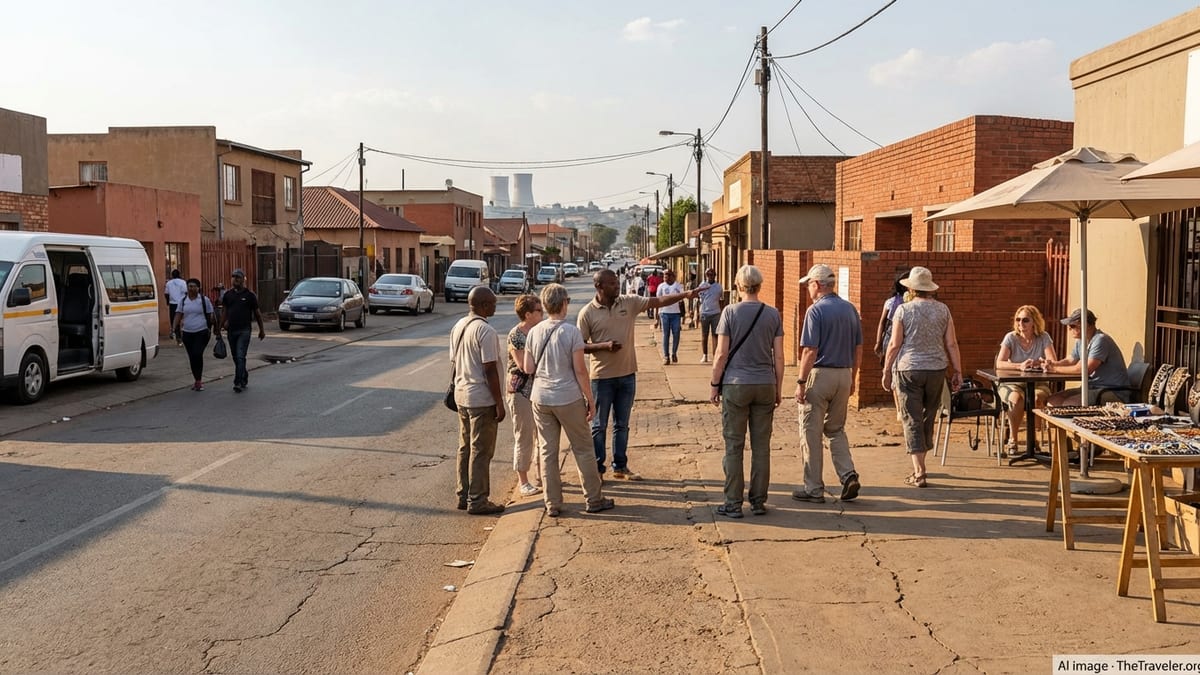
After lunch, we drove through a section of informal housing, then stopped for what was described as a short “community walk.” This was the moment I had been most anxious about beforehand, and it ended up being the most ethically complicated part of the day. We were led on foot through narrow lanes past small shacks, outdoor taps, and communal washing areas. Children waved and shouted hello, adults mostly watched us pass.
Our guide introduced us to a local resident who acted as a second, hyperlocal guide. He explained how many families share one tap, how electricity is sometimes informal, and how residents navigate the job market. Some of what he shared was candid and eye opening. Yet there was no escaping the fact that we were a small group of relatively wealthy foreigners walking through a community that had not invited us personally, taking pictures of cramped living conditions.
I did appreciate that the tour discouraged intrusive photography. We were explicitly told to ask people before taking photos and to avoid close ups of children. Even so, the power imbalance was obvious. A stop at a small shebeen and a craft stall at the end of the walk made the economic transaction clearer: the community tolerates this intrusion because it brings in some income. I bought a few items, not because I really wanted them, but because leaving without contributing felt worse.
Would I choose to do this part again? Probably not in the same format. If I returned to Soweto, I would prefer to join a locally run walking tour that stays in a more limited area and gives more time for genuine conversation, or I would look for volunteer or cultural exchange programs that are structured differently. As it was, the walk gave insight, but also left me uneasy about how suffering is packaged as an attraction.
Apartheid Museum Add On and Time Management
My tour included the option to continue to the Apartheid Museum in the afternoon. The museum is located near Gold Reef City and is open from Tuesday to Sunday, typically from 9 a.m. to 5 p.m., with tickets sold at the door. Prices have crept up over the years and now include an audio tour by default, with slightly higher rates for a guided experience. Children under about 11 are generally not encouraged to visit because of the graphic content.
We arrived at the museum with roughly two and a half hours before closing. That sounds like a lot, but it is nowhere near enough to do the full exhibition justice. The museum covers the rise and fall of apartheid, with a complex mix of documents, multimedia, and physical installations. The entrance itself, where visitors are randomly assigned different “race” tickets and must use corresponding doors, sets the tone for a challenging experience.
Inside, I quickly realized I had to prioritize. I followed the audio guide and moved steadily, but there were entire sections I could only glance at. The narrative is powerful, but dense. Two hours felt like speed reading a long, painful book. I was grateful to have been there, but I left feeling that I had only skimmed the surface. If you are serious about understanding South Africa’s modern history, I would recommend dedicating a separate half day to the museum rather than treating it as a footnote to a Soweto visit.
One practical disappointment was the crowding near some of the more dramatic installations. Our group merged with others, and sometimes it was hard to see or hear in tight spaces. That is not unique to this museum, but it added to the sense of being rushed through something that deserves a slower encounter. The gift shop at the end had some thoughtful books and materials, but again, time pressure limited browsing.
Safety, Logistics, and Emotional Impact
Before going, I had read a fair amount of nervous discussion about safety in Soweto. Experiencing it myself, I did not at any point feel unsafe while with the guide and driver. We stuck to main routes, well known sites, and populated areas during daylight. The only moments where I felt a flicker of discomfort were when our minibus briefly diverted down quieter side streets or when groups of men stared at us during the community walk. But even then, nothing happened beyond curiosity and the occasional sales pitch.
That said, it is important not to romanticize safety either. Soweto, like much of Johannesburg, has real issues with crime, and moving around independently at night or without local knowledge is not wise. The tour structure, with coordinated stops and a dedicated driver, mitigated a lot of that risk. It also limited spontaneity. There were a couple of times I spotted something interesting out the window and asked if we could stop, only to be told politely that it was not part of the route.
Emotionally, the day was draining. The combination of confronting stories of brutality, standing in spaces where people fought and died, and then being zipped off to lunch and optional bungee jumping created a roller coaster effect. By the time we drove back into central Johannesburg in the late afternoon, my mind was full and my energy low. It is not a day I would pack next to another heavy sightseeing experience. If you are the sort of traveler who needs decompress time after museums and memorials, plan for a quieter evening.
Another logistical note: summer heat can be intense, and many of the stops involve walking outside or standing in non air conditioned rooms. Water was not consistently included, and bathrooms were available but not always convenient. Comfortable shoes, sunscreen, and your own water bottle make a real difference. None of these are deal breakers, but they do affect how much attention you can give to the stories being told.
The Takeaway
Looking back, my Soweto tour was not the neat, uplifting narrative that glossy brochures sometimes imply. It was messy, uneven, and occasionally ethically uncomfortable. I felt rushed at key historical sites, ambivalent about the community walk, and slightly disoriented by the shift from memorials to adventure sports. Yet I also met people whose stories will stay with me, stood in places that changed how I understand South Africa, and saw a living township that refuses to be reduced to either tragedy or triumph.
If I were to do it again, I would make several changes. I would book a dedicated half day or full day just for the Apartheid Museum instead of tagging it onto Soweto. I would seek out a smaller, locally run walking tour focused on fewer stops with more time for conversation, perhaps even skipping the Orlando Towers entirely unless I specifically wanted the thrill activities. And I would build more unstructured time into the schedule to sit in one place, perhaps at a local café on Vilakazi Street, and simply watch life unfold.
Despite its flaws, I still believe a thoughtful visit to Soweto is worth it. For travelers interested in history, social justice, and the lived consequences of policy and protest, there is no substitute for stepping into the streets where those histories played out. The key is to approach the experience with humility and realistic expectations. This is not a sanitized museum circuit; it is a working community that has adapted to tourism on its own terms.
I would recommend a Soweto tour to visitors who are prepared to be emotionally challenged, who do not treat poverty as a backdrop for photos, and who are willing to question the structure of the tours themselves. It is less ideal for those seeking only light entertainment or Instagram friendly backdrops. Go with respect, stay curious, tip fairly, ask questions, and accept that you will leave with more questions than answers. For me, that unresolved feeling was not a failure of the day, but its most honest outcome.
FAQ
Q1: Is a guided tour the safest way to visit Soweto?
For a first time visitor, especially if you are unfamiliar with Johannesburg, a reputable guided tour is the most practical and safest option. The guide and driver know which areas to avoid, where to park, and how to navigate busy streets, which allows you to focus on the experience rather than logistics.
Q2: How long should I plan for a Soweto tour?
Most group tours run about six hours, including transfers from central Johannesburg. In practice, that feels tight for the number of stops included. If possible, allow a full day and consider dedicating separate time for the Apartheid Museum.
Q3: Is it appropriate to take photos during the tour?
It is generally acceptable to photograph public sites like Vilakazi Street, Mandela House exteriors, and the Orlando Towers. In residential areas or during community walks, always ask before photographing people, avoid close ups of children without consent, and put the camera down if it feels intrusive.
Q4: What should I wear and bring with me?
Wear comfortable walking shoes, modest clothing that covers shoulders and knees, and bring sunscreen, a hat, and a refillable water bottle. A small amount of cash or a card is useful for snacks, souvenirs, and donations at places like Regina Mundi Church.
Q5: Are the historical sites suitable for children?
Some stops, such as the Hector Pieterson Museum and the Apartheid Museum, contain emotionally intense and graphic material about violence and oppression. Older teenagers may find it educational and impactful, but younger children could be distressed or bored. It depends on your child’s maturity and your own willingness to guide them through difficult topics.
Q6: How commercialized is Vilakazi Street and will that ruin the experience?
Vilakazi Street is undeniably commercial, with many souvenir stalls and restaurants. While this can feel at odds with the street’s historical gravity, it also reflects how residents have seized economic opportunities. If you accept that tension and focus on the historical context during your time at Mandela House, the commercial layer does not have to ruin the experience.
Q7: Do I need to book Orlando Towers activities in advance?
Most standard activities like bungee jumping and the lift ride typically operate on a first come, first served basis during their opening days, usually Thursday to Sunday from late morning until sunset. For group activities such as paintball or rock climbing, advance booking is recommended. If you are combining them with a Soweto tour, confirm timings so you are not rushed.
Q8: How much walking is involved and is the tour accessible?
There is a fair amount of walking at sites like Vilakazi Street, the Hector Pieterson Memorial, and during any community walk segments. Surfaces can be uneven and some areas are not well suited to wheelchairs or people with very limited mobility. If accessibility is a concern, discuss this with the tour company in advance and ask how they can adapt the route.
Q9: Is tipping expected during the tour?
Tipping is not strictly mandatory, but it is widely expected and appreciated. Guides and drivers generally rely on tips, and small gratuities are also common for local speakers or community representatives, such as those at Regina Mundi Church. Budget for this as part of your overall cost.
Q10: Would you recommend staying overnight in Soweto rather than just doing a day trip?
Staying overnight can offer a more relaxed and immersive experience, especially if you choose a locally run guesthouse and arrange additional walks or conversations beyond the standard tour circuit. If your time is limited or you are nervous about independent logistics, a day trip is still worthwhile, but an overnight stay allows Soweto to become more than a checklist of stops.