

Travel writers like to joke that Minnesota is flyover country twice: once for coastal travelers skipping the Midwest, and then again for Midwesterners who head straight for the coasts. I arrived expecting a pleasant but predictable state of lakes and cabins. What I found instead, traveling from the bluff towns along the Mississippi to the Arrowhead’s boreal forests and the prairie edge at the state’s far southwest corner, was a place that kept surprising me at almost every turn.
The First Surprise: A Coastline That Feels Almost Oceanic
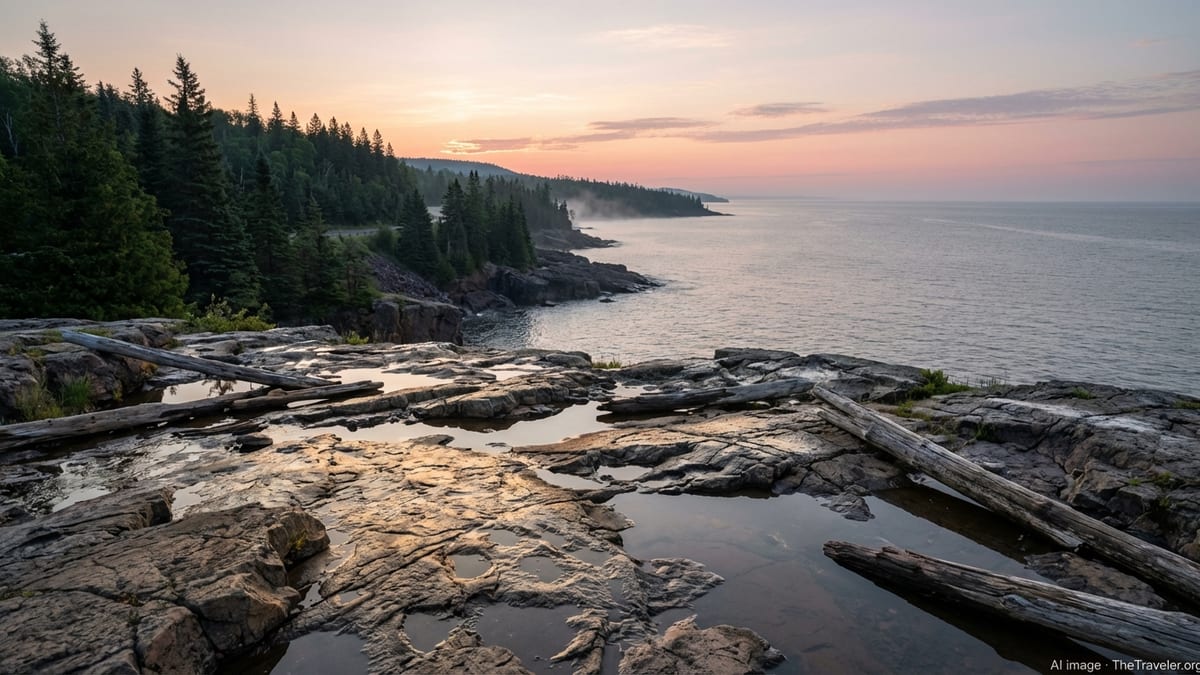
My assumptions about Minnesota began to crumble the moment I reached the North Shore of Lake Superior. Driving northeast from Duluth on Highway 61, I expected a scenic byway. I did not expect the lake to feel like a freshwater ocean, with a horizon so wide it swallowed the sky and waves that hit the basalt shore with a low, relentless roar. Standing above the tiered cascades at Gooseberry Falls State Park, then stepping out to the rocky beach where driftwood lay bleached by years of wind and spray, I had to remind myself that this was the interior of the continent, not a remote coastal province.
Farther up the shore at places like Grand Marais and Grand Portage State Park, the atmosphere grew wilder and more elemental. The High Falls of the Pigeon River, the tallest waterfall in Minnesota, crashed through a gorge that straddles the border with Ontario, throwing mist against the viewing platform and painting faint rainbows in the afternoon sun. Fishermen in small boats traced patterns on the vast gray-blue lake below the cliffs, while bald eagles circled on updrafts above the pines. It felt less like a road-trip stop and more like the end of the road itself, which, in a literal way, it is.
What surprised me most about this coast was not just its beauty but how quickly it tilts from postcard-pretty to genuinely wild. A short hike inland on the Superior Hiking Trail, the popular footpath that parallels much of the North Shore, delivered me to quiet overlooks where the only sounds were wind in the jack pines and the distant hiss of surf. One turn off the main route could lead to a muddy spur where moose tracks crossed the trail. The lake’s moods changed by the hour, from glassy calm under a pastel sunrise to whitecaps hammering the rocks by late afternoon.
The human presence along the shore also defied my clichés. Instead of endless rows of chain hotels and souvenir shops, I found small, independent lodges, coffee roasteries that filled tiny harbors with the smell of fresh beans, and galleries featuring local painters and carvers whose work drew deeply on the North Shore’s geology and light. For a place that many people imagine as a summer-only escape, it felt like a year-round community oriented toward the lake in a way that was both practical and almost spiritual.
Boundary Waters: Wilderness Closer and Tougher Than I Imagined
Like many visitors, I knew the Boundary Waters Canoe Area Wilderness by reputation long before I ever set foot there. What I did not understand until I arrived in Ely, one of the main gateways, was how accessible that wilderness feels from town and how quickly the civilized world falls away once you step onto the water or a remote trail. In the morning I could be sipping coffee within sight of an outfitter’s stacks of canoes; by lunch I could be listening to nothing but the drip of paddles and the calls of loons echoing off granite shores.
I entered the region via a side trip to Bear Head Lake State Park, a sort of gentler cousin to the canoe wilderness with similar forested shorelines and rocky points but a bit more infrastructure. It served as a soft introduction to what lay beyond: evenings of still water turned copper in the low light, distant wolf howls that may have been real or simply the creak of trees, and night skies dark enough that the Milky Way looked almost solid overhead. It was the quiet that startled me most. Even as someone who seeks out wild places for a living, I am used to the faint hum of a highway or a plane overhead. Here, hours went by without either.
On a later day, I hiked a stretch of long-distance trail that brushes the Boundary Waters region, a reminder that this landscape is not only for paddlers. The path climbed across rocky ridges and dropped into low wetlands where boardwalks floated over black water stitched with reeds. I had imagined Minnesota’s wilderness to be gentle, all soft shoreline and easy lakes. Instead I found a ruggedness that demands attention: roots that twist across the soil like ropes, sudden gaps in the rock where water collects, weather that can swing from sun to sideways rain in a single afternoon. It is a place that rewards preparation and humility.
Perhaps the most striking surprise in the Boundary Waters area was how fiercely people here are attached to the land. Locals spoke about fire seasons, water levels, and proposed mining projects with a level of detail and passion that would not be out of place in a graduate seminar. Even outfitters who spend their days shuttling tourists to and from entry points often framed their work as stewardship. They coached visitors on campsite etiquette, invasive species, and how to read the water not only for safe travel but for subtle shifts that can signal long-term change.
The Twin Cities: A River Metropolis With Indigenous Roots
Arriving in Minneapolis and St Paul after days in the woods felt like stepping into a different state altogether. Instead of cabins and campfires, there were light-rail trains, glassy towers, and the sort of restaurant buzz I normally associate with coastal cities. What surprised me most here was not the scale of the metro area but the way the Mississippi River shapes it and how present Native history and contemporary Indigenous culture are in the city’s everyday life.
In Minneapolis, I walked stretch after stretch of riverfront where bike paths, pedestrian bridges, and parks have been threaded through former industrial zones. Old grain elevators and mill ruins stand beside sleek condos, a visible reminder that this region once powered the country’s flour and timber industries. Near the St Anthony Falls area, the roar of the river over the spillway still sounds like a working river, even though its role has shifted from industrial to recreational and symbolic. Interpretive signs and public art installations reference Dakota history, reminding visitors that this dramatic stretch of water has been spiritually significant for centuries.
The deeper surprise unfolded at the table. The Twin Cities are often known nationally for a single invented dish, the molten-cheese Juicy Lucy burger, but the actual food landscape is far more varied and rooted than that shorthand suggests. In Minneapolis, the growing recognition of Indigenous foodways has given rise to restaurants that build their menus around pre-colonial ingredients, emphasizing game meats, wild rice, corn, beans, and squash while leaving out wheat flour and dairy. Eating plates built from bison, sunflower, and foraged herbs within sight of the Mississippi felt like a tangible link between past and present rather than an abstract history lesson.
St Paul, often described as the quieter of the two cities, surprised me with its neighborhood-level diversity. On one day I found myself in a compact area lined with Southeast Asian markets and restaurants, where the air was fragrant with lemongrass and charcoal grills; on another, I walked a corridor with East African cafes serving spiced stews and strong, cardamom-laced coffee. The city’s many small festivals and night markets layer additional flavors onto this picture, turning riverfront parks and downtown plazas into temporary crossroads of cultures that have made Minnesota home in recent decades.
Prairie Edge and Bison Country: The State’s Wild Southwest
If the North Shore felt like a freshwater coast and the Boundary Waters like a labyrinth of lakes and pines, Minnesota’s far southwest corner felt like another planet in the same state. Near the town of Luverne, the land opens into tallgrass prairie and bare pink cliffs of Sioux quartzite at Blue Mounds State Park. I had pictured flat, anonymous farmland. Instead I found a serrated horizon, a grazing herd of bison, and a sense of open sky so immense it almost made me lose my balance.
Blue Mounds is an exercise in subtlety. Up close, the rock is not blue at all but a warm rose color, flecked with lichens and split into ledges that catch the light differently throughout the day. A hike along the cliff line in the late afternoon brought long shadows that turned the grasses below into a rippling bronze sea. From certain viewpoints the bison herd appeared as small dark shapes, moving slowly through the prairie remnants, a living reminder that this landscape was once dominated by animals rather than crops or roads.
What surprised me here was how much story is written into what looks, at first, like empty space. The park preserves not only the prairie itself but traces of Indigenous presence, including a long line of rocks aligned with the sun at the equinoxes. Interpretive displays explain how this region escaped the plow largely because it was too rocky and thin-soiled to farm, an accident of geology that turned into a rare conservation success. Standing on the edge of the cliff, listening to meadowlarks, I realized how rarely I visit prairie landscapes compared with forests and mountains, and how much I had underestimated their quiet drama.
The nearby small towns added another twist to my expectations. Instead of the boarded-up main streets I half-feared, I found reoccupied storefronts with local bakeries, coffee shops, and art spaces, often supported by residents who drive long distances for work but fight to keep a sense of community alive. Conversations at diner counters ranged from crop prices to local theater productions, and more than once someone pointed me toward a little-known swimming hole or gravel-road overlook with the kind of pride usually reserved for famous landmarks.
Rivers, Rail Trails, and Small-Town Detours
Between headline destinations, Minnesota surprised me in the in-between spaces. The state seems to delight in stringing together towns, parks, and neighborhoods with an evolving network of bike paths and converted rail trails. On the Gateway State Trail, which runs from St Paul toward Stillwater, I cycled past wetlands, suburban backyards, and one enormous roadside snowman statue in North St Paul before the surroundings thinned into fields and forest patches. It was an easy ride that felt remarkably removed from city traffic, a reminder of how quickly Minnesota toggles between urban and rural.
These trails doubled as cultural corridors. In small river towns along the St Croix and Mississippi, I ran into Saturday farmers markets where vendors sold everything from wild rice harvested up north to jars of chokecherry jam, alongside the more expected sweet corn and tomatoes. Old brick warehouses that once stored lumber or grain now hold galleries and taprooms, often with historical photos on the walls showing horse-drawn wagons and steamboats where visitors now sip craft beer or kombucha. It is a kind of quiet reinvention that feels pragmatic rather than flashy.
Places like Stillwater and Red Wing, with their brick storefronts and views over bluff-backed rivers, offered a different sort of surprise: they are unabashedly picturesque without tipping entirely into theme-park territory. While there are souvenir shops, there are also independent bookstores, boot repair shops, and corner bars where the regulars still outnumber the tourists on a Tuesday afternoon. Short hikes up to bluff-top overlooks revealed ribbons of freight trains threading below and tows pushing barges upriver, proof that the river remains a working artery even as it doubles as a backdrop for leisurely weekends.
Again and again, I noticed how Minnesotans seize even short windows of good weather to be outside. On crisp fall days, trailheads were full of families, solo walkers, and cyclists of all ages. In summer, lakes and river beaches filled by late morning with swimmers, anglers, and groups grilling in park shelters. The seasonal intensity of northern living seems to sharpen people’s appetite for the outdoors, and that energy spills into the state’s trail and park systems in visible ways.
Weather, Seasons, and the Minnesota State of Mind
The question I heard most often as I traveled was not where I was headed next but when I planned to return in winter. For Minnesotans, seasons are not just a backdrop; they are central characters in the state’s story. I visited primarily during the shoulder seasons, when ice had broken on the lakes but snow still clung to shaded spots in the north, and again when maples and birches were just starting to flare into fall color. Locals treated these brief windows like precious commodities.
What surprised me about Minnesota’s climate was less its reputation for brutal cold than the variety packed into a single year. Residents spoke of cross-country skiing on groomed trails that in summer double as bike routes, of frozen lake festivals where trucks and ice fishing houses stand where sailboats bob in July, and of shoulder-season days where they might need a down jacket in the morning and a T-shirt by afternoon. In the north, autumn seemed to arrive almost overnight, with fog lying low over marshes and every breath in the morning feeling newly crisp.
The cultural response to this volatility is a kind of cheerful pragmatism often described with the untranslatable word “Minnesota nice,” but it struck me as something more specific than simple friendliness. People checked forecasts with the intensity of farmers, kept blankets and extra gear in their cars, and approached sudden storms as logistical puzzles to be solved rather than inconveniences to complain about. When I was caught in a surprise downpour at a rest area along the North Shore, strangers quickly shifted coolers and chairs to make space under a crowded shelter, pressing paper towels and cups of hot coffee into my hands as if we had known each other longer than the length of a weather app refresh.
Traveling across the state in different months, I came to understand that each season offers its own version of the same landscapes. The waterfalls of the North Shore, modest in late summer, roar in spring with snowmelt. The prairie that glows bronze in autumn hums with insects in July. The Twin Cities, crowded with cyclists and patio diners in June, transform into networks of ski trails and ice rinks when temperatures plunge. To fully know Minnesota would require visiting it in all of its incarnations, something many locals take for granted but that feels revelatory if you come from a place with less dramatic swings.
Encounters With History and Living Culture
Perhaps the most meaningful surprise of traveling across Minnesota was realizing how actively the state is reexamining and re-presenting its history. In Grand Portage, on the North Shore near the Canadian border, museum exhibits and guided programs foreground Ojibwe perspectives on trade, treaty-making, and land use, shifting the narrative from one of European exploration to one of long-standing Indigenous presence and resilience. The nearby state park, staffed in partnership with the Grand Portage Band, reinforces this focus, interpreting the High Falls not only as a scenic landmark but as part of a cultural landscape.
In the Twin Cities, murals and community centers along corridors like Franklin Avenue in Minneapolis speak to long-term Native communities and newer immigrant groups from Southeast Asia, East Africa, and Latin America. Events calendars are filled with powwows, Hmong New Year celebrations, Somali independence festivities, and neighborhood street festivals that blend food, music, and political organizing. For a visitor, the effect is to encounter a state that is far more globally connected than its “land of ice fishing and hotdish” stereotype suggests.
Even away from population centers, threads of history are woven into seemingly ordinary stops. Roadside markers along the Mississippi Bluff Country trace the routes of Dakota and Ho-Chunk peoples as well as early European traders. Small museums in towns like Winona and Pipestone explore how sacred quarries, river commerce, and waves of immigration have shaped local identity. Rather than presenting history as settled, many of these places frame it as an ongoing conversation, acknowledging hard truths about displacement and environmental change while also highlighting examples of collaboration and restoration.
As a traveler, I was struck by the number of people who politely but firmly corrected my assumptions. When I referred to Minnesota as a “young state” in passing, a guide reminded me that its Indigenous histories stretch back far beyond any modern political boundaries. When I asked about “traditional” foods at a festival, a vendor pointed out the difference between immigrant comfort dishes and pre-contact Native ingredients. The effect was not scolding but inviting, an encouragement to see the landscape and its communities through a wider lens.
The Takeaway
I arrived in Minnesota expecting lakes, cabins, and perhaps a famous burger or two. I left with a far more layered portrait: a state where a freshwater coast rivals any ocean shoreline for drama, where one of the country’s most visited wilderness areas lies within a morning’s drive of a sophisticated riverfront metropolis, and where prairies, bluffs, and bison herds share space with glass towers, bike highways, and crowded food halls.
What surprised me most, across all these miles, was the consistency of a certain ethos. Whether I was talking with a canoe outfitter near Ely, a chef reimagining Indigenous cuisine in Minneapolis, a park ranger watching over bison in the southwest, or a barista in a small river town, the conversation almost always turned to land, water, and weather. Minnesotans are acutely aware of the place they inhabit, its short growing seasons and long winters, its fragile prairies and heavily used lakes, its shifting riverfronts and changing climate.
For travelers, that awareness is an invitation. Minnesota rewards those who move slowly, who listen as much as they look, and who are willing to let their expectations be rearranged by a rocky Lake Superior shoreline, a quiet Boundary Waters portage, a noisy night market in St Paul, or a prairie sunset that refuses to end. Come for the lakes, by all means. But leave space in your plans for the surprises.
FAQ
Q1. Is Minnesota worth visiting if I am not into fishing or hunting?
Yes. While fishing and hunting are important here, Minnesota also offers scenic drives, hiking, paddling, cultural festivals, museums, theater, and a strong food and coffee scene.
Q2. When is the best time of year to travel across Minnesota?
Late spring through early fall is generally the most comfortable, with May, June, September, and early October offering mild temperatures and fewer bugs than midsummer.
Q3. Do I need a car to explore Minnesota beyond the Twin Cities?
A car makes travel much easier, as public transportation outside the Twin Cities is limited. Many of the state’s best parks, trails, and small towns are easiest to reach by road.
Q4. How challenging is it to visit the Boundary Waters region for a first-timer?
Outfitters around gateway towns can simplify logistics with gear rentals and route planning. Beginners often start with shorter trips or choose nearby state parks that offer similar scenery with more amenities.
Q5. Is the North Shore of Lake Superior crowded?
Popular spots can be busy on summer weekends and during peak fall color, but crowds thin quickly on weekdays, at sunrise or sunset, and on longer hiking trails.
Q6. What should I pack for Minnesota’s changing weather?
Layers are essential. A light waterproof shell, insulating mid-layer, sturdy footwear, and hat and gloves in cooler seasons help you adapt to rapid shifts in temperature and conditions.
Q7. Is it easy to experience Indigenous culture respectfully as a visitor?
Yes, if you approach with curiosity and care. Look for tribally run cultural centers, Native-owned businesses, and public events, follow local guidelines, and avoid entering sacred sites without permission.
Q8. Are mosquitoes really as bad as people say?
They can be intense in parts of the state in early and midsummer, especially near wetlands at dusk. Using repellent, wearing long sleeves, and choosing breezier campsites can make a big difference.
Q9. Can I rely on cell service in rural Minnesota and the Boundary Waters area?
Coverage is generally good near highways and towns but can be patchy or nonexistent in remote parks and wilderness areas, so offline maps and basic safety planning are important.
Q10. How many days do I need to get a good overview of Minnesota?
A week allows you to combine the Twin Cities with either the North Shore, the Boundary Waters region, or the Mississippi bluff country. Two weeks make a fuller loop across the state more realistic.