

I had dreamed of Kruger National Park for years, picturing endless savanna, lions at every bend, and a sense of wilderness that would swallow me whole. When I finally made it there and did a self-drive safari in my own rental car, the experience turned out to be far more nuanced than the fantasy.
I had magical moments and long stretches of nothing much, efficient systems and baffling bureaucracy, wild beauty and traffic jams of SUVs jostling for a glimpse of a leopard. It was memorable, but not in the simplistic, brochure-perfect way I had expected.
Planning, Permits and the Price of Access
Before I even saw an impala, I felt like I had already done a mini degree in Kruger logistics. Booking accommodation inside the park is straightforward in theory through SANParks, but the system feels dated and occasionally glitchy. I spent a couple of evenings figuring out which rest camps to choose, how far apart they were, and how much driving was realistic in a day. I underestimated all of it. Travel times between camps on public roads are longer than the distances suggest, because you are limited by speed and constantly stopping for game, other cars or just the unknown around the next corner.
The financial side is another wake-up call, especially for international visitors. On top of accommodation, every day in the park carries a conservation fee. For the current tariff year, international adults pay more than six hundred rand per person per day, with lower rates for South African residents and SADC nationals. That adds up quickly over several days. I knew about these fees beforehand but still felt the sting when I did the math. If I did it again, I would seriously consider a Wild Card for a longer trip or combine Kruger with other parks to get more value out of that investment.
Gate times and quotas also shape the whole experience more than I expected. Entrance gates generally open around 05:30 in summer and close around 18:30, with camp gates operating on similar but not identical times. The park enforces daily visitor quotas at busier gates, especially around holidays. I was there outside the major festive rush, but I still felt nervous about arriving early enough in the morning in case I was turned away. Overnight guests are not subject to the same restrictions, but as a self-driver you still live by the clock. Miss the closing time and you risk fines, serious lectures from rangers, or simply being locked out.
Layered on top of that were recent flood-related disruptions. In the weeks before my trip there had been heavy rains and temporary closures of certain roads and low-lying camps. By the time I arrived most main areas were open again, but I quickly learned that you cannot take access for granted in Kruger. Rivers flood, gravel roads close, bridges are inspected, and last-minute changes are part of the reality. It was reassuring in terms of safety, but also frustrating when a planned route suddenly required a long detour.
First Impressions at the Gate: Efficiency Meets Queue Culture
Arriving at the Paul Kruger Gate just after opening, I immediately realized this was not some remote, forgotten corner of Africa. There was a line of cars waiting to get in: rental sedans like mine, South African families with packed SUVs, and a few safari trucks from private operators. I had pre-filled the SANParks gate registration and indemnity form, which sped things up slightly, but I still had to wait my turn, show my passport, confirm my booking and pay the conservation fees.
The staff were efficient, if not particularly warm, and I actually appreciated the matter-of-fact approach. This is a massive operation with thousands of visitors a day, not a boutique lodge with a welcome drink. Still, the transactional vibe at the gate was a bit jarring. I had built up this almost spiritual moment of entering one of Africa’s great parks; in reality, it felt more like getting processed at a toll booth with elephants instead of billboards. That set the tone for the dual nature of Kruger: wild in theory, but heavily managed in practice.
Once inside, I stopped at Skukuza, the largest rest camp, and the sheer scale hit me again. This was not some small bush camp; it felt like a busy village, with fuel, a supermarket, restaurant, bank ATM, pools and accommodation blocks. On one level, it was incredibly convenient for a self-drive traveler like me. If I had forgotten something, I could buy it. If I needed to refuel, I did not have to exit the park. But the trade-off was atmosphere. The concentration of people, shops and vehicles eroded the sense of being far away from it all. I found myself glad I had also booked smaller camps deeper into the park for later nights.
Check-in and check-out routines were clear enough. Accommodation is officially available from mid-afternoon, usually around 14:00, and you need to check out by 10:00. That timing pushes you to plan your game drives carefully. I found it awkward on travel days: do you sacrifice prime early-morning viewing to move between camps, or do you drive first and arrive riskily late for check-in? In theory there is some flexibility, but I did feel pressure to be in the right place at the right time instead of simply following wildlife and light.
What Self-Driving Actually Feels Like on the Ground
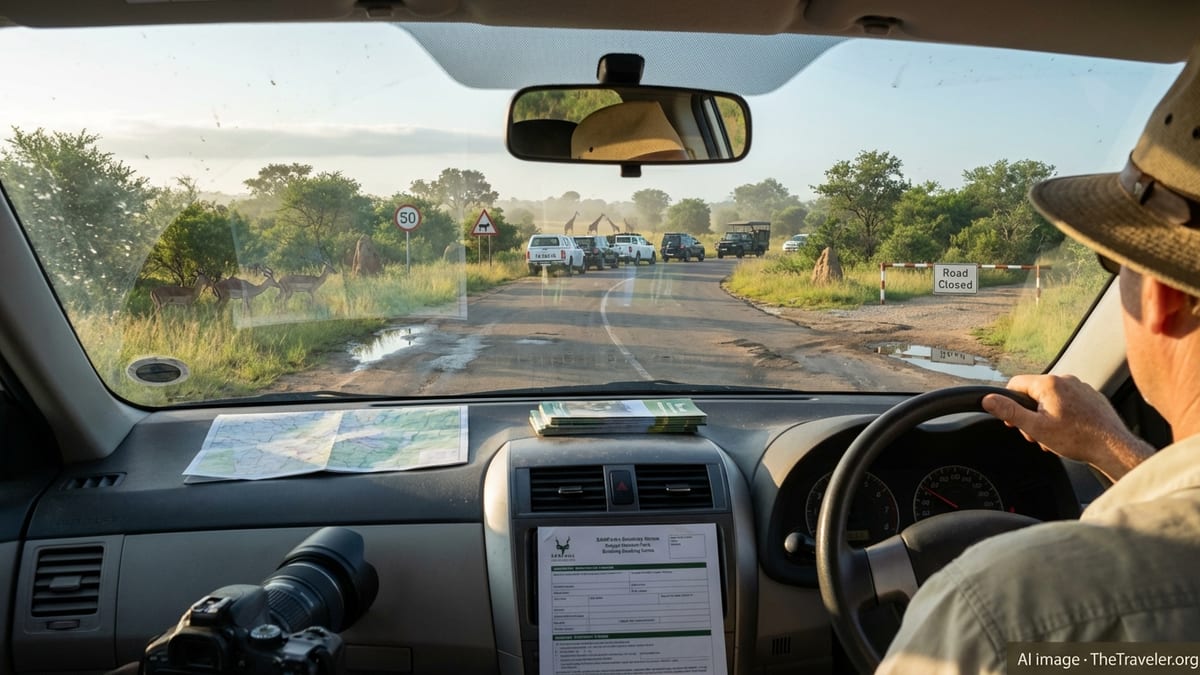
The real heart of the experience, of course, is driving your own car through Kruger’s vast road network. On paper it sounds liberating. In practice, it is a mix of freedom, concentration, and more fatigue than I expected. The sealed roads are generally in good condition, and many of the main gravel roads are drivable in a normal sedan when dry. After heavy rain, however, some gravel loops close for safety, which I experienced on one section north of the Sabie River. I had optimized my route around a particular river loop only to find a barrier across the road with a closed sign. No warning, just a necessary but annoying change.
Speed limits are strictly enforced, and rightly so. On tar roads you are capped at 50 km/h, and on gravel it drops to 40 km/h. On some stretches that felt tediously slow, especially when there was nothing to see. On others, when a herd of elephants spilled onto the road or a kudu bolted across my path, I was grateful I was not going faster. The net impact, though, is that you cover less ground than you would think from looking at a map. What looks like a short hop between a camp and a picnic site can easily turn into a two-hour drive once you allow for stops and low speeds.
Mental fatigue is a real factor. You are constantly scanning the bush, watching the edges of the road, checking mirrors for faster vehicles or safari trucks, and keeping an eye on the clock. After eight or nine hours of this, even punctuated by rest stops, I was drained. I had imagined leisurely game drives with long contemplative moments; in reality a lot of it felt like continuous low-level vigilance. If I were to return, I would build in more downtime in camp and fewer marathon driving days.
The other surprise was how much of a social experience self-driving becomes, whether you want it or not. Sightings often form spontaneous mini traffic jams, particularly near lions or leopards. You see a cluster of cars ahead and you know something is there, but you might spend ten or fifteen minutes inching forward to get even a partial view. I had some magical encounters this way, but also several frustrating ones where the animals moved off just as it was my turn. There is nothing quite like watching the back of a leopard disappear because two cars up front would not move their vehicles when asked.
Wildlife Sightings: Magic, Misses and the Reality of Expectations
I had braced myself for the reality that wildlife is unpredictable, yet I still arrived with secretly inflated expectations. The marketing images focus almost exclusively on the Big Five. The phrase becomes a kind of psychological checklist. I told myself I was there for the ecosystem as a whole, but a part of me still wanted the classic lion-at-sunrise shot. Kruger did deliver, although not quite in the sequence or abundance that the glossy photos imply.
On my first full morning I saw more impala than I thought existed in the world, plus zebras, giraffes, wildebeest and a respectable assortment of antelope. It was beautiful, but after a few hours the common species started to blur into the background. I had to make a conscious effort to stay engaged and not slip into a weird form of safari snobbery, where anything that was not rarer felt like filler. When I caught myself thinking “oh, just another elephant,” I knew my expectations had warped.
The headline moments did come, but not neatly packaged. I found my first lions by pure chance on a quiet side road, snoozing in long grass barely visible from the track. If the light had been different or if another car had not slowed down in exactly that spot, I would have missed them entirely. Later, near dusk, I had a more cinematic scene: a pride of lions walking down the road itself, framed by glowing dust. It was thrilling, but also slightly marred by the convoy of cars jostling for position. I had one eye on the lions, one eye on avoiding a fender-bender with the 4x4 behind me.
Leopards were a different kind of humbling. I spent a full day working the river roads that others raved about and saw nothing more than tracks and the telltale cluster of vehicles that dissipated just as I arrived. I finally got a view late in the trip when a young leopard lounged in a tree not far from a main road. It was beautiful, yes, but it was also distant and partially obscured. I did not come away with a calendar-worthy photo, and if I am honest, a part of me felt let down by that. That disappointment said more about my own internal script than about Kruger, but it was still there.
Camps, Facilities and the Trade-Off Between Comfort and Atmosphere
Staying inside Kruger’s rest camps is one of the park’s big advantages for self-drivers, but it is not a luxury experience unless you deliberately book the more expensive options. My basic bungalows were functional rather than charming: simple beds, fans or basic air conditioning, small kitchenettes and bathrooms that felt more like a modest motel than an iconic safari lodge. Everything was clean, and I never felt unsafe, but nothing about the rooms themselves felt special. I had to remind myself that I was paying primarily for location, not design.
The atmosphere varied a lot between camps. Skukuza, as mentioned, felt like a busy village. It was practical for resupplying but not particularly immersive once inside the fence. Other camps, such as Lower Sabie, managed a better balance, with smaller scale and lovely river views. Sitting on the deck at dusk watching hippos surface in the river, I felt that elusive sense of being in wild Africa despite knowing there were dozens of accommodation units behind me.
Camp curfews are strict. Once the gates close in the evening, you are inside until they reopen, unless you are on an official night drive. On paper that is to protect both wildlife and visitors. In reality, it also reinforces the feeling that you are in an island of civilization in the middle of a park, rather than fully part of the landscape. The fences are unsubtle reminders that this is a managed experience. I knew this in advance but did not expect to feel the slight claustrophobia that came with it after a few days.
I appreciated the presence of shops and restaurants on a practical level, but food quality was inconsistent. I had some decent meals and more than a few forgettable ones. Prices inside the park are understandably higher than outside, but still, I felt that the cost did not always match the standard. If I went again, I would self-cater more aggressively, using the communal braai areas and kitchen facilities, both to save money and to have more control over what I ate.
Safety, Weather and the Subtle Stress of the Bush
One aspect that seldom gets highlighted in glowing travel write-ups is how much low-level stress comes with self-driving in a wildlife area. The rules are clear: stay in your vehicle except at designated get-out points, keep a safe distance from animals, respect speed limits, and always be aware of closing times. In practice, you have to constantly judge what counts as a “safe” distance when an elephant is staring down your rental car or a troop of baboons decides your vehicle is the most interesting thing on the road.
I had one particularly tense encounter with a lone elephant bull who decided the middle of the road was his. I kept my distance and waited, but a car behind me grew impatient and started edging forward, clearly hoping to squeeze past. The elephant responded with a mock charge, ears out, dust flying. For a few seconds I had no control over the situation except to stay still and hope the other driver did not make things worse. Moments like that remind you that however managed Kruger is, the animals are very real and very large.
Weather played a bigger role than I expected. I visited after a period of significant rain. The bush was lush and green, which made the landscapes beautiful but also made animals harder to spot. Flood-damaged roads diverted me onto busier routes I might otherwise have skipped. The park had already evacuated some low-lying camps and closed certain bridges earlier in the season due to flooding, so there was a lingering sense that conditions could change fast. For a self-driver, that means being flexible: the route you planned over coffee in the morning may no longer make sense by midday if a storm starts building.
Heat was another factor. Even in the shoulder season, temperatures climbed steeply by late morning. Sitting in a closed car, engine frequently off to avoid noise when animals were around, I felt the interior turn into an oven more than once. It is manageable with water, hats and common sense, but it does sap energy and sharpness. I found myself less patient and more irritable in the afternoons, which in turn influenced how much I enjoyed the drives.
What I Would Do Differently Next Time
Looking back, there are several things I would change about how I structured the trip. The first is pace. I tried to see too much in too few days, which translated into long stretches behind the wheel and a constant sense of needing to move on. Next time I would pick fewer camps, stay longer in each, and allow entire afternoons to simply sit at a waterhole or camp fence rather than driving for the sake of it. Some of my most peaceful moments were actually when I stopped moving.
The second change would be to mix self-driving with guided activities more deliberately. I did one guided night drive and one sunrise drive with SANParks and found both surprisingly valuable. The guides picked up on small details I had been missing, and being in a raised vehicle allowed better visibility in thick bush. I had dismissed guided drives as touristy at first, but in hindsight I would book more of them, especially at the start of the trip, to calibrate my own expectations and spotting skills.
I would also adjust my expectations around sightings. Kruger is not a curated wildlife show, and the Big Five are not waiting on cue. I arrived intellectually aware of that, but emotionally still hoping for a highlight reel. Next time I would lean harder into the smaller things: birdlife, tracks, plants, and the simple pleasure of being in a huge, functioning ecosystem. That mental shift does not guarantee more lions, but it does make the quieter stretches feel less like disappointments.
On a practical level, I would put more thought into visiting outside peak public holidays and local school vacations, and I would monitor recent news more closely for weather disruptions. Given the recent floods and camp closures, it is clear that climate and infrastructure can shift the experience quickly. A flexible itinerary, with the ability to change routes if certain areas close, is not just a luxury; it is increasingly necessary.
The Takeaway
My self-drive safari in Kruger National Park did not match the romanticized version I had carried in my head, and that turned out to be a good thing in the long run. The park is not a quiet, untouched wilderness. It is a hugely popular, carefully managed, occasionally crowded protected area that has to balance mass tourism with conservation. You feel that tension in the traffic jams at predator sightings, the strict gate times, the fenced camps and the queues at the restaurant breakfast buffet.
At the same time, there are moments that cut through all of that: watching a line of elephants materialize out of the morning mist, listening to lions roar somewhere beyond the camp fence at night, or sitting alone on a gravel road with no other cars in sight and a herd of giraffes crossing in front of you. Those experiences were not constant, but when they came, they were quietly profound. They also felt earned, the product of patience, early starts and accepting that some days would be dominated by impala and empty road.
I would recommend a self-drive Kruger trip to travelers who value independence and are comfortable with a degree of uncertainty and effort. It suits people who enjoy planning, who do not mind early mornings, and who can accept that wildlife does not follow scripts. It is less ideal for anyone who expects guaranteed drama at every turn or who is looking for seamless luxury and hand-holding. For that, a private reserve with guided game drives and fewer vehicles might be a better fit, albeit at a much higher price point.
For me, Kruger was ultimately worth it, even with its compromises and frustrations. It challenged my expectations, forced me to slow down, and made me confront the realities of modern wildlife tourism. I did not leave with a perfect Big Five photo portfolio, but I did leave with a more grounded understanding of what a big public park can and cannot offer. Under the right conditions, with realistic expectations and a willingness to embrace both the mundane and the magical, a self-drive safari in Kruger can still be an extraordinary experience.
FAQ
Q1: Do I need a 4x4 vehicle for a self-drive safari in Kruger National Park?
In normal dry conditions, you do not need a 4x4. Most of the main roads are tarred and many gravel roads are suitable for standard rental sedans. However, heavy rain can close some gravel roads and make surfaces rougher, so a higher clearance vehicle is more comfortable. I managed in a regular sedan but would choose a higher clearance SUV next time for peace of mind.
Q2: How many days should I spend in Kruger for a self-drive trip?
I would say a minimum of three full days inside the park, with five to seven days being ideal if you want a more relaxed pace and a better chance of varied sightings. I tried to cram too much into a short stay, which led to long, tiring drives. More days with fewer camp changes makes the experience less rushed.
Q3: Is it safe to drive yourself in Kruger?
It is generally safe if you respect the rules. You must stay in your vehicle except at designated points, keep reasonable distances from animals and obey speed limits. The biggest risks I felt were from other impatient drivers and from misjudging animal behavior, especially with elephants. Using common sense and not trying to get too close makes a big difference.
Q4: When is the best time of year for a self-drive safari in Kruger?
The dry winter months typically offer easier wildlife viewing because vegetation is thinner and animals concentrate around water sources. However, they can be cooler at night and more crowded during school holidays. I visited after rains when the bush was lush and green. It was beautiful but made spotting animals harder. The best time depends on whether you prioritize sightings, scenery or fewer crowds.
Q5: How expensive is a self-drive safari compared with a private lodge?
A self-drive trip inside Kruger’s public camps is usually cheaper than staying at a private lodge, especially if you share a rental vehicle and self-cater. That said, conservation fees, fuel, accommodation and restaurant costs still add up. Private lodges charge significantly more but include guided drives, meals and more personalized service. It is a trade-off between independence and convenience.
Q6: Can I rely on finding food and supplies inside the park?
Yes, most main rest camps have shops with basic groceries, snacks and drinks, as well as restaurants. However, the selection is limited and prices are higher than outside the park. I was glad I brought some staples and snacks from outside. If you have specific dietary needs or want higher quality ingredients, it is better to stock up before entering.
Q7: Do I need to book accommodation and activities in advance?
For accommodation in the rest camps, advance booking is strongly recommended, especially in school holidays and peak seasons, as popular camps can fill up. Guided drives and walks can often be booked on arrival, but certain time slots and activities do sell out. I made my main bookings in advance and then added some activities after checking the weather and how tired I felt.
Q8: How early do I need to start my game drives?
The best wildlife viewing is usually around sunrise and late afternoon, when animals are more active and the light is softer. I tried to be at the camp gate as soon as it opened, which in summer can be as early as 05:30. It felt painfully early some mornings, but those first couple of hours often produced my best sightings. Midday drives were quieter and hotter.
Q9: What happens if I arrive late at a camp or gate?
Gates have strict closing times, and arriving late is taken seriously. In some cases late arrivals with confirmed bookings may be allowed in up to a point and charged a penalty, but this is not guaranteed and depends on the gate and distance to camp. I never pushed it because the potential hassle and risk were not worth an extra ten minutes out on the road. Planning your route with a generous time buffer is essential.
Q10: Is Kruger still worth visiting if I am not obsessed with the Big Five?
Yes, absolutely. While the Big Five dominate marketing, Kruger offers far more: rich birdlife, varied landscapes, fascinating smaller mammals and the broader experience of being in a large, functioning ecosystem. I found the trip more rewarding when I stopped fixating on ticking off famous species and started appreciating everything from hornbills to river views. If you are open to that broader perspective, Kruger can be very satisfying even without a perfect Big Five tally.