

More news on this day
The “flight to nowhere” lifted off from a cloudy Newark afternoon and landed back on the ground less than an hour later, but for passengers on board the Starlink‑equipped United Airlines jet, the real destination was a new kind of inflight connectivity that felt far closer to home broadband than the patchy, slow service many travelers have come to expect in the sky.
Get the latest news straight to your inbox!
A Test Flight That Felt Like a Glimpse of the Future
Positioning and demonstration flights rarely attract attention outside the aviation industry, but United’s decision to showcase SpaceX’s Starlink service on a short, out‑and‑back hop effectively created a “flight to nowhere” designed around Wi‑Fi rather than a specific destination. Reports indicate that similar early Starlink flights have served as proving grounds to validate equipment performance under real‑world conditions, from taxi to touchdown, before wider commercial deployment across a fleet.
On this flight, the cabin atmosphere was familiar, but the internet experience was not. Publicly available coverage of United’s rollout shows that Starlink hardware on narrow‑body jets typically includes low‑profile antennas mounted on the fuselage and multiple onboard routers, with stated speeds of up to 250 megabits per second. That is several times faster than many legacy inflight systems and is intended to support streaming, cloud‑based work and multiple devices per passenger without the slowdowns that often frustrate frequent flyers.
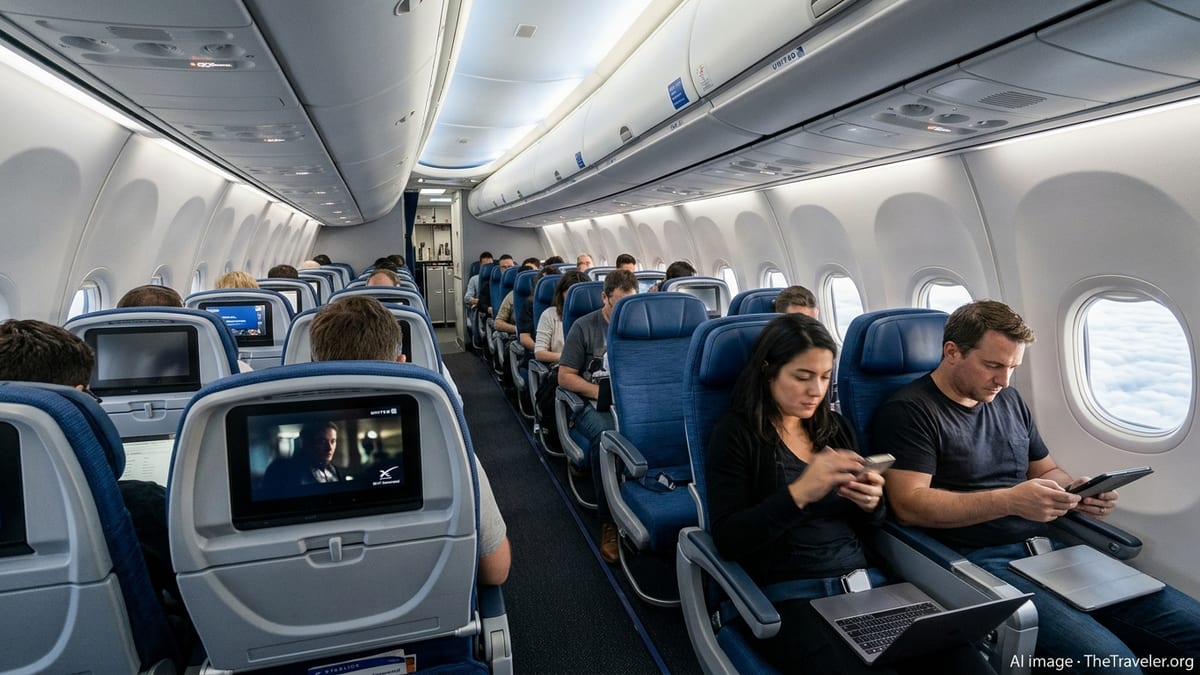
The route itself mattered less than what was happening behind seatbacks and on tray tables. Travelers used phones, tablets and laptops as if they were in a living room or office, with minimal buffering and stable connections throughout the brief cruise segment. According to published reports, Starlink’s low‑Earth‑orbit satellite network can deliver lower latency than traditional geostationary systems, which helps video calls and collaborative tools feel more responsive.
Because this was a non‑revenue demonstration flight, some activities that are normally restricted on commercial services, such as testing bandwidth‑heavy apps all at once, were emphasized to stress the network. Coverage of similar Starlink trials on United aircraft notes that passengers have been able to browse the web, stream video, access cloud storage and even attempt video calls without the service collapsing under load, an experience that contrasts sharply with older inflight Wi‑Fi products.
United’s Starlink Strategy Takes Shape in the Air
United’s Starlink partnership is part of a broader strategy to reframe inflight connectivity as a core amenity instead of an optional add‑on. Publicly available information from the airline’s announcements describes an agreement with SpaceX to install Starlink across both mainline and two‑cabin regional aircraft, supported by a multiyear retrofit program that aims to reach hundreds of jets by the middle of this decade. The test flight highlighted how that strategy translates for individual passengers, especially MileagePlus members who receive access without an additional fee.
According to published coverage of United’s rollout, the airline has already equipped more than 300 regional aircraft with Starlink and is adding the system to larger mainline jets, from Boeing 737 variants to long‑haul wide‑bodies. Regulatory milestones, such as certification of Starlink hardware on specific airframes, have been documented in industry news reports, which also note that United expects several hundred more aircraft to be outfitted by the end of 2026.
For travelers, the shift is also about predictability. Traditional inflight Wi‑Fi often varies sharply from one aircraft type or route to another. By standardizing on a single high‑bandwidth provider, United is attempting to reduce that variability. Reports from early Starlink flights indicate that customer satisfaction scores for connectivity have nearly doubled on equipped aircraft, with passengers citing reliable gate‑to‑gate service and the ability to stream as differentiating features.
The flight to nowhere showcased that intent in a concentrated form: no checked bags to worry about, no tight connections to make, just a focus on what life might look like when every seat effectively becomes a connected workspace or entertainment hub. The experience suggested that the airline views Wi‑Fi as a competitive advantage in the same way it has leaned into seatback screens and updated cabins on new jets.
From Patchy Connections to Living Room in the Sky
Starlink’s appeal for airlines rests on its architecture. Instead of relaying signals from a handful of satellites in high geostationary orbit, the system uses thousands of satellites in low Earth orbit, allowing shorter signal paths and lower latency. Technical reports and independent speed tests cited in coverage of United’s rollout show that Starlink‑equipped aircraft can see download speeds comparable to home broadband, even when dozens of passengers connect at once.
On board the test flight, that translated into behavior that would have been unthinkable a few years ago. Travelers were able to scroll through social media feeds, upload short videos, refresh cloud‑based documents and stream shows without visibly hunting for offline downloads in advance. Publicly available reviews of Starlink service on United flights describe similar experiences, noting that the connection remained stable enough to support live television streams and real‑time messaging throughout a typical domestic leg.
There are still limits. Coverage of the rollout notes that very large file uploads or extended high‑resolution live streams can take longer than on the ground, and certain gaming consoles may require software updates before they connect smoothly to the network. Even so, compared with previous inflight systems that struggled under peak loads, Starlink appears to offer significantly more headroom for everyday online tasks.
For United, this level of performance is central to a stated vision of enabling what company materials have described as a living room‑like inflight experience, with seatback screens, personal devices and Wi‑Fi all working together. The flight to nowhere framed that concept in a practical way: passengers could watch a movie on the seatback, scroll through a second screen on their phone and respond to work emails on a laptop simultaneously, without being forced to choose which device to prioritize.
Rollout Milestones and Remaining Challenges
While the experience on board felt polished, the path to fleetwide deployment has not been entirely smooth. Aviation and technology outlets have reported that United temporarily paused Starlink use on some regional jets last year following reports of radio interference, before working through technical fixes with regulators and suppliers. That episode highlighted how closely connectivity upgrades intersect with aircraft systems and certification requirements.
Despite those challenges, publicly available data shows that installation has accelerated. United communications and third‑party reporting indicate that the airline has been fitting dozens of aircraft with Starlink each month, with average installation times significantly shorter than for some previous satellite systems. Industry analysis suggests that this speed is crucial if United is to meet targets for equipping most of its mainline fleet within the next few years.
Travelers should also expect a transition period in which some flights offer Starlink while others still rely on legacy providers or have no Wi‑Fi at all, depending on aircraft rotation and maintenance schedules. Commenters and reviewers who have tracked the rollout note that apps and pre‑flight emails now increasingly flag whether a specific flight is scheduled to have Starlink, though last‑minute equipment swaps can still affect availability on the day of travel.
In that context, the flight to nowhere felt like a controlled preview of a future that will arrive unevenly across the network. For passengers who have already experienced Starlink on regional jets, the continuity of performance on a mainline aircraft reinforced the sense that this is not simply a one‑off perk but a system United intends to make standard over time.
What This Means for Everyday Travelers
Beyond the technical details, the flight underscored how high‑quality, free inflight Wi‑Fi could reshape expectations of air travel. For business travelers, reliable connectivity can turn short flights into productive work sessions instead of offline intervals. For leisure passengers, especially those on family trips, the ability to stream shows or share updates in real time can make long travel days feel shorter and more connected.
Published analysis of airline economics suggests that while connectivity upgrades require substantial investment, carriers increasingly view them as part of a broader value proposition that encourages loyalty and supports premium products. United’s Starlink agreement, framed as one of the largest of its kind, fits into that trend by targeting both customer satisfaction and operational efficiencies, such as simplified maintenance and common hardware across fleets.
The flight to nowhere highlighted another emerging expectation: that Wi‑Fi should be treated less as a luxury and more as a baseline amenity, similar to power outlets or on‑demand entertainment. As more passengers encounter Starlink‑equipped aircraft, the contrast with older systems may sharpen, raising questions about whether patchy connectivity will still be acceptable on competing airlines or unequipped jets.
For now, United’s early Starlink flights serve as a live demonstration of what connected air travel can look like when technical constraints recede into the background. The short loop from takeoff to landing may not have added many miles to anyone’s frequent‑flyer account, but it offered a clear preview of a future in which even a routine hop between cities feels less disconnected from life on the ground.