

India had lived in my imagination long before I ever booked a ticket. I expected color, chaos and heat. What I did not anticipate was how quickly the country would swing between exhaustion and exhilaration, or how often my assumptions would be upended. What follows is a candid account of my first journey through India: the highlights that left me awestruck, the challenges that tested my patience, and the surprises that quietly reshaped how I think about travel.
Arriving in India: First Impressions at the Airport and Beyond
My first real contact with India was not a temple or street market, but the orderly queue at immigration. After a long overnight flight from the United States, I shuffled into a line divided between traditional visas and e-visas, clutching printed confirmations and passport photos. The process was slower than many European airports but more efficient than I had feared. Officers glanced at my documents, asked a few routine questions about my itinerary and accommodation, and then stamped my passport with an authority that made the trip suddenly, thrillingly real.
Outside the terminal, India hit me all at once. The air felt heavier, warmer and more humid, with a faint mix of jet fuel, spices and dust. Taxi drivers clustered at the exit, offering rides, hotel bookings and tour packages, their voices overlapping in a kind of improvised chorus. I had arranged a prepaid taxi inside the airport, which helped buffer the initial sense of being pulled in ten directions at once. Even that short walk from the arrivals hall to the car brought my first lesson: in India, clarity and confidence matter. If you hesitate, a dozen alternatives appear immediately.
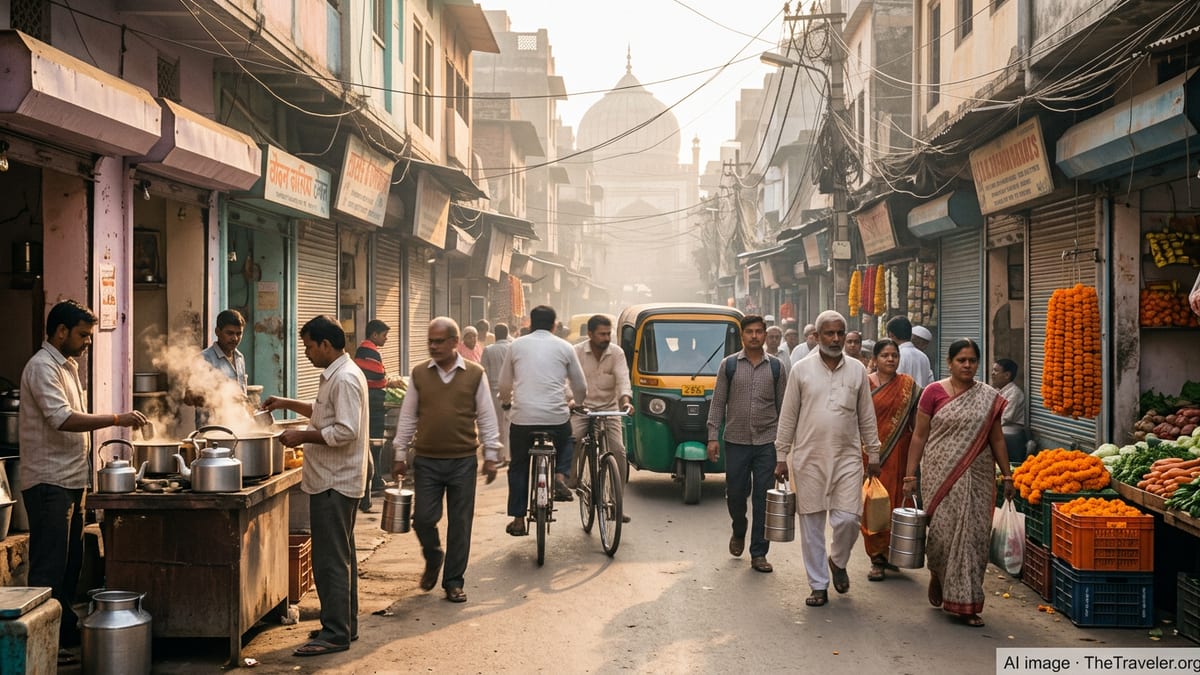
The ride into the city was an introduction to Indian traffic, which operates on a logic that looks chaotic but rarely feels reckless. Lanes seemed more like suggestions than rules, with cars, auto-rickshaws, buses, motorbikes and cyclists weaving around one another at close range. Horns were everywhere, not as angry outbursts but as a constant form of communication. I watched entire families perched on scooters, sari fabric rippling in the slipstream, and roadside tea stalls crowded with early-morning customers. It was noisy, dense and visually overwhelming, yet oddly reassuring. Despite the tangle of movement, the city functioned.
By the time I reached my hotel, I understood why so many first-timers describe India as an assault on the senses. Yet there was also something immediately welcoming in the small interactions: a porter insisting on carrying my bag even though it had wheels, a receptionist offering sweet masala chai while my passport was scanned, a security guard nodding with a hint of curiosity rather than suspicion. The country’s reputation for intensity is deserved, but so is its quieter tendency to embrace bewildered newcomers.
Highlights That Took My Breath Away
Before I arrived, I had seen the Taj Mahal a hundred times in photographs. Nothing prepared me for standing in front of it just after sunrise, as the marble shifted from soft pink to bright white. The crowds were already building, but the monument still managed to feel strangely intimate. Up close, the famous symmetry gives way to an astonishing level of detail: floral inlays, calligraphy running along the arches, subtle variations in the stone that catch the light differently as the day moves on. It is easy to understand why it remains India’s most visited historic site; what surprised me was how personal the experience felt, even in the presence of thousands of other visitors.
From the polished grandeur of Agra, I traveled to Rajasthan, where desert cities rise out of the landscape like something imagined centuries ago and never quite updated. In Jaipur, the Amber Fort sprawls across a hillside, a labyrinth of courtyards, mirrored halls and narrow staircases. The view from the ramparts at sunset, with the city glowing and the surrounding hills fading into violet, became one of those rare travel moments when you do not need a camera to remember what you are seeing. Udaipur, in contrast, felt softer and more romantic. Its lakeside palaces reflected in the water at dusk gave me a quieter, more contemplative version of India.
What I came to appreciate most were not individual attractions but the everyday rituals that wrapped around them. In Varanasi, I watched the evening aarti ceremony from the ghats along the Ganges. Priests moved in choreographed patterns with lamps and incense, while boats full of spectators bobbed in the dark water. On the steps behind us, families sat together, vendors sold flowers and candles, and stray dogs drifted through the crowd, looking content and well-fed. The moment was spiritual without being exclusive, and public without feeling performative. Religion in India, I realized, is less contained by buildings and more woven into the rhythm of daily life.
Even the most ordinary scenes could turn into highlights. A chai stall in a back lane, where the owner poured tea from a height into tiny glasses and insisted I have a second, “on the house.” A commuter train in Mumbai at non-peak hours, with passengers shifting politely to make room and offering unsolicited but thoughtful advice on what to eat and where to go. A quiet morning stroll on a beach in Goa before the shacks turned on their speakers, where fishermen hauled in their nets while school children in uniforms traced their names in the sand. These unscripted interactions left as strong an impression as any monument.
Practical Realities: Crowds, Climate and Conditions on the Ground
India is a global tourism heavyweight again, and you can feel it in the crowds. Popular destinations such as Agra, Jaipur and Varanasi see a steady stream of both foreign visitors and a rapidly growing number of domestic travelers. At peak times, especially around national holidays and school vacations, famous sites can feel full before they officially open. Arriving early, booking tickets in advance where possible and choosing shoulder seasons over peak months made a clear difference in my experience. Even then, I adjusted my expectations: a “quiet” day in India is still busier than many other destinations.
The climate demanded constant adaptation. Northern cities offered mild, pleasant mornings during the cooler months, but afternoons could quickly become hot and dehydrating. In many parts of India, the summer months are extremely warm, and the monsoon brings heavy, sustained rain that can flood streets and disrupt transport. I learned to carry a reusable water bottle, lightweight scarf and small umbrella, and to schedule temples and outdoor walks for early morning or late afternoon. Air conditioning provided welcome relief, but stepping repeatedly between cool interiors and hot, humid streets left me surprisingly drained by day’s end.
Air quality was another practical consideration, especially in and around major cities. During certain periods, pollution in Delhi and other urban centers can rise to levels that health authorities describe as hazardous, affecting not just residents but visitors as well. I packed a few high-quality masks and used them liberally on days with visible haze or heavy traffic, particularly in the evenings. It felt strange at first to explore a city behind a filter, but my lungs were grateful. Checking air quality forecasts along with weather reports quickly became part of my daily planning.
Infrastructure was a study in contrasts. India’s airports are generally modern and efficient, intercity trains can be comfortable and fast when booked in the right class, and app-based taxis work reliably in most larger cities. At the same time, pavements can be uneven or nonexistent, public toilets range from spotless to challenging, and power cuts, though less frequent than in the past, still occur in some areas. Rather than viewing these gaps as defects, I came to see them as reminders that India is enormous, diverse and still in the middle of rapid change. Flexibility, patience and a willingness to adapt made those realities manageable rather than frustrating.
Cultural Etiquette, Everyday Interactions and Missteps
Before my trip, I read guidebooks warning about dress codes, religious sensitivities and complex social norms. On the ground, I found that most etiquette in India flows from a simple principle: show respect and you will almost always receive it back, often with interest. Covering shoulders and knees in temples and more conservative rural areas was easy enough; a lightweight scarf became one of the most useful items in my bag. Removing shoes before entering places of worship or private homes felt natural, especially after noticing how much pride many people take in keeping floors clean.
My gender and appearance shaped some experiences. As a visibly foreign traveler, I attracted curiosity and occasional stares, especially in smaller towns. These looks were rarely hostile, more often a quiet calculation of who I might be and why I was there. When I smiled or greeted people, the atmosphere shifted instantly. Strangers in markets and on trains frequently initiated conversation, eager to know where I was from and whether I liked India. Many wanted selfies, usually in good spirits rather than with any underlying motive. Still, I learned to trust my instincts and say no when I felt tired or uncomfortable.
There were missteps too. On my first visit to a Hindu temple, I almost walked into the inner sanctum with my camera hanging around my neck, unaware that photography there was prohibited. A watchful attendant firmly and politely stopped me, explaining that while photos were allowed in some outer courtyards, the central shrine was a place for worship, not documentation. In another instance, I reached for a handshake with a woman who preferred to greet me with a small nod and the traditional “namaste,” palms pressed together. Moments like these were humbling but instructive, reminding me that cultural sensitivity is an ongoing practice, not a checklist.
What impressed me most was how forgiving people often were of my ignorance. Shopkeepers walked me through the basics of bargaining without turning impatient. Families on night trains shared food unprompted and showed me how to eat neatly with my right hand only, laughing gently as I struggled. Hotel staff spent significant time explaining local festivals and customs, proud that a visitor cared enough to ask. In a country of so many languages, religions and regional identities, there is no single “correct” way to behave, but genuine curiosity and humility opened far more doors than flawless etiquette ever could.
Food, Health and Learning to Pace Myself
Indian food was one of the great joys of my trip, but it demanded a cautious approach in the beginning. Even people with strong stomachs can struggle with the combination of new spices, street-side kitchens and changes in water quality. I started conservatively, sticking to freshly cooked dishes at busy restaurants and avoiding raw salads, ice cubes of uncertain origin and pre-cut fruit sold in the heat. Over time, as my body adjusted and my confidence grew, I ventured into street food with increasing enthusiasm, guided by the simple rule that high turnover often equals fresher ingredients.
Some of my favorite meals were also the simplest. A plate of steaming idli and sambar at a small south Indian café, eaten standing at a metal counter while fans pushed around the warm air. A fragrant thali, where a metal tray held small portions of vegetables, lentils, yogurt and pickles, refilled with cheerful insistence by a server who clearly enjoyed seeing a foreigner attempt to finish everything. A cup of cardamom chai at a train station, served in a biodegradable clay cup that I smashed underfoot once it was empty, as tradition suggests in many places.
I did get mildly sick once, likely from underestimating how long food had been sitting out in the heat. It was not dramatic, but it served as an important reminder to carry basic medication, electrolyte packets and a realistic understanding that a long trip in a new environment rarely passes without at least one minor health hiccup. I also underestimated how tiring India can be even when you are not ill. The combination of sensory overload, traffic noise, climate and constant navigation decisions made it essential to build downtime into my itinerary. Skipping a sunrise outing in favor of a slow morning with a book in a shady courtyard felt less like a missed opportunity and more like necessary maintenance.
Access to healthcare and pharmacies was better than I expected. In larger cities, clinics and hospitals cater regularly to both locals and international visitors, and pharmacists often speak enough English to explain the basics of over-the-counter medicines. I never needed anything more than basic supplies, but knowing that care was available made it easier to relax. Travel insurance, in hindsight, was less of a bureaucratic formality and more of a quiet safety net that allowed me to focus on the journey rather than on potential worst-case scenarios.
Transport, Scams and Staying Safe Without Losing Trust
Getting around India turned out to be both one of the greatest pleasures of the trip and one of its most consistent challenges. The country’s rail network remains a backbone for medium and long distances, and booking higher classes on major routes provided a comfortable, affordable way to see the countryside. From the window of a train, India unfolded as a series of vignettes: people bathing and washing clothes at village pumps, children waving as we passed, fields shifting from mustard yellow to lush green, and the occasional distant skyline announcing a new city. Even with reserved tickets, stations were crowded and loud, but the system worked more smoothly than many travelers imagine.
Within cities, I relied heavily on app-based taxi services where they were available, supplemented by auto-rickshaws and the occasional metro ride. Negotiating fares with rickshaw drivers was an art I never fully mastered, but I did learn to agree on the price before getting in, to carry small change and to accept that I would sometimes pay a modest “tourist tax.” A few drivers took intentionally longer routes or tried to steer me toward specific shops, but most simply wanted a fair fare and a brief chat about where I came from. Traffic could be intense, but I rarely felt unsafe in a vehicle. Crossing the street as a pedestrian, however, required calm nerves and a willingness to move steadily rather than waiting for gaps that never came.
I encountered a handful of classic travel scams, but none were particularly sophisticated. A “closed” ticket office miraculously reopened when I insisted on checking for myself. A helpful stranger at a monument attempted to guide me as an unofficial “friend,” then asked for an unexpectedly high tip at the end. A shop owner claimed that certain handmade items were unique to his family, even though I had seen near-identical pieces two streets away. In each case, polite firmness and a clear budget prevented the encounter from souring the day. India is not unique in this regard; any heavily visited destination develops a micro-economy around tourists.
Personal safety was always on my mind, but I rarely felt in immediate danger. I kept valuables in a money belt or locked in my accommodation, avoided drinking alcohol to excess, stayed in well-lit areas at night and informed someone of my plans when venturing out alone. Basic precautions that would be sensible in any large city served me well here. The more time I spent in India, the more I understood that the narrative of it being inherently “dangerous” is often exaggerated. It is demanding, certainly, and it requires attention and situational awareness, but I met far more kindness than malice.
What Surprised Me Most About India
India’s scale and diversity are widely discussed, yet experiencing them firsthand is something else entirely. Traveling between states felt, at times, like crossing national borders. Languages changed, scripts shifted on signboards, and even the way people tied saris or wrapped turbans evolved from one region to the next. Food menus transformed with geography: rich gravies and wheat breads in the north giving way to coconut-laced curries and rice-based dishes in the south, with countless regional variations in between. I knew intellectually that India was home to many religions, languages and ethnic groups; standing in a train carriage where several were spoken at once made that abstraction vivid.
I was equally surprised by how quickly the country is changing. In major cities, sleek metro systems, modern shopping centers and co-working spaces coexist with historic markets, hand-pulled carts and small, family-owned shops. Young Indians I met spoke confidently about careers in technology, design and entrepreneurship, while also staying deeply connected to local traditions and family responsibilities. Tourism itself is evolving, with more domestic travelers exploring lesser-known regions and a growing interest in sustainability and community-based experiences. What might once have felt like “old India” and “new India” now appears as a constantly shifting blend.
The hospitality I encountered went beyond the standard smiles of the service industry. In many places, people went out of their way to make sure I was comfortable, often without any expectation of payment. A hotel manager in a small town called a friend to escort me to a festival because he worried I might get lost in the crowds. A family on a train insisted I try their home-cooked food, gently refusing my attempts to pay them back. A temple volunteer spent half an hour explaining a ritual with patience and humor, simply happy that a foreigner wanted to understand its meaning. These gestures did not erase the more challenging aspects of travel, but they balanced them powerfully.
Perhaps the biggest surprise, though, was how much India encouraged me to relax my need for control. Plans changed frequently due to weather, traffic, delayed trains or local holidays I had not accounted for. At first, I found this stressful. Over time, I learned to build flexibility into my itinerary, leave room for detours and accept that not every day would unfold as scheduled. In return, the country offered unexpected rewards: a chance encounter at a roadside tea stall when a bus broke down, a quiet temple visit when a museum turned out to be closed, an impulsive decision to follow the sound of music down a side street and stumble into a neighborhood celebration. India, I realized, is not a destination you conquer with perfect planning. It is a place you learn to travel with rather than through.
The Takeaway
Looking back on my first trip to India, what stands out most is not a single city or monument, but the emotional arc of the journey. I arrived tense and overprepared, nervous about logistics, health and safety. Within days, those concerns gave way to a broader, more nuanced understanding of the country. India was indeed crowded, noisy and sometimes overwhelming, yet it was also generous, deeply human and often unexpectedly gentle. The moments that tested my patience usually led to insights, while the experiences that took my breath away often emerged from ordinary days rather than from carefully curated bucket-list items.
If there is one lesson I would offer to other first-time visitors, it is this: come ready to be surprised, and allow those surprises to reshape your assumptions. Prepare carefully, especially with visas, health precautions and realistic itineraries, but leave space for the country to introduce itself on its own terms. Respect local customs, move slowly, drink more water than you think you need and do not try to see everything in one trip. India is not a single experience; it is a collection of overlapping worlds. You will not grasp them all, but you will remember the attempt for a long time.
Most of all, understand that feeling overwhelmed at times is not a sign you are “doing India wrong.” It is part of what makes the journey transformative. The same streets that seem chaotic on your first day may feel almost comforting two weeks later, once you have learned how to read their rhythms. The challenges are real, but so is the reward: a deeper sense of connection, a richer appreciation for difference and a renewed awareness of how wonderfully varied our world can be.
FAQ
Q1. How much time should I plan for my first trip to India?
For a first visit, two to three weeks is usually enough to explore a few regions without rushing. India is vast, so focus on a handful of destinations rather than trying to cover the entire country in one trip.
Q2. When is the best time of year to visit India?
Many first-time visitors prefer the cooler, drier months from roughly November to February, when temperatures are more comfortable in much of the country. Some coastal and hill regions are pleasant outside this window, but summers can be extremely hot and the monsoon brings heavy rain.
Q3. Is India safe for solo travelers?
India can be safe for solo travelers who take sensible precautions, such as avoiding poorly lit areas at night, using reputable transport and keeping valuables secure. As in any large country, conditions vary by region, so it is wise to research current local advice and listen to your instincts.
Q4. What should I know about health and food safety?
Stick to freshly cooked food, be cautious with street snacks at first and avoid tap water, ice of uncertain origin and raw salads. Carry basic medication, hand sanitizer and oral rehydration salts. If you have specific health concerns, consult a travel medicine professional before departure.
Q5. Do I need to book everything in advance?
Booking key elements such as flights, initial accommodation and any long-distance trains or internal flights in advance is sensible, especially in busy seasons. Once you have a framework, you can often leave smaller details flexible to allow for spontaneous changes.
Q6. How should I dress to respect local culture?
Comfortable, modest clothing that covers shoulders and knees is generally appropriate in most places, especially at religious sites. Lightweight fabrics work best in the heat, and a scarf can be useful for covering your head or shoulders where required.
Q7. How do I handle money and payments?
Cities increasingly accept digital payments and cards, but cash is still important, especially for small purchases, rural areas and markets. Use bank ATMs for withdrawals, carry a mix of smaller bills and keep your main cards and cash separated in case of loss.
Q8. What about language barriers?
India has many languages, but English is widely used in airports, hotels, many restaurants and transport hubs. Learning a few basic phrases in Hindi or the main local language where you are traveling can help, but most visitors manage well with simple English and patience.
Q9. How can I avoid common tourist scams?
Agree on prices before accepting services, be wary of unsolicited “helpers” who appear overly insistent and verify claims that a site or office is “closed” by checking yourself or asking staff. Staying calm, saying no firmly when needed and using official channels for tickets and transport reduce most risks.
Q10. What mindset will help me enjoy India most?
Flexibility, patience and curiosity go a long way. Expect occasional delays, crowds and surprises, and view them as part of the experience rather than obstacles. If you arrive open to learning and ready to adjust your plans, India is far more likely to reward you than to overwhelm you.