

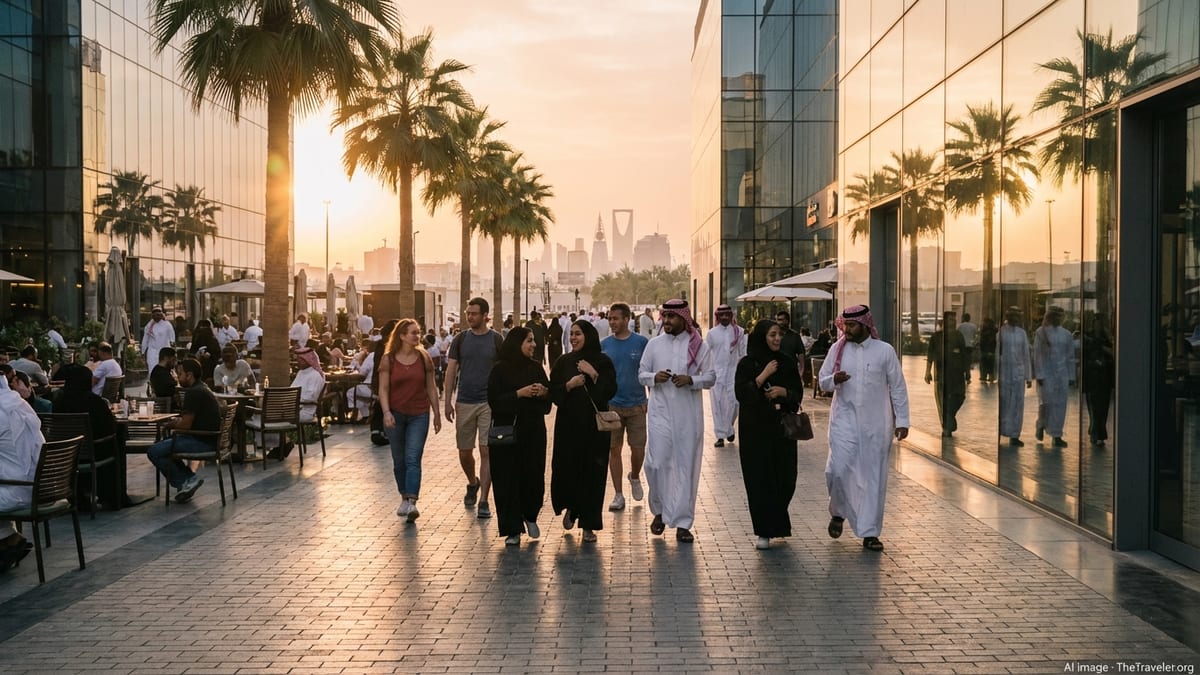
I landed in Saudi Arabia with a suitcase full of assumptions. Headlines and secondhand stories had painted a picture of a closed, strictly religious kingdom where daily life happened behind high walls. Yet within days of walking Riyadh’s new boulevards, drinking coffee in Jeddah’s historic alleys and watching the desert glow at AlUla, that picture began to blur. My first trip did not erase Saudi Arabia’s complexities, but it profoundly changed what the country looks like from the outside.
Arriving With a Head Full of Headlines
On the flight into Riyadh, I scrolled through years of articles about Saudi Arabia: oil wealth, conservative social rules, human rights concerns, rapid modernization under Vision 2030. The narrative was big and geopolitical, and it did not leave much room for ordinary people or small, human moments. I realized that I could list the country’s controversies more easily than I could imagine an average Saudi day.
Yet even the entry process hinted at a different story. Saudi Arabia has turned tourism into a national priority, and the streamlined e-visa system for dozens of nationalities shows it. The formalities still felt serious, but they were also efficient and unexpectedly welcoming. Immigration officers asked about my itinerary, not suspiciously but with something closer to local pride.
Outside the terminal, summer heat rolled over the tarmac like an open oven. I expected that. What I did not expect was to see families speaking a mix of Arabic, English and Urdu, pilgrims in white ihram garments, and young Saudis in sneakers and hoodies all funneling into the same ride-hailing queue. Within an hour, the “oil kingdom” in my imagination had already become something else: a bustling hub of workers, worshippers and increasingly, holidaymakers.
On the ride into the city, my driver switched between Arabic pop, a recitation of Quran and an English-language business podcast. When I asked if he liked having more tourists, he shrugged in the mirror and said, “Good for the country. Good for work. People see we are not only what they see on TV.” It was the first of many times I would hear some version of that sentence.
Riyadh: A Capital Caught Between Past and Future
Riyadh from a distance looks like a mirage of glass and steel rising from the plateau. Up close, it feels like a city midway through an enormous experiment. On one side are broad highways, sprawling suburban villas and old neighborhoods where small groceries and falafel stands still define daily life. On the other are new districts built to signal that Saudi Arabia is no longer just a place to transit through, but a place to visit in its own right.
Nowhere did that feel clearer than in the entertainment zones that have sprung up in recent years. At Boulevard World, an amusement and leisure complex connected to Riyadh Season, I found myself riding a small boat through an artificial lagoon while Saudi families took selfies in front of replicas of global landmarks. The atmosphere was more theme park than austere capital: teenagers clutching bubble tea, toddlers chasing soap bubbles, grandparents watching the chaos from shaded benches.
It was an image that clashed sharply with my preconceptions. I had read about the kingdom’s investment in entertainment as part of its economic diversification plans, but standing amid the neon lights and food trucks, the policy language fell away. What remained was a simple reality: the country wants its young population to have fun at home instead of flying abroad to do it, and it wants foreigners to join them.
Yet a few kilometers away, in older parts of Riyadh, a different rhythm prevailed. Traditional markets still sold spices, perfume, gold and textiles under buzzing fluorescent lights. Here, shopkeepers were more curious about my origins, my family, whether I found the country safe. Repeatedly, they pointed out that visitors now arrive not only for pilgrimage or business, but for leisure and cultural events. The capital, like the country, is learning how to be looked at.
Conversations That Shattered Stereotypes
What altered my perception of Saudi Arabia most were not the new towers or mega-projects, but conversations with people whose lives are unfolding in the middle of this transformation. Many of them grew up in a country far more restrictive than the one they live in now. Their stories sit uneasily beside the international narrative, which often freezes Saudi Arabia in an earlier frame.
In a Riyadh cafe owned by a young Saudi couple, baristas in abayas and jeans moved to a playlist that blended K-pop with Khaleeji hits. One of them, studying computer science, spoke openly about how quickly things had changed. She remembered when women were not allowed to drive and when public entertainment was scarce. Now, she commuted to work, attended concerts and traveled to other cities with her friends. “We know what people outside think of us,” she said. “Some things are true, some things are old news. Both can exist at the same time.”
Later, in Jeddah, I met a filmmaker who had worked on independent projects before cinemas were legalized again. Today he attends film festivals in his own country, including the Red Sea Film Festival, where female directors and actors walk the same red carpets as their male colleagues. He spoke cautiously about the boundaries that remain, but he also emphasized that, for his generation, tools and opportunities exist that were unimaginable a decade ago.
These conversations did not erase the criticisms that often headline coverage of Saudi Arabia. They did, however, complicate them. People spoke about social reforms in the same breath as they spoke about political red lines. They enjoyed the new freedom to go to concerts while acknowledging that activists and dissidents continue to face harsh penalties. The country they described was not monolithic. It was layered, sometimes contradictory and very much in motion.
Walking Through History in Jeddah and AlUla
Before my trip, I associated Saudi Arabia’s landscape with an abstract desert: empty, beige, harsh. On the ground, I found a rich geography that shifted as quickly as the headlines. Jeddah, on the Red Sea coast, greeted me with sea air, humidity and a cosmopolitan energy that felt distinct from the capital.
In Al Balad, Jeddah’s historic district, coral-stone houses with wooden latticed balconies leaned into narrow alleys. Restoration work has turned many of them into galleries, cafes and small museums, part of the wider effort to celebrate the kingdom’s heritage. At sunset, the light soaked into the weathered facades and the call to prayer echoed in waves, overlapping with the murmur of tourists and locals. It was the kind of scene that could have played out a century ago, were it not for the smartphones and designer sneakers.
Further north, in AlUla, history felt even older and more elemental. Rock formations and sand dunes stretched toward the horizon, punctuated by the carved tombs of Hegra, Saudi Arabia’s first UNESCO World Heritage site. Walking between these monumental facades, it was hard to reconcile the silence of the desert with the noise of international debates about the country’s future. Here, arguments about soft power and image-building dissolved into the stillness of a civilization that predated modern borders.
The tourism development in AlUla reflects the country’s current balancing act. Luxury resorts and art installations now share space with archaeological sites and traditional farms. Guides speak about sustainability, carrying-capacity and cultural preservation. For visitors, the result is an experience that challenges the old idea that Saudi Arabia has little to offer beyond oil and pilgrimage. For Saudis, it seems to be a reminder that their identity is anchored in a deep and varied past, not only in recent decades.
Faith, Pilgrimage and a New Kind of Visitor
For many, Saudi Arabia is synonymous with Mecca and Medina, cities that sit at the heart of the Muslim world. Even if you do not enter the holy sites as a non-Muslim, you feel their presence in the movement of people across the country. Pilgrims in white garments appear at airports, rest stops and hotel lobbies, their journeys intertwined with those of business travelers and tourists.
The government’s plans call for tens of millions of pilgrims and visitors annually, and enormous investment has gone into infrastructure to handle that volume. High-speed rail links key cities, and new urban projects aim to accommodate the growing number of Umrah pilgrims throughout the year. These changes are not just about efficiency. They are also about reshaping how the world encounters Islam’s holiest places: as part of a broader travel experience that can include cultural festivals, seaside vacations and desert retreats.
Standing on a hotel rooftop in Jeddah, watching planes trace silent lines in the night sky toward Mecca’s airspace, I understood why this matters. For centuries, people have imagined the holy cities as distant, enclosed spaces, accessible only to a small segment of humanity. Today, the kingdom is betting that by improving the wider visitor experience, it can shift perceptions of the pilgrimage from a purely spiritual obligation to something intertwined with hospitality, culture and even leisure.
At the same time, recent tragedies during peak pilgrimage seasons and subsequent visa policy changes are a reminder that this transformation comes with immense logistical and ethical responsibilities. Hosting more visitors means managing safety, crowding and climate risks in an era of rising temperatures. The stakes are not merely reputational. They are profoundly human.
The Everyday Saudi Arabia Visitors Rarely See
As a traveler, it is easy to focus on the extraordinary: the giant projects, the futuristic renderings, the record-breaking numbers. Yet some of the most revealing moments of my trip happened in spaces that would never feature in a promotional campaign: a suburban Riyadh supermarket late at night, a family barbecue on the edge of the desert, a roadside cafe off the highway between cities.
In those spaces, Saudi Arabia looked less like a stage-managed transformation and more like a society adapting in real time. Friends showed me how families now frequent mixed-gender cafes instead of only private homes, how women navigate driving apps and road trips that were once unthinkable, how young couples negotiate new expectations around work, marriage and travel. The old social codes are not gone, but they are being renegotiated in millions of small decisions.
Hospitality, a value long celebrated in Arab culture, turned out to be less of a stereotype and more of a lived practice. I lost count of how many times I was pressed to take another plate of food, another cup of qahwa, another ride to the place I was going. People wanted to know what I thought of their country, but they also wanted to know if I felt safe, if I found what I needed, if I would come back. The conversation was not only about image. It was about dignity.
Seeing this everyday life did not make me forget the concerns that shape many international views of Saudi Arabia. But it did make it harder to think of the country solely in terms of policies and power. It became a place where children argued over screen time, where parents worried about school and housing costs, where young professionals weighed job prospects against personal freedom. In other words, a place recognizably human.
Contradictions, Critics and the Question of Image
Any honest account of a first trip to Saudi Arabia has to grapple with the gap between what you see on the ground and what you know from international reporting. The country’s leadership is investing heavily in culture, tourism and mega-events to reshape its global reputation. At the same time, human rights groups and journalists continue to document severe punishments for dissent, censorship and crackdowns framed as moral or security campaigns.
Travelers encounter both realities, sometimes in quick succession. One day you might attend a film screening introduced by a young Saudi woman director, part of a festival that would have been unimaginable years ago. The next, you might read about a new legal action against activists or a campaign against what authorities describe as immoral behavior. It can feel like living inside a moving target: laws, norms and red lines are being renegotiated as the country tries to open up without losing control.
From the outside, it is tempting to interpret tourism purely as image management. Certainly, welcoming millions of visitors helps soften perceptions and generate positive stories like this one. Yet on my trip, I met many Saudis for whom these changes are not about branding, but about their own lives: their ability to work in new fields, to study abroad and return to creative industries, to see concerts or sports events without leaving the country.
The question for visitors is how to hold these truths together. It is possible to appreciate the warmth, beauty and dynamism you encounter while remaining clear-eyed about the country’s political realities. It is possible to enjoy new freedoms alongside Saudis while understanding that others still pay a high price for speaking out. A trip will not resolve these contradictions, but it can make abstract judgments more grounded, more informed and perhaps more humble.
The Takeaway
When I think back to my first mental picture of Saudi Arabia, I see how flat it was. It reduced a complicated, diverse and rapidly changing society to a handful of symbols: oil rigs, black-and-white photos of old Mecca, headlines about crackdowns and reforms. Travel did not magically correct every misconception I had, but it added depth, texture and faces to a place that had been mostly theoretical.
I left with images that sit side by side: schoolgirls in sneakers queuing for ice cream under skyscrapers; elderly pilgrims tracing prayer beads in airport lounges; artists debating funding models in newly opened galleries; farmers in AlUla discussing water and tourism in the same breath. None of these scenes cancels the others out. Together, they form a layered portrait of a kingdom in transition, one that cannot be captured by a single narrative.
For anyone looking at Saudi Arabia from the outside, the question is no longer whether the country is changing. It is how, for whom and at what cost. Visiting does not make you an expert, but it does make it harder to speak in absolutes. You start to replace sweeping statements with specific stories, and to recognize the limits of any viewpoint that does not include the people who live there.
My first trip changed what Saudi Arabia looks like in my mind from a distant, closed-off state to a complex, sometimes dissonant, often welcoming place that is still writing its next chapter. The transformation is uneven and imperfect, but it is real. And once you have walked its streets, listened to its residents and watched the desert sky deepen over its ancient sites, it becomes impossible to see only the headlines again.
FAQ
Q1. Is Saudi Arabia safe for first-time visitors?
Saudi Arabia felt generally safe throughout my trip, with a visible security presence and low street crime, though travelers should follow local guidance and stay informed about regional developments.
Q2. What should I know about local customs and dress?
Modest clothing is expected in public, with shoulders and knees covered; women are no longer legally required to wear abayas everywhere but many still do, and respectful dress is appreciated.
Q3. Can women travel independently in Saudi Arabia?
Yes, many women travel and work independently, drive, and use public services, though social expectations vary by region and visitors should remain attentive to local norms.
Q4. How easy is it to get a tourist visa?
Saudi Arabia has introduced e-visas and visa-on-arrival options for many nationalities, making the process relatively fast, but requirements can change so it is wise to check official updates before booking.
Q5. What are the must-visit places for a first trip?
Riyadh offers a look at rapid modernization, Jeddah blends the Red Sea with historic architecture, and AlUla showcases desert landscapes and ancient sites that help redefine the country’s image.
Q6. How strict are social rules in public spaces?
Public life has relaxed in recent years, with mixed-gender cafes and entertainment options, but conservative norms remain and visitors should avoid overt displays of affection and provocative behavior.
Q7. Is it possible to experience Saudi culture beyond mega-projects?
Yes, visiting historic districts, traditional markets, smaller towns and family-owned cafes or farms offers a more grounded view of daily life beyond headline-grabbing developments.
Q8. How should I talk about sensitive topics with locals?
Many people are open to thoughtful conversation, but it is best to let locals guide the depth of political or social discussions and to avoid putting anyone in an uncomfortable or risky position.
Q9. What surprised you most about Saudi Arabia?
The biggest surprise was the diversity of people and opinions, and how quickly everyday life is changing for many Saudis compared with the static image often seen abroad.
Q10. Will one trip change how I see the country?
One visit will not answer every question, but it can replace assumptions with firsthand impressions, making your view of Saudi Arabia more nuanced, personal and grounded in reality.