

France is one of those countries that appears fully formed in your imagination long before you ever arrive. You think you know its grand boulevards, lavender fields, and stone villages from films and postcards. Traveling across the country by train and car over several weeks challenged and confirmed those clichés in equal measure. What follows is my honest account of moving through France region by region, the small surprises and occasional frustrations, and the lessons I wish I had known before boarding that first train in Paris.
Starting in Paris: Expectations, Jet Lag, and First Impressions
Landing in Paris, I discovered quickly that the city rewards patience more than planning. On paper, it is a tight network of landmarks and metro lines; in reality, jet lag, crowds, and practical details like ticket machines and café customs slow you down. My first morning, I tried to race through a checklist of sights and ended up learning more about my own limits than about the city. The most valuable adjustment was letting go of the idea that I needed to see everything and instead focusing on small, specific corners of Paris each day.
Paris is part performance and part everyday life. Around the classic sights, you will feel the tourist machinery in full motion, from group tours to souvenir stands. Walk a few blocks away and it softens into neighborhood life: parents on school runs, office workers queuing at boulangeries, older couples lingering over a glass of wine. I felt more grounded once I allowed myself to sit at a café table without guilt, acknowledging that observation is as legitimate a form of discovery as museum-hopping.
Navigating the city is relatively straightforward, but the learning curve is real. The metro is fast and usually reliable, though at peak hours the crush can be intense. Occasional strikes or partial disruptions do appear, particularly on suburban RER lines, and they rarely make headline news outside France. I found it helpful to build a buffer of time into any trip that involved a train or connection, especially to or from the airports. That margin often turned potential stress into a simple pause.
My lasting first impression of Paris was not a single monument but a sound: the low rumble of traffic mixed with the clink of glasses and snippets of French, English, Spanish, and more floating through the air. It is a city that feels unquestionably international while remaining deeply itself. That tension, between myth and daily reality, set the tone for traveling across the rest of the country.
Crisscrossing France by Train: The Good, the Bad, and the Delayed
For this trip, I relied heavily on France’s rail network, and it shaped my experience more than any single destination. High speed TGV services between major cities are, when they run smoothly, among the most comfortable ways to cross long distances in Europe. Booking early typically meant better fares and guaranteed seats, while regional TER trains were more flexible, with fixed prices and less need for advance reservations. That combination allowed me to plan the backbone of my journey while leaving space for spontaneous detours.
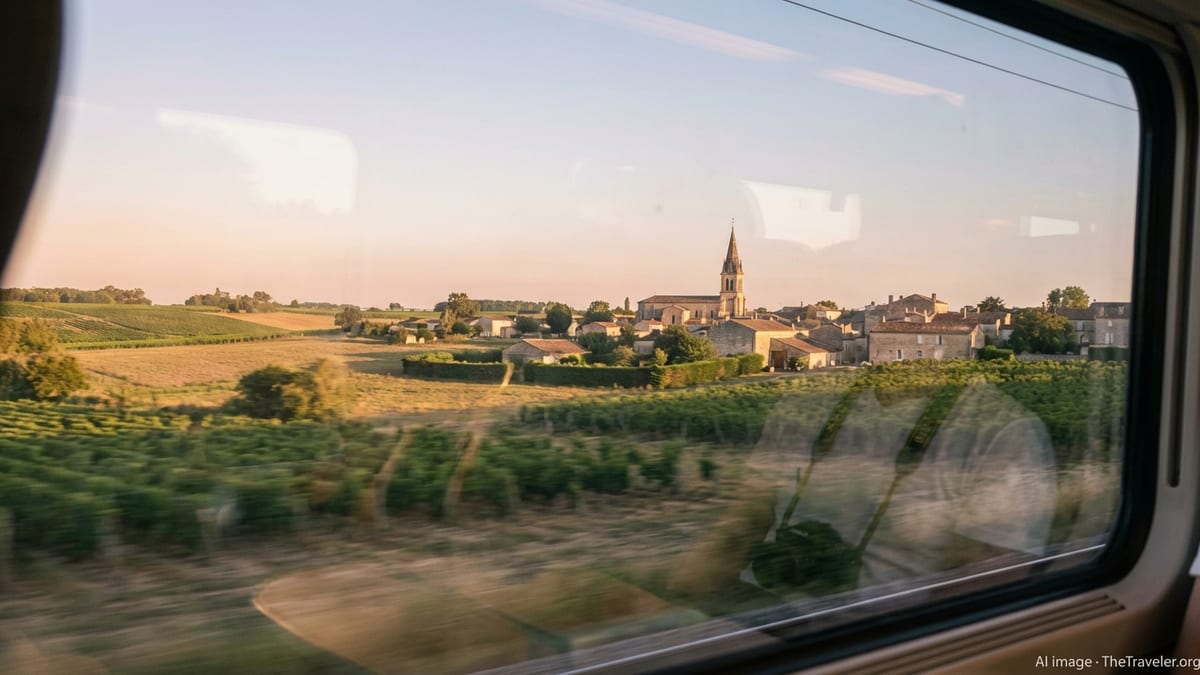
On the ground, the difference between train types matters. TGVs usually offered power outlets, Wi-Fi on many routes, a café car, and assigned seating. Regional TER trains were simpler but often more scenic, trundling through vineyards, small towns, and river valleys that you would never glimpse from a highway. I came to enjoy the TER journeys as much as the glamorous high speed stretches, especially when I could slide the window blind up and watch the countryside roll past at a more human pace.
Not every rail day was smooth. France has a long tradition of transport strikes, and during my time there I experienced one day of reduced service that forced a last minute adjustment. Strikes are usually announced in advance, with national rail operators publishing which lines will be disrupted and which will run close to normal. On my affected day, long distance trains continued on a nearly standard timetable, but some regional connections were thinned out, particularly in the south and west, which meant more crowded platforms and occasional gaps in service. It was inconvenient but not catastrophic, largely because I had left extra time between connections and kept my schedule flexible.
The biggest lesson from traveling by train across France was psychological: accept that disruptions are possible and build that assumption into your planning. Have offline copies of your tickets, carry a small picnic in case the café car is closed or busy, and keep a power bank handy for your phone so you can track last minute platform changes. Under those conditions, even a delay can become part of the experience rather than a crisis, a chance to eavesdrop on conversations, browse the station bookshop, or simply watch the comings and goings of French daily life.
From Paris to Normandy: Slower Rhythms and Quiet Coastlines
Traveling northwest from Paris into Normandy, the country seemed to exhale. The skyline gave way to low hills and patchwork fields, with small towns clustered around church spires. The shift in atmosphere was immediate; gone were the dense metro maps and hurried river embankments, replaced by two lane roads, harbors, and long beaches. It felt like stepping sideways in time rather than moving a few hours by train.
Normandy is a region that carries visible layers of history. Many travelers arrive primarily for the Second World War sites along the coast. Visiting them is an undeniably sobering experience, and standing on the wide, windblown beaches, it is hard to reconcile the peaceful present with archival images. Yet Normandy is not frozen in its past. Fishing boats still leave the harbors early in the morning, families picnic on the dunes, and cafés bustle with local conversation as well as tour groups. The coexistence of heavy history and ordinary coastal life was one of the most striking aspects of my time there.
Practically, Normandy is well suited to travelers who prefer moderate distances and relaxed driving or rail legs. Buses and trains connect major towns, but the most secluded beaches and villages often require a car. Driving was less stressful than I had anticipated, as long as I respected speed limits and village slow zones. Distances that look large on a map often translated to an hour or two on the road, which left plenty of room for unplanned stops at roadside bakeries or farm shops advertising cheese and cider.
Personally, Normandy gave me my first real sense of what rural hospitality in France can feel like when you move beyond heavily trafficked circuits. Guesthouse owners had time to chat, restaurant servers offered patient explanations of menus, and conversations shifted easily between French and English when my vocabulary reached its limit. The region showed me a softer, more intimate side of the country after the intensity of Paris.
Wine Country and the Atlantic: Discovering Nouvelle Aquitaine
Heading southwest toward Bordeaux and the broader Nouvelle Aquitaine region, the landscape changed yet again. Vineyards began to dominate the horizon, neatly ordered rows stretching away from the tracks or roads. Bordeaux itself felt like a smaller, more relaxed cousin of Paris, with classical architecture, a strong café culture, and a riverfront that invites long walks rather than quick snapshots. It is a city that rewards lingering, preferably with a glass of the local wine and a plate of something simple but carefully prepared.
Beyond Bordeaux, the region offers a wide variety of experiences, from historic inland towns to Atlantic beach resorts. Coastal areas near Arcachon or further south toward the Basque influenced corners feel markedly different from the interior. Here, pine forests give way to immense sandy beaches and surf spots. Even in busier seasons, I could often find long stretches of shoreline where the only sounds were the waves and the wind. The Atlantic weather can change quickly, so layers and a waterproof jacket were more useful than the perfectly coordinated outfit I had imagined.
Rail connections in this part of France were generally reliable during my visit, with mainline trains linking Bordeaux to Paris and other major cities, and regional services reaching out toward the coast and smaller centers. However, on one occasion a reduced timetable on a regional line meant I had to wait longer than expected in a small station. It was a reminder that while the system is extensive, it is not immune to local disruptions or seasonal adjustments. Reading schedules carefully and checking for last minute updates made a real difference to my peace of mind.
What I remember most vividly from Nouvelle Aquitaine is a sense of spaciousness. The combination of vineyards, rivers, and ocean created a feeling of breathing room that contrasted sharply with the density of the capital. Even on days with minor transport hiccups, that sense of wide horizons and open skies made the region one of the highlights of my journey.
Southbound to Provence and the Riviera: Beauty, Crowds, and Heat
Traveling southeast toward Provence and the Côte d’Azur, I began to understand why this region is so heavily photographed and mythologized. The light genuinely is different. Colors seem to soften at the edges while remaining vibrant, especially in the late afternoon when stone villages glow and the sea slips through shades of blue and green. Cities like Marseille and Nice anchor the coastline, while inland towns and hilltop villages offer quieter, more traditional scenes.
Marseille surprised me the most. It felt rawer and more complex than I had anticipated, with a working port, diverse neighborhoods, and a strong cultural scene that includes museums and contemporary art spaces. It is not a polished postcard, and that is precisely its appeal. A short ride away, the calanques, with their dramatic limestone cliffs and inlets, provided some of the most memorable hikes of my trip, though I was careful to check local advisories about trail closures and fire risk, especially during hot and dry periods.
The Riviera towns, including Nice and the smaller coastal communities, were where I felt the tension between beauty and overtourism most keenly. In peak season, crowded promenades and busy beaches can be overwhelming, and prices reflect sustained demand. Personally, I found early mornings and shoulder season visits more rewarding. Walking along the seafront before most cafés opened, with only joggers and dog walkers for company, restored the sense of serenity that midday crowds erased.
Trains along the Mediterranean coast were a mixed experience. On good days, they were punctual and uncrowded enough to allow window gazing as the sea flashed in and out of sight. On days with regional service reductions or minor strikes, some departures were canceled or merged, leading to packed carriages and more standing passengers. Again, the key was not perfection but preparation: knowing that such days were possible and adjusting expectations accordingly.
Daily Life on the Road: Food, Etiquette, and Language Lessons
Beyond the scenery, much of my experience of France came down to daily rituals: ordering coffee, buying train snacks, checking into small hotels or guesthouses, and handling the unglamorous chores of laundry and logistics. Food inevitably plays a central role. Breakfasts were usually simple, often a croissant or tartine with jam and a coffee, taken at the counter or a small table. Lunch and dinner ranged from fixed price menus in bistros to quick sandwiches from bakeries. The most memorable meals were not necessarily the most elaborate ones but those eaten unhurriedly, watching ordinary life unfold around me.
Tipping culture in France is more restrained than in some other countries, which was both a relief and a minor puzzle at first. In cafés and casual restaurants, a small tip of around 5 to 10 percent, or simply rounding up the bill, felt appreciated without being expected. In more formal restaurants or after exceptional service, leaving a bit more was appropriate. For taxis, I typically rounded up or added a modest supplement if the driver helped with luggage or navigated heavy traffic with skill. The key seemed to be moderation and sincerity rather than rigid rules.
Language shaped each interaction. In large cities and tourist centers, many people spoke at least some English, but the tone of conversations changed noticeably when I made the effort to start in French, however basic. Simple phrases such as greeting staff with a “bonjour” upon entering, saying “s’il vous plaît” and “merci” often, and acknowledging that French is the default language went a long way. When I stumbled, people were generally patient and sometimes switched to English to help, but that initial gesture in French set a more respectful tone.
Etiquette was subtle but consistent. In cafés, it is common to linger after finishing a drink without pressure to order more, especially at outdoor tables. In small shops and markets, making eye contact and greeting the vendor before asking for something is more than politeness; it is part of the transaction. These details are easy to overlook when you are focused on schedules and sightseeing, yet they colored my entire experience. Once I slowed down enough to notice them, France felt less like a stage set and more like a coherent, living culture.
Challenges, Surprises, and What I Would Do Differently Next Time
No honest account of traveling across France would omit the difficult moments. Beyond the occasional strike or delayed train, I encountered days when crowds were exhausting, heat waves made city sightseeing uncomfortable, and my limited French vocabulary felt like a real barrier. On one particularly hot afternoon, I tried to push through a full museum visit and a long walk, only to end up drained and irritable, which did little justice to the place I was trying to appreciate.
Another recurring challenge was the assumption that everything would be open at all times. In smaller towns especially, many shops and even some restaurants observe midday closures, and Sunday or Monday can be quiet to the point of feeling deserted. I arrived hungry more than once to find a street of shuttered doors, learning the hard way to carry snacks and to plan main meals around local rhythms rather than my own habits. Far from being an inconvenience, this ultimately taught me to pay attention to the weekly pulse of French life.
I was also occasionally surprised by how busy popular areas remained outside the classic summer peak. Events, school holidays, and long weekends can all swell visitor numbers. On one trip along the coast, I assumed an ordinary weekday would mean calmer beaches, only to find them lively with domestic visitors taking advantage of favorable weather. Had I checked local calendars more closely, I might have chosen different days for quieter experiences.
If I were to repeat the journey, I would leave even more room for unscheduled time and reduce the number of hotel changes. Every move, however short, consumes mental and physical energy. Staying longer in each region would allow for deeper familiarity and more resilience when things go wrong. I would also make a greater effort to learn practical French phrases beyond the basics, especially for dealing with train changes, reservations, and small talk. These adjustments would not eliminate challenges, but they would make each one easier to absorb.
The Takeaway
Traveling across France by train and car is not a seamless fantasy, but that is part of its appeal. The country reveals itself in layers: in the contrast between Paris and small coastal towns, in the differences from one region’s cuisine and landscape to another, and in the quiet rituals that structure daily life. There were delays and frustrations, moments of linguistic confusion, and days when expectations outpaced reality. Yet each of those moments also created space for small acts of kindness, unexpected conversations, and a more nuanced understanding of how France actually functions.
If there is a single piece of advice I would offer prospective travelers, it is to balance structure with surrender. Make use of the efficient rail network, but assume that disruptions can happen and plan accordingly. Choose a few regions rather than trying to see the entire country in one sweep, and give yourself permission to do less in each place. Let cafés, markets, and everyday streetscapes occupy as much space in your memory as museums and monuments.
In the end, my honest experience crossing France is one of layered impressions rather than a single story. It is the blur of countryside fields outside a train window, the taste of a simple pastry eaten on a station bench, the sound of waves on an Atlantic beach, and the glow of a Provençal evening. It is imperfect, human, and far richer than anything I imagined before I arrived.
FAQ
Q1. Is it better to travel across France by train or by car?
Both have advantages. Trains are fast, comfortable, and efficient between major cities, while a car offers more freedom in rural areas and for reaching small villages or beaches.
Q2. How reliable are trains in France with strikes and delays?
Most of the time trains run smoothly, but occasional strikes or reduced timetables do occur. Checking schedules close to departure and allowing extra time for connections is wise.
Q3. Do I need to book French train tickets in advance?
For high speed services, booking in advance usually secures better fares and seats. Regional trains are more flexible, but checking times ahead of travel still helps.
Q4. How much should I tip in French cafés and restaurants?
Service is often included, so tipping is modest. Rounding up the bill or adding about 5 to 10 percent for good service is generally appreciated but not mandatory.
Q5. Is it necessary to speak French when traveling across France?
You can get by with English in many places, especially cities, but basic French greetings and phrases make interactions smoother and are seen as respectful.
Q6. Which regions are best for a first trip beyond Paris?
Normandy, Provence, the Côte d’Azur, and the Bordeaux area are popular choices, offering a mix of history, coastlines, and countryside within manageable travel distances.
Q7. How expensive is it to travel around France?
Costs vary widely by region and season. Big cities and the Riviera are pricier, while smaller towns and inland areas can be more affordable, especially outside peak summer.
Q8. Are smaller French towns and villages easy to reach without a car?
Many are connected by regional trains or buses, but the most remote spots are harder to reach. A car or occasional taxi transfers offer more flexibility in rural areas.
Q9. What is the best time of year to travel across France?
Spring and autumn usually offer milder weather, fewer crowds, and often better prices. Summer brings longer days and festivals but also higher heat and busier destinations.
Q10. How many regions can I realistically visit in a two week trip?
For a relaxed pace, two or three regions plus Paris is reasonable. Trying to cover more often leads to rushed days and less time to appreciate each destination.