

I arrived in Cumberland, British Columbia with a head full of Instagram images and bike-film fantasies: misty forests, perfect loam, indie cafes, and that effortlessly cool small-town vibe Vancouver Island is famous for.
What I found was more complicated. Cumberland is attractive, friendly, and genuinely interesting, but it is also crowded in ways I did not expect, pricier than its gritty-mining-town image suggests, and occasionally frustrating if you are not there to ride bikes from dawn to dusk.
Here is my honest, first-hand take on what it felt like to land in this little former coal town turned outdoor playground.
Arriving in a Former Coal Town Turned Hip Village
Driving into Cumberland, I could feel the shift from highway sprawl to something more contained and self-conscious. The village sits in a shallow valley near the east end of Comox Lake, backed by the Beaufort Range and wrapped in forest, and at first glance it looks like a classic, slightly scruffy resource town with false-front buildings and narrow streets. Then the details start to register: high-end mountain bikes leaning against wooden benches, craft coffee in almost every hand, and rental vans with BC Ferries receipts still tucked on the dash. It is clear very quickly that this place has remade itself from coal economy to outdoor-culture economy.
Knowing a bit of the history added weight to that first impression. Cumberland grew up as a coal town in the late 1800s, with mines tunnelling under the village and out towards Comox Lake. Those mines powered industry far beyond Vancouver Island but came at a heavy human cost through dangerous working conditions and exploitation of immigrant labour. Today, the heavy industry is gone, replaced by breweries, bakeries, and bike shops, yet the ghosts of that past are still present in the layout of the streets, the brick foundations, and the museums and interpretive signs around town. I appreciated that mix of rough edges and rebranding, even if the current version can feel a little too curated at times.
My expectations going in were honestly skewed. I had heard Cumberland described as quirky, affordable, an under-the-radar base for outdoor adventures. Parts of that are still true, but when I rolled through the main street on a summer weekend afternoon, it was busy bordering on crowded. Parking was a mild headache, lineups snaked out of the most popular cafés, and it was obvious that tourism and in-migration have changed the rhythm of daily life. I would not call it overrun, but “sleepy” is not the word I would use anymore.
Despite those first frictions, there was an immediate sense of community. Hand-painted signs acknowledged that the village is on unceded K’ómoks territory, and conversations on the street felt local rather than staged for visitors. That authenticity, even in a place undergoing rapid change, became one of the through-lines of my stay and one of the reasons I warmed to Cumberland despite my reservations.
Main Street: Charm, Crowds, and Sticker Shock
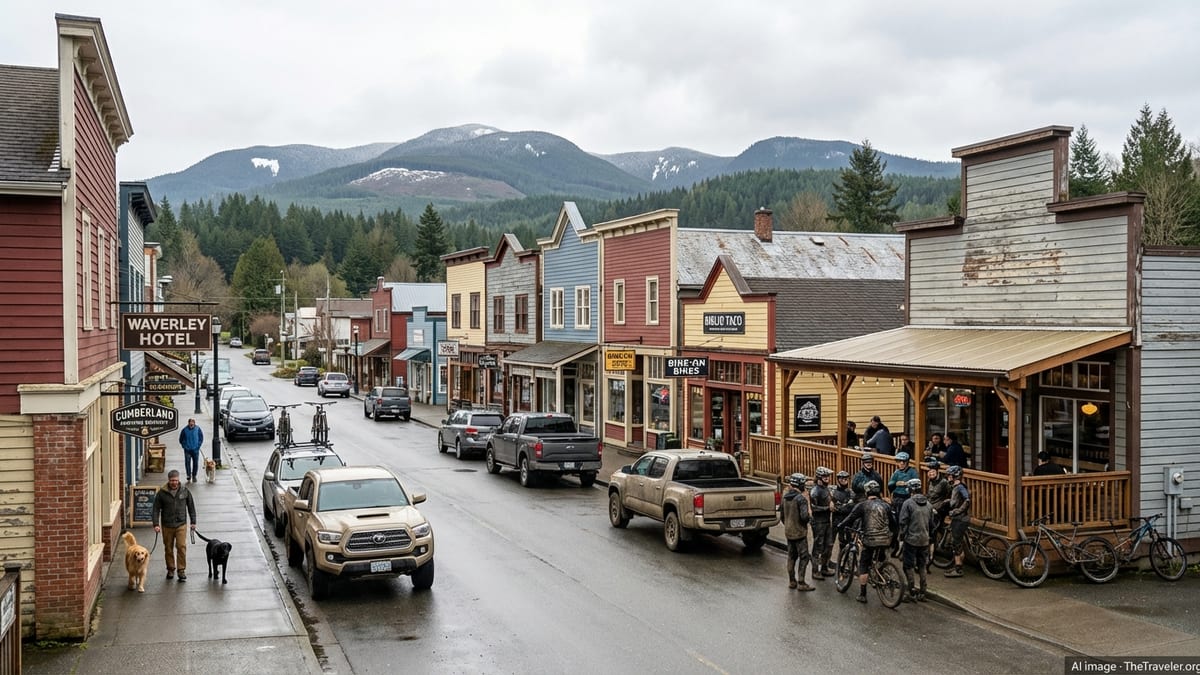
My first real stop was Dunsmuir Avenue, Cumberland’s compact main drag. Visually, it is almost exactly what you might hope for: historic buildings with character, a mix of cafés, pubs, small shops, and the kind of slightly worn facades that tell you this was a working town long before latte art arrived. On a grey morning, the street looked like the set of an indie film, right down to the muddy pickup trucks parked beside shiny roof-racked Subarus.
The charm is undeniable, but the crowds caught me off guard. By mid-morning, every outside table seemed claimed by mountain bikers debriefing their first lap of the day, families corralling kids, and remote workers nursing a single drink over open laptops. For a village of a few thousand people, the concentration of visitors was intense. I had to wait in line for coffee and then circle for a seat, which is not a deal-breaker but did clash with my expectation of a slow-paced small-town morning.
Prices were another jolt. I knew I was on Vancouver Island, not deep in the interior, but I still expected a bit of a discount relative to Victoria or Vancouver. That is not what I found. Food and drink were firmly in “urban hip neighbourhood” territory. The quality, to be fair, was generally very good: excellent coffee, thoughtful baked goods, decent vegetarian options, and local beer on tap. Still, it was hard to shake the feeling that the old mining town aesthetics were being layered over a cost structure that would be challenging for many locals and a surprise for budget travellers.
On the plus side, the businesses felt genuinely independent and rooted. Staff were relaxed and friendly rather than aggressively hospitality-trained, and I overheard plenty of locals greeting each other by name. It is not a polished resort town. There are gaps between the trendy spots, there are still modest homes and a lived-in feel, and that kept me from writing it off as just another gentrified, outdoorsy outpost. My main advice: arrive with realistic price expectations and the patience to navigate weekend lineups.
Mountain Biking Mecca: Fantastic Trails, Narrow Focus
It is impossible to talk honestly about Cumberland without talking about mountain biking. The trail network above the village is one of the main reasons people come here, and in that regard the hype is largely justified. I rode several days during my stay, and the access alone is impressive. From the edge of town, a short pedal on gravel brings you into a web of singletrack that coils through second-growth forest, across creeks, and along old rail grades from the coal mining days. The transition from village to woods is almost instantaneous, and that proximity is a huge part of the appeal.
The trails themselves are varied and well looked after. I found everything from gentle, flowy options suitable for newer riders to more technical, rooty and rocky lines that demanded attention. The work of local trail organizations is obvious in the signage, drainage, and the way routes are maintained despite heavy use. When the dirt is moist but not saturated, the riding is exceptional, with that velvety traction Pacific Northwest riders dream about. On those days, it is easy to understand why Cumberland has become a pilgrimage spot for mountain bikers.
Yet there were downsides that do not always make it into the marketing. The network can feel crowded, especially on weekends and during peak season. I had to pull over regularly to let faster riders pass, and some trailheads began to feel as busy as urban parks. While most people were courteous, a few close passes and impatient comments chipped away at the mellow-forest fantasy I had in my head. This is not a remote backcountry experience. It is a popular, shared space, and if you are expecting solitude you will likely be disappointed, at least near the main access points.
There is also the question of what happens if you are not a mountain biker. Cumberland’s identity has become so entwined with the sport that at times I felt like a guest at someone else’s convention. Many of the shops, posters, and even social events revolve around bikes. If that is your world, it is fantastic. If you are more of a hiker, paddler, or culture-focused traveller, you might feel sidelined, especially in conversations and local buzz. I enjoyed the riding, but I did catch myself wishing the village put the same public energy into its other assets as it does into its trail network.
Hiking, Forests, and Lakes: Quiet Beauty with Caveats
Beyond the bikes, I went looking for what Cumberland offers to those who just want to walk in the woods or sit by the water. The surrounding landscape is rich: forests, creeks, wetlands, and the long ribbon of Comox Lake define the area. I explored sections of the community forest that skirt the village, following old rail beds and mining roads now reclaimed by moss and salal. The trails here are gentler than the steeper bike routes higher up, and they offer a window into both natural regeneration and industrial history.
These walks were some of my favourite moments in Cumberland. The air was cool and damp under the canopy, birds were active, and the occasional mining artifact or interpretive sign gave a sense of place beyond generic “West Coast forest.” I appreciated that the community and local organizations have worked to protect and acquire parcels of forest that might otherwise have gone to logging. It felt like a concrete example of a small town reshaping its future rather than simply memorializing its past.
That said, access is not always as simple as brochures make it sound. Signage for non-bike trails can be vague, and I occasionally found myself at unsigned junctions trying to guess the correct direction. Maps posted at some trailheads were helpful, but they assume a certain level of local knowledge and, in a few cases, still privileged the main mountain biking lines. On top of that, sections of trail were muddy and churned up from heavy use during wet periods, something to plan for if you arrive in the shoulder season expecting crisp, dry walking.
Reaching the lake from the village also required more logistical effort than I anticipated. Comox Lake is a major feature of the local landscape, but direct, easy, pedestrian-friendly access from Cumberland is limited. I did manage to spend time on its shore, and it was undeniably beautiful, with clear water and views back to the hills. Yet between private land, industrial history, and a patchwork of recreation areas, it did not feel as simple or seamless as the “lake town” label suggests. If your idea of a perfect day is strolling from café to lakefront picnic without getting in a car, Cumberland might frustrate you.
Coal, Chinatown, and Memory: A Difficult History Handled Thoughtfully
One of the most compelling parts of my time in Cumberland had nothing to do with biking or coffee. The village has a deep, often painful history of coal mining, labour struggle, and immigrant communities, and I made a point of seeking out the historical sites and stories. Visiting the local museum and walking the remnants of the former Chinese and Japanese townsites gave me a different lens on the place, one that cut through some of the modern lifestyle branding.
Cumberland’s former Chinatown, once one of the largest Chinese communities on Vancouver Island, is now mostly gone, with only a few physical traces, storyboards, and a reconstructed sense of what once stood there. Knowing that hundreds of Chinese miners worked here for lower wages and in more dangerous conditions than their European counterparts, and that many lost their lives in explosions and accidents, changed how I looked at the forest paths and quiet clearings. It felt important that the village acknowledges this history, especially given how thoroughly resource towns elsewhere have erased the contributions and suffering of racialized workers.
I also followed interpretive trails through what is now parkland but was once the engine of the entire region’s economy. The remains of mine entrances, rail grades, and slag heaps sit under a layer of moss and salal, but they are not completely hidden. Information panels explain the strikes, lockouts, and coal dust explosions that repeatedly killed dozens of miners at a time. Standing in those spots, it is hard not to feel a sense of dissonance when you think about the modern marketing of Cumberland as a carefree playground.
In general, I felt the village handles this history with thoughtfulness, though not perfectly. The museum and heritage groups clearly put in the work, and there is a sincere desire to tell a fuller story that includes the K’ómoks people and the multicultural roots of the community. At the same time, the physical traces are fragile, and I occasionally wished for more robust preservation, more visible markers, and clearer connections between historic sites and the rest of the village experience. If you care about context and not just scenery, it is worth carving out time for this side of Cumberland, even if you feel like you are stepping out of the main tourist current to do it.
Staying in Cumberland: Atmosphere vs Practical Realities
Spending a few nights in Cumberland gave me a different perspective than a simple day trip would have. The atmosphere in the evenings is lovely: the surrounding hills darken, pub patios fill with a mix of locals and visiting riders, and the village feels cosy and contained. Walking back to where I was staying along quiet residential streets, I passed older miner cottages renovated with care, newer infill that signals rising prices, and a scattering of vans and campers parked as overflow accommodation for people who could not find or afford a proper place to stay.
Accommodation turned out to be one of the more challenging aspects of the trip. The village is small, and while there are some guesthouses, motels, and short-term rentals, the range is limited for the amount of interest Cumberland now attracts. I booked early and still found my options narrower and more expensive than I expected for a place of this size. If you leave things to the last minute in high season or on event weekends, you may end up driving in from Courtenay or camping further afield, which changes the easy, park-once-and-wander experience that many people are hoping for.
Noise was another minor but noticeable reality. This is not a resort bubble; it is a working community. Trucks rumble through, dogs bark, and late-night conversations spill onto the street from pubs on weekends. Personally, I found that part of the charm, but if you are sensitive to sound and expecting total quiet after 9 p.m., you might be in for a surprise. It is worth choosing accommodation a block or two off the main strip if you want a better chance at uninterrupted sleep.
On the practical side, Cumberland has enough services for a short stay, but not everything. For bigger grocery runs, specialized shopping, or medical needs, you are likely heading into nearby Courtenay. Transit connections exist but are not especially convenient for visitors, so a car or at least a bike makes life easier. None of these factors would keep me from returning, but they are part of the trade-off that comes with the village’s scale and setting.
Community Vibes, Growing Pains, and Who Cumberland Is For
The longer I stayed, the more I became aware of the tension between the old Cumberland and the new. I heard snippets of conversation about housing costs, about long-time residents being priced out or squeezed by short-term rentals, about the sheer volume of visitors during peak times. At the same time, I saw posters for community events, volunteer trail days, fundraisers for local causes, and cultural programs that spoke to a strong, engaged citizen base trying to navigate change intentionally rather than simply reacting to it.
As a visitor, it is easy to consume only the pleasant surface of that dynamic: good food, fun trails, friendly people. But there is a responsibility in recognizing that the same features that make Cumberland so attractive to travellers can also stress its infrastructure and housing market. I caught myself more than once wondering if I was part of the problem, especially when looking at crowded trailheads or overhearing locals talk about struggling to find rentals. That self-awareness is not something tourism boards often encourage, but it felt important here.
All of this fed into my sense of who Cumberland is really for right now. If you are a mountain biker or outdoor enthusiast who wants a hub with character, quick trail access, and a social scene built around your sport, Cumberland is an excellent fit. You will likely overlook the crowds because you are part of them, and the costs might feel reasonable compared to flying to more distant destinations. If you are a traveller looking primarily for a tranquil lakeside village, or a cheap alternative to bigger Vancouver Island destinations, you may find your expectations clashing with reality.
Personally, I enjoyed my time but would make some adjustments if I went back. I would avoid peak weekends, book accommodation earlier and a bit away from the busiest blocks, and plan my bike rides for early mornings and late afternoons to sidestep the heaviest trail traffic. I would also leave more dedicated time for the historical sites and quieter walks, balancing the adrenaline with reflection, which is where I felt Cumberland revealed its most lasting layers.
The Takeaway
My first impressions of Cumberland, BC were a mix of appreciation and unease. I loved the proximity of forest to front door, the way the village is trying to reckon with a complicated industrial and multicultural past, and the sense that real people actually live and work here despite rising tourist pressure. The mountain biking lived up to its reputation, the coffee and beer were as good as promised, and the setting, with the Beaufort Range in the background and Comox Lake nearby, is genuinely beautiful.
At the same time, I bumped into limits: crowded trails and cafés, higher-than-expected prices, accommodation scarcity, and a village identity that can feel dominated by one particular subculture. Some of the softer promises you encounter in glowing travel pieces a peaceful lakeside town, cheap character houses, empty trails did not match what I experienced on the ground.
Would I go back? Yes, but with clearer intentions. For me, Cumberland makes the most sense as a focused base for riding and exploring nearby nature, with a side of history and community culture, rather than as a general-purpose holiday spot. I would not recommend it to someone seeking a bargain beach vacation or total escape from other people. I would recommend it enthusiastically to riders, trail runners, hikers, and history-minded travellers who are willing to plan ahead, travel outside peak weekends if possible, and treat the place less as a theme park and more as a living village still working through what comes after coal.
FAQ
Q1. Is Cumberland, BC worth visiting if I am not a mountain biker?
Yes, but with caveats. There is good hiking, interesting history, and a pleasant village core, but the culture and marketing lean heavily toward mountain biking, so you may sometimes feel on the margins if you are not part of that scene.
Q2. How many days should I spend in Cumberland on a first visit?
For a first visit focused on trails and local history, two to three full days feels about right. That gives enough time to ride or hike, explore the museum and historic sites, linger in cafés, and take at least one side trip to the lake or nearby towns.
Q3. Is Cumberland expensive compared to other Vancouver Island towns?
Relative to its gritty, old-mining-town image, Cumberland is more expensive than you might expect. Cafés, pubs, and accommodation are closer to small-city prices, so it is wise to budget accordingly and not assume deep rural discounts.
Q4. When is the best time of year to visit Cumberland?
Spring and early fall can be ideal, with fewer crowds and generally good trail conditions. Summer offers long days but also higher visitor numbers, while winter can be wet, muddy, and more limited for non-bikers.
Q5. Is Cumberland family-friendly?
Yes, with some planning. There are easy trails, parks, and a generally relaxed atmosphere, but the busiest venues and trailheads can feel packed. Families who do best here tend to enjoy outdoor activities and do not mind a bit of mud and unpredictability.
Q6. Do I need a car to enjoy Cumberland?
A car makes the experience significantly easier, especially for reaching lake access points and nearby services in Courtenay. You can manage some of the village and immediate trails by bike or on foot, but public transit is limited for visitors.
Q7. How crowded are the trails around Cumberland?
On weekends and during peak riding season, the main trail network can feel busy, with regular encounters and occasional congestion at popular junctions. Early mornings, weekdays, and shoulder seasons offer a noticeably calmer experience.
Q8. What should I pack for a trip to Cumberland?
Weatherproof layers, sturdy footwear, and a willingness to get damp are key. If you ride, bring your usual bike gear and spares. Even in summer, mornings and evenings can be cool, and trails can stay muddy longer than you might expect.
Q9. Is Cumberland a good base for exploring the rest of the Comox Valley?
Cumberland works well as a base if your priority is trails and village atmosphere. For broader access to beaches, services, and transit, nearby Courtenay or Comox might be more convenient, with Cumberland as a focused day trip.
Q10. Would I return to Cumberland, and what would I do differently next time?
I would return, but I would avoid peak weekends, book accommodation further in advance, plan rides or hikes during off-peak hours, and carve out more time for the historical sites and quieter forest walks instead of spending as much time in crowded cafés.