

I arrived in Victoria, British Columbia with the weight of a thousand travel articles on my shoulders. For years I had seen the same images repeated: the storybook Inner Harbour, the ivy-draped Fairmont Empress, tea on fine china, hanging baskets bursting with flowers, and headlines calling it Canada’s most English city.
By the time I stepped off the ferry, my expectations were sky-high. What I found was more complicated: a city that is often beautiful and gracious, sometimes deeply frustrating, and definitely not the polished postcard it is so often made out to be.
First Impressions: Between Postcard and Reality
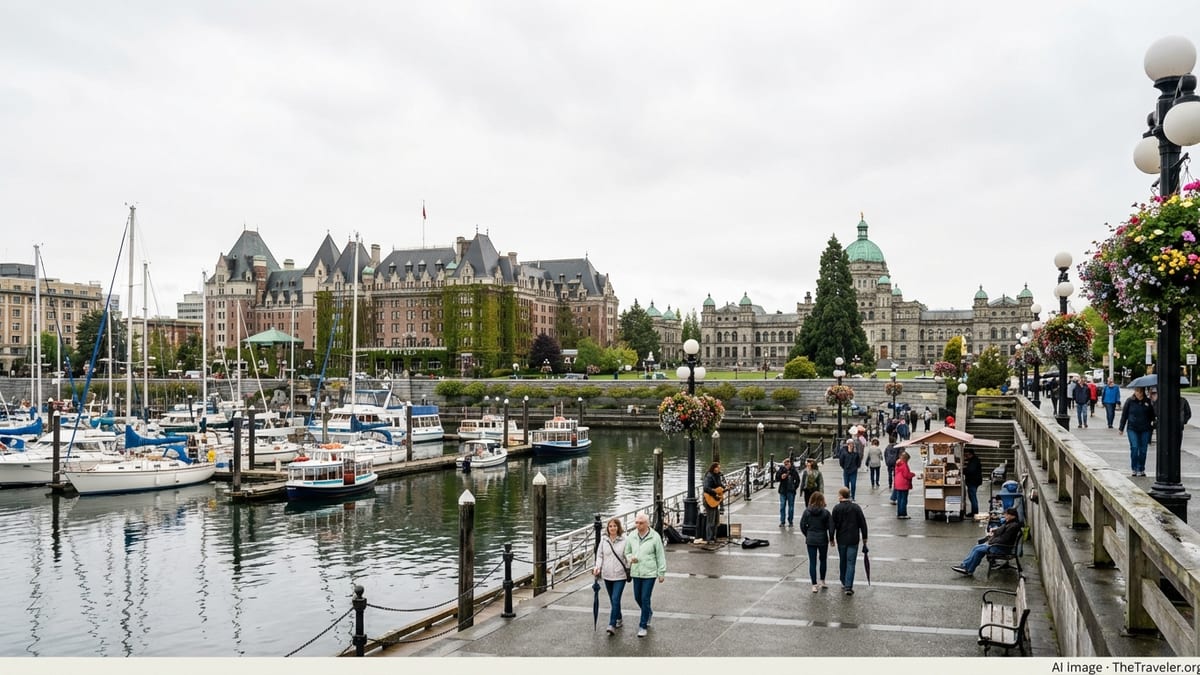
My first real glimpse of Victoria was from the ferry, watching the coastline sharpen into focus under a thin veil of Pacific cloud. From a distance, it fit the script: forested islands, sailboats, and a compact city tucked around a sheltered harbor. Approaching the Inner Harbour, those famous landmarks came into view, and for a moment it really did feel like stepping into a travel brochure brought to life. The Empress stood over the water with a kind of quiet confidence, and the Parliament Buildings looked improbably ornate for a city this size.
At ground level, though, that initial glow dulled a little. The harbor walkway was busy, almost to the point of feeling cramped, with a dense mix of cruise visitors, families, and day trippers funneling through the same narrow spaces. Street performers and food carts added energy, but they also added noise and clutter. I had pictured something more relaxed and breezy; what I got instead was a downtown core that, in peak hours, felt like a small city trying hard to manage big-city tourism numbers.
Still, that first evening stroll along the harbor left me with more positives than negatives. The light softens in a particularly flattering way over the water, and the city does know how to stage itself. If you arrive expecting a gentle, quiet little seaside town, you may be surprised by the amount of activity. If you arrive expecting a mid-size city that happens to have a lovely waterfront, the scene makes a lot more sense.
The Inner Harbour: Charming, Crowded, and Cruise-Ship Driven
There is no denying that Victoria’s Inner Harbour is easy to fall for. I spent a couple of days orbiting that stretch of water at different times of day, and each pass showed a different personality. Early mornings were my favorite, when the air was cool, the joggers and dog walkers outnumbered the tour groups, and the harbor still felt like a place locals might use. The reflections of the Parliament Buildings in the water had a quiet elegance, and for a while I understood why so many people leave raving about this city.
By late morning on a busy cruise day, the mood shifted. Large groups spilled from buses, queues formed for sightseeing boats and whale watching tours, and the narrow sidewalks around the harbor grew congested. In principle, I do not mind crowds; in practice, it felt like the infrastructure around the Inner Harbour was straining. Crossing streets became a slow process, and the simple act of stopping to take a photo without blocking someone else turned into a small logistical challenge.
The cruise presence was hard to ignore. Even though most ships dock a short drive away, the timing of the crowds and the style of the businesses around the harbor made it clear that the city has leaned into that market. Many of the small kiosks and shops felt calibrated for quick-spending visitors on a tight schedule rather than travelers lingering for days. Prices for snacks and souvenirs around the main harbor strip reflected that. I found myself walking a few blocks inland for coffee and food, where both the atmosphere and the prices felt closer to what I would expect from a mid-sized Canadian city.
None of this ruins the Inner Harbour, but it does change the experience from what I had imagined. If you come thinking you will spend hours peacefully ambling along the water in summer, you may be disappointed. If you treat it as a scenic focal point to enjoy in short bursts, especially early or late in the day, it still delivers on much of the charm that fills the brochures.
Gardens, Nature, and the Weight of High Expectations
It is almost impossible to visit Victoria without hearing about the gardens. Before I went, I lost count of how many people told me that the city was essentially one big flowerbed. In particular, the famous gardens just outside town came up again and again as an essential pilgrimage. That level of hype is a lot for any attraction to live up to, and it definitely colored my experience.
On the positive side, the region truly does excel at cultivating a kind of manicured natural beauty. Even within the city, residential streets are lined with flowering shrubs, and small neighborhood parks are often thoughtfully planted. When I visited in late spring, the mix of blossoms and fresh green growth was genuinely lovely, and I understand why garden lovers are so taken with the place. The mild coastal climate supports a long growing season, so there is usually some color somewhere, even outside peak bloom.
The flip side is that the most famous garden experience near Victoria is expensive, crowded, and highly choreographed. Walking through, I admired the design and the horticultural skill, but I also felt like I was moving along a well-rehearsed route with hundreds of other people, all funneling through the same viewpoints. It was hard to have any quiet, contemplative moment with the landscape when nearly every bench had someone waiting to sit down and every overlook meant gently squeezing in among other visitors’ cameras. I appreciated the craftsmanship, but the experience felt more like attending a garden-themed event than wandering through a peaceful sanctuary.
If you are primarily a nature person rather than a formal-garden person, Victoria’s wilder edges might suit you more. Short drives or bus rides can take you to rocky coastal parks where the wind and waves do the landscaping, and those places aligned more closely with what I personally enjoy. The tradeoff is that some of these areas lack the amenities and easy accessibility that draw so many people to the manicured gardens. In retrospect, I would have spent less time and money on the headline garden attraction and more on simple walks along the coastline.
Costs, Accommodation, and the Value Question
One of the most sobering parts of my trip was the cost. I went in knowing that Victoria was not a budget destination, but I still underestimated how quickly expenses would add up. Accommodation, particularly near downtown or the harbor, is priced at a level that feels more like a major metropolitan city than a relatively small one. Even simple mid-range hotels often command rates that made me pause, and short-term rentals were not always meaningfully cheaper by the time cleaning and service fees were included.
Food and drink followed the same pattern. There are plenty of good cafes and restaurants, and I ate well overall, but my daily spend was noticeably higher than in other Canadian cities of comparable size. Brunches, casual dinners, and even a couple of drinks out tended to creep above what I would consider reasonable for what I was getting. I did not feel gouged so much as quietly drained. I could see the value in the sense that much of the food was fresh and the hospitality industry is clearly dealing with high local costs, but that understanding did not make the final totals any easier to swallow.
The bigger question that lingered for me was whether Victoria delivers enough uniqueness to justify those prices. In some respects, yes: the combination of mild coastal climate, walkable historic core, and proximity to nature is not easily replicated. In others, I found myself mentally comparing similar experiences in places like Vancouver, Seattle, or smaller Gulf Islands towns and realizing that I had paid a premium in Victoria for moments I had enjoyed just as much elsewhere for less money.
If I were to return, I would be more strategic. I would travel in the shoulder season, book accommodation farther from the Inner Harbour and accept longer walks or transit rides, and be more deliberate about where I ate. Victoria can be worth the cost, but it requires planning and a clear-eyed understanding that the postcard setting does not come cheap.
Downtown Atmosphere, Safety, and Visible Social Challenges
One aspect of Victoria that rarely appears in glossy travel features, but is hard to miss in person, is the visible level of social challenges in the downtown area. As I explored beyond the immediate harbor, I encountered several blocks where homelessness, open substance use, and signs of mental health struggles were part of the everyday street scene. It did not make me feel directly unsafe most of the time, but it did change the tone of my walks and raised questions about how the city balances tourism with the complexity of real urban issues.
It is important to say clearly that this is not unique to Victoria. Many cities across North America are dealing with similar crises, and it would be unfair to single this place out as though it exists in a vacuum. Still, as a visitor who had absorbed years of carefully curated imagery, I felt a jarring disconnect between the marketed version of the city and the one I was walking through in certain corridors. At times, the contrast between the luxury hotel facades and people sheltering in doorways a few blocks away was difficult to ignore.
I adjusted my own patterns accordingly. In the evenings, I tended to stick to well-lit, busier streets around the harbor, Government Street, and areas where locals and visitors clearly mixed in a more relaxed way. I avoided a couple of stretches that felt tense or heavily impacted by street disorder, not because I thought I would be in immediate danger, but because the overall atmosphere was not one I wanted to linger in at night. During the day, I navigated those same areas with more ease but still with an awareness that this was a city grappling with serious social pressures.
The city has begun taking steps to address community safety and wellbeing, and that ongoing work shows in certain small ways, like outreach teams and coordinated services. But from a traveler’s perspective right now, it is important to arrive with realistic expectations. Victoria is not the flawless, old-world resort town that some marketing still suggests. It is a modern city, with all the beauty and all the fractures that implies.
Food, Culture, and Moments That Surprised Me
Despite my frustrations with pricing, I did find memorable bright spots in Victoria’s food and cultural scene. Some of my favorite experiences were small and almost incidental: discovering a quiet cafe a few blocks away from the main tourist corridor where the barista had time to chat, or stumbling into an understated neighborhood bakery that clearly catered to locals rather than visitors. These places did not announce themselves with glossy signage or harbor views, but they delivered something more valuable to me: a sense of everyday life in the city.
I also appreciated the way certain museums and historical sites handled their stories. Rather than romanticizing the past in the way I half expected, several exhibits I visited took a more nuanced approach, acknowledging colonial histories and Indigenous perspectives alongside the usual pioneer narratives. That willingness to complicate the story made my experience of Victoria feel more grounded and less like a performance of quaintness for visitor consumption.
On the culinary side, seafood is a logical highlight, and it generally lived up to expectations. I had a couple of meals where the quality of the fish and shellfish justified the bill, even if it stung a little. There are pockets of genuinely good, creative cuisine in Victoria if you are willing to look beyond the obvious harborfront options. That said, I sometimes had to work harder than expected to find spots that felt both reasonably priced and full of character, especially in peak season when reservations were at a premium.
These small, satisfying discoveries are ultimately what kept my overall impression from tipping into disappointment. They reminded me that beneath the curated visitor experience, there is a real city with real people doing interesting things. The challenge is that you need time, curiosity, and a bit of willingness to wander off the main track to find them.
Weather, Seasonality, and When I Would Actually Recommend Going
The weather in Victoria is another area where reputation and reality do not quite line up. The city is often described as mild and pleasant, which is broadly true compared to much of Canada, but that shorthand can be misleading if you interpret it as a guarantee of constant sunshine. During my stay, I experienced the full coastal mix: soft light and blue skies one afternoon, light rain the next morning, and a prolonged overcast stretch that cast a flat gray over the harbor for the better part of a day.
When conditions cooperated, the climate was close to ideal for walking, especially in the shoulder seasons. Temperatures were comfortable, and even in cooler months the air felt relatively gentle. However, if you visit outside the peak of summer, you need to be ready for drizzle and damp sidewalks. The city remains walkable, but its postcard looks are a little muted in flat light and mist. I found that my enjoyment of certain views depended heavily on the weather; the same harbor that sparkled in the sun felt a bit tired under low, unbroken cloud.
Season also mattered enormously for crowds and costs. In the height of summer, tourism and cruise arrivals ramp up, which brings energy but also congestion and higher prices. If I were planning another trip, I would aim firmly for the shoulder seasons: late spring when flowers are emerging or early fall when the air is crisp but the bulk of peak-season visitors have thinned out. You lose some of the heat and long evenings, but you gain breathing room, easier restaurant bookings, and slightly more humane accommodation rates.
What I would not do again is visit with the assumption that the city’s famed mild weather guarantees perfect outdoor conditions. I would pack layers, a decent rain jacket, and the expectation that at least a portion of my time would involve gray skies. If you can accept that and adjust your activities accordingly, the climate becomes a strength. If you insist on pure blue-sky days, you may find yourself quietly resenting the clouds.
The Takeaway: Who Victoria Is Really For
After several days in Victoria, my feelings settled into something more nuanced than either wholehearted endorsement or outright disappointment. The city did not fully live up to the glossy expectations I arrived with, but it also did not fall flat. Instead, it revealed itself as a place of tradeoffs: extraordinary harbor views paired with heavy cruise crowds, lush gardens paired with high ticket prices and orchestrated experiences, walkable streets paired with visible social hardship and big-city cost pressures.
If you are a traveler who values atmosphere, walkability, and easy access to both culture and nature, and you are willing to pay a premium for those things, Victoria still makes sense. You will likely enjoy slow mornings along the harbor, evenings in small restaurants, and day trips to coastal parks or gardens. You will also need to accept that the city’s social reality will occasionally intrude on the postcard, and that not every corner looks like the marketing materials.
If you are traveling on a tight budget, or if you are looking for a completely idyllic, sanitized escape, Victoria may not be the right fit, at least not in peak season and not in the way it is often advertised. In that case, you might be better served by smaller island communities or by treating Victoria as a short day trip instead of a multi-night base. The charm is real, but it is layered over real urban complexity and pricing that can feel out of step with the city’s scale.
Would I go back? Yes, but with adjusted expectations and a different strategy. I would stay slightly farther from the harbor, visit in the shoulder season, and prioritize coastal walks and neighborhood explorations over headline attractions. Approached that way, Victoria becomes less of a museum piece and more of a living city worth getting to know, imperfections and all.
FAQ
Q1. Is Victoria, BC still worth visiting if I am on a tight budget?
It can be, but you will need to be strategic. Consider traveling in the shoulder season, staying farther from the Inner Harbour, using public transit, and focusing on low-cost experiences like coastal walks and neighborhood explorations instead of pricey attractions.
Q2. How many days do I really need in Victoria?
I found that two full days were enough to see the main sights without rushing, but three to four days allowed time to explore beyond the tourist core and find quieter, more local experiences.
Q3. Is downtown Victoria safe to walk around at night?
I generally felt safe on the main, well-lit streets near the Inner Harbour and Government Street, but I chose to avoid a few blocks that felt tense or heavily impacted by street disorder after dark. Using the same common sense you would apply in any city is advisable.
Q4. When is the best time of year to visit Victoria?
For me, the shoulder seasons of late spring and early fall offered the best balance of manageable crowds, slightly lower prices, and reasonably pleasant weather, even if some days were cloudy or drizzly.
Q5. Are the famous gardens near Victoria really worth the cost?
They are impressive, especially if you love formal gardens, but they felt expensive and crowded. If your budget or patience for crowds is limited, you might prefer focusing on coastal parks and smaller green spaces.
Q6. How bad are the crowds from cruise ships?
On busy cruise days, key areas around the Inner Harbour and major attractions become noticeably congested, especially late morning to late afternoon. Planning early starts or visiting popular spots outside peak hours made a big difference for me.
Q7. Is Victoria a good base for exploring nature and outdoor activities?
Yes, if you are willing to travel a bit. Several beautiful coastal parks, beaches, and hiking areas are within a short drive or bus ride, and I found those outings some of the most rewarding parts of my trip.
Q8. How expensive is food and drink in Victoria?
I found prices higher than in many similar-sized cities. You can keep costs down by seeking out local cafes, casual eateries off the main tourist strips, and self-catering some meals if your accommodation allows.
Q9. Does Victoria really feel as “old-world” and British as people say?
In certain pockets near the harbor and around some historic buildings, yes, there is a deliberate old-world ambiance. Beyond that, much of the city feels like a modern Canadian coastal city, and I found that more authentic than the themed touches.
Q10. Would you visit Victoria again, and what would you do differently?
I would visit again, but I would return in the shoulder season, stay outside the busiest tourist zone, and focus more on local neighborhoods and coastal parks rather than trying to tick off every big-name attraction.